
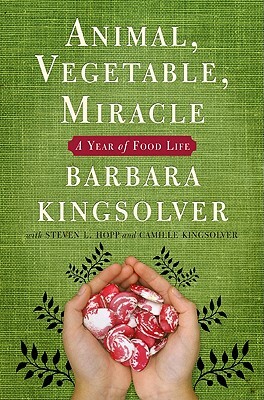
I usually enjoy Barbara Kingsolver, but even in her fiction, she can get preachy, so I have avoided her nonfiction. That is, I avoided it until I saw that this book filled a hole in my A Century of Books project. (At the book’s reading, I had seven or eight to go. Now, while I’m typing up this review, I have three. By the time it appears, I hope to have finished.)
Although Kingsolver is the primary author of the book, it also contains essays or informational sidebars written by her husband, Steve L. Hope, and her oldest daughter, Camille Kingsolver. It is about food—in particular, her family’s decision to act on its principles. To do so, they move from Arizona to her husband’s farm in Southern Appalachia (somewhere in Virginia). The idea is to try to live for a year only on food they grew or raised themselves or on local food.
Kingsolver has chapters on issues, for example, an early one is on the growth cycle—which vegetables and fruits are started when and when they are ready to be picked. (I didn’t find her concept of the vegetannual helpful at all. A timeline might have worked better.) But for the most part, she tells the story of the year, the things they plant or raise and when, the people they meet, the things they learn. These chapters were mostly interesting and sometimes entertaining. I was truly wrapped up in suspense about whether the turkey eggs would hatch.
Kingsolver talks also about issues around local food, such as how much gas is used transporting food that isn’t local to supermarkets; the takeover of Federal funds for farmers by large conglomerates (your local farmer isn’t getting the money); the negative effects genetically engineered seeds have on farmers, especially for organic farms; the growing local food movement and how to support it; and so on. The sidebars were some of the same topics, though, so I sometimes felt as if I was in church—tell them, tell them again, and tell them again. (Just as my own sidebar, I remember at about age ten asking my father after church why they did that and finishing my polite question with, “Do they think we’re idiots?”) You can see I have no patience with that kind of thing.
So, that’s a criticism, but on the other hand, lots of things in the book were interesting, and the descriptions of the meals had me licking my lips, recipes included in the book.
I personally have made steps at times to eat more locally. I belonged to a CSA for years, and I’m thinking of signing up for another one. I kept a vegetable garden here until growing trees cut off my sunlight, so now I just grow tomatoes on the back deck (in the tomato wagon). I try to stop often at a local farm store. (During the summer, I stop by every week, and I have stopped buying grocery store strawberries—I just wait for the fresh ones in late spring, because once I moved to this area and ate a real one, I realized that the ones in the store were not real.) In any case, this book has made me think of all this again.
Those of you who worry about the higher cost of local food may be very interested in the chapter about the food economics for a year. It turns out that when you forgo processed foods and do most of the cooking yourself, it’s a lot less expensive for a family to eat for a year even if paying more for some local foods. Of course, they were growing most of theirs, which everyone cannot do. However, like Michael Pollan also points out, Americans spend less money on food than people in most other countries. And even in the city, it’s possible to grow some of your food.

 What? Me Read?