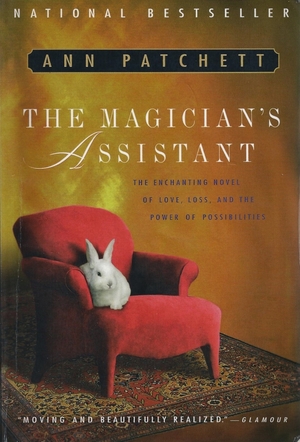
Review 2583: The Magician’s Assistant

Sabine was very much in love with her husband, Parsifal, when he died unexpectedly. A handsome, affectionate, and charismatic man, he was also gay. For Sabine, it was love at first sight, which he hired her as his magician’s assistant.

Sabine lived with Parsifal and his lover Phan before Phan died from AIDS. Parsifal was also diagnosed with AIDS (this was the 90s when it was a death sentence), but he died unexpectedly of a brain aneurysm. Sabine is devastated and finds it hard to get out of bed. Phan was wealthy, so she is alone in a large house with Rabbit.

Although Parsifal had told her he was from Connecticut and had no family, Sabine has a shock coming. He does indeed have a family, a mother and two sisters in Nebraska, and his real name is Guy Fetters. She learns from his lawyer that Parsifal has been sending them money and left them some in his will. Sabine hypothesizes reasons why she has never heard of them but decides to call Mrs. Fetters. Eventually, she agrees to take her and her daughter around a visit of L. A. Sabine’s parents think she should have nothing to do with them.

Sabine likes Dot Fetters and her youngest daughter, Bertie. She begins learning new things about Parsifal. When they are leaving to go home, she agrees to visit them and attend Bertie’s upcoming wedding.

This story is an absorbing and touching one. Sabine learns to deal with her grief and finds out more about Parsifal. His family hears stories from her about their exotic-seeming life. The truth about why he left Nebraska is a difficult one, but Dot Fetters has regretted not trying to find him.

I love this novel. I thought I had read it before when I picked it up for A Century of Books, but it was unfamiliar. Patchett knows a lot about human nature.

Related Posts

The Dutch House

Tom Lake

Commonwealth

Day 373: Tell the Wolves I’m Home

Cover for Tell the Wolves I'm HomeBest Book of the Week!

Although I think Tell the Wolves I’m Home is classified as a young adult novel, it has much to offer adults, too, in reading pleasure. Carol Rifka Brunt gives us a novel in which the voice of the narrator is so strong and the sense of her personality so developed that it is really outstanding.

Fourteen-year-old June Elbus is an unusual girl–a loner who likes to go to the woods and pretend she is living in the middle ages. She loves her Uncle Finn more than anyone and believes he is the only person in the world who understands her. She used to be close to her older sister Greta, but for some reason Greta has started treating her badly. So, when Finn dies of AIDS, June feels as if she has no one. The situation is made worse because it is the 1980’s, and no one understands the virus.

Something strange happens at Finn’s funeral. A man June has never seen before appears and tries to get her attention, but her sister hustles her away. Days later her uncle’s favorite teapot arrives for her with a note in it. The writer explains that he is a friend of Finn’s and asks to meet her. But Greta has told her that this friend, Toby, killed Finn.

A problem is posed by the portrait Finn spent the last months of his life painting. It is one of June and Greta, although Greta acted as if she didn’t want to sit for it. The Elbuses have the portrait in their living room until an article appears about lost works of art, including a picture of the portrait and reporting that its title is “Tell the Wolves I’m Home.” Until then, June didn’t even know her uncle was a famous artist. And who could have photographed the portrait and sent the article to the magazine?

June agrees to meet Toby but becomes jealous of him when she realizes how close he was to Finn. She is shocked to find they were partners for nine years, and she never knew he existed. June is torn because of her ambivalent feelings about Toby and the fact that they are keeping their acquaintance a secret from her parents, until she finds a note to her from Finn in a book, asking her to take care of Toby because he has no one.

Infused throughout with the voice of its teenage narrator, a girl like so many others struggling with feelings of self-doubt, trying to figure out what is right, this novel is beautiful and moving without being in the least sappy. It is really a wonderful book.