
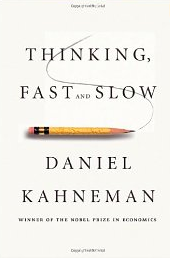
 Early in his career, Daniel Kahneman got interesting in why people, even experts, do not seem to use statistics and follow economic models in making decisions and judgments. His research with his main collaborator Amos Tversky eventually ended in his winning the 2002 Nobel prize in economic science, which is unusual because he is a psychologist. Thinking, Fast and Slow explains the results of years of studies on understanding how the human brain makes decisions and judgments. His major theme in this extremely interesting, well-written book is human irrationality. His work with Tversky, he says, “challenges the idea that people are generally rational.”
For better understanding of the ideas explained in the book, Kahneman begins with the analogy that there are two systems employed in decision making: the fast-thinking, intuitive, unconscious system that keeps us safe and handles our day-to-day actions but is prone to error, and the deliberative system that reasons through more informed decisions but is lazy and has to be actively engaged.
Kahneman shows the evidence from experiments that many more of our decisions are controlled by our unconscious than by conscious decision-making, and therefore, we do not always make decisions the way that economic models have assumed. He makes his points using fairly simple experiments that you can try yourself, so that you recognize the faulty assumptions and cognitive biases underlying your own reasoning. In examining these experiments, he shows their profound implications. The result is an entertaining book full of intellectual surprises that was chosen as one of the New York Times Best Books for 2011.
Although Kahneman provides some ways of recognizing patterns that can result in bad decisions, he cautions that it may be impossible to teach yourself to always avoid these pitfalls and says that he is unable to do it consistently himself. He reminds us that all of us tend to have an exaggerated sense of our understanding of the world and shows that much more of what happens is random than we acknowledge or understand.

 What? Me Read?
Your review convinced me that I should put this on my “to read” list.
I think you’ll enjoy it.