Review 2020: #ThirkellBar! Peace Breaks Out

Although Peace Breaks Out begins by returning to Anne Fielding, now almost 19, who was Miss Bunting’s student in the last book, it spends a lot of time with the Leslie family, whom we have encountered in several of the books. Anne has just met Sylvia Halliday, a beautiful, golden girl a few years older, and shortly thereafter, both girls come to the attention of David Leslie.

At 37, David should have toned down his tricks, but he hasn’t, so Anne is smitten while the older Sylvia’s reaction is a bit harder to ascertain. Anne’s being smitten puts her friend Robin Dale in a funk, which is good because he was tending to take her for granted. And David seems to be almost seriously considering her as a wife.

For the first time, we get a true sense of how tired the British are with the living conditions of the war. This is expressed by being upset about the peace, which makes conditions even worse.

In this novel, readers meet or hear of almost all of the main characters from the previous novels. Rose Fairweather, in all her beautiful idiocy, reappears from America, and more importantly, Rose Bingham, a Leslie cousin who we saw a bit of on the occasion of the other Rose’s wedding, returns from the continent.

It’s really been useful for me to have begun reading these novels in order. I only wish I had started out making charts of characters’ relationships, what books they appeared in, and some notes about each one.

Related Posts

Miss Bunting

The Headmistress

Growing Up

Review 2000: #ThirkellBar! Miss Bunting

Miss Bunting is another re-read for me. I’ve looked over my original review, which seems fine, so use the link for the plot synopsis. One thing I notice is that because of reading the books in order and thereby getting to know the characters better, I found the ending of this novel more affecting than I did the first time.

So, here are my observations from this time through. First, I noticed the subtleties of the class distinctions. Although I mentioned in my first review that Thirkell’s usual upper-class characters are flustered at having the wealthy and vulgar Mr. Hill thrust his way in amongst them (and thrust he does, appearing several times uninvited), Jane Gresham is shocked when he implies that he considers himself better than his landlady Mrs. Merivale, who is educated and middle class and whose daughters have better marriage prospects than Heather Hill does. Of course, Heather’s ambitions are different than Mrs. Merivale’s. I myself was surprised to find the Middletons, who seemed fully accepted in Before Lunch, being considered socially inferior (mostly by Lady Fielding, who’s a real snob). Toward the end of the novel, Lady Fielding reflects that men like Mr. Hill have taken over, and there won’t be room for people like them. Lord Fielding reassures her, but she’s not far wrong.

This novel is sad in more ways than one, but particularly affecting is Jane’s situation, not knowing whether her husband is dead or alive. I won’t give the other reason away.

Related Posts

Marling Hall

The Headmistress

Before Lunch

Review 1883: #ThirkellBar! The Headmistress

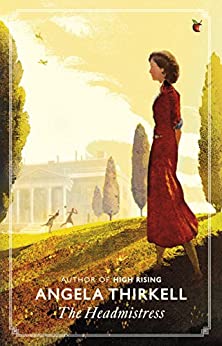
Owing to financial difficulties, the Beltons have had to lease the house their family has lived in for 150 years, Harefield Park. It has been leased by the Hosiers’ Girls School, which, having been evacuated from London, had shared space with Barsetshire High School.

Mr. and Mrs. Belton have moved into Arcot House, recently inherited by Captain Hornby at his aunt’s death, which is in the village of Harefield. Although it seems odd not to live in their own house, the person who seems to mind most is their daughter, Elsa, who is away most of the time doing something secret.

Miss Sparling, the headmistress of Hosiers’ Girls School, has not only been sharing the school, she has been living with Barchester High School’s dread headmistress, Miss Pettinger, so she is happy to have her own quarters. The community of Harefield is very welcoming, so Miss Sparling quickly gets to know the village families. She is delighted to find out that the vicar, Mr. Oriel, once studied with her grandfather, a noted scholar.

One of her new acquaintances is Mr. Carton, an Oxford don, who goes around making disparaging remarks about female academics. Little does he know that Miss Sparling’s grandfather was an expert on an obscure poet that Mr. Carton is writing a book about. Further, one of Carton’s few sources is an article published by Miss Sparling herself.

At the Belton’s, Captain Hornby begins discreetly courting Elsa, and an unattractive schoolgirl at Hosiers falls madly in love with Commander Belton, the Belton’s oldest son.

As this series continues, the books become more full of incident, new characters, and references to characters already encountered and thus more difficult to describe. In this one, there is a hilarious description of a working party and a new awareness that the young men may die, although we haven’t heard of any war deaths among our favorite characters (except Lettice Watson’s husband, whom we never met), just of the natural passing of older characters such as the original Lord and Lady Pomfret.

A new character who proves entertaining is the pleasant Mrs. Updike, such a clumsy woman that she is constantly injuring herself. And key to the events of the plot is Mr. Adams, who I fear will become one of Thirkell’s types—a vulgar, wealthy manufacturer who is the father of the aforementioned schoolgirl.

Sometimes Thirkell’s prejudices bother me, such as her overt snobbishness and her disparagement of Dr. Morgan on the grounds she is a woman doctor rather than because she is a nitwit. However, although Thirkell has her tropes and stock characters, I feel that somehow her series is gaining a little substance.

On another note, I will have my usual wrap-up topic for this book with its announcement of the next book next Wednesday, but since that is well into July, let me just say now that the next book is Peace Breaks Out, and that my review will appear one day earlier than usual, on Thursday, July 28.

Related Posts

Growing Up

Marling Hall

Northbridge Rectory

Reading Thirkell’s Barsetshire Series in Order: #13 The Headmistress + #12 Growing Up Wrap-Up

Thanks to everyone who joined in commenting on or reviewing or even just reading along with Growing Up. Although we met some new characters, I enjoyed catching up with some old friends. The participants were

This month’s book is The Headmistress, which I will be reviewing on Thursday, June 30. I am fairly sure I have never read this one before, so I’m looking forward to it.

And here’s our badge.

Review 1864: #ThirkellBar! Growing Up

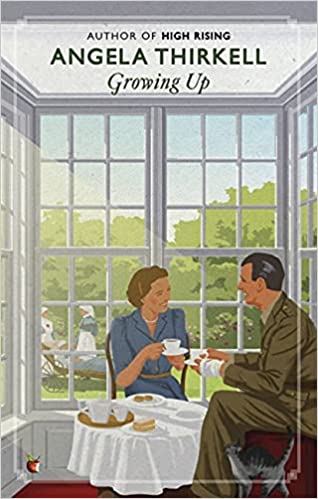
Growing Up takes us to Beliera Priory, the home of Sir Harry and Lady Waring. The Warings have moved to the servants’ quarters, because the Priory has been taken over as a convalescent hospital. Nearby is a secret base, and the Warings receive a request to house an officer who is stationed there along with his wife. Although they are expecting their niece Leslie on a convalescent leave, they agree to billet the couple in their larger extra room.

To our delight, the couple turns out to be Noel and Lydia Merton, and in their exchanges of news with the Warings, we get to hear about almost everyone from the previous books. The Warings have been busy during the war, but the Mertons bring a little extra interest to their lives.

Leslie’s arrival is marked by a stranger carrying her case from the station. In the dark, she can barely see him, but he turns out to be Philip White, now a Colonel, whose disastrous romance with Rose Birkett was a feature of Summer Half. Leslie finds herself immediately interested in Philip.

In this novel, we are treated to the courtship of Selina, the Warings’ maid, by three men (a private young enough to be her son, a sergeant with eye trouble who is a greengrocer by trade, and Jasper, the Warings’s mysterious half-gypsy gamekeeper); the return of Tommy Needham, the fiancé of Lydia’s best friend Octavia Birkett, missing an arm; the goings-on at the Winter Overcotes (which you will be delighted to know is near Summer Underclose) railway station; as well as, of course, the progress of Leslie’s romance. Tony and Mrs. Morland make a brief appearance as do other old friends. Another delightful novel by Thirkell.

Related Posts

Summer Half

Cheerfulness Breaks In

High Rising

Reading Thirkell’s Barsetshire Series in Order: #12 Growing Up + #11 Marling Hall Wrap-Up

Thanks to everyone who participated in or commented on this month’s reading of Marling Hall, in which we caught up on some familiar characters and met some new ones. Participants were

The book for May is Growing Up, for which I will be posting my review on Tuesday, May 31. This is another new one for me, so I’m excited. I believe it features the return of one of my favorite characters, Lydia Merton.

And here’s our badge.

Review 1847: #ThirkellBar! Marling Hall

Lettice Watson, the Marling’s older daughter, has moved back home with her two little daughters after the death of her husband at Dunkirk more than a year ago. The younger Miss Marling, Lucy, is one of those bouncing, hearty girls that Thirkell depicts so well. Brother Oliver, whose poor eyes don’t allow him to serve, has a job in the regional government offices. Mr. Marling is aggressively deaf and likes to play what his children call “the olde squire.” Mrs. Marling is a bit silly.

From the beginning of Marling Hall, we realize we’re going to encounter some familiar characters. The Marlings, along with Miss Bunting, their former governess (who gets her own book later in the series), go to call on the Leslies at Rushwater. It was David and John Leslie who made up two thirds of a love triangle in Wild Strawberries, and David very soon is trying his charm on Lettice. Soon after, Lucy brings home Captain Tom Barclay, a much steadier young man, who is also attracted to Lettice.

Because of this visit, we meet again the charming but disorganized Lady Emily as well as her daughter Agnes, so besotted with her own children that she can talk of nothing else. And we continue not to meet Agnes’s husband Robert. The efficient Miss Merriman also reappears on the scene. We hear about characters from Pomfret Towers and other books in the series.

Some newcomers to the area are the Harveys, who both work in Oliver’s office. Geoffrey Harvey is one of the artistic types that Thirkell likes to make fun of. His sister Frances is Oliver’s very organized assistant. The Harveys have been living with the Nortons and wish to find a house for themselves, but housing, along with everything else, is difficult to find during these days of war. They find the Red House, a repulsively decorated place owned by Mrs. Smith. A lot of the comedy of this novel comes from their encounters with Mrs. Smith, who, after she leases them the house, continues to return to it to remove one object after another, including the beans from the garden and the eggs from the chickens the Harveys purchased, and eventually the chickens themselves.

Unfortunately for me, more humor is derived from the visits of Harvey’s old French teacher and later her nephew. Although Thirkell has poked fun at the French before, she hasn’t actually included so much dialogue in French, which I don’t really know. Last time, it was little enough for me to type into my iPad and get a translation or simple enough for me to muddle out myself, but this time there was a lot more, also, I think, including some mocking of the quality of one character’s French. The part with the nephew was funnier because of being told the gist of what he was saying rather than the exact words.

In this novel, the difficulties of life during the war become more apparent, especially in regard to food and clothing shortages. However, it continues on in the Thirkell vein—funny, with its little side comments directed at the reader, insightful, touching, and certainly snobbish, but more as if she is laughing at her own and her characters’ snobbery. Another good one.

Related Posts

Wild Strawberries

Pomfret Towers

Cheerfulness Breaks In

Reading Thirkell’s Barsetshire Series in Order: #11 Marling Hall + #10 Northbridge Rectory Wrap-Up

Looks like hardly anyone had time to read along or comment on Northbridge Rectory last month, a bittersweet little novel, and well worth reading. I hope I’ll get some more participation this month. (I got more after posting this the first time.) My steadfast commenters were

Our book for April is Marling Hall. I hope some of you will join me in reading along. I’ll be posting my review on Friday, April 29.

And here’s our little badge.

Review 1828: #ThirkellBar! Northbridge Rectory

Cover for Northbridge Rectory

Northbridge Rectory is the tenth book in Angela Thirkell’s Barsetshire series and another reread for me, so I won’t repeat my review but simply provide the link to it. Instead I’ll comment on what I noticed this time through.

Everyone is much more actively involved in the war in this one, so it seems closer. Yet it seems far away, too, as we busy ourselves with the emotional lives of several characters.

I’m starting to notice Thirkell’s tropes, and one is for the infatuation of a young man for an older woman. In this case, it’s the young officer Mr. Holden for Mrs. Villars, the rector’s wife. Sometimes, these infatuations are handled sympathetically and in one case a few books ago, it was a mutual regard that added a bit of pathos to the plot. In this case, it is more comic, with Mrs. Villars not noticing at first or making herself respond in a practical way after feeling in herself a tendency to want to imitate the fragile flower that he thinks he worships. However, his comments about how tired she looks make her more and more irritated.

The other very touching story is the restrained love triangle of the two penniless scholars, the terrifying Miss Pemberton and the timid Mr. Downing, and the comfortable and warm Mrs. Turner. Miss Pemberton, who seems at first a grim bully with Mr. Downing under her thumb, turns out to have a much more sympathetic side.

I loved the depiction of Mrs. Turner’s nieces, Betty and “the other girl,” and their swains, Captain Topham and Mr. Grieves. And I don’t know how Thirkell does it, but even though Betty has as many verbal tics as the voluble Mrs. Spender, Betty seems delightful while Mrs. Spender is just plain irritating.

Not only am I finding these novels just as delightful as I go on, but I’m also finding them deeper (in a light way) and more touching. We get just a sentence about the (backwards spoiler for Cheerfulness Breaks In) survival of Lydia Merton’s husband at Dunkirk, since Thirkell with this book is dealing with other characters, but it cheered me right up.

Related Posts

Cheerfulness Breaks In

Before Lunch

The Brandons