Review 1700: #ThirkellBar! Wild Strawberries Recap

Cover for Wild Strawberries

It’s time for our reviews of the second Barsetshire novel, as we read Angela Thirkell’s Barsetshire series in order! In this case, I had already reviewed Wild Strawberries some time ago.

I looked at my original review of Wild Strawberries to see if I have anything to add for this reread. I don’t, except to point out how vividly Thirkell has depicted her characters. Lady Emily, for example, is equally adorable and frustrating. That first scene in church is a comic masterpiece, enough to make even the reader impatient with her, yet her family shows no sign of frustration, only affection. Most of Thirkell’s characters are funny, even our heroine Mary in her childish infatuation with David, and some of them, like managing Madame Boulle or finagling Mr. Holt, are hilarious. Or Agnes, so infatuated with her children that she heartily bores everyone else. Only John remains as the straight man.

I liked this book even more this time through but found the ridiculous errors in my Moyer Bell edition, which didn’t even employ a spell-checker, even more frustrating. Sadly, the Virago edition was not yet out in paperback when I reread this one (now it is).

Related Posts

Wild Strawberries

High Rising

Pomfret Towers

Review 1684: #ThirkellBar! High Rising

I have long been saying I will read Angela Thirkell’s Barsetshire novels in order, but I just keep potting way at them as I encounter them. So finally, I decided to go back and read them all, in order, and I hope some others of you will join me at least part of the way. High Rising is the first one.

Mrs. Morland is a widow who has supported her three sons by writing what she calls “good bad books,” featuring skullduggery in the fashion industry. Her old friend, George Knox, is a widower and also an author, of serious historical works.

It is Laura Morland’s habit to work in London while her young son Tony is in school and come to High Rising when he is on holiday. When she and Tony arrive for the Christmas holidays, she learns there is a disturbing new resident at Low Rising. It is George’s new secretary, Una Grey, who is efficient and sweet to George but behaves officiously as if she were the mistress of the house even to George’s quiet adult daughter, Sybil. It is clear that Miss Grey is aiming at marriage with George, and she immediately treats Mrs. Morland as an enemy and rival.

The plot of High Rising is mostly concerned with this situation, but it also introduces more sympathetic characters. There is Miss Todd, who has been doing all the caretaking of her dying mother and works half-time as a secretary for Mrs. Morland. Dr. Ford is in love with her but thinks the difference in their ages makes him ineligible. Miss Todd herself believes she is the type of woman that men don’t marry.

Adrian Coates is Mrs. Morland’s editor. Although he is a good deal younger than she is, early in the novel he proposes. But Laura has no interest in marrying again and thinks he will make a much better match for Sybil Knox.

There are lots of characters, but one of the funniest is Tony, Laura’s single-minded young son. He is absolutely besotted with railways, and Thirkell does a great job of making him a believable motormouth of a boy.

Most of Thirkell’s books are notable for a subtle wit, but this one is a lot funnier than I remembered. I also felt really invested in the problems of these characters. This novel makes a nice start to the series.

So, who read High Rising along with me, and what did you think?

Related Posts

A Winter Away

Bramton Wick

The Native Heath

A New Challenge: Reading Thirkell’s Barsetshire Series in Order

Angela Thirkell

For a long time, I have been saying I was going to read Angela Thirkell’s Barsetshire series in order, but I just continue to pick them up randomly. I think there would be some benefit to reading them in order, because although each one seems to focus on different people and different plots, I’m sure I would better understand the relationships if I read them in order. So, I finally decided to do it and to announce it in case anyone wants to do it with me.

We’ll see how far we get along, as I understand that the post-war books are not as good as the others. I propose to announce each book at the beginning of the month and post its review at the end, starting in June. I would appreciate the company of anyone who wants to read along with me. I realize that for some people one book a month is a big commitment or even a difficult rate to read. However, there are lots of Barsetshire novels and to read one every two months would take this project five years into the future.

Since I have already posted reviews on a few of these books, I won’t repost my original reviews, but I will make comments on any insights I have gained since the last review. Even if you don’t want to go along with me, if you would like to jump in with comments on the books you have read or read one or two at the same time, any participation is appreciated.

Although I will post reminders of what the next book is, for now, here is the list:

  1. High Rising
  2. Wild Strawberries
  3. The Demon in the House
  4. August Folly
  5. Summer Half
  6. Pomfret Towers
  7. The Brandons
  8. Before Lunch
  9. Cheerfulness Breaks In
  10. Northbridge Rectory
  11. Marling Hall
  12. Growing Up
  13. The Headmistress
  14. Miss Bunting
  15. Peace Breaks Out
  16. Private Enterprise
  17. Love Among the Ruins
  18. The Old Bank House
  19. County Chronicle
  20. The Duke’s Daughter
  21. Happy Returns
  22. Jutland Cottage
  23. What Did It Mean?
  24. Enter Sir Robert
  25. Never Too Late
  26. A Double Affair
  27. Close Quarters
  28. Love at All Ages
  29. Three Score and Ten

So, if anyone wants to get a head start on June, the first book is obviously High Rising. I made a tag, #ThirkellBar, for those who want to use Twitter. I don’t.

Review 1644: The 1936 Club! August Folly

This week it’s time for the 1936 Club, hosted by Stuck in a Book. For my first book published in 1936, I am delighted to review August Folly by Angela Thirkell. As usual with my first posting for the club, I am also listing the links for the books published in 1936 that I have reviewed previously:

__________________________________

Louise Palmer, who likes to manage things, has decided to put on a Greek play. This endeavor will involve the participation of most of the young people around the village of Worsted, including her summer guests, the Deans. Richard Tebbins, just up from Oxford with a poor third, is at the age when everything his parents do irritates him (although that’s usually earlier, in my experience). However, when he sets eyes on Mrs. Dean, his parents’ contemporary, he falls into puppy love. Mr. Fanshawe, the Deans’ guest, seems to be a confirmed bachelor, but he has always only loved young Helen Dean. However, he fears he is too old for her. These are just a few of the characters and subplots of Angela Thirkell’s fourth Barsetshire novel.

Sometime, I would like to read these novels in order, because although each one concentrates on different characters, they have characters that reappear in different books—presumably also plot lines. However, I used to randomly encounter the novels in bookstores and just picked up whatever I found.

August Folly is one of the more fun books, featuring eccentric academics, delightful children, realistic but absurd romances, and a cat, a donkey, and a bull. It is froth at its best. I was happy to revisit it for the 1936 Club and my Classics Club list.

Related Posts

Pomfret Towers

Wild Strawberries

Northbridge Rectory

Day 1119: Northbridge Rectory

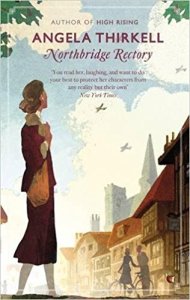
Cover for Northbridge RectoryEclipse day! We are not in the path of totality here,
but we are at about 97%. We thought about driving down into Oregon, but since the state is supposed to have more than a million extra people coming for the eclipse, we decided to stay home. I hope you have a nice view!

* * *

Northbridge Rectory is another of Angela Thirkell’s delightful Barsetshire books. I have been making no effort to read them in order, and this one is set during World War II.

The Villarses moved to Barsetshire only a year ago when Mr. Villars was appointed Rector. Mr. Villars formerly had a career as a headmaster of a boys’ school, and Mrs. Villars feels somewhat inadequate in her new role as rector’s wife.

The Villarses expected the rectory to receive its quota of refugees from London, but instead eight officers of the Barsetshire regiment have been quartered there. The Villarses particularly enjoy the company of Mr. Holden, who is managing some of his work as a publisher’s associate along with his military duties. Mr. Holden has become attached to Mrs. Villars and is constantly wearing her out by telling her she looks tired.

Although Northbridge Rectory is mostly from Mrs. Villars’s point of view, it also deals with two poverty-stricken scholars who share a house. Mr. Downing is a middle-aged man working on an abstruse book about medieval Provençal literature. His hostess, Miss Pemberton, is an older lady working on a monograph about the work of an Italian Renaissance artist. Miss Pemberton spends a lot of time keeping spinsters away from Mr. Downing. Mr. Downing, however, soon begins to feel very comfortable visiting the widowed Mrs. Turner and her bouncing teenage nieces.

Wartime brings everyone among unaccustomed people and activities, as when a watch from the church tower is proposed to look for parachutists. The Villarses spend an excruciating weekend entertaining an unexpected guest who will not stop talking, Mrs. Spender, the wife of Major Spender. Other entertaining characters include the couple of spinsters who so loved living in France that they throw mispronounced and misused French into every conversation.

Thirkell’s books are always funny, with a gentle humor that pokes fun without making anyone entirely unlikable. She has an unusual style of narration that breaks out to address readers directly, as if she is having a private conversation with us, usually just before a zinger.

Related Posts

Wild Strawberries

Pomfret Towers

Enter Sir Robert

Day 1093: Pomfret Towers

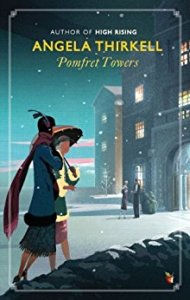
Cover for Pomfret TowersSomeone once remarked to me that the Angela Thirkell novels set before or during World War II are the best, and so it seems to me, reading this one. Pomfret Towers is set before the war.

Timid young Alice Barton is terrified when she learns she must accept an invitation for a weekend at Pomfret Towers along with her brother, Guy. Lady Pomfret is home on one of her infrequent visits from Italy, and Lord Pomfret wants some young people around to entertain her.

But she needn’t have worried: almost everyone is kind to Alice. Phoebe Rivers, a cousin of the family, has made sure Alice’s room is next to hers and helps her pick out her outfits for dinner. Alice’s good friends, Roddy and Sally Wicklow, are there, Roddy being the junior estate manager. Gillie Foster, Lord Pomfret’s heir, is extremely kind and fetches her shoes for her from the servants. Even Lord Pomfret, who is known for his rudeness, is kind.

One figure who continues to be terrifying is Mrs. Rivers, a best-selling author. Although Alice’s mother is also an author (a better one, we suspect), she is modest about it, unlike Mrs. Rivers, who constantly talks about herself and tries to arrange things for everyone, as if she were the hostess.

Another egoist is Julian Rivers, but Alice only sees how handsome he is and how wonderful he seems to be. His behavior is sometimes unusual, but he is an artist.

One of the things Mrs. Rivers is trying to manage is a marriage between her daughter Phoebe and Gillie Foster, but Gillie seems to prefer talking to Alice or working in the office with Sally. And Phoebe keeps running off with Guy to look at buildings he and his father are restoring.

Pomfret Towers is another romance by Angela Thirkell, full of delightful characters and slightly winking at society. This novel is one I particularly enjoyed. Alice is a little silly, but she is young and lovable, and we are sure everything will come out all right.

Related Posts

Wild Strawberries

Miss Bunting

Vittoria Cottage

Day 892: Wild Strawberries

Cover for Wild StrawberriesThis title does not refer to the Ingmar Bergman film but to the second (or third, depending on where you look) Barsetshire novel by Angela Thirkell. Unlike the others I’ve reviewed lately, Wild Strawberries was written before World War II. It is a delightful and gentle comedy with a romantic triangle.

Wild Strawberries is about a summer with the Leslies. Lady Emily is universally adored, a vague woman always leaving a trail of her possessions behind. She is also a managing type whose attempts to arrange things that are already decided repeatedly throw the family into chaos. The novel opens with a hilarious scene in which the family is late for service and disrupts the sermon while Lady Emily tries to tell everyone where to sit. Lady Emily is the mother whose passing is much lamented in Enter Sir Robert, which I reviewed a few months ago.

And if I am not mistaken, Agnes, a daughter of the house, is the same Lady Graham who is a major character in Enter Sir Robert, and as in that novel, Robert is continually referred to but not present. Agnes is a young mother with three children, kind but silly, and entirely obsessed with the children.

Other members of the household are Mr. Leslie, gruff but kind, sons John and David, and grandson Martin. Martin is the son of the Leslies’ deceased oldest son. John is a widower who has been mourning his wife Gay. David is a charming but selfish playboy.

The Leslies have invited Mary Preston to spend the summer with them while her mother recuperates at a spa on the Continent. Mary is Agnes’s niece by marriage, and her affections play a major part in the plot. She is a young, naive girl who is immediately charmed by David. John, on the other hand, falls in love with her when he hears her singing. We find ourselves rooting for John, but in Thirkell’s novels, the characters we like best are not always successful in love.

Providing humor are a visit from Mr. Holt, a toady to the upper class and expert on gardens, who invites himself to visit the Leslies, and the establishment at the vicarage of a French family. Seventeen-year-old Martin gets himself embroiled in a demonstration to restore the French monarchy, and Mr. Holt finds himself rewarded for his gate-crashing by being entertained by Agnes and her children.

This is a delightful novel with sympathetic and engaging characters and a great deal of humor. I enjoyed it very much.

I have to say that my Moyer Bell edition (not the one pictured above) was riddled with typographical errors, including a chapter that literally ended in the middle of a word, to be completed after the next chapter title. I just picked this up at a used bookstore, but next time I buy Thirkell, I will look for a Virago edition.

Related Posts

Enter Sir Robert

Miss Bunting

Happy Returns

Day 820: Enter Sir Robert

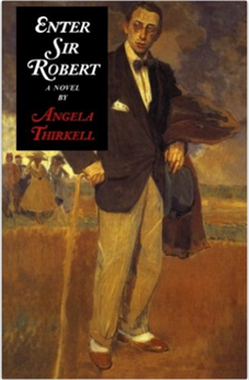
Cover of Enter Sir RobertLady Graham and her youngest daughter Edith are the main characters of Enter Sir Robert, set in post-World War II Barsetshire. Thirkell relates her novels as if she’s personally telling you a story, and although all the novels are set in Barsetshire, this one seems a little more rural than the others I’ve read recently. People are always running off to look at the pigs.

Lady Graham is a charming woman whom everyone loves, although she is a little scatter-brained. With most of her children married and her husband, Sir Robert, almost always away on some vital service to the nation, she has only Edith, who is 18, left at home.

Mrs. Halliday has an invitation for Edith. Her daughter Sylvia, who is expecting, is coming for a visit. Mrs. Halliday would like Edith to stay for a while to be company for Sylvia. Mrs. Halliday is taken up with Mr. Halliday, who is not well, and her son George has been working the farm as best he can alone. Meanwhile, Lady Graham is preparing a small memorial service for the anniversary of her own mother’s death.

Edith enjoys herself very much at the Halliday’s, visiting with Sylvia, entertaining Mr. Halliday, and viewing the farm with George, who seems to like her company. When the Hallidays all go to view the Old Manor House, which they have been leasing to a bank, they meet Mr. Cross, son of Lord Cross and also a delightful young man.

Like Thirkell’s other novels, Enter Sir Robert depicts the everyday life of the people of a certain social station with wit and humor. Her characters are mostly nice people, with only a few barbs directed at the bishop. The countryside is lovingly described, and there is always a little light romance. They are a pleasure to read. Oh, and if you care to read this one, you’ll find that the title is Thirkell’s little joke.

Related Posts

Happy Returns

Miss Bunting

Barchester Towers

Day 766: Miss Bunting

Cover for Miss BuntingMiss Bunting, an elderly governess, has left her usual home at Marling Hall to live with young Anne Fielding in Hallbury. Anne’s health is considered too delicate for her to live with her parents in Barchester, so Miss Bunting has agreed to take her on, with an eye to improving her health, her poise, and her education.

Miss Bunting is an old-school type of governess, a force in herself, whose presence makes others sit up straight. Still, she is fond of her pupils, too many of whom are being killed in World War II.

Jane Gresham has been having a particularly tough war. Her husband Francis is on an island in the Pacific, and he hasn’t been heard of for three years. She has been living with her father, Admiral Palliser, and doing her best to raise her eight-year-old son Frankie.

Robin Dale, son of the rector Dr. Dale, is feeling a bit adrift. He lost his foot in combat. Although his old school has asked him to return to a job as master, he feels he must keep his elderly father company. So, he’s been running a small school for boys preparing for public school.

Jane does a favor for the admiral, going to view housing for Mr. Adams and his daughter. Mr. Adams is a wealthy factory owner looking for a place for the summer, and the admiral is on his board.

This novel is about a disappearing way of life for the British upper class, as personified by Miss Bunting. Class is an important issue in the novel, as the upper levels of Hallbury society are taken aback when Mr. Adams and Heather breach their ranks. Thirkell tells this story with liveliness and wit. Although her tone is sometimes one of asperity, none of her characters are bad, or even ill-meaning, people. Thirkell shows their foibles while still making you like them very much. I’m happy to be rediscovering these novels.

Related Posts

Happy Returns

The Warden

Some Luck

Day 743: Happy Returns

Cover for Happy ReturnsHappy Returns is one of Angela Thirkell’s books set in Barsetshire, the setting also of Anthony Trollope’s novels. Thirkell’s novels were written in the 1930’s-50’s and feature, in large part, pleasant and well-meaning characters, gentle romances, and problems bravely dealt with, particularly during and after the war.

Happy Returns is set in 1951 and 1952, just before and after Winston Churchill’s ascension to the office of Prime Minister. Much of the conversation at the beginning of the novel is about the government, called Them, the depredations its taxes have made to the neighborhood, and the characters’ hope that there will be an election that will bring Churchill into office.

The situation of Lady Lufton is one of the focuses of this novel. Her husband is recently dead at an early age, and she is struggling with grief and apathy. The family fortunes have suffered so from death taxes that she is forced to lease half her house to a tenant, Mr. MacFadyen of Amalgamated Vedge. She is concerned because her son, the young Lord Lufton, can’t afford to rent a better place when he goes up to London for Parliament and has to stay with a miserly relative, who does not feed him well in exchange for his ration card. Frankly, the gentle Lord Lufton fears he is too poor to marry.

Charles Belton is another important character. He has been engaged for a year to Clarissa Graham, but they show no sign of marrying. Clarissa has been behaving petulantly, so that Charles has begun to doubt that she wants to marry him. It takes his friend Eric Swan to notice that Clarissa is actually madly in love with Charles and fears he doesn’t love her back.

Swan, a schoolteacher, doesn’t seem very ambitious, but he is actually considering trying for a place at Oxford. But then he meets Grace Grantly and falls in love with her. At this time, fellows at Oxford couldn’t be married, so he decides to put his plans on hold and see what develops.

The whole neighborhood notices that Francis Brandon hasn’t been treating his nice wife Peggy very well lately. She, along with several other women in the novel, is very pregnant and despite her husband’s behavior keeps her good humor.

As an example of the flavor of this book, Lady Lufton and Lord Lufton are having a conversation when Mr. MacFadyen comes in. Mr. MacFadyen observes sympathetically that some of Lady Lufton’s comments are of the type to make a young man impatient, but Lord Lufton always replies gently and patiently.

Most of the characters in Happy Returns are nice people, except maybe the Bishop, who never actually appears. Throughout the entire novel, Mrs. Joram is planning a party but is waiting for the Bishop and his wife to depart for Madeira so she won’t have to invite them. The Bishop is apparently so disliked by many people that when he finally leaves for Madeira and his ship is overtaken by a storm, almost every character wishes for a shipwreck.

I enjoyed this novel with its depiction of the hardships of post-World War II Britain. My only problem with it was the plethora of characters, for I could not keep track of who they all were and what their relationships were. Probably someone following the series from the beginning would not have this problem. I have read several of the books, but that was a long time ago.

There are also quite a few cultural and literary references I didn’t get—and probably many jokes. For the tone of the novel, although it has touching moments, is one of humor, with many funny asides addressed directly to the reader about what will or will not be further explained. I think a fair comparison for someone who is not familiar with Thirkell’s work would be the novels of Nancy Mitford, although they are more obviously unrealistic and caricatured.

Related Posts

The Warden

The Pursuit of Love

Love in a Cold Climate