
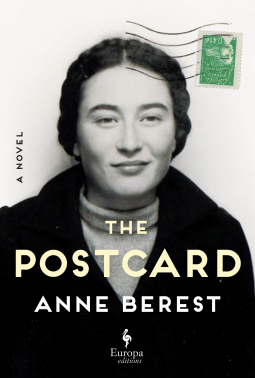
Although sold as fiction, I believe that The Postcard is very much autobiographical and historical, the story of the fates of Berest’s relatives and her own search for an identity.
The search begins with a postcard, one that arrived years before but that Anne’s mother Lélia shows her much later. It is an old postcard containing only the names of Anne’s grandmother’s parents, sister, and brother. All of them died in Auschwitz. The postcard is addressed by another hand to Lélia’s mother Myriam, but at Lélia’s address, where Myriam did not live. It is a mystery. Is it a threat? A reminder?
Myriam has never spoken about their family’s past and now she is dead, so both Lélia and Anne have grown up knowing very little about their family, Ephraïm and Emma Rabinovitch and their children, Noémie and Jacques. Since receiving the postcard, though, Lélia has built up an archive of documents about the history of the family up to when they were deported by the French government. The first part of the novel covers this history.
The further sections of the novel are about Anne’s attempts to discover who sent the postcard and what happened to Myriam. Why was she the only one missed, and what did she do during the war? And finally, how has her family’s experience affected Anne’s own life?
This is a deeply engaging story and an important one, I think. Although the Holocaust is long past, its effects are still reverberating.
 What? Me Read?