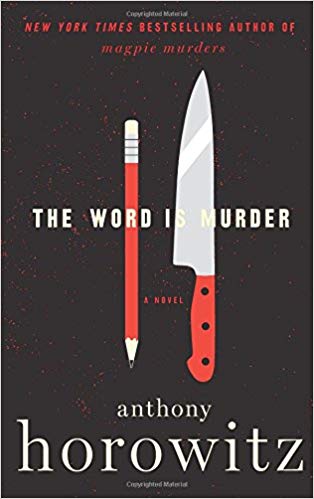
Review 1340: The Word Is Murder

Cover for The Word Is MurderAnthony Horowiz does an unusual thing in his new mystery. He inserts himself into his novel as a character. It’s not just first-person narration by a fictional character, because he mentions projects he has worked on in real life.

He is approached by Daniel Hawthorne, a brusque ex-police detective, who wants Horowitz to shadow him on a case and write about it. Horowitz is hesitant at first but soon gets interested in the case.

Diana Cowper is murdered on the same day that she met with an undertaker to plan her own funeral. There may be some connection to an accident she had nearly ten years ago, in which she hit two boys with her car when they ran into the street. One was killed and the other badly injured. She has received threatening letters from Alan Godwin, the boys’ father.

Diana’s son Damian is a famous Hollywood actor who returns for his mother’s funeral. Horowitz assumes Diana’s murder is connected to the car accident, but then Damian is murdered, too.

Frankly, I was underimpressed by Horowitz’s last mystery, and I probably wouldn’t have read it if I hadn’t run across it in the library. I felt it was too concerned with the complicated plot and too little with the characters.

Right off the bat with this novel, I felt uncomfortable with Horowitz’s angle of making himself a character. I didn’t really like the narrative style.

I was really offended, though, when I realized that he kept important information that was vital to discovering the solution until the last 100 pages of the novel. That’s just plain cheating.

Horowitz has written screenplays for very good mystery shows, but his novels seem superficial and facile to me. I feel that his approach is more suited to television than to novels.
Related Posts

Magpie Murders

Moriarty

The Silkworm

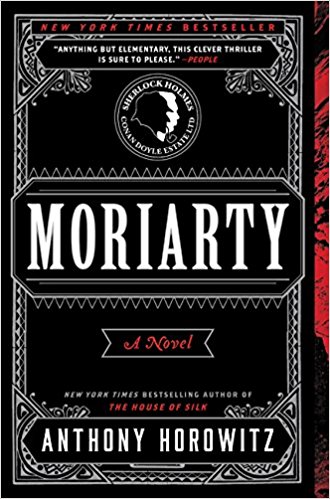
Day 1245: Moriarty

Cover for MoriartyDespite not being a fan of Sherlock Holmes-based contemporary mysteries, I read Moriarty because I recently enjoyed Magpie Murders. In this case, Sherlock Holmes does not appear, and the only link to the older mysteries, aside from a few characters, is Moriarty himself.

The novel begins right after the Reichenbach Falls incident, when both Holmes and his nemesis, Moriarty, are assumed dead. The body of one man, identified as Moriarty, is found.

Shortly after the incident, two detectives arrive on the scene. One is Frederick Chase, an investigator from Pinkerton’s in the United States. The other is Inspector Athelney Jones from Scotland Yard. Chase reports that he has been following Moriarty with information that he was meeting with Clarence Devereaux, a criminal mastermind from New York who purportedly wants to join forces with Moriarty. No one has ever seen Devereaux, but the Pinkertons understand he suffers from extreme agoraphobia. Chase and Jones team up to find him.

This, however, is not an easy quest. Every time the two men get a lead, someone is murdered. Soon, the two investigators must fear for their own lives.

I found this novel clever, but there was something missing from it. I don’t know how else to describe my reaction. I was just a little underwhelmed, even though there were twists and turns.

Related Posts

Magpie Murders

Moriarty

Mr. Timothy

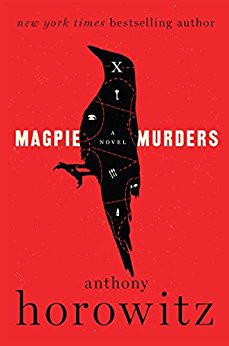
Day 1200: Magpie Murders

Cover for Magpie MurdersMy husband and I love Midsomer Murders. The program has not been broadcast in Austin for years, so we began collecting the DVDs. After our move, we were happy to find that the Portland PBS station periodically airs the older series, which we’ve been watching. So, I was delighted to learn that Anthony Horowitz, the author of Magpie Murders, had written some of the screenplays. How could I go wrong?

Alan Conway, the author of the successful Atticus Pünd mystery series, has sent his latest manuscript, Magpie Murders, to his publisher. After a brief introduction by his editor, Susan Ryland, we’re plunged directly into his Christie-esque whodunnit.

But the novel comes to an abrupt end before it is finished. The last few chapters are missing. Before Susan can contact Conway, she learns he is dead from an accidental fall off the tower in his home.

The publishing house hasn’t been doing that well recently, so Susan begins looking for the final chapters. They have been erased from Conway’s computer, and the manuscript is not with his others. Susan’s boss’s copy is missing the same pages.

Susan begins to suspect that Conway’s death was not an accident. As she investigates, she finds that Conway borrowed characters, settings, and ideas from his real life and liked puzzles and anagrams. Susan thinks that the key to Conway’s death may lie in his manuscript.

I enjoyed Magpie Murders and thought that its novel within a novel structure was clever, but I also didn’t think that the Pünd novel was all that important to the plot. That is, it was important, but it wasn’t necessary to include the entire novel. Of course, this structure gives you two entertaining mysteries for the price of one, but I thought that there were too many characters in the Pünd novel, and it was confusing. Also, too much was told in narrative rather than in action and dialogue.

I did not solve the Pünd mystery, but I did somehow sense who the murderer was in the “actual” mystery despite not knowing the motive. When the motive was revealed, it seemed weak to me.

This seems like a severe review, but I actually enjoyed the novel very much. So, I guess I am carping at small things. The action moves forward nicely, the interior mystery has a pleasant old-fashioned feel, and the “real” mystery has an engaging heroine.

Related Posts

At Bertram’s Hotel

As She Left It

The Iron Clew