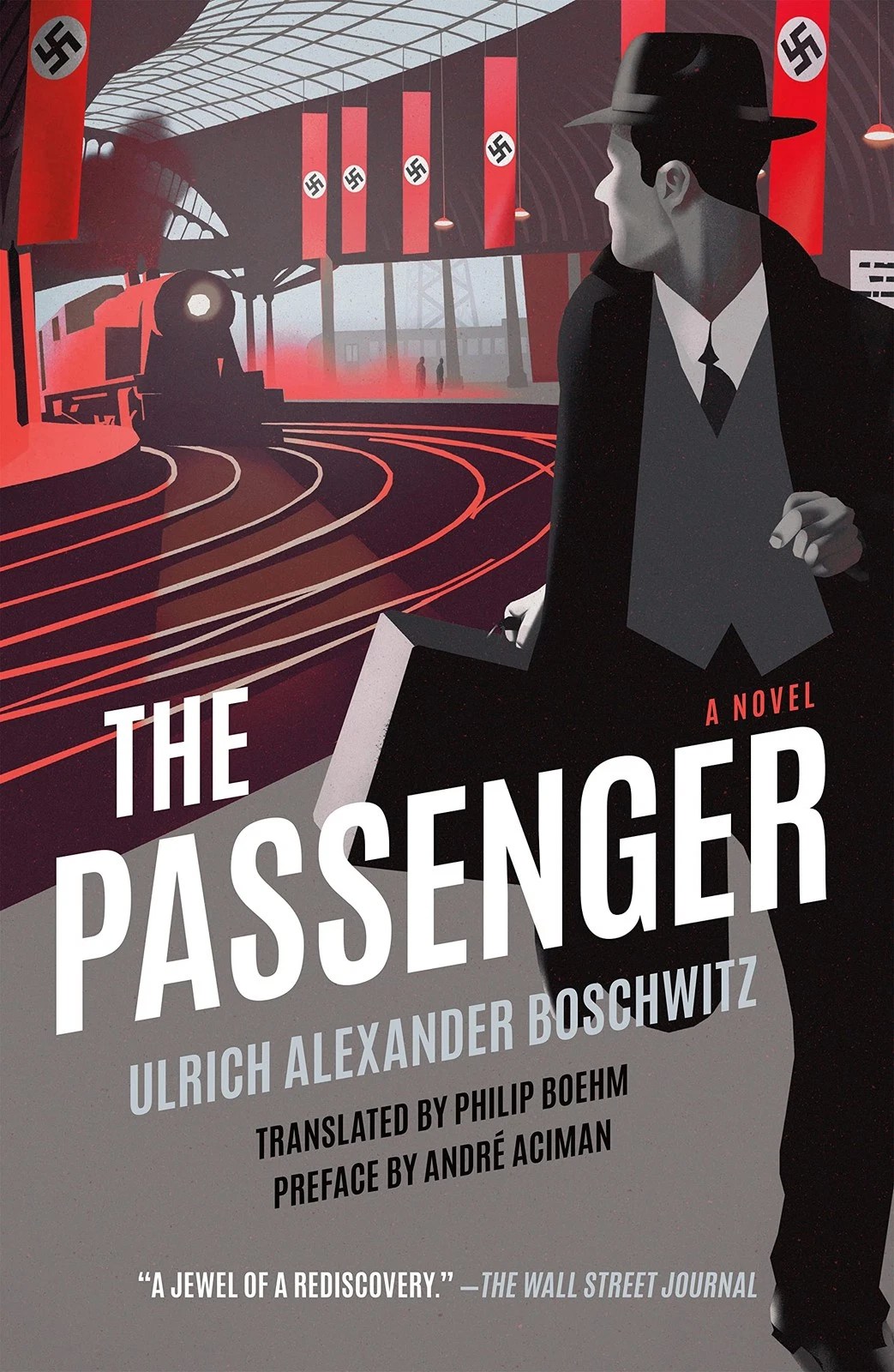
Classics Club Spin Result! Review 2595: The Passenger

I know I’m early in reviewing my Classics Club Spin book, but it just so happens that when it was picked for the spin, I had just read it but not reviewed it yet. Lucky for me, because so many of the books remaining on my list are really long!

I am not sure how The Passenger made it onto my Classics Club list, but its origins are certainly interesting. Boschwitz, who had already escaped Germany with his mother, was so affected by the events of Kristallnacht that he wrote this novel in a great hurry. It was published in England in 1939 and in the U. S. in 1940, but then it just vanished. Revisions he mailed to his mother never arrived. Then, in 1942, he and his manuscript were on a passenger ship that was torpedoed by a German U-boat, and they were lost. Nearly 80 years later, a correspondence with Reuella Shachaf, Boschwitz’s niece, mentioned to Peter Graf that the manuscript for the book was held in an archive of the Deutsche Nationalbibliothek. So Graf looked it up and helped edit it and get it republished. It came back out in 2018.

The book opens with wealthy Jewish businessman Otto Silbermann handing over 51% of his business to a friend, Becker, to save it from being taken. As Becker points out, there is nothing Silbermann can do about it because he’s Jewish. Jewish men are being rounded up, but Silbermann has an advantage of not looking Jewish.

Back at home with his Christian wife, he tries to sell his house to another friend, Findler, who cheats him. Again, there is nothing he can do about it. Then thugs begin pounding on the front door, so Findler sends him out the back, saying he’ll protect Elfrieda.

Silbermann begins a journey lasting days, traveling by train from one city to another to find a way to escape Germany. His goal is to go to his son Eduardo in Paris. But Eduardo has been unable to get him the papers he needs. In the meantime, he lives in a state of paranoia, listening to constant insults to Jews, fearing strangers, and thinking he’ll be arrested any minute.

This is a tense novel that seems very realistic, although Silbermann occasionally becomes incandescent with anger about the injustice, thereby risking his own life. It’s a compelling novel.

Related Posts

The Oppermanns

Sarah’s Key

The Weight of Ink

Day 659: The Prague Cemetery

Cover for The Prague CemeteryThe Prague Cemetery opens in 1897 with a monologue that is so vile and bigoted against just about everyone—the French, the Germans, the Italians, Jesuits, Masons, women, and especially Jews—that I almost put it down at that point. That monologue is the ranting of the main character, Simonini, as learned at his grandfather’s knee. Simonini is an absolutely repellent person who makes his living forging wills and other documents but who also works for the French secret police, and the German secret police, and the Okhrana, making up lies and creating international incidents.

Simonini has a problem. He has gaps in his memory. Further, when he explores a passage in his house, it leads to the rooms of someone who wears a cassock. Following the advice of an Austrian Jew (whom he calls Froïde), he begins writing down what he can remember of his life. The next time he awakens, he finds his diary annotated by the Abbe Della Piccola, who seems to remember the time periods he cannot but doesn’t remember the others. It is soon obvious that these are two personas of the same man.

Simonini is already a forger when he begins his first employment in espionage, spying on the leadership of Garibaldi’s army for the Piedmontese secret police. He always ends up exceeding his orders, though, so when he blows up the ship containing Ippolito Nievo, who is in charge of Garibaldi’s finances, instead of simply assuring the books go to the government and nowhere else, he is shipped off to Paris.

Simonini is most concerned with the fate of what he considers his life work, a document that is supposed to be a true account of a meeting of eminent rabbis—and one Jesuit—in the Prague cemetery, where they plot against the Gentiles and scheme for world domination. Although Simonini has plagiarized some of this document from other sources, he has fabricated most of it, including the setting. Over the course of 40 years, he perfects this document, eliminating the Jesuit and changing it to a series of protocols, all the while trying to sell it to different governments. It is this document that becomes the infamous Protocols of the Elders of Zion, used by the Nazis and other hate-mongers through the years to justify anti-Semitism, even though everyone involved in its creation knew the document was apocryphal.

Although this tale is supposed to be some sort of answer to Dan Brown’s The Da Vinci Code, being based on actual instead of made-up events, and though it is told with proper postmodern irony, it left a bad taste in my mouth. As Simonini and his abettors make up more and more ridiculous stories linking, say, the Masons to Satanic rites, with the public gleefully believing everything, I felt disgusted. Almost every character in the novel except Simonini was an actual person, and all the events the novel is based on are true, which makes it even more disturbing. Eco even has Simonini responsible for framing Dreyfus. Simonini also murders people and dumps their bodies in the sewer beneath his house.

Maybe I agree with one reviewer that some readers may not understand irony. I’m not sure. The construction of a truly dark and repellent protagonist reminded me of the novel Perfume, except that I enjoyed Perfume. I just know that although I have a dark sense of humor myself, this novel made me want to take a bath.

Related Posts

Great House

In the Garden of the Beasts

The Bones of Paris