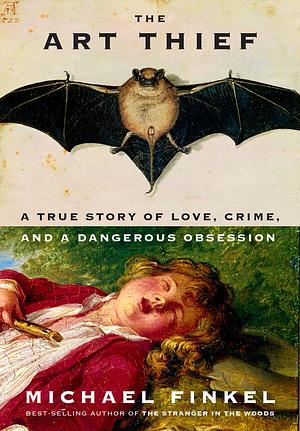
Review 2636: The Art Thief

The Art Thief is a nonfiction book about the most prolific art thief ever known. Stéphan Breitwieser, aided by his girlfriend Ann-Catherine Kleinklaus, stole hundreds, maybe thousands of paintings and objets d’art while only in his 20s.

Breitwieser was a young man who grew up wealthy and spoiled by his mother until a traumatic divorce that broke with his father and left him and his mother quite poor. Not that he went out and got a job. Instead, he lived with his mother, received some money from his father, and was supported by the state.

He loved the beautiful things that filled his father’s house, though, and he read extensively about art and antiques, becoming very knowledgeable. Then one day while visiting a museum, he swiped a lovely ivory statue of Adam and Eve. It was easy.

Breitwieser seemed compelled to steal these beautiful things, not to sell them but to decorate his two attic rooms and to be admired and touched. Kleinklaus participated in his thefts—it seems, because she won’t talk about it—mostly to keep him from doing something reckless.

This is a fascinating story of obsession gone wrong. It manages to build a fair amount of suspense along the way and is written in more of a novelistic style.

One thing that disturbed me slightly was a hint of not exactly admiration but in any case just a bit of the kind of attention that fuels some people to do heinous acts. I say this despite the book’s deprecations of Breitwieser’s actions. It particularly grated when I learned what became of the more fragile items in his collection once he was caught.

Nevertheless, it is an interesting true crime book.

Related Posts

The Shakespeare Thefts: In Search of the First Folios

The Hare with Amber Eyes: A Hidden Inheritance

The Collector’s Apprentice

Review 2533: The Stone Angel

When I was looking for books to fill a hole in my A Century of Books project, I found this one. I thought I had read a book by Laurence before, but apparently not. The Stone Angel is the first in her Manawaka series.

Hagar Shipley is 90 years old. She is a proud, tough woman who has never expressed any of her gentler feelings. Now she finds that her son Marvin and his wife Doris are thinking she needs to move to a senior home. She understands this idea as greed for her home and possessions, although that is not the case. She is fighting the idea as best she can.

Hagar, though, is prone to falling and has memory lapses. In between the scenes from her current life, she returns in her memory to important events and tragedies in her life.

Hagar is not a pleasant person, but Laurence makes us interested in her and manages to make us understand and even sympathize sometimes with this complex character.

Related Posts

The Night Stages

Fifth Business

The Northern Lights

Announcing a new blog

Dear book blogging audience, OK, this has nothing to do with books, or maybe it might at some time, but not now. Still, some of you might find it interesting.

I have always been interested in art, although I am not schooled in it. In middle school, my electives were band class and orchestra (flute) until I got braces in 9th grade and ruined my embouchure. I wanted to take art in high school, but I was afraid that all the people who took it through middle school would know more than I did, so I took something else (and I can’t remember what). As an adult, I occasionally took a six-week class, but I never had a lot of time to work on it.

However, once I retired and moved to Washington, I thought that art classes might be a fun thing to do with my sister, who has always been much more persistent in working on art. We both enrolled at an art school in Vancouver, and I have been going there ever since. (My sister dropped out after a couple years.)

Although I never felt very strongly about myself as an artist, just recently things have been opening up for me. I won first place at the county fair (a big $1.50 and a ribbon), I sold a print of that painting, I shared a booth with my sister in the Battle Ground Art Fair this September, and I joined the Battle Ground Art Alliance. In December, an art gallery is opening up in Battle Ground, and one of my paintings will be for sale there.

A discussion with the webmaster for the BGAA’s website about contact information on their page for me (I submitted my email address and he was advising me to use something else) led me to create a blog about art. It isn’t a sale blog, although I may join the blog owned by the BGAA’s website for selling art once I get my act in gear. It will be a weekly blog talking about my experiences in painting and art. It’s called What? Me Paint? Check it out if you’re interested. So far, there is only one post, but you can see photos of two of my paintings.

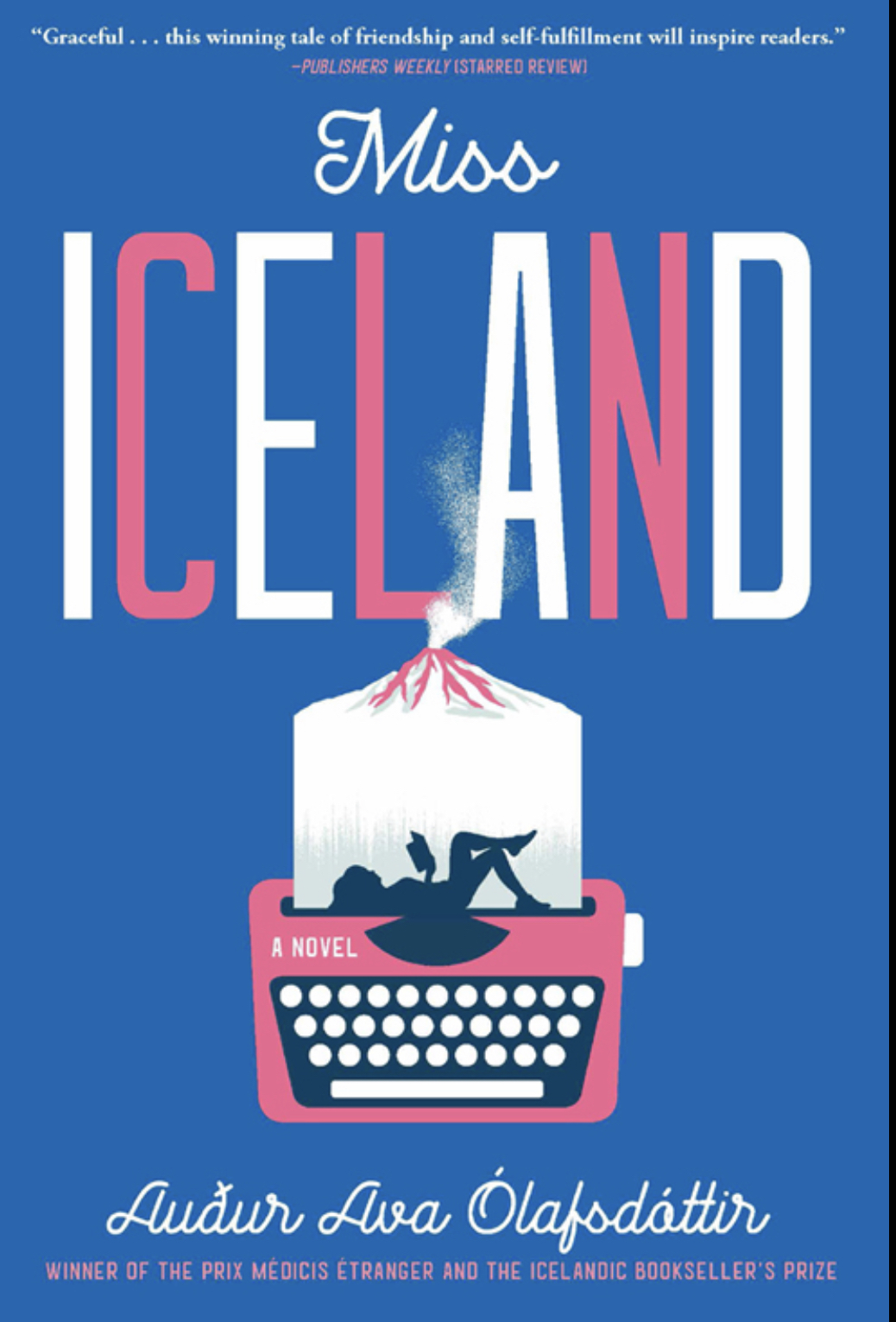
Review 2159: Miss Iceland

I was so entranced by Miss Iceland that I ended up reading it all in one day.

It’s 1963, and Hekla is leaving home at 21 to go live in Reykjavik and become a writer. She has plans to stay with her best friend Jón John Johnsson, while he is at sea, and she also has another friend there, Ísey, a young mother.

Hekla gets a job waitressing in a hotel restaurant, but when middle-aged men try to grope her, she is told to put up with it. One man repeatedly tries to get her to enter a Miss Iceland competition. She is not interested but later learns that another girl who entered was raped by one of the presenters. She really only wants to write, read, and visit her friends.

She loves Jón John, but he is gay, and apparently 1960s Iceland is no place for a gay man. He brings her clothes from Hull and dreams of escape.

Ísey also has ambitions to be a writer and fears that she will only have more children. Soon, she is pregnant again.

Hekla finds that in Iceland, poets are men. She gets a boyfriend, Starkadur, who is a poet and works in a library. She hides from him that she is a published poet, and when she asks about Mokka, the café where the poets hang out, she is told they don’t welcome girlfriends. When Starkadur finds out she is not only a poet but more gifted than he is, he begins obsessing and can no longer write. Still, he wants to marry her and buys her a cookbook for Christmas.

I can’t really describe what was so fascinating about this book. Hekla herself is quite detached, although not from her friends. I think it was because the story seemed real, not at all contrived. The ending is a little abrupt and unexpected, but I liked the story and wanted there to be more. The novel explores friendship, the urge to create, and the search for self-expression. It’s both delicate and powerful.

Related Posts

The Blazing World

Z: A Novel of Zelda Fitzgerald

Brooklyn

Review 2087: Burnt Sugar

When Antara was three, her mother Tara took her and left her home out of boredom to join an ashram, becoming the guru’s lover. In the ashram, Antara hardly ever saw her mother, and when she did, Tara alternated between effusive love and abuse.

Now Antara notices her mother is losing her memory. Although she tries to help her with diet and memory exercises, she still bears her a lot of resentment for events in the past. But this novel reveals its secrets slowly, and its secrets include betrayal. This novel, which I read for my Booker project, is mostly a character study about a woman who felt unloved as a child and is still suffering.

Antara is an artist, good enough to have her own show in a gallery, so I found it disturbing how slighting her family was about her art. When her mother burns some of her drawings, no one is upset, and later someone refers to her art as a hobby.

Antara is not a reliable narrator, nor is she a likeable person, but I found this novel fascinating.

Related Posts

The Blazing World

Suzanne

Black & White

Review 1819: Dirty Birds

Just before I read Dirty Birds, I attempted to read Quichotte by Salman Rushdie, and I was surprised by the parallels. Both protagonists are on a quest to make a woman love them. Although Rushdie’s protagonist is old and Murray’s is young, both are naïve and deluded. Road trips are part of each novel, and so is satire—Rushdie’s for the cult of personality and big pharma, among other things, Murray’s for the Montreal art scene and the young man as artist. I found Murray’s book more successful and a lot funnier.

Milton Ontario is a hapless young man who is not only utterly average but characterized by the extent of his naiveté and inexperience. He gets an idea in his head that he wants to be a poet, even though he writes atrocious poetry (at first dedicated to the love of his life, Ashley, and later to the love of his life, Robin), so he sets out from his small town for Montreal and a tiny room he has rented sight unseen in a dilapidated, filthy house full of students and would-be artists. There he attempts to enter the art scene and falls in love with Robin, the maker of a seven-minute documentary entitled Dirty Birds, who is almost unaware of his existence.

Milton stumbles through a series of horrendous jobs horrendously performed and meets a cast of rowdy, raucous characters. He inadvertently starts a riot and gets to meet his hero, Leonard Cohen, only to find he is a mob boss (where I think the novel starts to go a bit astray). In among all this silly action is a series of footnotes enlightening us about the history of Canadian mistreatment of indigenous peoples, Newfies, and French-Canadians, among others.

Although I think it gets a little carried away with itself (and I didn’t like the part about the late, great Cohen), for the most part, this novel is a hoot.

Quichotte

Cluny Brown

The First Bad Man

Review 1713: The Narrow Land

As a young child, Michael Novak was rescued during World War II and sent to the States as part of a program for orphaned children. There, he was adopted by the Novaks. At 10, he is still extremely fearful and full of routines he follows to calm himself. So, he is resistant when Mrs. Novak tries to put him on a train, the first step in a journey to spend the summer on Cape Cod with the Kaplans. Finally, he decides to go.

On the island in 1950 live the artist Edward Hopper and his wife Jo. Although they tend to be standoffish with the vacationers, Michael forms a friendship of sorts with Jo. And it’s really the relationship between Edward and Jo that this book is about.

Edward has been having a dry spell, and he seems preoccupied with trying to find a woman he painted a few years before. She is right under his nose in the person of Katherine Kaplan, Mrs. Kaplan’s daughter, who is dying of cancer. He has seen her and noted the resemblance, but she is no longer dyeing her hair blond. He is an introvert who spends most of his time in his own head.

Jo is extremely jealous of him and thinks he pays too much attention to Olivia, Mrs. Kaplan’s daughter-in-law, when it is really Olivia paying attention to him. Jo is in fact irrationally and violently angry at times, particularly when she feels she had to abandon her career when she became his wife. Although Jo has some moments of self-awareness, I really think Hickey treats her harshly as a character. Granted, I know nothing about the couple’s life, but Hickey shows her making a fool of herself at a party with her airs and graces and spiteful remarks about other people.

Hopper is not very nice to Jo and belittles her art, although I read about that and found she had some standing as an artist.

This novel, which I read for my Walter Scott project, was slow moving, and for a long time I couldn’t tell whether it was going anywhere. Sometimes that doesn’t bother me, but in this case I had a hard time staying interested. The novel does have a payoff in the end, but it is more character study than plot-based.

Related Posts

That Old Cape Magic

The Blazing World

Suzanne

Review 1666: The Winged Horse

It’s going to be hard to describe this novel without either giving too much away or being too vague. The description on the Virago back cover focuses too much on the role of business tycoon J. G. Baron, when really he is more the catalyst of the action.

Harry Levitt is an American on his way to England for a job with J. G. Baron. He and Baron’s entourage are on shipboard along with Baron’s oldest daughter, Celia, who has been living in the States but is now separated from her husband and moving home.

J. G. is an unlikable person. He surrounds himself with yes men and is hypocritical and self-deceptive. He dislikes two of his three children and terrifies the third. Celia is the only one who doesn’t try to please him, as she dislikes him back.

When we meet Harry, he is a practiced dissembler who feels insecure about his Midwest background so has invented Californian origins. Despite a bad start with Celia, while living in England, Harry develops a close relationship with her siblings Tobias and Liz and with their friend Anthony Carey, a mediocre sculptor known to the family as Thank-God-for-Anthony. Anthony seems perfectly assured and the only person who is not afraid of J. G. The Barons consider him the epitome of probity.

Harry, as he grows to love England and feel accepted, becomes calmer and more assured. However, there is a family tragedy, and subsequent events allow Frankau to explore themes of power, truth, and dishonesty.

At first I had trouble being interested in these characters, but eventually I became involved in this story. I did find irritating the way Frankau handled the characters’ inner thoughts, just as if they were dialogue, which seemed artificial. But this is a minor criticism.

I read this book for my Classics Club list.

Related Posts

They Knew Mr. Knight

Because of the Lockwoods

Consequences

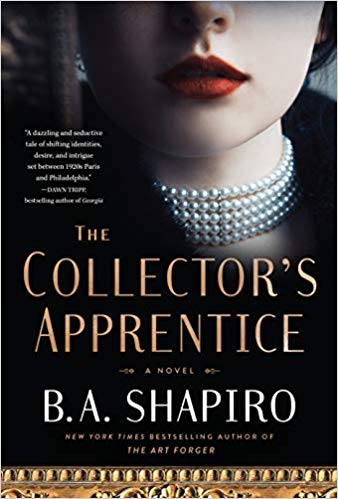
Review 1477: The Collector’s Apprentice

I find that as I read more, I have a lot less patience with mediocre fiction. Either a novel has to grab me immediately or I have to feel that I am reading good fiction. So, I had only about 50 pages of patience for The Collector’s Apprentice.

Vivienne has taken on an alias after her fiancé, George, scammed her father and other investors of their money. Even though she doesn’t believe George was guilty (he told her a Swiss banker cheated everyone), she has been blamed for it and ostracized from her family. She finds herself with no means of support in 1922 Paris.

She has to put up with about five pages of hardship before being hired as a translator for Edwin, a collector of fine art from the United States. As her ambition was to curate her father’s collection, this job is perfect for her.

I was willing to put up with the chick-lit-like features of this novel because of my interest in the art world it seemed to be approaching. However, soon it became clear that we were going to get entangled with George again, and I found that not at all interesting. So, I quit reading.

Related Posts

The Paris Architect

The Light of Paris

At the Water’s Edge

Review 1458: Winter

The beginning of Winter was so bizarre that I wasn’t sure I was going to finish it. Sophia is an older woman living in a large home in Cornwall. She has begun to hallucinate a child’s head that floats in the air and interacts with her.

Art, Sophia’s son, has split from his girlfirend, Charlotte, and she is now posting tweets on his Twitter account that are causing problems for him. Art is supposed to take Charlotte to his mother’s house for Christmas. Unable to explain what happened, he hires a girl named Lux to pretend to be Charlotte.

When Art and Lux arrive at Sophia’s house, they find it barely furnished, with no beds in the extra bedrooms and no food in the refrigerator. Sophia seems vague and much too thin. At Lex’s insistence, Art summons his Aunt Iris, even though Iris and Sophia haven’t spoken in years.

As I said, this novel started in such a way that I wasn’t sure I would like it. It is quirky, certainly, but it grew on me. Things that seem inexplicable are explained, in a way. As usual with Smith, there is a strong focus on art and ideas. Smith is always interesting and inventive.

Related Posts

Autumn

How to Be Both

Look at Me