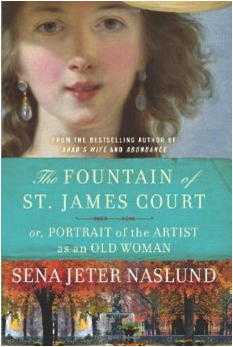
Day 394: The Fountain of St. James Court or, Portrait of the Artist as an Old Woman

Cover for The Fountain of St. James CourtI received this book in a First Reads giveaway from Goodreads. I haven’t read Naslund before, so I am not sure whether she adapted her writing style for this novel, but it took me awhile to accustom myself to it. She follows the activities of two artists, one Kathryn Callaghan, a fictional older writer in the current time, and the other a once-living person, Élisabeth Vigée-Le Brun, a painter known especially for her portraits of Marie Antoinette.

The modern-day story begins at midnight next to a fountain of Venus in a neighborhood of Louisville, Kentucky. Kathryn, or Ryn, is taking her newly finished manuscript to her friend Leslie’s door because she can’t wait to deliver it.

The novel’s structure is a book within a book. Chapters following one day in Ryn’s life are interleaved with chapters covering the whole of Vigée-Le Brun’s life, which are from Ryn’s book. Both stories are about the theme of what it means to be an artist and what you must give up of your personal life to pursue your profession. The novel is said to be a deliberate variation on Joyce’s Portrait of an Artist as a Young Man, but it has been so long since I’ve read it that I cannot comment on that.

This novel is contemplative, especially in the modern-day narrative, but the interleaving of stories in such short chapters slows down the pace too much. It literally takes until page 34 for Ryn to walk across the street and deliver the manuscript. Even with some chapters from the 18th century interleaved, the pace is frustrating. I found myself thinking, when is this woman going to make it across the street?

I found the story of Vigée-Le Brun’s life more compelling than the modern-day story, during which we follow Ryn’s every thought. She is an excitable, emotional woman who contemplates everything she looks at and repeatedly broods over the same things. We read about the russet and yellow fall colors or the appearance of the fountain many times. Nothing much happens all day until a late-night confrontation that seems artificially created to provide some tension.

I did not feel, however, that the two women, Ryn and Vigée-Le Brun, were two different people–they seemed to be the same person in different time periods. Vigée-Le Brun is slightly less emotionally excitable than Ryn, but their observations of the world around them, their attention to color and the details of design and structure, are very similar. Vigée-Le Brun’s narrative style, in first person where Ryn’s is in third person, is a little more formal as befitting an earlier age, but conversations in this story often sound stilted, and her first conversation with Marie Antoinette is positively sycophantic.

Naslund’s writing style, although sometimes vibrant and lyrical, often seems affected, particularly in the modern-day story. The copy I read was an advanced reader’s edition and it had quite a few typos, which I assume will be corrected. I was not quite as sure of some self-consciously unusual phrases, whether they were stylistic choices rather than errors. Naslund’s writing style tends to the unusual, to be sure, but I stumbled over some of these phrases. The only one I wrote down was an instance where some characters “made quick chat.”

I wanted to like this novel more than I did. I think the theme of women and art is worth exploring, although I’m not sure how much this novel actually explored this issue, despite its obvious intentions. I am actually curious about the alleged feminist leanings of Naslund and their effect on this book. Vigée-Le Brun has to put up with her father and then husband appropriating all her money and, in her husband’s case, only giving her a bit of it back as an allowance. When they divorce, he gets almost everything. Yet, she is determined not to let it bother her. I am not sure whether that is a feminist viewpoint or not.

However, the characters in this novel certainly reflect the “gift for pleasure” noted in reviews of Ahab’s Wife (which I am currently reading). The women go on pursuing their lives and dreams without much heed to their menfolk, they have cordial relations with those around them, they delight in color and the fineness of life. Their regrets and sorrows mostly focus on their children.

One thing that surprised me about the historical story was that Vigée-Le Brun hardly seemed to notice the causes of the French revolution or the revolution itself. There is one scene where a woman confronts her on the street and another where she grieves for the fate of so many. That’s about it.

Conversely, it is hard to believe that she would be shocked to the core by seeing a model of internal organs, as artists had been studying the body for hundreds of years. I do not know how much of this novel actually reflects Vigée-Le Brun’s true thinking and feeling. The danger when portraying a historical person is that you are imagining who the person really is–you don’t know–and you have no idea if you are doing them justice or injustice.
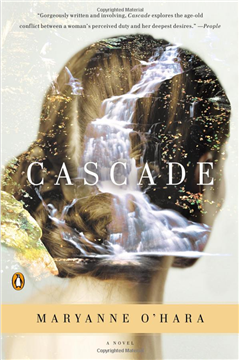

Day 378: Cascade

Cover for CascadeIt would be nice to know how much O’Hara expects us to like Desdemona Hart Spaulding, the heroine of Cascade. Unfortunately, I think we may be thrust too abruptly into Dez’s troubles to get to like her.

A promising artist who has studied in Boston and Paris, Dez has already been forced to leave that life when we meet her. The Great Depression cost her father his fortune, and he had to close down the famous theater he founded in the resort town of Cascade and sell his treasured First Folio of Shakespeare. Dez was forced to withdraw from art school and hastily married her childhood friend Asa Spaulding so that she and her father would have somewhere to live. Her father dies soon after, and she is taken aback to find he has left the theater to Asa.

Still, considering she married a man with little interest in or understanding of her drive to create art, Asa has set aside a bright room in their house for her studio, and she paints for several hours on most days. Asa wants a child, though, and Dez fears that her precious painting time would be taken up with child rearing. She is secretly doing what she can to prevent conception.

Two things soon make her dissatisfied with her life. Her art school friend Abby stops by on her way to a new life in New York, and suddenly everything in the depressed town looks shabby, even the beloved playhouse. Dez has also formed a friendship with a Jewish man named Jacob Solomon, who has taken over his father’s peddlar’s route. Jacob, though, is a gifted artist who plans to sell his father’s inventory and move to New York, hoping for a job with the Works Progress Administration. He meets Dez once a week to discuss art, but after a dispute, Asa asks her to stop meeting Jacob.

Asa is concerned because the town is under threat. Cascade is one of two possible towns that may be flooded to create a reservoir that will supply water to Boston. Asa wants to mobilize an effort to save Cascade, and Dez has the idea to paint a series of postcards showing Cascade in the past and present in an attempt to garner public support for the town. She is able to sell this idea to a prominent national magazine. All the while, however, she is secretly hoping the town will lose and she will have an excuse to move to a large city. The agreement she makes with the magazine and other disastrous decisions cause her to betray her husband, her town, and finally even Jacob.

I think O’Hara wants us to sympathize with Dez in her growing ambition to go to New York and take up a career in art. But some of her actions don’t just show poor judgment; they are despicable. As the plot advances, I feel less and less sympathy for her.

A review from the Boston Globe calls Dez complex and says she doesn’t always make the right choices. I think it’s worse than that; the trouble is really with where she places her priorities. The town is in danger of dying, in the horrible economy many people’s welfares are at risk, but Dez puts her future as an artist first and barely gives the other townspeople a thought, in fact, seems to feel superior to them. She supposedly yearns to reopen her father’s playhouse but doesn’t seem to give it much attention when it is threatened, although she eventually makes a deal that saves it. She has married for selfish reasons and is all too ready to give up on her marriage.

Of course, the principal theme of the novel is how much to give up for art, but in this case, it is not Dez who does the sacrificing. I wish I had liked this novel better. I think that if we’d had a longer time with Dez in her art student life and gotten to know her before she began a series of lies, deceptions, and betrayals, I could have felt more sympathy with her struggle.

Special Post. Change of Pace

Magic of ReadingTo start out today on a different note, I’d like to post a picture of this beautiful painting called The Magic of Reading. This picture appeared today on the Texas Education Agency web site, and is student art, by Elvina Almeida of the Dealey Montessori Vanguard and International Academy, in Dallas.

Day 267: Black & White

Cover for Black & WhiteI had an ambivalent reaction to Dani Shapiro’s Black & White. By coincidence, while I was reading it, I read an article about adult survivors of child abuse that helped me focus on what was bothering me about the themes and conclusion of this novel. I’ll talk about that later.

Clara Brodeur has not seen her mother since she left home at the age of 18. She is a seemingly ordinary housewife with a nine-year-old daughter, but she has a secret. Her mother is Ruth Dunne, a world-famous photographer who made Clara’s childhood miserable by documenting it with evocative, nude photos.

Clara’s life is interrupted by a phone call from her older sister Robin telling her that their mother is dying, and she can’t cope anymore. Despite herself, Clara finds herself in New York City, where she is forced to face her feelings about her mother.

The strength of this novel is its finely observed descriptions, especially of Clara’s memories of the photo shoots–both from the point of view of a young child and then overlaid with adult awareness. Shapiro accomplishes the difficult task of explaining only with words both how striking Ruth’s photos must be and why they are disturbing. Clara feels that she has had her life stripped bare for the entire world and her relationship with her mother destroyed because of Ruth’s obsessions.

Of course, the novel evokes questions about art and its importance, whether the creation of an object of art justifies Ruth’s treatment of Clara, the impact of abuse upon the family, and so on. Perhaps I should warn now about spoilers, although I will try not to reveal too much.

Emily Yoffe’s article in Slate deals with how there is often a societal pressure put upon adult survivors of child abuse to reconcile with their abusers  and bring them back into their lives as the abusers get older. She points out the possible destructiveness of this expectation as well as the possibility of more harm to the original victim, or as she puts it better, “the potential psychological cost of reconnecting.”

One of my problems with this book is that it buys wholeheartedly into this assumption that reconciling with and forgiving one’s abuser is automatically healing for the abused, with a much too indulgent and simple-minded conclusion. Robin has been telling Clara “it’s not about you,” and suddenly she realizes that is true. But it is about Clara. Moreover, when Clara asks why her mother didn’t stop, her husband answers “Because she couldn’t.” I’m sure that is true, and Ruth’s form of abuse is admittedly different than sexual or physical abuse, but if you ask a sex offender why he or she doesn’t stop, you’re going to get the same answer.

Shapiro’s novel provides too facile an answer to her heroine’s problems and then wraps everything up in a pretty package. Not a satisfying or particularly realistic ending to a novel of promise.

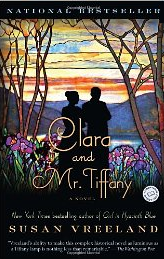
Day 181: Clara and Mr. Tiffany

Cover for Clara and Mr. TiffanySusan Vreeland’s Clara and Mr. Tiffany is a novel about Clara Driscoll, a real artist who headed a woman’s workshop designing the most complex lamps and screens for Louis Comfort Tiffany. The novel details the ups and downs of a long professional relationship, including Driscoll’s frustration at not being recognized as the designer of some of Tiffany’s most famous pieces. A lot of the interest in the novel resides in the tension between the women’s division and the men’s division, which was only allowed to work on the more mundane pieces.

Right now I am reading some of Vreeland’s own comments about the captivating woman she found depicted in Clara’s own letters. Unfortunately for the novel, Vreeland does not do a great job of making her characters interesting in this book or of conveying the woman she found in those letters. Several important but minor characters are so undefined that I couldn’t keep them straight.

I believe that Vreeland is hindered rather than helped by the fact that she is fictionalizing the lives of real people whose relatives are probably still alive. She has written more successful books about artists who lived farther in the past–Monet in Luncheon of the Boating Party and Artemisia Gentileschi in The Passion of Artemesia, for example. There are certainly interesting aspects to the story–Driscoll had an unusual life featuring at least one bizarre event–but the novel is written more like a series of incidents than a narrative with an arc.

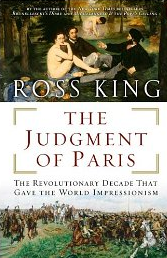
Day 123: The Judgment of Paris

Cover for The Judgment of ParisThe Judgment of Paris: The Revolutionary Decade That Gave the World Impressionism is Ross King’s account of the art and politics of the decade beginning in 1863 and ending in 1874 with the first Impressionist show. The book follows the lives and careers of several significant French artists in the years leading up to the introduction of what was eventually called “Impressionism.”

At that time in France, artists were taught that the proper subjects for art were scenes from history, mythology, or the Bible. The “best” paintings observed the minutest of details, colors were muted, and the surface of the painting was smooth so that brush marks could not be distinguished.

Although the book touches upon the careers of many artists, in particular it follows the fortunes of two–Ernest Meissonier, who was considered one of the greatest artists of his time and was certainly the highest paid, and Edouard Manet, an unofficial representative for the younger painters. Meissonier progressed from painting small, very detailed scenes from the 17th or 18th Century of “goodfellows” in ordinary domestic scenes, such as playing chess or smoking, to huge  historical paintings, several of events in Napoleon’s career. The younger painters were more interested in depicting scenes from modern life. At that time they were called Realists, not for their painting style but for their subject matter.

The book begins with the preparations for the Paris Salon of 1863. The Salon was the most important art show of its time, almost essential to getting an artist’s work viewed. King explains how changes in the rules affecting how the jury was selected resulted in most of the landscape painters and those with less traditional approaches being shut out of the show. So many artists were excluded and the outcry was so great that Emperor Louis-Napoleon authorized a second exhibition called the Salon des Refusés to show the paintings refused by the jury. Ross continues on from there to show how the new art moved slowly from the scorn and derision of the artistic community to acceptance and admiration. I was particularly surprised to find that the first place this new way of looking at the world was accepted was not France, but the United States.

King’s explication of the prejudices and politics surrounding the evolution of new approaches to painting is extremely interesting, as is his corollary discussion of the reign of Napoleon III, the disastrous Franco-Prussian War, and the subsequent shifts in the government of France, and how all this had its effect on the acceptance of the new art.

Day 91: Mortal Love

Cover for Mortal LoveMortal Love is Elizabeth Hand’s extremely unusual and strange novel about artistic inspiration and its relationship to obsession. It is narrated in two parallel stories, one taking place in the present and the other in the Victorian age.

In the story from the past, an American painter named Radborne Comstock meets Evienne Upstone, a model who has inspired the work of members of the Pre-Raphaelites and who has supposedly driven one painter insane. He finds this woman irresistable but she may be insane herself. Evienne has a close associate, a maid, who has blue fingers. Comstock experiences weird hallucinations when he is near Evienne, but is not sure whether they are hallucinations or he is going insane.

In the present time Daniel Rowlands, an American writer visiting in London, meets Larkin Meade, who seems to be the same woman as Evienne Upstone. She becomes his lover and leaves him physically and emotionally deranged.

In the meantime, a young man, Comstock’s grandson, who has been raised by a man with blue fingers and has fought insanity all his life, has become obsessed with his grandfather’s paintings of Evienne and decides to visit London.

This book is a wild, fantastic tale linking Celtic folklore, the Pre-Raphaelite art movement, and ancient mythologies. It is at times bewildering but also makes compelling reading.