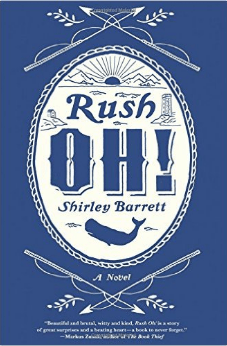
Day 961: Rush Oh!

Cover for Rush Oh!Best Book of the Week!
Perhaps I am harping on this subject, but yet again a distinctive authorial voice has made for an outstanding novel. In this case, the voice is that of Mary Davidson, the 18-year-old daughter of a whaler in 1908, Eden, Australia. Mary is relating the events of the year from a distance of 30 years later.

At that time, some of the whaling in Australia was done from shore, the whalers rowing out to chase the whales. In this activity, the whalers of Eden were assisted by, amazingly, a group of killer whales, who behaved more or less like really rough sheepdogs, herding and battering the other whales. In the novel, the leader of the killer whales, Tom, summons the whalers when whales are in the bay by smacking his tail loudly, and the whalers at times attempt to call the killer whales by smacking their oars.

The story begins with the arrival of a young man hoping for a seat in one of the boats. He is John Beck, reputed to be an ex-Methodist minister. Beck very soon seems to be courting Mary, although he is inconsistent in his attentions. Also, there are some indications that he has not been strictly truthful about his past.

Mary’s father George is short on men and had a very bad whaling season the year before, when they caught not a single whale. Although George “Fearless” Davidson (an actual historical person) is highly esteemed in the region, the financial situation is dire, and he must accept this totally inexperienced man onto his second boat.

The novel is peppered with rampaging whaling scenes and descriptions of the whaling life. It is written in a sprightly, witty, and engaging tone that reflects the personality of naive young Mary. Although it documents a disappearing way of life, it is wonderfully entertaining, and I loved every minute of it.

Related Posts

The Rathbones

Galore

History of the Rain

Day 938: What Alice Forgot

Cover for What Alice ForgotAlice Love wakes up from an accident thinking she is 29, pregnant with her first child, and madly in love with her husband Nick. But she is actually 39, the mother of three children, and separated from Nick. It takes her a while to understand she is ten years older, much thinner, and quite a bit harder and more driven than she remembers.

Alice escapes from the hospital by simply lying to the doctors. But somehow, she must piece together her life from the allusions of other people and her own feelings of occasional discomfort. How can she get along with her three unknown children? What happened between her and Nick? Why are she and her sister Elizabeth on the outs? And who the heck is Gina?

I thoroughly enjoyed this novel, mostly because of its characterizations. Alice in her 29-year-old reincarnation is guileless and likable, and Nick in her memories is also endearing. Alice’s children seem like real kids, adorable one minute and infuriating the next.

I didn’t like as much the sections written by Elizabeth to her therapist or by Frannie to her long-dead fiancé, but their stories add more depth to the novel. Since the focus was so much on Alice, there probably wasn’t another way to fit that information in.

All in all, this is another highly enjoyable novel from Moriarty. Toward the end, I was afraid she was going to take an easy path, but she did not.

Related Posts

Big Little Lies

The Lace Reader

Before I Go to Sleep

Day 909: Big Little Lies

Cover for Big Little LiesBest Book of the Week!
From the very beginning of Big Little Lies, we’re aware that someone has been killed, but we don’t know who, or why, or by whom. Liane Moriarty’s novel artfully builds suspense as it draws you in to care about certain of the characters.

The action of the novel is centered around Pirriweee Public School, and it begins six months before school trivia night, when the death occurs.

Madeline Mackenzie is taking her five-year-old daughter Chloe to kindergarten orientation when she has a small accident. Jane, the younger single mother of Ziggy, helps her, and Madeline and her friend Celeste befriend her. Jane is moving to the area in a few months when Ziggy will be in kindergarten with Chloe and Celeste’s twin sons Max and Josh.

During the orientation, the kindergarten teacher notices that someone has been choking Amabella, so she brings this up in front of all the children and parents, asking Amabella to say who hurt her. Amabella doesn’t want to say but ultimately seems to indicate Ziggy. Ziggy states clearly that he didn’t hurt Amabella, so Jane believes him.

However, Renata, Amabella’s high-powered corporate mother, starts a campaign with some of the other mothers to ostracize Ziggy. This begins with not inviting him to Amabella’s birthday party. All of this behavior escalates, and for a while I thought it might be taking on a comic edge, like the school-based nonsense caused by helicopter parents in Where’d You Go, Bernadette? But underlying it all is the knowledge that someone will end up dead.

And the characters have their secrets. Madeline, whose husband Nathan deserted her with a newborn baby 14 years earlier, is upset because he and his new wife Bonnie seem to be winning her older daughter away from her. And Jane’s and Celeste’s even darker secrets come out later.

This novel is striking in its ingenuity and in how much Moriarty brings you to care for its characters. I was deeply involved from beginning to end. The conclusion was eminently satisfying. I’ll be looking for more books by Moriarty.

Related Posts

Where’d You Go, Bernadette?

Relativity

Quiet Neighbors

Day 908: Relativity

Cover for RelativityIt’s hard to express my feelings about Antonia Hayes’s first novel, Relativity. When I say it’s sort of a feel-good novel about the ramifications of shaken baby syndrome, you’re going to get the wrong idea. So, maybe I should just start at the beginning. I read recently that Hayes’s own son was a victim, and that adds an unexpected dimension to the novel.

The novel begins from the viewpoint of a delightful character, Ethan Forsythe, the 12-year-old ex-baby in question. He is thrilled about astronomy and physics, and we meet him with his mother, Claire, watching the stars from the park. Ethan is a science nerd who is having some problems at school from bullying, and he also wonders about his father, whom his mother refuses to talk about. Finally, some particularly nasty comments about his father by his ex-best friend Will at school lead him to hit Will, an incident that he can’t remember. In the resulting conference with parents and his teacher, Will’s mother makes some cruel comments and Ethan is so upset that he has a seizure.

Claire, who is a distracted, hazy, self-involved person and overly protective parent, has been having her own problems. Her ex-husband Mark has written her a letter telling her his father is dying and wants to see Ethan. Claire has not allowed Mark’s family any contact with Ethan since Mark left. Claire decides it is not in Ethan’s best interest to meet Mark’s father John, so John dies without seeing Ethan. We know that Ethan had developmental problems as a baby, but it is a while (but still in the first third of the book) before we find out that his father was found guilty of shaking him and injuring him. For that, he served time in prison.

One of the questions of the novel is whether Mark did it or not. However, this novel deals with more issues than that. Mark insists he did not, and we don’t learn the truth about it until the latter part of the novel. It also deals with how both parents handle self-blame over the injuries to Ethan and the disintegration of their marriage. Another theme is Ethan’s own need for knowledge of his father.

link to NetgalleyThis was quite an enjoyable read for me, although I had some problems with the last part of the book. It is hopeful and gentle without providing a magic ending that solves everyone’s problems. That sounds good, right? But something about it bothered me in this context. The novel is compassionate and understanding, maybe too much so.

But the characters are convincing. Ethan is charming, especially in his friendship with his hospital friend Alison and in his love of and excitement for physics. Claire has reason for her over-protectiveness, although she is also very self-obsessed. Mark gradually pulls out of his own self-involvement over his ruined future to consider his son. Overall, I have to decide in favor of this novel, especially as Hayes undoubtedly knows her subject.

Related Posts

The Fault in Our Stars

The Possibilities

We Are All Completely Beside Ourselves

Day 722: The Narrow Road to the Deep North

Cover for The Narrow Road to the Deep NorthDon’t expect good cheer and humor from The Narrow Road to the Deep North. It is the often harrowing novel based on the experiences of Richard Flanagan’s father as a POW during World War II, one of the hundreds of thousands of Australian soldiers forced to build a railroad through Burma with not much more than their bare hands. A much-sanitized version of this story was the basis for The Bridge on the River Kwai.

Dorrigo Evans is the main character of the novel, a surgeon who ends up being in charge of the prisoners simply by virtue of not having died. We meet him first as an older man, one of Australia’s greatest war heroes, feeling no self-worth, unhappily married, and unfaithful to his wife. The novel moves back and forth in time between the days when he is waiting to be shipped overseas at the beginning of the war until his death years later. In the summer before he went to war, we learn, he fell madly in love and had an affair with his uncle’s young wife Amy.

I think it is interesting that the New York Times reviewer thought this affair was a huge flaw in the novel while the Washington Post reviewer thought it was beautiful. I agree with neither of them (although I lean more toward the Times reviewer’s opinion) but think the Times reviewer was off base in blaming the affair for keeping Dorrigo from pulling his life together after the war. It wasn’t the affair at all but the memory of the decisions Evans was forced to make during the war. At one point, he must decide whether to try to save Darky Gardiner an undeserved beating or try to save another man’s leg. Both die, and the later revelation of Darky’s true identity makes this more painful. At another point Dorrigo is made to decide which of his starving, disease-ridden men must march 100 miles north of the camp. He picks the men with boots, reasoning they might have a chance of making it alive.

Occasionally, we see the thoughts of the men’s captors, the Japanese officers or Korean guards. In all his life after, only for a moment does the Japanese Major Nakamura have the slightest doubt of his behavior during the war. To him, the Australian soldiers had shamed themselves by surrendering and were being given a chance to redeem themselves by serving the Emperor. We occasionally also get glimpses of the brutality of mind that characterizes the Japanese military.

Whether you like this book or not, it is not one you will soon forget. This novel won the Booker Prize last year. Although I preferred several of the other short- and long-listed books for the prize, I still found it compelling reading.

Related Posts

Unbroken: A World War II Story of Survival, Resilience, and Redemption

Life After Life

A God in Ruins

Day 605: The Watch Tower

Cover for The Watch TowerBest Book of the Week!
The Watch Tower opens when Laura and Clare Vaizey are abruptly pulled out of school after their father dies. They move with their mother Stella to an apartment in the Sydney suburbs. While Stella lounges around in bed, she has the girls do all the housework. Laura, who thought she might become a doctor or an opera singer, is made to leave school and take a secretarial course. Later, to keep Clare in a decent school, Laura has to turn over all her earnings from a secretarial job in a factory, for her mother would as soon see Clare in the local high school, which only teaches girls home economics.

When World War II breaks out, Stella decides to return to England, leaving her girls to fend for themselves. By then, Laura is in her early 20’s and Clare in high school. When Laura wonders what she can do to keep Clare in high school, her mother suggests she get her a job in the factory.

Laura confides her problems to her boss, Felix Shaw, whom she thinks of as a good man. Felix has an idea that will keep Clare out of the factory. Laura should marry him, and he will support both girls. Stella refuses to give her advice, but she obviously prefers any solution that will be less trouble for herself. Seeing Felix’s offer as a sort of business deal, Laura accepts.

Laura and Clare do not know it, but they have put themselves into the hands of an emotionally and sometimes physically abusive man. The resulting story is one of great psychological depth. While Laura becomes a woman who will do anything to keep peace in the house, Clare finds herself attempting to stay in some way true to herself.

The novel is an absorbing account of the need of one person for escape from an abusive and emotionally stifling situation while another attempts to close every avenue of escape. Felix is continually involved in shady business deals with proteges who disappear as soon as they’ve managed to cheat him. Felix then takes everything out on his wife, showing her contempt so that others treat her contemptuously, too. Laura will do anything to appease him, including preventing her sister from attempting to leave.

This story is a dark and compelling one.

Day 590: All the Birds, Singing

Cover for All the Birds, SingingBest Book of the Week!
Jake Whyte is a tall, strong young woman doing a man’s job on an island in northern England. She is keeping a sheep farm, doing the best she can at a hard job all by herself. She is haunted, though, by terrifying memories and the feeling that someone is watching her and coming into her house. Her neighbor Don thinks she’s imagining things, but there is no doubt that something is killing her sheep.

Interleaved with her struggles in the present time are scenes from Jake’s past, from the most recent backward in time to when she was a teenager in Australia. So, we slowly learn why Jake finds herself alone, feeling like an outcast from society.

This novel is haunting and in many ways reminds me of the excellent, Tethered, which I just recently reviewed, in dealing with damaged people. I don’t want to say more about it for fear of giving too much away. Let me say that the novel is extremely atmospheric and that I was completely involved in discovering the secrets from Jake’s past as well as what is hanging around her farm. It is also beautifully and sparely written, evoking a distinct personality in Jake.

Day 579: The Daughters of Mars

Cover for The Daughters of MarsNaomi and Sally Durance are sisters and Australian nurses in 1914. They are divided by old grudges and a new crime. The older Naomi deserted their home in the bush for a career in Sydney, leaving Sally stuck there with their parents. More recently, their mother was struck down with cervical cancer and suffered terribly. Sally stole enough morphine from her own hospital to help her mother die, but one day after Naomi arrived, Sally found their mother dead and the drugs gone. Sally feels guilt at her part of the crime and resentment that Naomi could do what she could not.

There is a fervor in Australia for the war, so both women decide independently to volunteer as nurses. They set out by ship for Egypt, then to serve on a hospital ship off Gallipoli, and finally to France.

This novel shows extensive research into the conditions of World War I for nurses, and of their treatment. Although by and large they receive respect, that is not always the case. In an incident based on a true event, their hospital ship Archimedes is employed for one mission as a troop carrier, its red crosses blacked out. It is torpedoed and the survivors, including Sally and Naomi, wait in the water clinging to a raft for hours for rescue. During this traumatic wait, one soldier after another simply lets go.

After the nurses are rescued, they are put to work in a hospital on Lemnos, where the officer in charge sees no use for them and lets the orderlies treat them with disrespect. All their possessions lost, they are given local peasant dresses to wear instead of uniforms. Eventually, an orderly rapes one of the nurses and after a perfunctory investigation, gets off lightly.

The adventures of the sisters and their friends are indeed interesting and provide a different view of the war. With the few of Keneally’s books that I have read, Schindler’s List being the most well known, I have felt a certain distance from events and characters. This book is no exception, but at the same time I wanted to see what would happen.

Although told in a straightforward limited third-person narrative that moves between the point of view of the two women, Keneally offers up an alternate ending. It is not one we can choose between, but one where he tells us what might have happened and then tells us what did happen. The ending brought tears to my eyes but also seemed a little like a trick.


Day 96: The Forgotten Garden

Cover for The Forgotten GardenKate Morton’s The Forgotten Garden was one of my big discoveries two years ago. I absolutely love this book.

A four-year-old girl walks off a ship in Australia in 1913 with a little white suitcase. No one meets her. She won’t say who she is or where she came from. The harbor master takes her home, calls her Nell, and adopts her, and she forgets her previous life. When she is 21 and on the verge of marriage, he tells her about it. This information is so shocking to Nell that she breaks with her fiancé and her family and isolates herself, feeling that she has been living a lie.

In 1975, Nell’s irresponsible daughter drops her own teenage daughter, Cassandra, at Nell’s house and drives away, never to return. Nell has other plans, but puts them aside to take care of her granddaughter.

In 2005, Cassandra is mourning Nell’s death. She has inherited Nell’s property but is only vaguely aware of her history. When she looks through Nell’s things, she finds a white suitcase with a book of fairy tales in it. She also finds that Nell never stopped looking for her real family. Continuing Nell’s search, Cassandra ends up in a small Cornish village where she learns she has inherited a small cottage on the Mountrachet estate.

Cassandra finds an entrance into a walled garden, and another one from there to the estate. Eventually, she also discovers the history of her grandmother’s parentage.

The book traces Nell’s history by alternating among these times. The modern story is one of investigating one’s roots, but the older tale is more gothic. Ultimately, it is the story of two cousins, the wealthy Rose Mountrachet and the slum-born Eliza Makepeace, who comes to live with her and be her companion.

A mystery about family secrets, the story is complex and enthralling. Some readers may be daunted by its length, but once you begin reading, you will not be able to stop.