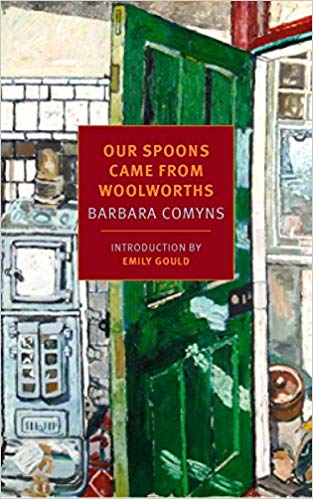
Review 1304: Our Spoons Came from Woolworths

It’s typical of Barbara Comyns that she tells a horrifying story in a disarming, naive style. In Our Spoons Came from Woolworths, her theme is an ill-considered marriage.
Sophie marries Charles at 21 despite considerable opposition from his family. They make it plain that they don’t like her, think she isn’t good enough for Charles and that he shouldn’t marry before he can support a wife. They assume she has tricked Charles into marriage by getting pregnant when in reality she knows nothing whatever about sex. The fact that Charles says nothing in response to his family’s insults to his fianceé should have tipped Sophia off, but she’s not very good at picking up on things.

Charles is an artist, and apparently Sophia is meant to support him on her meager salary as a commercial artist. Although he occasionally picks up a contract, most of the time they are just getting by. Getting by, that is, until Sophia soon finds herself pregnant. Slowly, she learns that she has married a self-absorbed man who feels no responsibility toward her or their life.

This may sound like a depressing story, but there is something about its light, naive tone that lifts it up. Instead, it is a charming and funny story of depression-era poverty and a bohemian lifestyle.

Related Posts

Who Was Changed and Who Was Dead

The Vet’s Daughter

Sisters by a River

Day 902: Who Was Changed and Who Was Dead

Cover for Who Was Changed and Who Was DeadWho Was Changed and Who Was Dead is another eccentric and original novel by Barbara Comyns. With its characters and plots, it contains more than a slight touch of the bizarre.

We meet the Willoweed family after the nearby river has flooded. Some of the family are wading on the lower floor of the house, and Ebin Willoweed has taken the girls out in the boat, from which they are observing the dead animals floating by.

The novel is almost entirely concerned with the Willoweeds. Ebin is a writer who lost his newspaper job years ago and hasn’t worked since. He lives in his mother’s ramshackle but enormous house with his three children, the entire household terrorized by his tyrannical mother.

The Willoweeds seem stuck in a monotonous existence. Ebin occupies some of his time by having an affair with the wife of the village baker. Emma, the oldest daughter, yearns for pretty clothes and shoes but has to be content with clumsy ones made in the village. Dennis and Hattie love playing in the river.

Then a mysterious malady strikes the village. People begin to run mad and commit suicide. No one knows who will die next.

Who Was Changed and Who Was Dead is narrated with the same innocent simplicity of Comyns’ other novels, which deal with similar grotesque situations and characters. It’s one of the things that makes them so readable, yet so eerie.

Related Posts

Sisters by a River

The Vet’s Daughter

Let Me Tell You

Day 763: The Vet’s Daughter

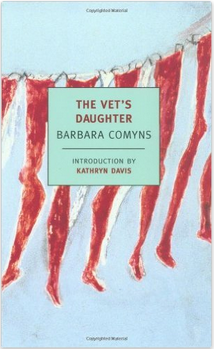
Cover for The Vet's DaughterIt was several days before the doctor came. It was my father who sent for him. Even he noticed something was wrong with Mother. When he saw her all doubled up over the dining room sideboard, he suddenly bellowed, “For Christ’s sake, woman, send for the doctor, and if he can’t put you right, keep out of my sight!”

Best Book of the Week!
Alice and her mother live in terror of her father, the vet, in this novel written in 1959. He ignores Alice and treats his wife with brutality and contempt. Alice is in her teens, living in a dreary house in a London suburb with only one friend, a deaf girl, when her mother becomes ill. The one bright light for Alice is it brings vulgar but kindly Mrs. Churchill to help.

Mrs. Churchill continues to come after Alice’s mother dies, but within weeks Alice’s father has brought his lover home to live there, so Mrs. Churchill leaves. Rosa Fisher moves into Alice’s mother’s room and stays until she tries to pimp Alice out to an acquaintance.

Alice occasionally seems to have what first appears to be some kind of fits. But they are actually the slow development of an uncanny ability.

As with Sisters by a River, the simple, innocent manner in which this novel is narrated gives it a distinctive tone. Alice is a naive and unsophisticated girl whose isolation from society means she doesn’t always understand very common things. The plot is impossible to predict, as it takes us to some unusual places. The Vet’s Daughter is another strange and vivid novel from Barbara Comyns.

Related Posts

Sisters by a River

The Lace Reader

The Death of Bees


Day 739: Sisters by a River

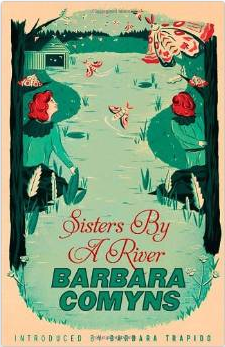
Cover for Sisters by a RiverBest Book of the Week!
In trying to characterize the tone and atmosphere of the autobiographical Sisters by a River, I have to say that it reminds me a bit of Shirley Jackson’s We Have Always Lived in the Castle, minus the murder. As reported in the introduction by Barbara Trapido, this novel did not fit the 40’s vogue for fond and touching memories of childhood, so it was not published for six years after Comyns began looking for a publisher. Comyns wrote it as a private recollection.

It is difficult to explain just how gripping this novel is. It is an unordered collection of fictionalized memories written by Barbara about the life of her family. Barbara and her sisters suffer a combination of abuse and neglect. Her father, known as Daddy, met her mother, called Mammy, when Mammy was a young child and arranged with her mother to marry her. She began having children when she was eighteen and only stopped after her sixth childbirth made her deaf. She also seems to be insane, periodically rampaging around or talking to invented lovers. Aside from cooking delicious meals, she completely neglects her children.

Granny is a dark and unpleasant presence. She does not allow anyone to clean her room, which is filthy, the floor caked with spilled substances. There she spends most of her time brewing up potions. When Daddy leaves the house, he has to lock up the billiard room to keep her out of the booze.

Daddy is prone to attacks of rage and cruelty. He throws Beatrix downstairs when she is a baby because she is crying. He blackens Mammy’s eye right before they are to host a big party. Yes, both of them are conscious of their social position. Mammy tells her semi-illiterate, poorly dressed, neglected daughters how cultured they are while Daddy takes pride in his hundreds of pairs of polished boots and shoes and takes three hours to prepare for a monthly meeting in town. Meanwhile, the girls’ teeth go bad and one governess after another is fired for some silly infringement or because her feet smell.

The oldest sister Mary has learned bullying from her father. She won’t allow the younger girls to read any of the books she likes, and she chooses what color clothes they may wear. Barbara must always wear brown, which she hates.

I could go on and on about this violent and eccentric family. But what really stands out about the book is its style. All of these events, and many that are worse, are related in a completely matter-of-fact way, no pathos or complaining. The writing style is that of a very young person, including many spelling errors, and this air of innocence and matter-of-face quality give the novel its charm. It’s hard to figure out how old the narrator is. The novel moves back and forth in time, and it seems that at her oldest, she is about sixteen. But there are references to her husband, so it’s hard to tell. My guess is the book was written at different ages.

If you care to try this novel, prepare yourself for something truly unconventional. It sounds dreadfully harrowing, I know, but it actually is not.

Related Posts

The Pursuit of Love

Brother of the More Famous Jack

The Death of Bees