
I was planning to read Witold Gombrowicz’s Ferdydurke for the 1937 Club, but I got about 70 pages in and just wasn’t in the mood for it. I may never be.
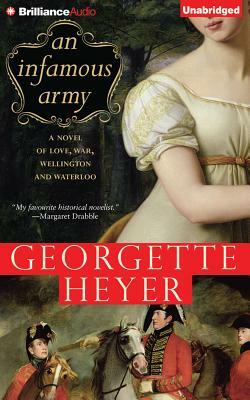
Georgette Heyer is usually a good bet for me, and I conveniently had An Infamous Army on my shelf. I remembered, though, that it was not one of my favorites despite featuring characters from or related to those from some of my favorites. I decided to try to read the novel by pretending I had never read a book by Heyer, just judging it as a historical novel.
The novel is set in Belgium in the summer of 1815, so if you know your history, you know what’s coming up. The military of all the countries allied against Bonaparte are gathered in Brussels, as are the fashionable. Colonel Charles Audley, brother of Lord Worth of Regency Buck, is on Lord Wellington’s staff, so he is busy but occasionally has time to spend with Lord and Lady Worth. And everyone attends the frequent balls and parties.
Judith, Lady Worth, has found a girl she considers perfect for Charles, Lucy Devenish, a pretty, demure, heiress whose only detraction is a vulgar uncle. Society is being scandalized by the behavior of such young women as Lady Caroline Lamb and Lady Barbara Childe, a shocking young widow whose Alastair heritage (see These Old Shades and The Devil’s Cub) has given her quite a temper. Nevertheless, as soon as Charles sets his eye on her, he is in love. Unfortunately, thinks Judith, so is Barbara, and they are engaged in no time.
It’s no surprise that this is a rocky love affair. However, Heyer’s purpose is to depict the Battle of Waterloo and the frivolous months that led up to it.
Heyer was a serious historian, but her books aren’t often serious, and when they are, I miss the brilliant conversations and her humor. Sticking to my decision to try to forget about that, here are my observations. At the parties, there is too much enumeration as Heyer tries to list all the brilliant people attending. I felt like I was reading the beginning of The Iliad when Homer lists all the Greek commanders plus how many ships, men, and horses they brought.
Then, the social season seems to drag on a little too long. Things get going when the war starts, but when Heyer begins explaining troop dispositions and geography, I got lost. I could have used a map. Finally, although parts of the battle are brilliantly described, I felt as if Heyer was trying to include every anecdote she ever read about. There was just too much.

I have read battle scenes in other novels that were so clearly explained that I understood exactly what was going on. Here, there were so many different types of soldiers, so many leaders’ names, most of them only briefly described. There was too much going on for me.
As for the love story, while I didn’t much like Barbara, I was disappointed in how judgmental Judith, who had her own mishaps in her youth, was. It was nice, though, to have a brief appearance of Barbara’s grandparents, the Duke and Duchess of Avon, once Vidal and Mary of The Devil’s Cub.

 What? Me Read?