Day 941: Let Me Tell You about a Man I Knew

Cover for Let Me Tell You About a Man I KnewLet me first get this over with. I have rarely encountered a book title that seems so inappropriate to the actual book. This title, which seems so similar to the opening of a 60’s Ray Charles song, is for a historical novel about a fictional relationship between an ordinary woman and Vincent Van Gogh.

That over with, the book itself is another matter. Susan Fletcher’s Corrag was one of my favorite books a few years ago. Even though I have missed some of her others, I was excited to hear about this one. It did not disappoint.

Jeanne Trabuc is the wife of Charles, who runs the mental asylum in Saint-Rémy. She finds herself in a lonely time of life. Her best friend has left town, and her boys have gone off to lead their own lives. She and her husband sleep separately, and she feels unloved. He has many rules about how the house should be run. She feels separate from the other women in the village, whom she feels gossip too much.

link to NetgalleyThere have been no arrivals at the asylum in years, so Jeanne’s interest is piqued when she hears a Dutch painter is coming. Charles does not allow her near the asylum, but she sees the man in the olive orchard painting and begins talking to him. Slowly, she finds herself wondering how she became what she is, instead of the adventurous girl she was.

This novel is more about Jeanne than Van Gogh, but it is touching and compelling. Jeanne Trabuc and her husband were actual people that Van Gogh painted, but Fletcher tells us that the lives she has created for them within the novel are entirely fictional. This novel is about the silences that can grow between people.

Related Posts

Corrag

Clara and Mr. Tiffany

Burning Bright

Day 931: Horses of the Night

Cover for Horses of the NightHorses of the Night seemed like a good choice for me, because it’s about Christopher Marlowe, and I do enjoy novels about literary figures. I just never developed much interest in this novel, however, and gave it up after 100 pages or so.

The novel concentrates on Marlowe’s spying career, involving him right away in the Babington Plot. Although Marlowe is alleged to have been a spy, nothing is known of his activities. At least as Aggeler depicts it, Marlowe seems to have little role in the case, sent in at the end of the plot with only a few lessons in how to be a Catholic. He is involved long enough, however, to become sympathetic with one of the alleged plotters, Margaret Copley.

link to NetgalleyAggeler appears to be previously an academic writer. For this novel, he has adopted a pseudo-Elizabethan writing style throughout, even for descriptive passages. This is an interesting approach, and it is not inherently irritating, but I found the writing overblown at times.

I also felt as if I was seeing a Marlowe who was not the actual person I would expect from my admittedly limited reading, a man more conventionally likable than Marlowe probably was.

Related Posts

The Secret Life of William Shakespeare

The Marriage Game

The Tudor Secret

Day 918: Ghost Light

Cover for Ghost LightBest Book of the Week!
The Irish playwright John Millington Synge was engaged to marry an actress, Molly Allgood, when he died in 1909. Their relationship was of several years’ standing, but it was considered scandalous because of the difference in their ages and stations. Synge was nearly twice as old as Molly, and Molly was from a poor and uncultured family.

Ghost Light is a fictionalized account of this relationship, and O’Connor freely admits to taking liberties with it. The novel begins in 1952, when Molly is an old lady, nearly destitute and living in a cheap rooming house in London. The story follows her for one night and day of her life, during which she remembers the events in her love affair with Synge.

This novel is beautifully and atmospherically written, poetic at times, and partially in different flavors of Irish vernacular. It eloquently tells a story of frustrated love and loss. This is a compelling characterization of Molly and her view of the character of Synge. Ghost Light has been another interesting experience from my Walter Scott Prize list.

Day 906: Enchanted Islands

Cover for Enchanted IslandsEnchanted Islands is a novel based on the lives of Frances and Ainsley Conway, an American couple who lived on the Galapagos Islands in the late 1930’s and the 40’s. Although based on two memoirs written by Frances Conway, Amend has expanded the novel to cover most of Frances’s life and her friendship with Rosalie Mendel, all presumably fictional.

This book is a rather odd one. It begins with Frances and Rosalie in their old age and then returns in time to their childhood in Wisconsin. It spends some time there, following them until Frances’s late teens, when she discovers Rosalie with her own boyfriend and flees. Then it glosses over the next 20 years until Frances meets Rosalie again in California and later marries Ainsley. After that, Frances and Ainsley go on a spying mission for the Navy, something Frances is never able to tell her friends about.

The result creates a sort of divided effect. First, sections of the novel are either full of Rosalie or have no Rosalie, which made me wonder, why even bother with her? Why not just write about Galapagos? The other parts seem to belong to a different novel.

Then there is Galapagos, which Amend simplifies to the island Floreana when actually the Conways lived on three different islands. The existence there seems harsh, bleak, and lonely. There is little description of scenery or anything else to make us understand why, according to Amend, they came to love it. In fact, there is very little going on there, even including the spying.

I felt a distance from all these characters. Although we learn a lot about Frances, we don’t ever feel as if we understand her, and Ainsley is a sort of charming enigma. Most of the time, we don’t even like Rosalie.

link to NetgalleySo, a middling reaction to this novel. I was interested enough to finish it, but only mildly interested. I thought there was no sense of place in any of the settings. The characters didn’t seem like real people. The cover of the novel is lovely, but the islands seemed in no way enchanting. Did Amend bother to visit them, or is she just not good at description? Or are they not lovely?

Amend comments that she is a novelist first and only a mediocre historian. That remark irritated me, because I think that’s what’s wrong with with many historical novels. If authors aren’t willing to do the research to bring a time and place to life, maybe they should stick to contemporary fiction.

Related Posts

Exposure

Euphoria

Midnight in Europe

Day 897: That Lady

Cover for That LadyThat Lady is another book I’ve read for my Classics Club list, and a good one it is, too. In the Preface to the novel, Kate O’Brien states that it is not a historical novel because, although all of the events are real, the scenes between characters are wholly imagined. But I would argue that this is the very definition of a historical novel, with the proviso that the author attempt to preserve the true nature of the peoples’ characters, if they are known. That Lady is based on a curious interaction between Philip II of Spain and Ana de Mendoza, Princess of Eboli, that historians are still struggling to understand.

The novel begins in 1576, when Ana is a 36-year-old widow. Her husband was Ruy Gomez de Silva, Philip’s secretary of state. But Ruy has been dead for several years, and Ana has been living a retired life with her children on her country estate of Pastrana.

Philip comes to visit, however, and tells her he wishes her to return to Madrid. He and Ana have enjoyed friendship and a mild flirtation, and he misses her company.

Ana does not return to Madrid immediately, but she eventually does in the fall of 1577. There, she becomes reacquainted with Don Antonio Perez, her husband’s former protégé and friend, who is Philip’s current secretary of state.

Although Ana has heretofore been a virtuous woman, she begins an affair with Perez, partially because she realizes she has done nothing of her own volition for years. This relationship eventually becomes a complication in a political battle.

This novel is primarily a character study of a fascinating woman and to a lesser extent of Philip II, whose poor government of Spain has stricken with poverty the inhabitants of what was at the time the wealthiest country in the world. It is also a very interesting study of the politics of the region of Castille.

At first, I found it difficult to grasp Ana’s character, but the novel centers on her strong sense of principle and protection of her privacy. It is also about the tension between her religious beliefs and her principles. That is, having committed herself, she refuses to abandon her lover when he is in trouble, even to save her soul or her life.

That Lady is a powerful novel about an unusual, strong woman who struggles against the restrictions of her life based on sex and station. I highly recommend it. By the way, the picture on the cover above is of a painting of the actual lady.

Related Posts

La Reine Margot

People of the Book

The Marriage Game

Day 890: Charlotte and Emily

Cover for Charlotte and EmilyI have read two of Jude Morgan’s literary biographical novels but never felt I was really seeing the true character of the subjects. However, with Charlotte and Emily, Morgan seems to have found his subject.

Charlotte and Emily covers most of the Brontës’ lives, from the time they were children until Charlotte marries Arthur Bell Nicholls. By that time, all the other Brontë siblings have died.

Charlotte is the main character of the novel, although it is occasionally told from the point of view of Anne. Emily remains distant from the reader, harder to know.

Much of the novel is concerned with the focus of the entire family on the future of brilliant Branwell, the only son. The girls are sent for schooling so that they can be teachers and earn money to help educate Branwell. Although Charlotte wonders if she can become a writer and even tries sending poetry to Southey, the poet laureate, she is discouraged by both Southey and her father.

Of course, Branwell never finds a vocation and instead becomes a wastrel. Charlotte and Anne work doggedly as teachers, although they hate it. Emily gets herself sent home both from school and work.

I have read biographies of the Brontës, but this novel is the first I’ve read that gave me a sense of what their lives may have been like. I found it completely absorbing. If you are a Brontë lover, this is a book for you.

Related Posts

Passion

The Secret Life of William Shakespeare

Indiscretion

Day 865: Arctic Summer

Cover for Arctic SummerFrom its description, I thought that Arctic Summer might be one of the most interesting books I’m reading from the Walter Scott Prize list. It is described as a fictional biography of E. M. Forster, particularly leading up to his publication of A Passage to India.

That is certainly the time period the novel covers, and A Passage to India is one of its preoccupations. But the novel spends most of its time on Forster’s obsession with his homosexuality and his desire for sexual experience. As I’m not all that interested in reading about anyone’s obsession with sexuality, this novel was not the best fit for me.

The novel begins in 1912 on Forster’s first trip to India. While he is there, he will visit a good friend, Masood, and he has hopes that his life will open up, particularly in regard to sex. At the age of 33, he is still a virgin, his fear of disgrace holding him back from expressing his sexuality at home. Perhaps in India he will have an experience, maybe with Masood, whom he loves.

Unfortunately, Forster, who goes by Morgan, has a tendency to fall in love with heterosexual men and prefers men from a lower class, so nothing quite works out the way he wishes. Even when he finally has some encounters, years later, what he is actually looking for is love, which he never finds. The novel follows him during the long gestation of his novel about India, back to England, to Alexandria during World War I, and back to India again. During this time, his most significant relationships are with two friends who do not return his feelings.

The novel is extremely well written, and Galgut deeply characterizes Morgan, if not the other characters. It did make me wonder if any person could be so relentlessly focused on sex, although of course he is also lonely. It also made me wonder how, if he really felt this unrelenting focus, he ever got anything written. Certainly this novel makes you feel for Forster—he was a sad man.

Related Posts

The Master

Under the Wide and Starry Sky

Studio Saint-Ex


Day 814: Passion

Cover for PassionPassion tells the stories of the Romantic poets from the points of view of their women. It begins with each as a young girl, starting before Romanticism with the broad strokes of the life of Mary Wollstonecraft, Mary Godwin Shelley’s mother, a famous early feminist, writer, and philosopher.

Mary Wollstonecraft dies shortly after childbirth. Her daughter, Mary Godwin, grows up worshipping her mother and taking seriously the ideals of her father, William Godwin. However, he compromises his principles (he doesn’t believe in marriage) by marrying Mrs. Clairmont, a woman Mary detests. Her ideals and the poisonous atmosphere at home make her open to the advances of Percy Byssche Shelley, even though he is already married. She runs off with him at the age of sixteen, unfortunately accompanied by her stepsister Jane (who later calls herself Claire).

Lady Caroline Lamb loves her husband, but she is prone to a certain instability that her husband’s family deplores. When she sets eyes upon the famous Lord Byron, she is entranced and is soon engaged in a flagrant affair. When he breaks with her, she stalks him, sneaking into his rooms, following him around dressed as a boy. Her behavior is a scandal.

The only woman George Byron really loves is his half-sister Augusta. Even she succumbs to his charms. After he makes the mistake of marrying a self-righteous and vengeful woman, his worst secrets come out and he must leave the country.

Fanny Brawne comes late to the novel. She falls in love with a neighbor, John Keats, but he is a victim to a family weakness, consumption.

This material could be sensationally or romantically told, but it remains at a distance from us, more like biographical writing. We do feel sympathy for some of these women, especially for Mary Shelley, but I was not drawn right in. Although the book is named Passion and we know that this emotion was an important force for the Romantics, we don’t really see much of it in the novel, nor truly understand just what the attraction is to this group of neurotic young men. Sometimes I could catch a glimmer of the attractions of Byron, the only one who did not seem permanently deluded about the virtues of humanity. Still, for firmly setting a background for bits and pieces of information I picked up over time, I mildly enjoyed this novel. Although I admire the intent of Morgan’s more serious depictions of figures from literature, I have so far enjoyed most his romance novel, Indiscretion.

Related Posts

Indiscretion

The Secret Life of William Shakespeare

Miss Emily

Day 812: Shirley

Cover for ShirleyBest Book of the Week!
Shirley is both an homage to Shirley Jackson, dealing with some of her own themes and preoccupations, and a novel about her. It works well on both counts. Don’t be mislead by how it is being marketed, though. It is not a thriller, even though its main character becomes obsessed with a disappearance that may be a crime.

Young, pregnant Rose Nemser and her husband Fred travel to Bennington, Vermont, in the fall of 1964. Fred is a graduate student working on his dissertation who has taken a position as teaching assistant with Shirley Jackson’s husband, Stanley Edgar Hyman. The Hymans welcome the  young couple and offer them a place to stay in their spare bedroom.

Rose is a shy and unconfident 19. Because of her poverty-stricken upbringing and meager education, she feels inferior to her husband and his family. Surprised at this invitation, she is delighted to stay. She is a fan of Jackson’s work and hopes to become her friend.

Soon Rose believes she has made a friend of Shirley, but Rose is naive and can’t begin to understand the demons that haunt her hostess. Shirley’s husband is a professor at Bennington who is known for having affairs with his students. Shirley, too, is jealous of male colleagues whose work has received more recognition than hers.

Rose begins delving into Shirley’s books on witchcraft and also becomes fascinated by stories of Paula Welden, a Bennington student who disappeared years ago while on a hike in the mountains. She begins having fancies about the house, similar to the ones held by Eleanor in The Haunting of Hill House.

So, the novel develops that mixture of the mundane and the off-kilter that characterizes much of Jackson’s fiction. Shirley is a deeply interesting and atmospheric novel that causes you to sympathize with the fictional Rose while feeling that you learn something about the actual Shirley Jackson. Like some other recent fiction I have read (Miss Emily comes to mind), it combines a completely made-up plot, aggravated by Rose’s fantasies, with biographical details of Shirley’s life.

Related Posts

Let Me Tell You

A Good Hard Look

Miss Emily

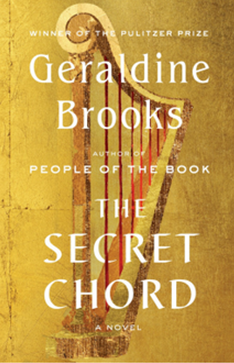
Day 788: The Secret Chord

Cover for The Secret ChordBest Book of the Week!
The characters in Biblical stories have always provided fodder for fiction but are particularly popular since Anita Diamant’s The Red Tent. They can be interesting for me not because they’re telling something familiar but because they are not, since I have one of the spottiest Christian upbringings on the planet. This situation was caused by a combination of my parents’ lack of application and my own fundamental lack of interest from a very young age. I’ve always been fine with it except when I crashed and burned over Christian symbolism in graduate school. However, halfway through Brooks’ remarkable The Secret Chord, I was driven to Wikipedia and found I only knew two David stories, David and Goliath and David and Bathsheba.

The Secret Chord is about the life of David from the point of view of his prophet, Natan. When David asks Natan to write up his victories, Natan refuses, telling him that anyone can have their victories commemorated, but Natan wants to leave behind a true relation of David’s life, the good and the bad, so people in the future will understand him. David agrees and even gives Natan a list of people to interview.

Natan also remembers his own interactions with David, whom he met right after the rebel David murdered Natan’s entire family because his father refused aid to his men. It was then that Natan made his first prophetic utterance, the words of which he couldn’t even remember.

link to NetgalleyThis is truly a fascinating novel, beautifully written, that presents us with the complex man, including his glory and flaws. Brooks is wonderful at conveying his charisma and his faults, so that you feel for him in his sorrows even as he brings many of them on himself.

Brooks uses the names and place names of the time, lending authenticity to this colorful re-telling. The Secret Chord evokes a convincing time and place.

Related Posts

People of the Book

Caleb’s Crossing

The Testament of Mary