Day 756: Z: A Novel of Zelda Fitzgerald

Cover for ZTo write a novel about Zelda Fitzgerald, Therese Anne Fowler had to make many decisions between competing sources. Historians and biographers are sharply divided between those who think Zelda ruined Scott’s life and those who think Scott ruined Zelda’s life. Fowler ends up coming in pretty firmly on Zelda’s side. Ernest Hemingway’s A Moveable Feast said nasty things about both of them, but many of those things have been found to be exaggerations or outright lies. In any case, I’ve always thought Hemingway was a jerk.

This novel begins when Zelda, fresh out of high school and a popular debutante, meets Fitzgerald, at that time in the army and due to ship out to Europe and World War I. It ends shortly after Fitzgerald’s death. It paints a vivid portrait of Zelda, a woman trying to find a purpose in her life beyond being a wife.

If Fowler has made the right choices, the novel creates a devastating idea of Fitzgerald, insecure, unfaithful, controlling, and alcoholic. He undercuts Zelda in every way possible, publishing her stories under his own name, taking control of her published novel in the editing stage and butchering it, being generally nasty, and threatening to take away her daughter Scottie when she wanted to accept a solo role in the ballet in Naples. His friendship with Hemingway especially drove them apart, as Hemingway was relentless in accusing her of being selfish and ruining Scott’s career, and Scott began to believe it. Note that Hemingway is the same person who did all he could to halt his own wife’s career as a war correspondent.

I was completely absorbed by the novel, which strongly characterizes Zelda and to a lesser extent, Scott. My only criticism, besides a few too many descriptions of clothes, is that most of the other characters are only sketchily drawn. A great many characters appear in these pages, and I can’t say that I had much of an impression about any of them, to the point where I couldn’t remember whether some were friends or relatives. With such vivid personalities as Cole Porter, Gertrude Stein, H. L. Mencken, and Hemingway appearing in the novel, more could have been done with them.
Related Posts

Circling the Sun

The Happy Foreigner

The Other Daughter

Day 753: Blood & Beauty

Cover for Blood & BeautyBest Book of the Week!
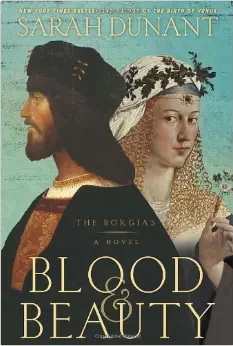
Blood & Beauty is a historical novel about the Borgia family that shows meticulous research, examining in light of modern findings the legends that have surrounded the family for centuries. It also powerfully evokes the period.

The novel begins with the election of Rodrigo Borgia as Pope Alexander VI. He is clever and ruthless but sentimental about his four illegitimate children. Although historically there is some debate about the birth order of the oldest two sons, Dunant firmly places Cesare as the oldest, followed by Juan, Lucrezia, and Jofrè.

Although the pope loves his children, especially Juan and Lucrezia, their value is largely in the alliances he can make through their marriages. Cesare’s value, on the other hand, is to back up his father on the religious front. He begins as a cardinal, although he is unsuited to his religious profession and eventually throws it off to become a commander of armies.

Juan’s marriage is first, but the novel is mostly concerned with the relationship among Pope Alexander, Cesare, and Lucrezia. It is much more complex than and different from what you may have heard. It is Lucrezia’s misfortune to be married into families that become enemies of the Borgias because of shifting alliances. This is particularly true of her second marriage to Alfonso of Aragon, whom she loves.

Dunant remarks in the afterward that the Borgias have not deserved their evil reputation. Certainly they were rapacious and ruthless—and more interested in the good of the Borgias than anything else—but so too were most of the great families of Italy at that time. In this novel, alliances are made and discarded at will by most of the great families.

This novel is historical fiction at its best. None of the characters are invented or romanticized, and we become immersed in the world of Renaissance Italy.

Related Posts

The Malice of Fortune

A Folly of Princes

Worldly Goods: A New History of the Renaissance

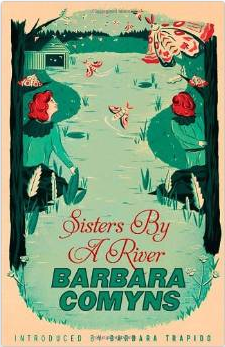
Day 739: Sisters by a River

Cover for Sisters by a RiverBest Book of the Week!
In trying to characterize the tone and atmosphere of the autobiographical Sisters by a River, I have to say that it reminds me a bit of Shirley Jackson’s We Have Always Lived in the Castle, minus the murder. As reported in the introduction by Barbara Trapido, this novel did not fit the 40’s vogue for fond and touching memories of childhood, so it was not published for six years after Comyns began looking for a publisher. Comyns wrote it as a private recollection.

It is difficult to explain just how gripping this novel is. It is an unordered collection of fictionalized memories written by Barbara about the life of her family. Barbara and her sisters suffer a combination of abuse and neglect. Her father, known as Daddy, met her mother, called Mammy, when Mammy was a young child and arranged with her mother to marry her. She began having children when she was eighteen and only stopped after her sixth childbirth made her deaf. She also seems to be insane, periodically rampaging around or talking to invented lovers. Aside from cooking delicious meals, she completely neglects her children.

Granny is a dark and unpleasant presence. She does not allow anyone to clean her room, which is filthy, the floor caked with spilled substances. There she spends most of her time brewing up potions. When Daddy leaves the house, he has to lock up the billiard room to keep her out of the booze.

Daddy is prone to attacks of rage and cruelty. He throws Beatrix downstairs when she is a baby because she is crying. He blackens Mammy’s eye right before they are to host a big party. Yes, both of them are conscious of their social position. Mammy tells her semi-illiterate, poorly dressed, neglected daughters how cultured they are while Daddy takes pride in his hundreds of pairs of polished boots and shoes and takes three hours to prepare for a monthly meeting in town. Meanwhile, the girls’ teeth go bad and one governess after another is fired for some silly infringement or because her feet smell.

The oldest sister Mary has learned bullying from her father. She won’t allow the younger girls to read any of the books she likes, and she chooses what color clothes they may wear. Barbara must always wear brown, which she hates.

I could go on and on about this violent and eccentric family. But what really stands out about the book is its style. All of these events, and many that are worse, are related in a completely matter-of-fact way, no pathos or complaining. The writing style is that of a very young person, including many spelling errors, and this air of innocence and matter-of-face quality give the novel its charm. It’s hard to figure out how old the narrator is. The novel moves back and forth in time, and it seems that at her oldest, she is about sixteen. But there are references to her husband, so it’s hard to tell. My guess is the book was written at different ages.

If you care to try this novel, prepare yourself for something truly unconventional. It sounds dreadfully harrowing, I know, but it actually is not.

Related Posts

The Pursuit of Love

Brother of the More Famous Jack

The Death of Bees

Day 736: Circling the Sun

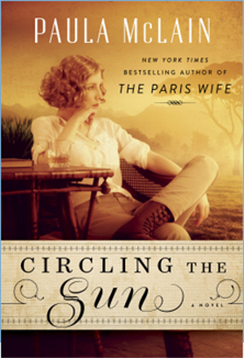
Cover for Circling the SunPaula McClain’s novel about Beryl Markham begins with her historic flight over the Atlantic from east to west—and then flashes back to cover her life until then. Of course, the story of her life is interesting because she was a fascinating person.

Beryl is raised in Kenya, and after her mother leaves the family to return to England when Beryl is four, Beryl is allowed to run around freely for years. She befriends the local natives and plays with the boys until she is almost a teenager. At that point, her father hires a series of governesses in an attempt to civilize her, an effort not entirely successful.

Beryl’s father is a horse trainer, and she works with him up to the point where her last governess, by then her father’s mistress, decides she should prepare for husband-hunting. She makes a marriage of convenience when her father is forced to sell their farm and take a job in Capetown, but soon she is separated from her husband and seeking a job as a horse trainer. She becomes the first woman licensed horse trainer.

The novel follows Beryl through her introduction to the Happy Valley set, her friendships with Karen Blixen (Isak Dinesen) and Denys Finch-Hatton, and her second marriage to Mansfield Markham.

Although this material is certainly interesting, I was never convinced that the character McLain presents us with is the true Beryl. This interpretation of Beryl’s character doesn’t match the one presented by other sources. My feelings made me wish I had read a biography of Markham before reading this novel, so I could be surer of these statements.

link to NetgalleyI feel as if Beryl’s character and other facts are somehow sanitized for our easier acceptance. Although some expression is given to her impatience of convention and yearning for freedom, McLean still portrays her as a woman who wants acceptance and love. I’m guessing, for example, that her abandonment by her mother at a young age left her with few mothering skills and her lifestyle left her with little desire to be a mother. Some sources I consulted said she willingly abandoned her son to her mother-in-law, but in McLain’s book, she is grief-stricken when the child is taken away from her. That tells me that McLain can’t imagine a different reaction to motherhood than the typical one. I think McLean mentions the qualities that made Markham different without really understanding them.

As another example of what I called sanitization, let’s not forget Karen Blixen’s illness, referred to briefly a couple of times, but never explained as syphilis, given to her by her husband Bror.

Related Posts

Love in a Cold Climate

The Signature of All Things

Savage Beauty: The Life of Edna St. Vincent Millay

Day 720: Galway Bay

Cover for Galway BayGalway Bay is fiction based on the stories of Mary Pat Kelly’s great-great grandmother about leaving Ireland in the first half of the 19th century to come to America. The novel covers a lot of ground—the iniquities of Ireland’s Anglo-Irish landlords, the Great Famine, early Chicago, the American Civil War, the Fenian Brotherhood—and ends with the Chicago World’s Fair.

Honora Keeley is a young girl living in a fishing village on Galway Bay when she meets Michael Kelly and they fall in love at first sight. They want to marry, but they have to convince Honora’s family, because Michael owns nothing but his horse. However, he earns enough to marry by winning a horse race in Galway.

Honora’s sister Maire, who was married the day Honora met Michael, is soon a widow after her husband dies in a fishing accident. On Honora’s wedding night, Maire saves Honora from the landlord’s droit du seigneur by volunteering in her stead. I’ll say something about this later.

Michael is no fisherman. Honora and Michael have a tough enough time of it farming but are making out okay when the potato blight hits. The behavior of the landlords and the British government during this time is shameful, and Kelly depicts it vividly. After several years of the blight and other misfortunes, Honora finally is able to convince Michael to leave for America, to Chicago, where his outlawed brother Patrick is said to reside.

Although this novel has a fairly good story, there is something about the narrative style that bothered me. It is told in first person, but in a modern style that is not convincing. Many things happen, but I didn’t ever feel as if I understood much about the characters’ personalities. Especially early on, when we are getting to know the main characters, often opportunities for revealing dialogue turn into storytelling episodes, where we hear another Irish legend. Everyone has one or two identifying characteristics, but they don’t feel like real people. I think the novel may have been more successful in the third person.

Finally, I was highly skeptical of whether droit du seigneur would have occurred in the 19th century, as it is usually associated with Medieval times. I’m sure this event is based on family legend, but I think Kelly could have treated this one with a little skepticism, especially as the lord’s behavior is abetted by a priest. I attempted some research on the topic and was surprised to find a lot of discussion about whether it was ever actually practiced at all. But with one exception, the references were to Medieval mainland Europe, not the British Isles. That exception was a Facebook page about Ireland, but I was unable to find the actual reference on the page to see if it cited any sources. I have read several history books about Ireland and took a graduate course in Irish history, and I have never heard anything about this, although the other abuses are well known. (I have since found one source for this alleged practice, Arthur Young, the author of a book called Tour of Ireland in 1780, who stated it was commonly practiced in rural Ireland. He is listed in Wikipedia as an agriculturalist who traveled to observe agricultural practices. Still, with this little information, we have no idea if his statement is based on rumor or fact, and this report is 50 years or so before the time of this novel.)

Related Topics

The Sea House

Troubles

Giants in the Earth

Day 666: The Magnificent Spinster

Cover for The Magnificent SpinsterJust a quick update! The members of Literary Wives have just finished choosing books for the coming year. See my Literary Wives page for the list of upcoming books. If you want to read along, join us April 6 for a discussion of The Bishop’s Wife by Mette Ivie Harrison.

***

In 1985, May Sarton wrote The Magnificent Spinster in an attempt to honor her friend Anne Longfellow Thorp. It is a fictionalized biography of her friend’s life that is being reissued.

Cam has returned from her friend Jane Reid’s funeral thinking that no one will remember her extraordinary friend after her friends and relatives die. So, she sets out to write a novel about Jane.

This novel is just as concerned about the act of writing a novel as it is about the subject matter. Each section begins with a paragraph or two about the author’s uncertainties or difficulties and about her conversations with other friends of Jane while gathering information for the book.

The novel has feminist overtones, one of its purposes being clearly to illustrate how a single woman, even one born around the turn of the 20th century, could live an active and fulfilling life. Although I was interested especially in the depiction of Jane’s summer times spent on a family island, I felt there was too much worship in this portrait to really get a sense of Jane. Opportunities of real possible interest, like learning about her teaching, her reason for quitting teaching, or her work in Germany after World War II are lost in surfacy descriptions or ignored. When she helps found some sort of group house in Germany, the purpose of the project isn’t even explained until later in that section.

When some of the most interesting possibilities have to do with Cam’s own life, for example her experiences during the Spanish-American war, they are only alluded to. I understand that Sarton was trying to focus on the character of Jane, but Cam is a character in the novel, too, and the novel sometimes deals with her problems. The novel is missing some opportunities to gain interest from those experiences. In fact, it suffers overall from assuming a knowledge of both characters’ friends and activities that the reader cannot know. For example, some people come to visit Jane on her last summer on the island, but it takes a long time before Sarton explains who they are.

link to NetgalleyToo often the dialogue is trivial and to little purpose, and almost all conversations end with people agreeing what a wonderful, extraordinary person Jane is. Some of this rubbed me the wrong way, too, because it was clear her friends thought she was the more extraordinary for having decided to lead an active life of service rather than the one of privilege that she was born to. Although this decision is admirable, I don’t think she deserves more praise than anyone not born to privilege who leads a life of service, perhaps less, because another person would have a harder time affording to live the way Jane chooses to do. I have no doubt the original subject of this bio-fiction was an unusual and worthy woman, but Sarton doesn’t really make us feel it.

Related Posts

Miss Marjoribanks

The Signature of All Things

The Daughters of Mars

Day 651: Literary Wives! The Last Wife of Henry VIII

Cover for The Last Wife of Henry VIIIAgain, we have a group book review with Literary Wives, where a group of bloggers get together and review the same book about wives on the same day. If you have read this month’s book and would like to participate, leave comments on any of our blogs. Be sure to read the reviews and comments of the other wives!

***

In considering The Last Wife of Henry VIII, I come smack up against the issue I’ve mentioned in the reviews of several historical novels based on the lives of actual people. That is, how an author can make the subject interesting while staying faithful to the events of the person’s life and to the person’s character.

In this novel, Erickson has a fairly clean slate to work with, because Catherine Parr’s life has not been covered as exhaustively as that of other Tudors. Yet it is one thing in historical fiction to invent the details of ordinary life and another to present readers with questionable events. The most obvious of these is to have Parr’s love affair with Thomas Seymour begin while she was still married to John Neville, when to all indications it began after Neville’s death, when she was left a relatively wealthy widow. And, might I add, the unlikelihood that they continued their physical relationship (if they had one) while she was married to Henry VIII. Not in that court and atmosphere, with that history, I’m guessing.

But this is aside from the point that with all this inventing, Erickson still fails to make Catherine Parr an interesting character or her story compelling—despite the fact that it probably was compelling. The actual Catherine was much more capable and influential than Erickson’s character, in fact.

Literary Wives logoWhat does this book say about wives or the experience of being a wife?

First, for the Tudors wives were bargaining chips. The novel depicts Catherine as taking control of her own fate in some of her marriages, but only within limits. That is, in both instances if she hadn’t had another suitor, she would have had to marry the person chosen for her. Within the marriages, the limits to her spheres of action are chosen by her husband unless, as in her marriage to Seymour, she has her own money, which gives her leverage. In three of her marriages, her husband’s activities or relations with her husband’s relatives make her position insecure, so much so in her first marriage that she is left a poor and unprotected widow, at least according to Erickson. I would submit that in actuality, what left her insecure after the death of Henry VIII was more likely her marriage to Thomas Seymour than anything else.

In what way does this woman define “wife”—or in what way is she defined by wife?

Catherine usually tries to do her duty by her husband, whether she loves him or not. The exception is her affair with Thomas Seymour while she was married to John Neville (which I don’t believe actually happened). In the terms of the novel, this is probably supposed to make it more romantic (it doesn’t), but it makes her character less consistent. I would say that for Parr, a wife is dutiful, affectionate, and tries to do the right thing. Her marriage to Henry VIII also shows her as compassionate, capable, and politically astute. Her marriage to Thomas Seymour, on the other hand, shows her as fatuous and besotted, unfortunately the reputation that has survived her. If I can sneak in a comment about stepmothers here, I believe her actual relationship with Henry’s children was much warmer than depicted in the novel.

Related Posts

The Tudor Secret

Bring Up the Bodies

The Marriage Game

Day 650: Nora Webster

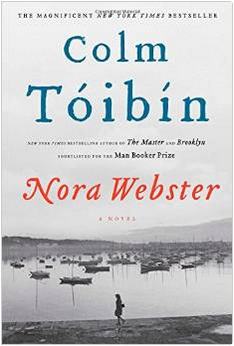
Cover for Nora WebsterIt took me awhile to place Nora Webster in time. Irish readers may be quicker to identify its setting from some events, but I am not familiar enough with recent Irish history. Finally, I identified the novel as set in the late 60’s and early 70’s. It wasn’t long after gaining that knowledge that I began to wonder how autobiographical the novel is. Since then, I have read that it is indeed autobiographical, as details about Nora’s husband match those of Toíbín’s father.

Nora Webster is in her 40’s a recent widow. She is finding it difficult. Not only does she miss her husband Maurice, but she finds the attention paid to her as a widow painful. She feels comfortable only with a few people, those who stayed with her and Maurice during his painful death.

Making things more difficult is the fact that she is left with little money. One of the first things she is forced to do is sell the holiday cottage where the family stayed every summer. She finds it hard to return there, especially under those circumstances.

She also has her children to worry about, particularly her two young sons. Donal has begun stammering since his father’s death, and when her Aunt Josie comes to call, it is immediately clear to Nora that all did not go well when the boys stayed with Josie while their father was dying.

Soon Nora is forced to return to her old job at Gibney’s, where she has not worked since she married 20 years before. She must report to Mrs. Kavanaugh, a woman she disliked when they were girls at work there together and who bullies the office staff.

There are no big events in this novel, which is more of a character study. It is about grief and the act of making a new life after a major event.

Nora is an interesting character. She doesn’t say much of what she thinks, so is sometimes misunderstood. She does not listen to other people’s opinions of who she should like or what she should do. She is intensely private and does not discuss things with her family, even things that she should perhaps discuss. She is also fiercely protective of her family.

This is a quiet, contemplative book and is not for those who read only for plot.

Related Posts

The Master

The Year of Magical Thinking

The Gathering

Day 646: The Marriage Game

Cover for The Marriage GameAlthough I have read several of Alison Weir’s meticulously researched histories and historical biographies, I feel her gifts are more for nonfiction than fiction. In her novel The Marriage Game, she concentrates on the struggles and power plays around the issue of Queen Elizabeth I’s marriage during the first years of her reign. Unfortunately, Weir focuses on this subject so much to the exclusion of others that you would think it was the only item of concern in the realm. For example, Elizabeth sends Cecil away to broker a peace with Scotland, which is almost the only mention of a war.

The novel begins right after Elizabeth hears of her sister’s death and takes the throne. Her advisor William Cecil almost immediately raises the issue of her marriage. Elizabeth, determined not to lose her hard-won power to a husband, finds her repeated statements that she will not marry either not believed or met with the opinion that her remaining unmarried would not be good for the kingdom. Elizabeth takes a flirtatious stance, refusing to be pinned down to a decision but forever pretending she’s considering a suitor.

Confusing the issue is Lord Robert Dudley, for whom she has a decided preference. But he is already married. Still, she heeds no one’s warnings about her reputation. She keeps him with her even when his wife is dying, and at least in this novel, their physical relationship includes everything except actual penetration. Just whether the Virgin Queen was a virgin is a subject of debate, and this seems to be Weir’s (perhaps unlikely) compromise. The mystery of what happened to Dudley’s wife seems much less important than it actually was at the time.

http://www.netgalley.comWeir has not chosen to make this story romantic or even depict the two main characters sympathetically. Neither is fully formed, but both are selfish, ambitious, demanding, and conniving. Although the novel is well written and should be interesting, it eventually devolves into repetitious arguments, with Dudley’s ambitions thwarted and Elizabeth incensed because he has overstepped his bounds. If there is an arc to the plot, I couldn’t discern it. I couldn’t help thinking that a novel about Elizabeth that was a little broader in scope would be more interesting. After reading most of the novel, I finally decided I was finding it tedious and quit reading it. Very disappointing, especially considering Weir’s excellent biography of Mary Boleyn.

Related Posts

Mary Boleyn

The Wars of the Roses

Wolf Hall


Day 641: Remarkable Creatures

Cover for Remarkable CreaturesRemarkable Creatures is based on the true stories of Elizabeth Philpot and Mary Anning. These were two women of the early 19th century who collected fossils along the sea near Lyme Regis, beginning before fossil collections became wildly popular. Some of their finds resulted in discoveries about evolution and extinction. The novel is told in alternating chapters from the point of view of the educated upper-class Elizabeth and the uneducated working-class Mary.

Elizabeth Philpot already realizes she will be a spinster when her newly married older brother nudges her and her two sisters to look for a less expensive place to live away from the family home in London, perhaps in some genteel seaside resort. The women choose Lyme Regis, and their brother soon finds them a comfortable but small stone cottage.

Louise Philpot becomes interested in gardening and Margaret busies herself with the town’s social scene, but Elizabeth realizes she must find something to occupy herself. When visiting a carpenter’s shop, she meets Mary Anning, at the time a child, and sees the fossils Mary has collected and is trying to sell. She is fascinated particularly by the fish and decides to look for fossils herself, doing much to help label herself and her sisters as eccentric.

Mary Anning finds and sells fossils to support her family, but she is also fascinated by them. After she begins her acquaintance with Elizabeth, she starts learning more about the scientific theories behind her work. When she discovers the fossil of a previously unknown animal, she does not know that her discovery challenges the beliefs of conventional religion that every animal created by God is currently alive on Earth.

Philpot and Anning, who made significant contributions to the science, both eventually find themselves frustrated by the lack of recognition for their contributions. It is worse for Mary, for she is not only a woman and uneducated, she is considered just a fossil hunter.

I found the subject matter of this novel interesting but feel Chevalier was probably struggling with the difficulties of depicting real people in fiction. Although she depicts two distinct women, they do not seem fully formed to me. I couldn’t help contrasting this novel with the wonderful The Signature of All Things, which is a similar story although completely fictional. There I got a sense of a strong, fully realized individual. To contrast, Chevalier gives each of her main characters a few signature traits—for example, Elizabeth judges people by what part of their physique they “lead with”—and we don’t get a sense of fully formed individuals.