Day 635: The Secret Life of William Shakespeare

Cover for The Secret Life of William ShakespeareAs I am interested in Shakespeare and recently enjoyed a Regency romance by Jude Morgan, I wanted to enjoy this novel a lot more than I did. There is of course a risk in making a historical figure a main character in a novel, and that is that no author truly knows the mind of the real person. The truly successful novel of this type bravely forges a persona. Morgan’s solution, however, is to make Shakespeare, about whom little is known, truly amorphous in character.

The novel centers mostly on the relationship between Shakespeare and his wife, Anne Hathaway, an interesting choice, since we know they lived apart for much of their marriage. Morgan explains the marriage between Shakespeare and his bride, almost ten years older, as a love match, which is perhaps more unlikely than many different explanations for it (although of course not impossible). He has Anne reluctantly agree to Will’s eventual decision to join a group of players only on the condition that he is never unfaithful to her. Anne does not understand Will’s fascination with the theatre and views it with jealousy.

To go along with the amorphous nature of Will’s character, the details of his London life are murky. Morgan hardly ever shows him at his work or refers to any of the events of his life. Instead, he has him in conversation with various players and writers, particularly Christopher Marlowe and Ben Jonson. The introduction of Jonson into the novel is particularly confusing, as often we side track to examine his life and career as a playwright. In fact, he is a much more definite character than Shakespeare is.

It felt to me as though, in being perhaps reluctant to misinterpret Shakespeare’s personality, Morgan just doesn’t interpret it at all. Wife and friends find him equally unknowable. I had a hard time reconciling my knowledge of the plays with this reticent character. In particular, it seemed as though a man who was so fascinated with language would play with it more in his speech, as he does in Anthony Burgess’s much more adventuresome book Nothing Like the Sun. I did not buy Morgan’s idea of Shakespeare’s personality at all.

Day 620: Literary Wives! The Shoemaker’s Wife

Cover for The Shoemaker's WifeToday is another meeting of Literary Wives, where a group of bloggers get together and review a book about being a wife. If you have read this month’s book and would like to participate, leave comments on any of our blogs. Be sure to read the reviews and comments of the other wives!

One thing I can say about The Shoemaker’s Wife. It provoked discussion in our household. After reading the novel’s first two paragraphs to my husband, I asked, “Does this qualify as purple prose?” and he answered, “It’s at least very mauve.” In any case, the novel is packed with labored metaphors, some of which leave us readers with very odd mental images—for example, a comparison of the Alps to silver daggers.

The novel is based on the story of Trigiani’s grandparents, a couple who met as teenagers in the Italian Alps and then were separated by circumstances for years. I haven’t read any of Trigiani’s other books, but along with many other writers these days, she doesn’t seem to understand in this novel that making things happen to her characters doesn’t automatically make readers care what happens to them. Her characters have traits, but they don’t have any emotional depth, so we don’t care about them.

A specific example of this comes early in the book, when the girl Enza’s little sister dies. Abstractly, the death of a child is sad, but since we barely know Enza and we just met Stella a few paragraphs before she died, we don’t feel much about it. If we had a sense of the child or the older sister, we would care more.

I was unable to finish this book, so I can’t answer the usual Literary Wives questions about it. Realizing I was not enjoying it at all, I decided to read a quarter of it and if I still felt like I was wasting my time, to stop. It is a very long book, so I read about 120 pages, and Ciro and Enza had just met by then, with Ciro banished to America immediately after. When I quit reading, Ciro was on the ship to New York. So, no answers to questions about how wives are depicted in this book, not even about the main character’s mothers. Ciro’s mother abandons her sons at a convent at the beginning of the book because she can’t support them and is never seen again, and Enza’s mother is a vaguely drawn figure who simply works hard.

All novels aren’t character driven, but for me there has to be something that makes a novel interesting besides the plot. Sometimes it’s the voice of a compelling character, sometimes a puzzle, sometimes a fascination with the subject or world view being described, but it has to be something.

Literary Wives logoWhile I’m writing this, I’m thinking of examples, about how Agatha Christie could create a distinct character in a few sentences, not a nuanced one, but a distinct one nevertheless. I’m thinking how in The Secret Garden we immediately recognize Mary as an unlikable child, but we can see how the fear of waking to find everyone gone from her home in India has made her more demanding, and we sympathize. I’m thinking of how hard I cried when Beth died in Little Women. And I’m thinking how fascinated I was by 18th century Japan in The Thousand Autumns of Jacob De Zoet.

Read along with us in February, when we will be reading and commenting on The Last Wife of Henry VIII by Caroly Erickson.

Day 612: The 19th Wife

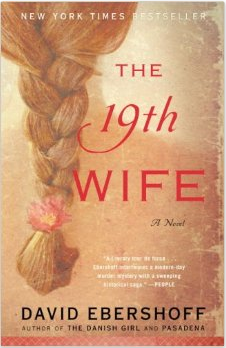
Cover for The 19th WifeBest Book of the Week!
The 19th Wife is actually two interleaved novels, one as interesting as the other. The novel that begins the book is a modern mystery. The novel that dominates the book, however, is historical, about Ann Elizabeth Young, Brigham Young’s 19th wife, whose lectures after she left the Latter-Day Saints were partially responsible for ending the authorized practice of polygamy within the church.

In the modern story, Jordan Scott is a young man who grew up with the Firsts, a fundamentalist Mormon group that still practices polygamy. At the age of 14, Jordan was booted out on his own because he held his stepsister Queenie’s hand. Jordan’s intentions were not amorous, because he is gay, but he realizes that the young men are ejected from the group so that the old men can keep the young girls for themselves.

Jordan is living in California when he reads that his father has been murdered and his mother, Becky Lynn, arrested for it. As his mother is a complete believer who actually dumped him out on the highway herself those years ago, he does not believe she murdered his father. The evidence against her is that another wife saw her coming from their husband’s room looking upset. Jordan’s father was texting someone just before he was killed and remarked that his 19th wife was at the door. That wife is Becky Lynn.

While Jordan tries to find out what happened that night, we read the story of Ann Elizabeth Young, a woman born into the Church of Latter Day Saints but who has always been clear on the evils of the practice of polygamy. This story is told through fictional excerpts from her autobiography, newspaper clippings, statements by Brigham Young, and other documents.

Ann Elizabeth begins with the story of how her own parents, once devoted to each other, were forced into polygamy by Brigham Young, and what pain it caused her mother every time her husband took another wife. This pain was amplified by the hypocritical ruling that the first wife had to accept all future wives into the household before further marriages could take place. Ann Elizabeth’s own first marriage is also marred by threats of polygamy, which her husband uses to manipulate her despite having promised before marriage not to practice it.

Well written and convincingly characterized, this novel is absolutely engrossing. Although I found the modern mystery interesting in its insights into fundamentalist Mormonism as currently practiced, I found the story of Ann Elizabeth’s life even more compelling. Ever since reading Jon Krakauer’s Under the Banner of Heaven, I have been fascinated by this subject.

Day 486: Empress of the Night

Cover of Empress of the NightIn early November 1796, Catherine the Great of Russia suffered a stroke and lay on her deathbed for 36 hours before she finally succumbed. Eva Stachniak’s second novel about Catherine imagines her spontaneous flashbacks of her life, interrupted by moments of fleeting awareness, as she lies there helplessly.

Empress of the Night covers some of the same ground as Stachniak’s The Winter Palace, only the previous novel is told from the point of view of Varvara Nikoleyeva, Catherine’s spy turned confidante, and concentrates mostly on the time before Catherine was Russia’s ruler. Varvara is only a fleeting presence in Empress of the Night, and I wonder if readers who had not read The Winter Palace would be confused by references to her.

Stachniak’s deathbed approach for this novel by definition causes it to be disjointed in narrative style and sometimes difficult to follow chronologically. The novel portrays Catherine as a figure more sympathetic than otherwise, but other characters are left relatively undeveloped.

Catherine’s memories go all the way back to her arrival in Russia as Sophie von Anhalt-Zerbst-Dornburg, a prospective bride for the Empress Elizabeth’s spoiled and childish heir Peter. We follow her struggles to be accepted as a future wife, to conceive, and to maintain some kind of standing in Elizabeth’s court, although that subject is covered more thoroughly in the first novel. The narrative carries us through the coup against her husband after Elizabeth’s death and the most important events of Catherine’s reign, ending with her attempts to marry her granddaughter Alexandrine to the king of Sweden and to leave her office to her grandson Alexander instead of her foolish and tyrannical son Paul.

Although this novel is interesting, I was not as drawn in as I was by the first book. The parts of the novel dealing with Catherine’s stroke and its aftermath interrupt the flow of the narrative too often. I was also taken aback by the preponderance of attention given in the novel to Catherine’s favorites, especially to the annoying Zubov, versus the actual events of her rule. The emphasis seems to lie with her personal attachments, which I frankly think is unlikely for a world ruler. I also find it hard to believe that Catherine had so much patience with some of her relatives and lovers, most of whom are characterized as being annoyingly selfish.

Since I have read a fair amount about Catherine’s life, I was able to follow the references to important events with little difficulty, but I am left wondering how easy it would be for someone who is unfamiliar to form a good understanding of what is going on. Still, I think this novel draws an appealing portrait of a complex and difficult person.

http://www.netgalley.comMy original understanding of The Winter Palace was that it was the first in a trilogy about Catherine the Great. I am left wondering if I was mistaken, because this novel does not seem to leave anywhere for the writer to go in a third novel. Empress of the Night is ultimately much less satisfying than The Winter Palace in the depth it applies to its subject, which makes me wonder if Stachniak simply lost interest.

Day 468: The Invention of Wings

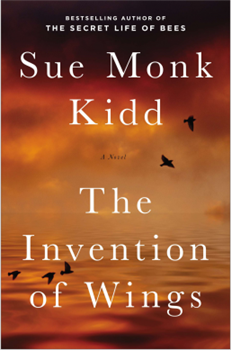
Cover for The Invention of WingsBest Book of the Week!

When I began reading The Invention of Wings, I thought it was purely historical fiction. It wasn’t until later in the novel, when some names rang a few bells, that I realized I was reading biographical fiction about two women whose accomplishments have been forgotten—Sarah and Angelina Grimké. A third important character, the slave Hetty, is fictional, except that Sarah was given a slave by that name when she was 11 and they both got into trouble when Sarah taught her to read.

The novel tells a remarkable story, narrated alternately by Sarah and Hetty (known as Handful), beginning in 1803. Sarah was born into privilege in Charleston, South Carolina. When she is given Handful as an 11th birthday present, slavery is already so abhorrent to her that she tries to free her slave. But legally doing so has been made more difficult, and her parents won’t allow it. Sarah is her father’s pet, and he takes pride in and encourages her intelligence, but when he finds out she thinks she can become a lawyer, he firmly rebukes her and bars her from his library.

Handful’s mother Charlotte is a strong and rebellious figure and a wonderful artist. She is the best seamstress in town and keeps the history of her life in a quilt she is sewing. By earning money hiring herself out behind Mrs. Grimké’s back, she is trying to save enough to buy the freedom of herself and her daughter. After Sarah’s mother has her brutally punished, she takes whatever liberties she can get away with, including sneaking away to have an affair with a freedman named Denmark Vesey.

As Sarah gets older, her sense of injustice deepens to the point where feels she must leave Charleston to move north to Philadelphia and become a Quaker. She is eventually followed by her much younger sister Angelina (Nina), where they become infamous for their lectures and articles on abolition, racial equality, and feminism.

http://www.netgalley.comFor the first half of the book, I was fascinated most by Handful, a character with a distinctive voice and personality. She becomes as gifted with her needle as her mother and loves to hear Charlotte’s stories of her African homeland. More subtly subversive then her mother, after Charlotte disappears, Handful visits Denmark Vesey’s household and assists with his attempted slave revolt. Later when Sarah and Nina find their purpose in life, I found both stories equally interesting.

This novel is remarkable. The Grimkés’ story is amazing, especially for their time, which was years before Uncle Tom’s Cabin. But Handful’s story is evocative, compelling, and touching.

Day 452: Under the Wide and Starry Sky

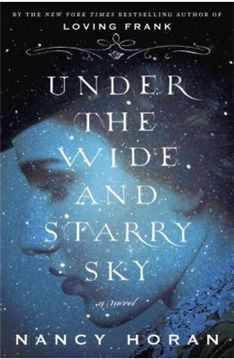
Cover for Under the Wide and Starry SkyUnder the Wide and Starry Sky traces the relationship between Robert Louis Stevenson and his wife Fanny from shortly before the two meet. At that time, he was a young man still trying to decide his profession and she was a married woman, although separated from her husband, ten years his senior and with children.

Fanny Osbourne has a great creative urge, and she has moved to Paris for art lessons for both herself and her grown daughter Belle, leaving her philandering husband in America. Fanny meets Stevenson while on a recuperative visit to southern France after the death of her youngest son.

The novel follows closely the entirety of their relationship from courtship to his death and her life afterwards, mostly from Fanny’s point of view. They separate because Fanny wants to give her marriage another chance, but they finally come together again. Stevenson, called Louis by his friends, is a sickly man, and his health often requires them to move to climates that are better for his lungs. When it seems as though he cannot live much longer, they find that his health revives on ocean voyages, so they go to sea and finally settle in Samoa until his death.

Although Horan appears to follow faithfully the course and events of the couple’s life together, and the novel is interesting from that standpoint, she never really brings the characters or settings to life. Aside from Fanny’s devotion to Louis, Horan concentrates on her frustration at not being able to live her own creative life. The characters seem relatively flat.

http://www.netgalley.comI was struck also by how, on the original voyage to the South Seas, Horan describes almost nothing but one chieftain until they get to Samoa. If she was working from journals or letters, surely she could have researched further to find out or even imagine what the islands would have been like for Louis and Fanny, seeing them the first time. Instead, we come into their voyage toward the end, as if all the sights and experiences are routine. I’m missing the sense of wonder. Although this novel should have been fascinating in its focus on some amazing lives, it generally does not fulfill its promise.

Day 422: Studio Saint-Ex

Cover for Studio Saint-ExAnia Szado has written an interesting historical novel based on the writing of Antoine de Saint-Exupéry’s classic The Little Prince. The novel centers around a relationship between the famous aviator and author and a young French-American woman, Mignonne Lachapelle. This relationship is fictional, although Saint-Exupéry, or Saint-Ex, as he is called in this novel, was known to have such connections.

Mignonne is a recent graduate of design school who is struggling to start a career in fashion design during the early days of the American involvement in World War II. Although with Paris out of the picture things are looking up for American design, no one is ready to hire a rank beginner for a design position. So, Mignonne is forced to turn to Madame Véra Fiche, her instructor from design school who stole Mignonne’s ideas for a dress collection to open her own atelier. Fiche takes her on under a vague promise of partnership.

Mignonne has just returned from Montreal, where she has been staying with her mother, but she is already under the spell of the middle-aged Saint-Exupéry, whom she tutored in English the year before. They have carried on a sort of dalliance. On the scene, however, comes Saint-Ex’s tempestuous wife, Consuelo, whom he continually tries to dodge. He claims he cannot get any peace while she is around and cannot work, yet their relationship is more complex than that.

Saint-Ex himself worked to get America involved in the war in an effort to save his beloved France. Lately, he has been lobbying to join the services, but he is considered too old and too frail to fly, having crash-landed his airplanes many times in the course of his adventures. To calm his frustration and anxiety, he begins writing The Little Prince and seeks refuge from Consuelo in the Atelier Fiche studio to work and see Mignonne. Soon Mignonne is caught up in a tangled relationship with Saint-Ex and Consuelo.

This novel is well written and evokes its time successfully. I don’t think I was taken with its characters so much, though. I had some sympathy for Mignonne, but in her own way she is almost as difficult as Consuelo. Consuelo herself seems almost uniformly manipulative and conniving, and it is difficult to comprehend why Saint-Exupéry stays loyal to her, albeit in his own way. I frankly find Saint-Exupéry himself to be not so much a spellbinder as a high-strung and excitable man encouraging the attentions of a beautiful young woman without really paying much heed to her. I don’t find him romantic so much as also manipulative.

Nevertheless, I was engrossed in the story and found the details of Mignonne’s work and her sensual descriptions of the fabric fascinating even though I don’t pay attention to fashion. The story of the launching of The Little Prince around a fashion show and play was interesting, too.

I won this book in a giveaway from Unabridged Chick blogspot.

Day 410: Inheritance

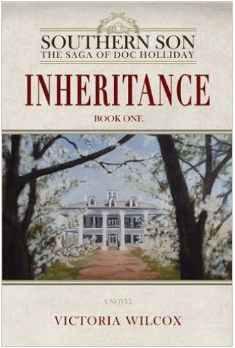
Cover for Southern Son: InheritanceIt seems extremely difficult to write a novel about an actual historical person. The writer must strike some kind of balance between doing justice to the person and to actual events and inventing details and dialogue to make the novel interesting. As well as having to invent huge swaths of the subject’s life, I am guessing that the author sometimes has to struggle with whether to include all the known events, especially if they don’t fit in with the author’s view of the subject’s character.

Inheritance, the first book of a trilogy about John Henry (Doc) Holliday, shows evidence of a great deal of research. It begins when Holliday is ten years old, shortly before he finds out his mother is dying from tuberculosis, or consumption. The novel follows his life until his departure from his home state of Georgia for Texas when he is twenty-one.

The engaging Doc by Mary Doria Russell, which I read a few years ago, revealed Holliday as a much-misunderstood individual, demonstrating how his reputation as a gunslinger was exaggerated by the press from a few incidents, showing his innate courtesy and all his contradictions. Despite its obvious intentions, Inheritance had the opposite effect on me, at times making me lose a considerable amount of my sympathy for him.

One false step is taken, I think, by starting the story so early in his life. He is supposed to gain our sympathy as a motherless boy with a stiff and judgmental father, but the depiction of children in this novel is not convincing. In fact, at the beginning of the novel I was troubled by flat characterization, as most of the main characters’ relatives and acquaintances have only one quality. His cousin Robert is competitive, his mother and cousin Mattie are loving, and so on. Only very slowly do some of the characters develop a few other dimensions.

The novel is written in a workmanlike style, a little too given to clichés, but certainly fluent enough except for a tendency to use “refugee” as a verb. There is some evidence of this usage as a colloquialism, especially during the Civil War, but it is used here in the narrative as well as in the dialogue.

Although the point of view appears to be third-person limited, at times it slips into third-person omniscient, which causes some confusion and a problem. Certainly, I do not hold with changing a person’s views to make that character more acceptable for the current time. Even when a fictional historical character has too modern a viewpoint, that bothers me. Holliday is definitely depicted as a racist who treats African-American characters even worse than I would expect from a character self-described countless times as a “gentleman.” So, when the reader cannot always discern the attitudes of Holliday from the attitudes of the narrator, the effect is unfortunate.

Overall, Inheritance is a novel that balances a great deal of knowledge of its subject with some inexperience in writing.

I received this book through a giveaway from Unabridged Chick.

Day 371: A Good Hard Look

Cover for A Good Hard LookA Good Hard Look is a novel about the last few years of writer Flannery O’Connor’s life. The book begins with the wedding of Cookie Himmel and Melvin Whiteson, which Cookie believes has been ruined because Flannery’s peacocks made so much noise the night before that Cookie fell out of bed and gave herself a black eye. Flannery’s mother Regina insists that Flannery attend the wedding, but Cookie is not happy to see her there.

Lona Waters lives her life absentmindedly and takes pleasure only in the hour of solitude she has every day before her daughter Gina comes home from school. Then her friend Miss Mary asks her if she will give her awkward teenage son Joe a job, thereby eliminating her hour.

Soon Melvin Whiteson has struck up a friendship with Flannery, but he keeps it a secret from his wife because of her dislike of the writer. Cookie is busily serving on committees in town and trying to get Flannery’s books banned from the library, while Melvin, a successful New York banker who gave up his career to move to this small town in Georgia with Cookie, is feeling out of place and bored with his insurance job.

These seemingly mundane stories eventually result in tragedies that force the main characters to take a good hard look at themselves, as Flannery states is a technique she uses in her fiction.

The novel is well written but not evocative. It does not evoke the 60’s South, and my feeling is that it does not evoke Flannery O’Connor. I am not an expert on her or her life, but the incisive spirit I would expect from her is missing in this character. Napolitano uses O’Connor’s peacocks to great effect, but I found that the novel tidied things up a bit more neatly than I would expect from one inspired by O’Connor’s life and works. Finally, the character of Cookie is essentially a caricature of the southern junior matron, similar to Hilly Holbrook in The Help, although Cookie evolves a bit. Most of the other characters are only sketchily drawn.

It is rather risky to use an actual person as a main character in a novel, especially if you are not able to create a character who is convincing as that person. For a much better attempt at using a famous writer as a main character, see Colm Toíbín’s wonderful The Master.

Day 265: Here Was a Man: A Novel of Sir Walter Raleigh and Elizabeth I

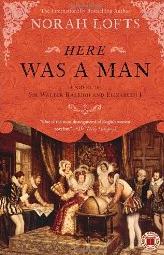
Cover for Here Was a ManI don’t think I’ve read anything by Norah Lofts before, but even though she was a prolific historical novelist, I would rate this effort as mediocre.

Here Was a Man attempts to draw most of Raleigh’s life in a short space and does so by a series of vignettes illustrating important events. Although I am not completely familiar with his career, I know that Lofts  has chosen to portray a couple of apocryphal events, in particular the cloak in the mud story, which I believe has no basis in fact. The other serious lack of the novel is any depth of characterization.

The novel begins with Raleigh as a teenager, listening to sailors’ tales and dreaming of traveling the seas. He is also full of ambition for worldly success, an ambition that sometimes works to his disadvantage.

We are told many times about Raleigh’s sense of adventure, but we don’t really feel it. In fact, he seems to spend more time in prison than on his adventures. It is curious, too, that although he has many enemies at court, at least in this novel he has done nothing to earn their enmity. I would doubt that was really the case.

Raleigh is probably a character who could support an interesting and exciting novel, but this is not it. To be fair, it looks like it may have been one of Lofts’ first works.