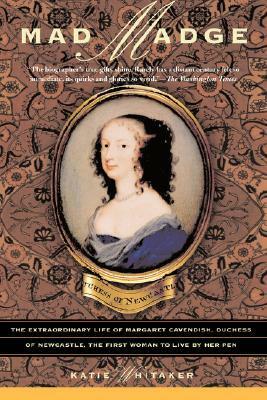
Review 2567: Mad Madge: The Extraordinary Life of Margaret Cavendish, Duchess of Newcastle

Before reading Margaret the First for Novellas in November, I had never heard of Margaret Cavendish, which is interesting because I have a master’s degree in English Literature. But that all falls into place once you read Whitaker’s epilogue to this biography.

In fact, Margaret was the first woman to publish prolifically and publicly, as opposed to having writings privately printed and distributed or, more likely at the time, including a poem or two in her husband’s writings.

Margaret Lucas, according to her own writings, was determined to be famous. Unfortunately, she was very shy. She wrote even from a girl, what she called her fancies, and commented that her mind was full of ideas.

The Lucases were a prominent Royalist family. Margaret was still fairly young when she left home to be a lady in waiting for Queen Henrietta Maria at the court of Charles I. Margaret wasn’t very good at this job, because her shyness made her seem standoffish.

The English Civil War broke out, and first the court moved to Oxford, but eventually it had to move overseas. There, Margaret met William Cavendish, fully 30 years her senior, who had valiantly fought on the Royalist side but eventually left when things seemed hopeless. At the time, he was the Marquis of Newcastle. The couple married, despite having little income, William’s estates having been taken by Parliament, and most of his money gone to the Royalist cause. However, it was in William’s house that Margaret got what she had long sought, the opportunity to meet and discuss issues with men of note and with philosophers and scientists.

Margaret began writing prolifically—plays, poems, essays on philosophy and science. Once she published, many people supposed that her works were actually written by her husband.

Eventually, she became one of the first female literary celebrities, and her name was known throughout Europe. In the epilogue, though, we learn that not too long after her death, critics began to disparage her work, and she was almost lost to history. We learn that the nickname of “Mad Madge” was bestowed on her centuries after her death (and repeated by Virginia Woolf). I looked at my own 1985 Norton Anthology of Literature by Women, and despite her prolixity, they only included one page by her and perpetuated the story of her strangeness, which apparently was based only on her original clothing, designed by herself, and her odd social behavior (not speaking much).

Although this material is undoubtedly interesting, I think that Whitaker falls over the too much/not enough detail line that I find plagues a lot of biographical writing. Whitaker falls over on the “too much” side, synopsizing every section of every work Margaret wrote, quoting every person of note who respected Margaret’s work, describing details of every house she lived in, and so on. This got a little tedious when it continued for pages, although now, having read the epilogue, I see why Whitaker felt that she needed to prove that in her lifetime, Margaret was a famous and respected figure with very early feminist leanings.

Related Posts

Margaret the First

Georgiana, Duchess of Devonshire

Queen Anne: The Politics of Passion

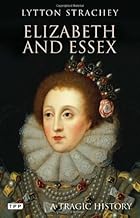
Review 2540: Elizabeth and Essex

Years ago, I read Lytton Strachey’s Eminent Victorians and found it both informative and entertaining—full of scandalous information about some of the Victorian age’s most prominent citizens. I was hoping for something similar from this book, but it is a little more serious, although Strachey gets some zingers in.

The book is the 1928 version of history written for the general public. There are a very few footnotes and a couple of pages of bibliography at the end. It is written in Lytton’s liquid, sometimes sardonic style.

This book is about Queen Elizabeth and her last favorite, Robert Devereaux, Earl of Essex. He was more than 30 years younger than she and the stepson of her earlier favorite, Robert Dudley, Earl of Leicester. Elizabeth’s relationships with her favorites, at least with this one, seemed more like volatile love affairs than anything else, with fulsome compliments expected and fiery spats, which usually resulted in Essex stomping out and being forgiven after an apology. In fact, considering her own temper, I’m surprised that Elizabeth put up with him, because he certainly treated her less respectfully than he would if his sovereign was a man.

You have to get used to Strachey, because he starts out right away by making assertions about Elizabeth’s character without giving examples or showing how he is right, as a modern historian would do. And his depiction seems pretty sexist. Over time, he demonstrates some of these characteristics, though. Still, Elizabeth’s main problem with Essex seemed to be that he didn’t behave as if she was his sovereign. I think he had an inherent assumption that he was superior because he was a man, not surprising in that time.

Without going into all the details of the story, which Strachey labels “tragic,” I’ll say that it boils down to temperaments. Essex was proud and fiery, and he valued his family name. He had poor judgement about who to take advice from and was actually incapable of taking any that involved caution and circumspection. He was brave in battle and pictured himself as a great war commander, but he was not. In fact, he seemed to me like a charismatic, well-liked bear of little brain. But he wrote wonderful letters.

Strachey clearly didn’t like Sir Walter Raleigh, but I don’t know why. He just hinted around about him. According to Strachey, no one liked him.

Essex was a loyal friend to many, among them Francis Bacon. It was Bacon’s Machievellian advice that Essex was unable to follow. Despite Essex having supported him for several positions, Bacon did his best to put the nail in Essex’s coffin when he was tried for treason.

This is an interesting book and even though Essex seemed to me like a spoiled baby most of the time, I saw by the end that indeed it was a tragic story.

Related Posts

The Marriage Game

Hunting the Falcon: Henry VIII and Anne Boleyn and the Marriage That Shook Europe

Mary Boleyn

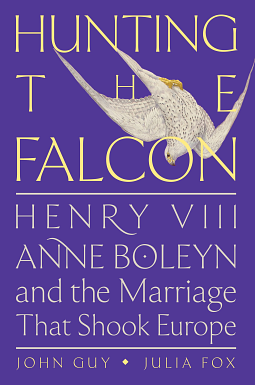
Review 2520: Hunting the Falcon

I have read quite a bit about the Tudors, fiction and nonfiction. This book deals especially with the relationship between Henry VIII and Anne Boleyn, although it starts earlier in their lives.

A strong theme in the book is Anne’s formative time spent at the court of France. There she witnessed a different kind of court than that in England, one in which powerful women discussed politics and were forces behind the throne and in which court was gay and flirtatious. As queen and as a woman who had worked in tandem with Henry on their cause for six years before marriage, she tried to create that sort of court.

In addition, her leanings toward France helped incline Henry toward an alliance with Francis of France, despite a long history of enmity between the two countries, rather than one with Charles, the Holy Roman Emperor and his first wife Katherine’s nephew. Francis had his own agenda, though, that did not always match Henry’s.

All-in-all, the book paints Anne in a more positive light than I’ve seen, emphasizing her true piety and her generosity to the poor. However, she also clearly got caught up in her own power and was sometimes rapacious and unforgiving.

Recent programs about the Tudors are notoriously inaccurate, but we are sometimes affected nonetheless. Used to thinking of Jane Parker, wife of Anne’s brother George, as someone who betrayed her, I now find she was one of the people who had the nerve to speak up for her.

Biographers and historians can err by including too much information on a subject. Although this book was written for a general audience in an entertaining style, it occasionally has that fault, for example, describing every detail of Anne’s coronation, including her outfits and the themes of the spectacles presented. However, in general, I found it interesting and illuminating.

Related Posts

The Last Wife of Henry VIII

Mary Boleyn

Wolf Hall

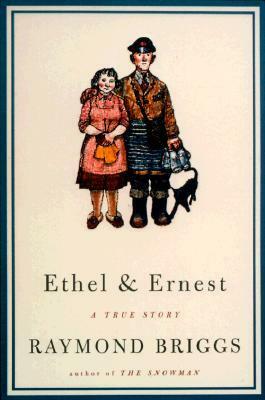
Review 2465: Ethel & Ernest

Ethel & Ernest is a completely charming graphic biography about the lives of Briggs’s parents from their meeting in 1928 until their deaths in 1971. The drawings are delightful, and the characters of the two emerge from the story.

Ethel is a lady’s maid and Ernest is a milkman when they meet. They marry two years later. The book shows their upward mobility starting with their purchase of a house that actually has a bathroom, to their astonishment, and continuing with their modifications and additions of appliances. Ernest is staunchly working class and pro-labor, while Ethel has pretentions to more, but through all, they are loving.

Through childbirth, World War II, and the Blitz, the privations of post-World War II Britain, and so on, the couple stick together and remain loving. The book has quite a bit of humor to it and is also touching. I was charmed by it.

Related Posts

Agatha: The Real Life of Agatha Christie

Ducks: Two Years in the Oil Sands

Britten and Brülightly

Review 2461: Agatha Christie: An Elusive Woman

I usually take much longer to read a work of nonfiction vs. fiction—up to a week as opposed to two or three days—but such was the power and readability of historian Lucy Worsley’s prose that I was astonished to finish this book one day after I started it. Of course, many people may want to know about the days Christie was missing, and she deals with that, but there is much more.

Christie lived an interesting life, and Worsley tells us about it, from the pampered, loved child of wealthy parents, to the loss of her father and the family fortune when she was 11, the World War I nursing and dispensary work, the ill-planned marriage to Archie Christie, and so on. Worsley’s main message is that Christie understood people to hide their actual selves and she presented her own masks, as well as evolved during her life into different personas. That was why she presented as shy when she had a lot of self-confidence, why she said little about her disappearance, why she told everyone she was a housewife rather than an author, and so on.

I’m fairly sure I have already read a biography of Christie, but this one was much more interesting. It is written in a lively style but looks thoughtfully at some of the problems posed by other writer’s remarks, and is thoroughly documented.

Related Posts

Agatha: The Real Life of Agatha Christie

Jane Austen at Home

The Secret Rooms

Review 2310: Jane Austen at Home

Although I read Claire Tomalin’s biography of Jane Austen years ago and thought it was very good, I feel that historian Lucy Worsley’s book provides a more personal look at Austen with more detail about her everyday life. Although some references are drawn from Worsley’s knowledge of Georgian society, she doesn’t hesitate to draw inferences from Austen’s novels and letters. Further, I think she has a better sense than some biographers of when in Austen’s letters she is joking

Worsley points out how important a settled home is in Austen’s fiction. Certainly, from the time of her father’s retirement from Steventon, that is something she and her sister and mother did not have that provoked much anxiety.

It was Tomalin’s suggestion that Austen was unable to write when she was unsettled, but Worsley suggests that Austen was working on novels all along but not doing much to market them. She also pointed out some subversive ideas in Austen’s fiction that I never noticed despite how many times I’ve read the novels. In any case, she does a good job of showing how revolutionary Austen’s fiction was for her time.

Related Posts

Jane Austen: A Life

Charles Dickens: A Life

The Life of Sir Walter Scott

Review 2100: Mistress of the Monarchy: The Life of Katherine Swynford, Duchess of Lancaster

I looked for a biography of Katherine Swynford after reading Anya Seton’s Katherine, a novel about her life. I had a suspicion that the story was greatly romanticized, and acclaimed biographer Alison Weir agrees with me.

The bare bones of Katherine Swynford’s story are dramatic. Of undistinguished foreign parentage, Swynford was married to a low-ranking knight in the army of John of Gaunt, the Duke of Lancaster and son of Edward III. John was the most wealthy and powerful noble of his time except for the King. Katherine was attached to the Duke’s household as sort of a governess for his children with his duchess, Blanche of Lancaster, to whom he was devoted. Katherine’s husband served overseas. (Weir has him dying of illness rather than being murdered by a servant faithful to the Duke.)

After Blanche’s death, John married Constance, titular Queen of Castile and tried for years to take back her country from usurpers. This marriage was not successful, and soon the Duke began an affair with Katherine that lasted for years. The couple parted then reunited, but Lancaster astounded everyone by marrying her after Constance’s death. Amazingly, Katherine was the ancestress of every king of England since 1399 and of six American presidents.

Although Katherine’s story is an intriguing one, there is so little historical information available about her that the biography is mostly about her husband and sons, with information derived from records of grants and budgets. This is the kind of research that is probably fascinating to the writer but not so interesting to the reader.

Related Posts

Katherine

Queens of the Conquest: England’s Medieval Queens

The Wars of the Roses

Review 2069: Mobituaries: Great Lives Worth Reliving

TV host and comedian Mo Rocca loves obituaries and little factoids. So does my husband, so I bought him Mobituaries last Christmas. Then, after listening to the podcast, I decided to read it myself.

Unfortunately for me, a good deal of the content of the book was in the podcast and in seemingly greater detail. Still, it’s a fun book to read and full of factoids.

Rocca has written not just about the lives of people, some well-known, like Audrey Hepburn and Elizabeth Taylor, some whose contributions are less known, like Elizabeth Jennings (the first black woman to refuse to leave a streetcar, 100 years before Rosa Parks) or Ada Lovelace (inventor of the computer algorithm in 1843) but also of objects and concepts that are not longer with us—the belief in dragons, Prussia, the station wagon, alchemy, and other medieval sciences. Obviously, this book, while not at all comprehensive, more notional, is wide-ranging. It is also fairly funny, and its asides, quips, and incidental factoids remind me of some of the works of Bill Bryson, although Bryson is a better prose stylist.

In any case, the book is enjoyable to read and provides plenty of fodder for trivia buffs.

Related Posts

At Home: A Short History of Private Life

The Body: A Guide for Occupants

Brief Lives

Review 1886: Dostoevsky in Love

Up until now, it has seemed to me that biographies fall into two categories: more academic works that are full of notes and citations and are sometimes turgid or too detailed or works meant primarily for the public that often list no backup material whatsoever and are sometimes sensational or even untruthful. Dostoevsky in Love makes an interesting compromise between the two. It is short at a couple hundred pages, it does include notes, and it somehow distills a sense of the true person that pages and pages of detail may not. Dostoevsky lived an interesting life and Christofi relates the events and Dostoevsky’s ideas in an interesting way, including quotations from his work to illustrate his points.

Dostoevsky’s life was difficult. He was poor for most of it, yet one reason was his generosity. (Unfortunately, another was his addiction to gambling, which he finally conquered.) Most of his life was spent in ill health, including epilepsy, serious bladder infections, and finally emphysema. As a young author, his first work was acclaimed, his next reviled, and then he was arrested for his radical politics and spent four years in Siberia (after suffering through a fake execution), followed by a stint of extra compulsory military service (he had already completed his usual service) with years before he was allowed to go to either Moscow or St. Petersburg.

Finally, in the last few years of his life, he gained the recognition he deserved, but he was still so poor that his wife Anna had no money to bury him with.

I found this to be an absorbing book. I have always wondered why most of Dostoevsky’s characters seemed to be in a frenzy, and now I think it’s because he himself was often in a frenzy, beset as he was with cares.

Related Posts

The Brothers Karamazov

The Idiot

Charles Dickens, A Life

Review 1749: The Life of Sir Walter Scott

I happened to read a comment that Sir Walter Scott had led a sad life, which made me realize that I knew nothing about him. So, I looked for a biography, but I might have done better to look for a used book. I was concentrating on not getting a print on demand book but ended up with one anyway. Boy, I hate those things.

I wouldn’t necessarily call Scott’s life sad. He overcame childhood disease that sounds like polio and resulted in a withered, weakened leg. However, because of strenuous exercise, he became remarkably fit until the strains of later life.

He was also crossed in love but overcame that as well, and two years later formed a lifelong attachment to his wife, Charlotte. He remained warm friends with the man who married his first love, Wilhelmina Stuart.

In actuality, Scott was successful at everything he did until the stresses of later years resulted in several strokes. Even then, he was amazingly productive. However, a collapse of a series of businesses, for which he was in no way responsible but took responsibility for, resulted in the ruination of him and his partner in a printing company, and he was doggedly repaying his debts the last few years of his life.

The book is interesting enough for about half the time, but the problem with it is that the author is obsessed with the biography written by Scott’s son-in-law, Lockhart. Although Wright frequently criticizes Lockhart’s wordy, “journalistic” writing style, this book would have been half as long if Wright wasn’t concerned to refute practically everything Lockhart said about Scott, even to the point of repeatedly calling Lockhart a liar. The problem with this for readers who have not read the Lockhart book is that they therefore don’t care.

As for my edition by Borgo Press, it was full of typographical errors and oddities, probably as a result of an old text being machine-read with no subsequent human editing.

Charles Dickens: A Life

Jane Austen: A Life

Thomas Hardy