Day 747: Literary Wives! The Astronaut Wives Club

Cover for The Astronaut Wives ClubToday is another review for the Literary Wives blogging club. Be sure to read the reviews and comments of the other wives! If you have read the book, please participate by leaving comments on any of our blogs.

Emily of The Bookshelf of Emily J.
Lynn of Smoke and Mirrors
Naomi of Consumed By Ink

* * *

The Astronaut Wives Club just plain irritated me. I don’t know why such a potentially interesting story had to be written as if it was chick lit. If I had had to read one more description of an outfit before the end of the book, I would have screamed.

The book tells the stories of the wives of the astronauts from the beginning of the space program in the 1960’s until the manned exploration program was cancelled in the early 70’s. It keeps its focus on the wives with admirable intention but sometimes unfortunate results, as its determination not to focus on their husbands’ activities, even in moments important in history, sometimes sucks any potential drama right out of the book. For example, anyone who has seen Apollo 13 knows what a stressful bunch of hours those must have been for the families. Yet, the mission gets a bare few paragraphs in the book.

Since the wives were determined to keep their family lives private and their upper lips stiff, what are we left with? Well, basically the kinds of things Life magazine wrote about in the 60’s, the glitz, the perks, the outfits, the parades, the parties. We get so little insight into the wives’ characters that well into the book, I was still unable to connect very many wives’ first names with their last names or remember which one was the pilot. Although we learn a little more about their home lives than the public did in the 60’s, for example, whose husbands were unfaithful or the pressures the wives were under from NASA to present the front of a perfect family, we still get to know very little about the individual women. I recently saw a one-hour TV program about the Apollo wives that told more about what they were feeling than this entire book did!

I believe I was also handicapped by getting an electronic copy from Netgalley that did not have any photos in it. It may have been easier for me to keep the wives apart if I could have had photos to refer to as the other Literary Wives did. All I had was the cover of the book showing the first group of wives, in such a small size that I couldn’t see their faces.

link to NetgalleyThe level of information presented sometimes reminds me of the horrors of watching Entertainment Tonight! For example, at the beginning of Chapter 8 about the parties in Houston, Koppel tells us that a society person she mentions was played by Julia Roberts in a recent movie, a completely gratuitous comment. On the other hand, Koppel is so determined not to get technical in her approach to a general audience that she describes almost nothing of the missions. In a relatively lengthy description of Apollo 8, she twice mentions a maneuver called a trans-earth injection that Susan Gorman was worried about without once explaining what it is. I would like to see this subject handled again by someone who is willing to do more research than thumbing through old Life articles.

Literary Wives logoWhat does this book say about wives or the experience of being a wife? In what way does this woman define “wife”—or in what way is she defined by “wife”?

NASA pretty much defined what wives were in their concern that the astronauts’ families appear to be perfect representatives of America. This definition was strictly by the standards of the 1950’s. Wives were housewives who got up at 5 AM to make steak and eggs for their husbands’ breakfasts. The wives were expected to show support for their husbands no matter what was going on in their marriages, to ignore infidelities, and to do everything possible to keep stress away. They also weren’t supposed to show any stress during their husbands’ missions. NASA controlled them to the point of telling them what to wear before their first photo shoot.

Being a wife also had a lot to do with protecting your privacy and that of your family. This habit extended so far that Koppel didn’t really get much more out of them in her recent interviews than they were willing to say in the 50’s and 60’s.

Related Posts

Death by Black Hole and Other Cosmic Quandaries

The Life and Times of the Thunderbolt Kid

Nora Webster

Day 661: The Bully Pulpit: Theodore Roosevelt, William Howard Taft, and the Golden Age of Journalism

Cover for The Bully PulpitNoted historian Doris Kearns Goodwin approaches her subject of the relationship between Theodore Roosevelt and William Howard Taft from several insightful angles. Although her book examines their careers separately, it is focused on the differences in their personalities and approaches that finally led to the serious rift in their friendship of many years. This rift also led to Roosevelt’s third run for president, which split the Republican ticket.

One of the major differences that Goodwin identifies is their relationships to and use of the press. The journalists particularly close to Roosevelt and involved in the fortunes of both presidents all worked for McClure’s magazine and make up an impressive list of names in journalism: Ida Tarbell, Ray Stannard Baker, William Allen White, and Lincoln Steffens.

I wanted to read more by Goodwin after I read Team of Rivals, the great history of Lincoln’s career that inspired the movie Lincoln. Although I also have her book about FDR and Eleanor Roosevelt in my queue, I was interested in this one because I know only a little bit about Teddy Roosevelt and almost nothing about Taft, just the broad outlines of their careers.

Without going into detail about the careers and personalities of either man, although I developed respect for both, after reading this book, I confess to having a lot of sympathy for Taft over their split. The fact is that Roosevelt regretted his decision not to run for a third term and so looked for excuses to find fault with Taft’s presidency. After Roosevelt’s return from Africa, he criticized Taft’s record of progressive legislation even though it was actually better than Roosevelt’s own. Taft later acknowledged that he wasn’t as good as Roosevelt in publicizing his accomplishments or explaining his policies to the press.

This book is thoroughly interesting and revealing of the characters of both men. It is carefully researched, and it is also very well written. Although quite hefty at 750 pages, it moves along at a good pace and does not get bogged down with extraneous details.

Related Posts

Team of Rivals: The Political Genius of Abraham Lincoln

The River of Doubt: Theodore Roosevelt’s Darkest Journey

The Gods of Gotham


Day 645: The Secret Rooms

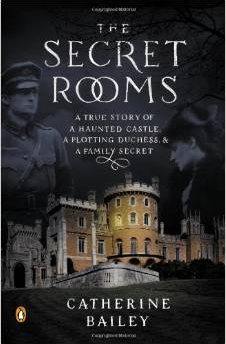
Cover for The Secret RoomsWhen British documentary producer Catherine Bailey began looking through family archives at Belvoir Castle, she was searching for information about the men from the area who served in World War I, including the 9th Duke of Rutland. What she didn’t find surprised her. Not only did she find few letters from the war, surprising for a family who wrote each other and others often, but the letters were missing from two other periods—when John Manners, later the 9th Duke, was nine years old and in 1909, when he was serving the ambassador in Rome.

Soon, Bailey learned that Manners spent the last days of his life, when he was dying of pneumonia, working among the archives in the room, that he died there, and that the rooms had been locked up ever since he died. It became clear that he was destroying correspondence and other papers. Further, she learned that the rooms had been broken into shortly after his death, the thief being identified later as John’s mistress, Hilda Lezard.

Bailey realized that without the letters for World War I, she could not complete her original project. However, she then decided to try to find out what happened during those three periods of the Duke’s life that he wanted hidden.

The result is a story as fascinating as any mystery novel. Although the entire truth of these periods will never be known—in particular, exactly what happened to the Duke’s brother Haddon when they were boys—the search is  as interesting as any modern crime story. The truth involves cruelty, duplicity, and a completely unscrupulous parent.

The Secret Rooms is an entertaining and interesting book. I highly recommend it.

Related Posts

The Forgotten Garden

Goodbye to All That

The House of Walworth

Day 617: Charles Dickens

Cover for Charles DickensReading this biography of Charles Dickens was very interesting to me after reading The Invisible Woman, about Dickens’ long illicit affair with Nelly Ternan. I have read biographies of Dickens before, but these two were the first I read that were forthright about some of Dickens’ inconsistencies and hypocrisies.

Renowned British actor Simon Callow puts a different spin on this book by examining Dickens’ love of and relationship to the theatre and his audience. Dickens adored the theatre and made quite a few forays into amateur theatrical productions, some of them quite large in scope, before settling on dramatic readings of his novels that were hugely successful.

It was of course during one of these productions, performances of a play he wrote with Wilkie Collins, where Dickens met Ellen Ternan, the young actress who became the focus of his mid-life crisis, which eventually ruined his marriage. She was brought in to replace Dickens’ daughter when a public performance made it improper for a young lady to appear.

This book is written in vivid and humorous style. It is entertaining and provides a view of Dickens’ career from the point of view of a theatrical background. Callow has himself played Charles Dickens more than once, most notably in a one-man performance, and is the author of nine books on theatre.

P. S. This book is sometimes titled Charles Dickens and the Great Theatre of the World.

Day 601: The Talented Miss Highsmith

Cover for The Talented Miss HighsmithI became interested in reading this biography after hearing about interviews with Schenkar, who called Patricia Highsmith a sociopath. Patricia Highsmith is, of course, the author of many mid-20th century thrillers, the most famous being Strangers on a Train and The Talented Mr. Ripley. After reading the biography, I don’t really think Highsmith was a sociopath. I think she was fascinated with certain dark themes, but she strikes me as more of a social inept, perhaps partially on the autistic spectrum.

Highsmith was certainly a complex person of many contradictions. She was a lesbian misogynist, as contradictory as that sounds, who was a great womanizer in her younger years and was seldom faithful to any of her lovers. She was an outspoken anti-Semite who had Jewish lovers and a lot of Jewish friends. Known in later years as a recluse, she visited her neighbors every evening and corresponded with many people, as well as making an appearance whenever invited.

She certainly was a damaged person. She had a love-hate relationship with her mother for her entire life, blaming her for abandoning her briefly when she was young and for not divorcing her stepfather. She was a woman who always thought she should actually have been a man. A heavy drinker and smoker, she barely ate any food for years and was probably anorexic.

Her life was an interesting one. She did not seem to be a likable person and frequently behaved very badly. Yet, she had many sincerely devoted friends.

I was interested in this book but had some issues with its structure. Schenkar explains at the beginning that a chronological approach wouldn’t do Highsmith justice, so she approaches Highsmith’s life sort of organically. The problem I found with this approach was that after awhile I could not figure out what organizing principle is holding some of the chapters together. Sometimes they just seem to follow a stream of consciousness approach. It makes the information conveyed very repetitive and chronologically impossible to follow. Schenkar helpfully provides a chronology at the back of the book, along with about 100 pages of supplementary material, but by then I was exhausted and had no interest in exploring any of it.

Finally—this is a small quibble—I got irritated by Schenkar’s chapter naming. The table of contents shows only nine chapters in this very long book, but there are really forty-nine. That is because she actually names them Les Girls Part 1, Les Girls Part 2, and so on. Perhaps I’m being unfair, but I could just imagine Schenkar’s editor telling her she couldn’t have a 150-page chapter, which is the length of Les Girls, Parts 1–14. Such an approach does not strike me as being very imaginative.

Day 566: Savage Beauty: The Life of Edna St. Vincent Millay

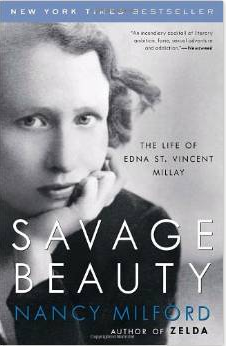
Cover for Savage BeautyNancy Milford, author of an acclaimed biography of Zelda Fitzgerald, was able to gain unlooked-for access to Edna St. Vincent Millay’s papers to write this compelling biography. She explains in the prologue that she stopped by the house of Millay’s sister Norma in 1972, hoping to talk her into working with her on a biography. Norma, who had all along refused access to her sister’s legacy, decided it was time.

The result is a riveting biography, full of excerpts of letters—some never sent—poetry and scraps of poetry, and notes. It is unflinching in looking at Millay’s lifestyle and addictions.

Millay, of course, is famous as the voice of a newly liberated youth, particularly of women, in the Jazz Age. She began publishing her poetry at a young age and became famous after her first book, when she was in her early twenties. For a long time, she was wildly popular—movie star popular—which is interesting in a nation that generally doesn’t love poetry. And, like many a modern idol, she had a lot of attention paid to her appearance, which was small, with fiery red hair, and sprite-like.

That is about all I knew about her—that and a bit of her verse. Her childhood was hard. Her mother left her father when Edna and her sisters were young and was away much of the time trying to make a living for them as a nurse, while the girls fended for themselves. Still, she brought the girls up with a love of music and poetry. Millay published a few poems in a children’s poetry magazine and won all their awards, but her big break came when she attracted the attention of a wealthy patroness, who arranged for her to attend Vassar.

I am not going to relate Millay’s life story in this review—you can read the book for that—but instead ruminate on some ideas this book made me consider. One is the strange relationship Millay had with her mother Cora and her sisters Norma and Katherine. For Cora, her letters always expressed much affection, often resorting to baby talk. Yet increasingly, Millay kept her mother at arm’s length, sending money instead of visiting her.

With Norma, too, the messages were affectionate, but the visits were few. In her case, there seems to be fair enough evidence that Edna’s husband Eugen Boissevain acted as a barrier between Millay and some people, including her family. As time progressed, for example, almost all of Norma and Katherine’s letters to Edna were answered by Eugen.

Katherine’s case was different, a life that seemed to be an attempt to compete with Edna in her own backyard, and failed. Edna’s patroness also saw Katherine into Vassar, from which she failed to graduate. She published a couple of prose books and some poetry, but her work was deemed too similar to her sister’s to succeed. This evaluation must have been disheartening, but in later years she claimed that Edna stole her ideas, an allegation that was patently absurd, especially as they had barely been in touch for years. Katherine’s relationship with Edna toward the end consisted solely of letters that were a combination of vituperation and demands for money. Like Edna, Katherine was an alcoholic, although not apparently a high-functioning one.

Edna’s relationship with her husband was unusual, too. After a gay and determinedly single life including many affairs with both men and women, Millay married not long after the failure of an affair with another man. Eugen is frequently described as a man who did everything for Edna, including absenting himself so that she could have an affair with a much younger man. Her family and some of her friends seemed to blame him for keeping her apart from them, but I can’t help feeling that most of that was at her desire, since she seemed to see who she wanted to see.

All of this makes me wonder how far a creative person can go in selfishness—how acceptable that is in the service of art. Millay was certainly one of those extremely charismatic people who attracted others like moths. How often such people are completely self-absorbed, even if they are not geniuses. If a person’s genius is fueled by intense emotion, is it okay to fire that  emotion at the expense of others? To blow hot and cold on people’s passions until they are madly in love and then discard them? I don’t really know. Many of Millay’s lovers remained her lifelong friends after the affair was over, but it seems that charismatic people are more often forgiven their actions than others. I haven’t come to any conclusions on this. These ideas are just some the biography made me consider.

I read this book in tandem with The Selected Poetry of Edna St. Vincent Millay. Review to come.


Day 550: The Invisible Woman: The Story of Charles Dickens and Nelly Ternan

Cover for The Invisible WomanThe Invisible Woman is the interesting story of the relationship between Charles Dickens and Ellen Ternan, the true nature of which is still being debated. Although Dickens’ reputation was jealously guarded by himself during his life and by his friends and family after his death, Claire Tomalin shows convincing evidence that the two had an affair during the last 13 years of his life.

They met when Nelly was just 18 and he was at the height of his fame at 45. She and her mother and two sisters were struggling, hard working but respectable actresses, or as respectable as actresses could be during the Victorian era. It is possible that Dickens at first thought he had latched onto a bird of a different feather as he befriended the family.

Although Nelly was excited by the attention of such a famous man, it seems clear that she succumbed to him only reluctantly. He offered her a chance at a life free from the worries of poverty but one in which she could not be a member of society.

This is a fascinating story, particularly because of the lengths Dickens went to protect his own image even while shedding his wife Catherine in a cruelly public way and telling lies about it. The actions of his sister-in-law at this time toward her own sister seem almost inexplicable. Also interesting is how Nelly managed to reinvent herself after Dickens’ death.

This book is an engrossing, well written, carefully researched account of events in Dickens’ life that were hidden for years. Only a few years ago I read another biography of Dickens that glossed over this friendship, alternately suggesting that it was perfectly innocent and that Nelly was a gold digger while never actually committing itself about the nature of the relationship. Although there were rumors even at the time of the affair, the cover-up was so pervasive that details are still being uncovered.

Day 541: Cradle of Gold

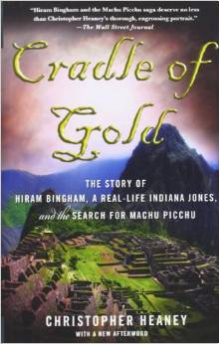
Cover for Cradle of GoldA few years ago I reviewed The Lost City of Z, which told about Percy Fawcett’s search for a fabled city in the Amazon jungle. That book alleged that Fawcett was a possible model for Indiana Jones. It is a minor point of Cradle of Gold that Hiram Bingham III is much more likely to be the model. Bingham was the man who brought the world’s attention to Machu Picchu.

At the time, Bingham was hailed by the western world as Machu Picchu’s discoverer, despite its being known about all along by the nearby farmers. Bingham’s story also has other examples of chauvinism and controversy, including his removal of artifacts without the permission of the Peruvian government. (He more or less permanently “borrowed” them.) Peru has only recently won a law suit against Yale University for the return of the collection, including many human remains. Still, Bingham is recognized even in Peru for his contributions to Peruvian history and archaeology.

The book begins in Hawaii, where Bingham was born the son of missionaries who expected him to study theology. But Bingham did not see himself taking up his father’s mantle. He was still fairly young when he took the money saved for his education and tried to embark for San Francisco. Although he was prevented from leaving and eventually ended up attending Yale University, he soon after became an explorer.

The book is named Cradle of Gold after Choqquequirau, supposedly the home of the Virgins of the Sun, which was the first site Bingham visited. He found it had been looted long before. Instead of pursuing it further, he became interested in finding Vilcabamba, the residence of Manco Inca, one of the last rulers of the Inca who was captured and slaughtered by the conquistadors. Initially attracted because no one knew what happened to Manco Inca’s great treasure, Bingham eventually became more interested in Incan history and artifacts.

This book is the engrossing story of Binghams’ origins and expeditions, his contributions to science, and the controversy that followed. Author Christopher Heaney is a Doctoral Fellow in Latin American history at the University of Texas, Austin. He has written a clear and interesting account for the general public but supported by extensive documentation. If you are interested in stories of exploration, you will like this one.


Day 522: Véra (Mrs. Vladimir Nabokov)

Cover for VeraBefore I start on my review of Véra, I just wanted to comment on the death of Mary Stewart, which I just heard about. I have been reading and re-reading Mary Stewart’s books since I was a young girl. Not only did she write some of the best romantic suspense stories ever, but she also wrote a much-praised historical-fantasy series about Merlin. Her works were well grounded in their settings and beautifully evoked places (some of which we will never see again, such as 60’s Damascus and Beirut). To my surprise, my post about her book This Rough Magic continues to be one of the most visited on my site. We are going to miss Mary Stewart. I have re-read Stewart’s books so many times that I can write reviews of them from memory. I’ll post another one soon.

***

I’ve read two biographies now by Stacy Schiff, and both of them are about elusive women. Cleopatra was elusive because most of the information about her life is available only from prejudiced sources. Véra Evseevna Nabokov was elusive because she wanted to be.

Véra considered Nabokov to be a genius and his work to be of sole importance. She never publicly acknowledged her own contribution to it. Even the subtitle of this biography reflects the way she presented herself, always as Mrs. Vladimir Nabokov.

I don’t know a lot about Nabokov. I have read only one of his books, Lolita, but I found it astounding. Despite my dislike of the subject matter, reading it was an amazing experience, and I found the use of language astonishingly beautiful. But you do not need to be familiar with Nabokov’s oeuvre to find this biography, which won the Pulitzer, fascinating.

The Nabokovs had a truly collaborative relationship even though they never publicly acknowledged it. Although Véra denied helping him write, he often called her his first reader. Visitors heard her tell him to reword phrases or even remark, “You can’t say that!” For years, she typed up his manuscripts from his note cards or his dictation. She oversaw the translations of his work into different languages, even laboriously correcting them in the several languages she spoke. She was exacting about the use of words. She took care of all Nabokov’s correspondence, even to friends and family, as well as his business and financial affairs. She was the gatekeeper for interviews and visitors. She also drove him everywhere (and carried the luggage). Her entire married life was dedicated to providing him time and peace to write.

In areas even more directly affecting the success of his literary career, it was at Véra’s suggestion that Nabokov begin to write fiction in addition to poetry. Once the Nabokovs emigrated to America, Véra convinced Vladimir to begin writing in English. She pulled the manuscript of Lolita out of the fire on three different occasions, and it became his most famous work. Students taking his classes at Cornell were bemused by his “assistant,” who provided quotations or page references just when he needed them, drew complex diagrams on the blackboard, and erased it after class. Véra also taught his literature and language classes for him on many occasions and was acknowledged as a better, more systematic Russian language teacher than her husband.

Véra never seemed to resent this role she had taken on; she fostered it. But she was in no sense a nonentity. In correspondence she was much more direct than her husband. Although they tended to share correspondence—he would start a letter, perhaps; she would finish it; he would sign it—she was always left to impart the hard news—the refusal of contracts, the dictation of terms, the correction of translations. Many people believed that she was a dragon who was screening Nabokov’s mail or keeping people away from him, but she was doing what he wanted.

The couple was seldom seen apart. Although Nabokov had an affair early in their marriage and liked to flirt with women, he dedicated almost all his books to Véra. They had an extraordinary marriage, and this is an extraordinary, surprisingly entertaining book.

Day 518: The Fall of the House of Walworth: A Tale of Madness and Murder in Gilded Age America

Cover for The Fall of the House of WalworthJust a quick note before I get started about the Classics Club Spin #6. The spin selected #1, so I’ll be reading Herland, by Charlotte Perkins Gillman!

The Fall of the House of Walworth begins in the 1950’s with Clara Walworth living in a crumbling mansion in Saratoga Springs. She obsessively goes through the possessions of her once-eminent family, not realizing that its members have hidden from her a shocking truth. Her father was once imprisoned for the murder of his own father.

The book then returns to trace the history of the Walworths, a family of prominent figures who became New York state aristocracy. In particular, it looks at the career of Reuben Hyde Walworth, the last Chancellor of New York. It was his younger son Mansfield Walworth who was murdered in a New York City hotel room by Mansfield’s own son Frank, then only 19 years old.

The book relates the story of the marriage of Mansfield and Ellen Hardin. Ellen was Mansfield’s step-sister after the marriage of his father to her mother, Sarah. As a young girl, Ellen was apparently carried away by Mansfield’s streak of romanticism. But she did not realize he had already gained a reputation as a wastrel and a bully. O’Brien theorizes that the family may have hoped the love of a good woman would help him to reform.

The book examines the history of Mansfield and Ellen’s marriage and the reasons the situation reached such heights of drama, including a strain of mental instability in the family. Mansfield was an author of overblown romantic novels, who saw himself as a misunderstood genius. O’Brien’s comments about his dreadful writing and excerpts from his novels show us how deluded Mansfield was about his own talents, even in a sentimental age. They also provide a hint of amusement to the book.

Cultural historian O’Brien has written an interesting true story of an unusual crime that shocked the country. Frank Walworth’s trial provided the test case for the new concept in law of second degree murder. The book also provides insight into the views and treatment of epilepsy, at the time considered a mental illness.