Day 518: The Fall of the House of Walworth: A Tale of Madness and Murder in Gilded Age America

Cover for The Fall of the House of WalworthJust a quick note before I get started about the Classics Club Spin #6. The spin selected #1, so I’ll be reading Herland, by Charlotte Perkins Gillman!

The Fall of the House of Walworth begins in the 1950’s with Clara Walworth living in a crumbling mansion in Saratoga Springs. She obsessively goes through the possessions of her once-eminent family, not realizing that its members have hidden from her a shocking truth. Her father was once imprisoned for the murder of his own father.

The book then returns to trace the history of the Walworths, a family of prominent figures who became New York state aristocracy. In particular, it looks at the career of Reuben Hyde Walworth, the last Chancellor of New York. It was his younger son Mansfield Walworth who was murdered in a New York City hotel room by Mansfield’s own son Frank, then only 19 years old.

The book relates the story of the marriage of Mansfield and Ellen Hardin. Ellen was Mansfield’s step-sister after the marriage of his father to her mother, Sarah. As a young girl, Ellen was apparently carried away by Mansfield’s streak of romanticism. But she did not realize he had already gained a reputation as a wastrel and a bully. O’Brien theorizes that the family may have hoped the love of a good woman would help him to reform.

The book examines the history of Mansfield and Ellen’s marriage and the reasons the situation reached such heights of drama, including a strain of mental instability in the family. Mansfield was an author of overblown romantic novels, who saw himself as a misunderstood genius. O’Brien’s comments about his dreadful writing and excerpts from his novels show us how deluded Mansfield was about his own talents, even in a sentimental age. They also provide a hint of amusement to the book.

Cultural historian O’Brien has written an interesting true story of an unusual crime that shocked the country. Frank Walworth’s trial provided the test case for the new concept in law of second degree murder. The book also provides insight into the views and treatment of epilepsy, at the time considered a mental illness.

Day 497: The Last Pre-Raphaelite: Edward Burne-Jones and the Victorian Imagination

Cover for The Last Pre-RaphaeliteYears ago in London I was wandering through the Tate with my friends, tired of seemingly endless rooms of Italian Renaissance paintings, when I walked into another room and was simply blown away. The room was full of life-size paintings of stunning beauty, with gemlike colors, exact details of greenery and complex woven fabrics, and narrative depictions from myth and legend. They were by the Pre-Raphaelite Brotherhood, and they must be seen in person to be fully appreciated. Ever since then I have been interested in the Pre-Raphaelites, so when I read a glowing review of The Last Pre-Raphaelite in the New York Times, I tracked it down.

Although all art movements go in and out of fashion, the Pre-Raphaelites seem to come in for more than their fair share of controversy. I have even now picked up art history books that don’t contain a single Pre-Raphaelite picture. Edward Burne-Jones was the youngest of this group of painters, although he was outlived by Holman Hunt. He was also a prolific designer of stained glass windows and even jewelry.

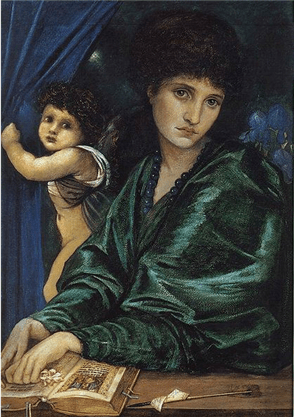
Portrait of Maria Zambaco
Burne-Jones Portrait of Maria Zambaco

MacCarthy’s biography is a fairly exhaustive study of Burne-Jones’ life and works, his marriage and family, life-long association and partnership with William Morris, his mentoring of younger painters and friendships with many important figures in art, literature, and politics and with a string of little girls, and his famous affair with Maria Zambaco. It discusses his association with the Pre-Raphaelites, the Arts and Crafts movement, and the philosophy of Aesthetics.

Burne-Jones believed strongly that beauty should be available to everyone. Hence, his involvement with William Morris in producing items of home decor, in illustrating manuscripts, and in designing stained glass windows for public venues. In fact, he is closely associated with the revival of the stained glass industry in England.

One surprise of this biography was to find the personality of a puckish jokester underneath Byrne-Jones’ ascetic, attenuated appearance. He continued throughout his life a schoolboy habit of drawing little caricatures of himself and his friends, particularly teasing ones of his good friend Morris. Although generally a moral person, he was understanding of the foibles of others and supportive of his friends, even those of whose habits he did not approve. He was beloved by many.

picture of Burne-Jones The Golden Stairs
Burne-Jones The Golden Stairs

I was interested throughout this book, even though much of it had to do with Burne-Jones’ struggles to finish work. He apparently had far more ideas than he could ever accomplish and was always working on many projects at the same time. The book is full of beautiful photographs of his art—although unfortunately most of them are too small to see the details—as well as of himself, his family and friends, residences, etc. The interiors of rooms are stunning examples of the Arts and Crafts movement.

A small quibble is the epilogue, which is concerned with the revival of interest in Burne-Jones. It is interesting up to a point, where it seems to be attempting to trace of ownership of every single work. Still, this is a fascinating biography.

Day 489: Queen Anne: The Politics of Passion

Cover for Queen AnneHistorically, the legacy of the reign of the last Stuart monarch, Queen Anne, has been marred by allegations that Anne was a weak woman who was ruled by her favorites. The accomplishments of her reign have been attributed to men she entrusted with leadership roles, most notably John Churchill, Duke of Marlborough. Similarly, the wrongs perpetrated during her reign have been imputed to the misguidance of her favorites. Historian and biographer Anne Somerset’s new book exhaustively shows that Anne, to the contrary, was a sensible and conscientious ruler, most consistent in her views and often very stubborn, although private and reserved.

Much of what was popularly known about Queen Anne came from the writings of Sarah Churchill, the Duchess of Marlborough, who was Anne’s close friend and confidante for many years before becoming her bitter enemy. Even when they were close, the duchess seems to have been a demanding harridan, whose idea of her own power and desserts grew too rapacious and who treated the queen abominably for years. Having read a biography of the duchess several years ago, I approached this book believing Anne was a weak and silly woman, but it has made me change my mind.

Somerset makes an interesting point that Anne’s lack of charisma and physical appearance may have hurt her legacy. Although the portrait of the young Anne reveals a beautiful lady, by the time of her reign she was grossly overweight and plagued by serious physical ailments. These were diagnosed at the time as various disorders, including gout, but a modern look at her symptoms indicates that she may have suffered from lupus, a serious autoimmune disease. For the most part she soldiered on uncomplaining to do her duty for her country.

This book lucidly explains the complex issues that echoed throughout Anne’s reign, including the ouster of King James II, Anne’s father, and the refusal to acknowledge his son, Anne’s half brother James Francis Edward Stuart, as a legitimate heir to the throne because of his Catholicism; the bitter feuds between the Whigs and the Tories; and the War of the Spanish Succession. The book is thorough in its research and very well written. Although I tired at times of its dissection of a seemingly endless series of disputes among those vying for power, I think the book offers a considered and balanced look at Queen Anne’s life and reign.

I received a copy of this book free through a giveaway on Goodreads.

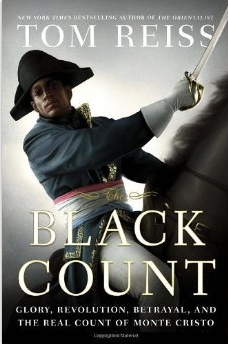
Day 484: The Black Count: Glory, Revolution, Betrayal, and the Real Count of Monte Cristo

Cover for The Black CountTom Reiss, previously the author of the fascinating biography The Orientalist, seems to be drawn to unusual figures who were famous in their own time but have become virtually unknown. Such is the case with Thomas-Alexandre Dumas—the father of the famous author of The Count of Monte Cristo, among other classics—who reached the heights of his fame as a great soldier and general of revolutionary France.

Dumas, who went by Alex rather than Alexandre or Thomas, had a colorful past. He was born on the island of Saint-Domingue (now Haiti), the son of a black slave and a French marquis, Antoine Davy de la Pailleterie. His father was a wastrel and a scoundrel who, although he apparently did not raise his son in slavery, sold him in order to raise the passage money for his own return to France after his family had thought him dead for years. After claiming his right to his title and property (which his relatives had been maintaining and improving for years at their own expense), Pailleterie redeemed his teenage son and brought him up in privilege.

However, shortly after entering manhood, Alex broke with his father, took his mother’s name, and proceeded to make his own way as a soldier. He was the first person of color to become a general-in-chief of the French army and was the highest ranking black officer in the western world of his time.

This book is an account of Dumas’ fascinating life, in which his physical courage, ability, and principled behavior won him acclaim. Unfortunately, he was not as gifted politically and inadvertently made an enemy of Napoleon Bonaparte, who perceived him as a rival and really comes off here as a jealous and power-hungry opportunist. Bonaparte’s resentment, in combination with an abrupt change in policy of the French government to remove the rights previously granted subjects of color, ended in the loss of his career and a death in neglect and poverty.

The book is written in an energetic and informal style for the general public, although it is copiously documented in the back. The Black Count is an engrossing story of an event-filled life.

Day 479: Jane Austen: A Life

Cover for Jane Austen: A LifeIn Jane Austen: A Life, noted biographer Claire Tomalin has handily accomplished a difficult task. Because most of Jane Austen’s letters and papers were destroyed by well-meaning relatives, very little first-hand information about her life is available. As a 19th century unmarried woman, her experience was circumscribed, so the events of her life are ordinary ones. Descriptions of a life like this could be thin and lifeless, but Tomalin manages to provide us with a biography that is full of interest and lively and creates a convincing idea of Austen’s character.

From records, letters, the remaining few of Austen’s papers, and accounts of her by relatives, friends, and neighbors, Tomalin reconstructs the story of not only Austen’s life but of those who were important to her. Tomalin acquaints us with the members of Austen’s family and the bustling environment in the Steventon Rectory, where Jane’s father ran a small boys’ school. She describes friendships and visits to neighboring families. Even though Austen never used her own neighborhood in her books, it is easy from them to imagine the daily social calls and the housewifely tasks with which she and her female relatives were engaged.

It is not too hard to imagine the relationship between Jane and her sister Cassandra as close to that of Lizzie and her sister Jane in Pride and Prejudice, although Tomalin never mentions that either of these characters were based on real people. Still, the two sisters were extremely close.

Unlike Lizzie and Jane, though, both Jane and Cassandra were disappointed in love, Cassandra because her fiancé died, and Jane because her suitor needed to marry a woman with money. Tomalin makes the points that a married Jane Austen would probably have been too busy or too distracted to produce a body of literature and that later in life she seemed to understand some of the benefits of remaining single. As to the first point, it is certainly true that being removed without warning and against her will from Steventon because of the retirement of her father, and her family’s failure to settle anywhere for ten years afterward, completely cut off Austen’s literary production for that time period.

It seems that Austen’s status as a spinster with no money of her own gave her no control at all in her life about such questions as where she would live and even in one case when she could return home from a family visit. That is, she had no control until her late thirties, when she began to publish her novels. Even then, she ultimately earned very little money from them but enough to give her a small amount of autonomy.

Although most of the events of Austen’s life were relatively small, Tomalin’s book provides an absorbing account. I did not always agree with her interpretations of Austen’s novels, but I feel that this book allows me to know Austen and her family and friends a little better.

Day 473: The Immortal Life of Henrietta Lacks

Cover for The Immortal Life of Henrietta LacksIn 1951 an African-American woman died of cervical cancer in the colored ward of Johns Hopkins, founded as a hospital for the poor. Her doctors had routinely removed cells from her unusually virulent cancer. The cancer was fast acting and when the woman died, her body was riddled with tumors. Her name was Henrietta Lacks, and her cells have been used ever since for research and experimentation, resulting in many medical breakthroughs.

At that time, scientists had been trying to find a way to preserve cells, but all their attempts failed. None of the cells lived more than a few days. At Johns Hopkins the staff used their usual method of attempted preservation for Henrietta’s cells with little hope of success. Henrietta’s healthy cells died like the others, but not only did the cancerous cells survive, they reproduced dramatically.

Henrietta’s cells helped solve a fundamental problem in biological and medical research, that of having a supply of human cells readily available for use in various experimental studies. George Gey, the head of the department, immediately began shipping them to any scientist who needed them. Henrietta’s cells, called HeLa, are known and used throughout the world.

In the meantime, the Lacks family was completely unaware that Henrietta’s cells were in use. An impoverished family of little education, they had difficulty understanding the use the cells were put to when they did learn about them, which wasn’t until 1973. Even at that time, researchers at Johns Hopkins took further samples from the family without their informed consent. Deborah Lacks, Henrietta’s daughter, understood them to be performing a test for cancer, not medically available at the time. Even though the removal of Henrietta’s cells was commonplace in the 1950’s and did not break any medical code of ethics, at the later time that further samples were taken from the family, this was certainly not the case.

In clear prose, Rebecca Skloot tells the story of Henrietta Lacks’ cells and their uses in the biomedical industry but also the story that has hitherto been neglected, that of Henrietta herself and her family. The book brings up issues of racial discrimination, medical ethics, and other issues in biomedical research, such as cell contamination. It also affectingly tells the story of the Lacks family.

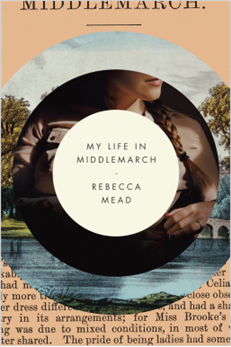
Day 461: My Life in Middlemarch

Cover for My Life in MiddlemarchMy Life in Middlemarch is a difficult book to categorize and an unusual effort. It is part memoir, part literary criticism, part literary history and biography, part thoughtful examination. Its focus is on George Eliot’s greatest novel, Middlemarch.

New Yorker writer Rebecca Mead muses about what the novel, her favorite as it is mine, has meant to her during different periods of her life, how different parts of the novel and different characters have spoken to her and how her sympathies with characters and comprehension of the novel’s themes have changed as her life was in its varying stages. She also examines events in Eliot’s own life—how they and the people she knew may have contributed to her works.

This book is about all things Middlemarch. Mead visits the towns and homes where Eliot resided and places where she may have set the novel. She reports on the ways that literary criticism of the novel changed over time—how it was immediately popular and then fell out of favor in later years to be rehabilitated, partially by the appreciation of Virginia Woolf. The book provides interesting insights into the novel and into Eliot’s life and possible thought processes as she wrote the novel.

http://www.netgalley.comFor those who have not read Middlemarch, the book still may hold some interest, but a lot will be lost. To those who have read and loved it, you will probably, like me, be compelled to pick it up again and reread it. I’ll be doing that soon.

Day 380: Lady Gregory’s Toothbrush

Cover for Lady Gregory's ToothbrushLady Gregory’s Toothbrush is more of a biographical essay than an extensive biography of Lady Gregory, one of the founders with William Butler Yeats of the famous Abbey Theatre in Dublin and a huge figure in the Irish cultural revival of the 1890’s and early 1900’s. The title of the book is based on a comment she made that reflected her own inconsistencies, that is, her firm roots in the Protestant aristocracy against her support for the culture of rural, Catholic Ireland. When Playboy of the Western World was being produced by the Abbey, there was a huge uproar by Catholic nationalists. Lady Gregory remarked that the dispute was between “those who use a toothbrush and those who don’t.”

Tóibín’s sketch effectively shows the contradictions in Gregory’s character. It would be easy to dismiss her as an elitist snob, but Tóibín makes very clear her contributions to Irish theatre and folk lore. She was one of the first people traveling to rural Ireland to collect Irish folk tales before they were forgotten. As well as writing her own plays as part of the movement to encourage and advance Irish culture, she collaborated with Yeats on his without credit, and some of her contemporaries believed she wrote the bulk of one or two.

An interesting detail from Lady Gregory’s life is how this redoubtable woman cossetted and gave in to Yeats. Tóibín recounts her son Robert’s indignation, for example, when he found that his mother had served Yeats “bottle by bottle” the entirety of his prized Tokay handed down to him by his father.

Copper Beech in Coole Park
The copper beech at Coole Park

Tóibín makes very clear the love she had for her husband’s estate, Coole, which she carefully preserved for her son while he was in his minority. There she entertained many of the great talents of Ireland, including Yeats, his brother Jack, J. M. Synge, George Bernard Shaw, and Sean O’Casey. The home no longer stands, Tóibín says it has been covered in concrete, but I myself have seen the great copper beech bearing their initials.

If I have any complaint of this short book, it is at my own ignorance (even though I have done some reading), for my lack of knowledge of the events of this time and particularly of the plays discussed makes it difficult to understand some of Tóibín’s remarks, particularly the furor around some of the plays. Having never read or seen Playboy of the Western World, for example, I don’t understand what was so upsetting (and indeed he implies that a modern audience may not).

Tóibín effectively and elegantly draws a brief but balanced portrait of this complex woman, showing us both her accomplishments and faults. Although I have read some of Yeats’ poems and some of Shaw’s plays, this short work makes me want to do more exploring around these figures in the Irish cultural nationalism movement and their works.

Day 367: Between the Woods and the Water: On Foot to Constantinople: From the Middle Danube to the Iron Gates

Cover for Between the Woods and the WaterBest Book of the Week!

In December 1933, 19-year-old Patrick Leigh Fermor set out to walk from Amsterdam to Constantinople. He wrote about the first leg of this journey years later in A Time of Gifts, ending the book as he crossed a bridge from Czechoslovakia into Hungary. In 1986, he finished this memoir of the second leg of the journey, which begins on that same bridge in Esztergom the evening of Easter Sunday and ends in the early autumn of 1934.

In the second part of the journey, Leigh Fermor breaks his rule of making the entire trip by foot and also spends much of the time in more luxurious surroundings than he did in the first part. As he makes his way through Hungary and the Romanian border, as it was then, into Transylvania, he is passed by his growing list of acquaintances and friends from one kastély to another, spending days with a learned professor discussing languages and history, borrowing a marvelous horse from a count for part of the journey across the Hungarian plain, staying for weeks with a new friend named István in Romania, and dallying with a young married woman on a motor trip with István to Prague.

Leigh Fermor does not spend all his time in such exalted circles, though. He happily camps out with gypsies, spends the night outside a shepherd’s cottage, is hosted by a Jewish family after an afternoon spent discussing the Hebrew language, sleeps in a cave, and camps on an island in the Danube near a village inhabited by resettled Turks. On his way, he describes the scenery in lyrical terms, explains the ancient history of each area he passes through, and tells us about the people he meets and the sights he sees. His chronicle is supported by the notebooks he kept and a nearly photographic memory of a remarkable journey. In addition, he tells us that he revisited some of the areas 20 years later.

This memoir is beautifully written. Although relatively unacquainted with formal learning, having abandoned military school at that early age, Leigh Fermor has an astonishing range of interests, and he tells us all about them. He is constantly plunging into dusty tomes in his hosts’ libraries but is just as ready to dance and drink the night away. This is a delightful series of books, still full of the youthful joy and enthusiasm Leigh Fermor must have felt when he was 19 and 20 years old.

In the Appendix to this book, Leigh Fermor reflects on how many of the sights he writes about in this book are now under water, for the Danube valley that he traversed and the torrents and currents that once rushed along it as well as the Iron Gates themselves have been subsumed by a huge concrete dam and hydro-electric power plant. And of course there have been other causes of destruction since 1934.

Unfortunately, The Broken Road, the unfinished manuscript of the final portion of the journey, is being republished but is not available from Amazon until March of next year! (It may be available used from some other site.) I am so disappointed to find the book never gets us all the way to Turkey but stops in Greece.

Day 335: A Time of Gifts: On Foot to Constantinople: From the Hook of Holland to the Middle Danube

Cover for A Time of GiftsIn December 1933, nineteen-year-old Patrick Leigh Fermor set out alone on a great adventure, a walking trip from Amsterdam to Istanbul, or as Fermor still called it, Constantinople. (It was renamed in 1930.) He had no idea when he left that he would not return until 1937. In 1977, he collected his notebooks from the trip and wrote A Time of Gifts and its sequel Between the Woods and the Water.

Although Leigh Fermor had one notebook stolen from him with all the rest of his gear, he otherwise must have kept careful account and his memories of the trip must still have been vivid, for the result is an entrancing account of scenery and architecture, tales of chance encounters, glimpses of foreign customs and celebrations, and so on. Jan Morris, who wrote the introduction, calls him “one of the great prose stylists of our time,” and Wikipedia, quoting an unnamed British journalist, “a cross between Indiana Jones, James Bond and Graham Greene,” presumably for his work with the Cretan resistance in World War II as well as his writing. (He was also a friend of Ian Fleming.)

From his drinking bouts with Dutch barge men to his extended stays in various German, Austrian, and Czech castles, Leigh Fermor plunges enthusiastically into every experience on offer. At one moment he is sleeping in a barn, in the next hanging out with fashionable youth in Vienna. Along the banks of the Danube he is mistaken for a 50-year-old smuggler. All of these adventures as well as his observations of nature are described in beautiful, evocative prose. To add interest to the modern reader, he is describing a Europe that no longer exists.

If I have any complaint, it is one of my own education, for Leigh Fermor’s writing assumes for his audience a familiarity with classical culture that is no longer common. The book often alludes to mythology and refers to obscure historical events that I do not fully understand. Finally, in the footnotes, which are Leigh Fermor’s original ones, all utterances in modern languages (some of which I could have taken a stab at) are translated, but the quotations in Latin are not. They are not integral to comprehension, but it is a little frustrating to be unable to understand them. (Of course, I could have googled them, but I was almost always reading this on the bus.) That being said, I look forward to reading the sequel.