Day 174: Pauline Bonaparte: Venus of Empire

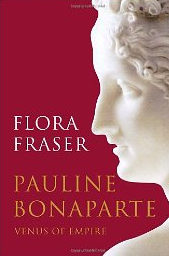
Cover for Pauline BonaparteI didn’t know anything about Pauline Bonaparte before I read Pauline Bonaparte: Venus of Empire. I picked it up because it was by Flora Fraser, a noted biographer who specializes in 19th century women. (She is also the daughter of Antonia Fraser, the famous biographer.)

Pauline Bonaparte was Napoleon Bonaparte’s youngest sister, renowned for her beauty. She lived a colorful life and is immortalized by a life-sized, nude statue by Antonio Canova that resides in the Villa Borghese in Rome.

The connection with the Borghese family is not one that they cherish. Pauline’s second husband was Prince Camillo Borghese. During their long marriage, they lived mostly apart, and Pauline entertained herself with numerous flagrant affairs.

In fact, Pauline’s reputation was dreadful. Napoleon’s enemies spread numerous rumors about her, even stooping to claim that her relations with her brother were incestuous. Not only did she not care, she encouraged that particular rumor to show how powerful she was.

Although she could be very charming, she spent most of her career manipulating infatuated men and intimidated women. Stories abound of her using generals as footstools, turning people our of their own houses, and so on. A particularly odd one was that when she was visiting an officer of the church, she made him cut a hole in the ceiling of his bathroom over the tub so that someone could stand on the floor above her and shower her with milk.

Although extremely jealous of the prerogatives granted her sisters (as they were of hers) and generally hateful to the Empress Josephine (she and her sisters held onto Josephine’s train during her coronation so that she could not move forward), Pauline’s most positive trait was her loyalty to her family. She was devoted, although not faithful, to her first husband, General Victor Emmanual Leclerc. When Napoleon fell out of power, she was persistent in trying to improve his living conditions and tried to get permission from the British to share his exile.

Fraser’s biography is interesting and well written. I found Pauline to be a fascinating subject, although not an admirable person.

Day 149: Hons and Rebels

Cover for Hons and RebelsAfter reading the other Mitfords’ criticisms of this book in The House of Mitford, I expected a biography that was cruel and critical, but Hons and Rebels is mostly an amusing story of Jessica Mitford’s teenage rebellion. The Guinesses (authors of The House of Mitford and Jessica Mitford’s nephew and great-niece), who claimed that Jessica Mitford lied on several points, do not seem to have considered the common phenomenon that people who experience the same things frequently remember them differently, from their own frames of reference. A different recollection of an event in the far past (and in one case an apparent misidentification) is not necessarily lying.

I became interested in finding a good biography of the Mitfords after re-reading several of Nancy Mitford’s novels. I was curious about the kind of family that could have spawned children with such radically different ideas and such extreme characters. Unfortunately, at the time, I was only able to find a couple of biographies written by family members, this being one.

Nancy Mitford, of course, was a brilliant social satirist and author of several light comic novels–and not as politically involved as some of the other girls. Diana left her aristocratic husband, Bryan Guiness, for the infamous British Fascist leader, Oswald Mosley, and was interred with him in prison during World War II for their pro-German sympathies. Unity Mitford became a fan and friend of Adolf Hitler and shot herself in the head the day that Britain declared war against Germany, but failed to kill herself and was mentally disabled for the rest of her life. On the other hand, Jessica as a teenager ran off to the Spanish Civil War with the socialist Esmond Romilly, whom she married. Later she moved to the United States and became a member of the American Communist Party and a famous muckraking journalist.

Hons and Rebels covers Jessica’s childhood, rebellion, later life in the States, and estrangement from the rest of the family. It is light and easy to read, and quite funny. It depicts Esmond and Jessica as extremely naive but equally unprincipled. Mitford does not attack the other family members, as I would have expected after the comments in The House of Mitford. If anything, she looks back at them all nostalgically. In fact, as I commented in my review of the other book, the Guinesses are more prone to attack and criticize the other Mitfords, particularly Jessica and Nancy, and try to mitigate the faults of the Mosleys and the fanaticism of Unity. The only biography I can find written by an unbiased author is apparently superficial and focuses on Unity, so I guess my curiosity about the Mitfords will remain unsatisfied.

Just a note for my consistent readers: I thought that by reviewing one nonfiction book a week, I would be able to continue to write nonfiction reviews indefinitely, but I have now caught up with my nonfiction reading for the past two years, which just shows how much more fiction I read. From now on, nonfiction reviews will appear as I finish the books instead of more regularly.

Day 139: Abigail Adams

Cover for Abigail AdamsI think Abigail Adams suffered from the fact that I had recently read David McCullough’s biography of John Adams, and Woody Holton’s book covers a lot of the same ground. This fact made me ponder a bit about how much a woman’s history is often treated as an echo of her famous husband’s. I am sure that not as much information is available about Abigail as there is about John, especially before they married, but I felt like these two books didn’t need to cover so much of the same territory.

The picture that emerges of Abigail Adams is of a well-meaning but bossy woman of strong views. Her feistiness had two sides. I know that people are captivated by the thought that she spoke her mind during a time when many women didn’t and behaved as if she had rights that she did not, but I had the distinct impression that on numerous occasions she would have driven a lot of people crazy, particularly in her attempts to manage her relatives. When, for example, Abigail interfered in John Quincy’s posting to Russia, he must have been very patient, or very angry.

On the other hand, Holton shows that Abigail was an expert manager of the couple’s property and fortune, actually more astute than John. She took upon herself rights that were not hers legally, from principle, and she stood up for what she believed.

I am not sure I understand the expectation at the time, but I was also struck by the fact that she made very little effort to move into or even visit the White House. I know that it was only partially built at the time and was more like a rustic men’s boarding house than the building we know today, but it seemed that John Adams spent a lot more time without his wife than was necessary, as Abigail also did not accompany him on all of his diplomatic trips. Perhaps this arrangement suited the two of them, but I had the impression that it suited her much more than it did him.

These comments are not a criticism of the biography as such, but here is one. Like many biographers do, I feel that Holton occasionally draws conclusions and makes generalizations based on too little evidence. Perhaps he is trying to avoid the problem of scholarly presentations that provide too much evidence to keep the material interesting, but if so, he goes too far the other way at times. I found myself thinking several times that he had not proven his point of view. At other times, he buries his themes in too much biographical detail. I think he was having difficulty keeping that vital balance between too much information and too little. However, Holton does usually manage to preserve a tone that is light and interesting, and Abigail Adams is certainly a compelling figure in history.

Day 135: The Sun King

Cover for The Sun KingThe Sun King is an interesting biography of Louis XIV and a history of his court, although it occasionally assumes a level of knowledge about French history that I do not have. It is also not terribly revealing of the personality of Louis XIV, who was apparently a very guarded person. For example, the book contains no revealing quotes from personal letters or anything similar.

I was interested to read that Nancy Mitford originally envisaged the book as a description and discussion of the architecture and gardens of Versailles rather than a biography, which perhaps partially explains the focus.

The book starts with the beginning of Louis’s reign, so there is no information about his early life. Chapters are organized around incidents during his reign rather than periods of history. The book describes the opulent court and details intrigues and power struggles within it. The chapter about poisoning was shocking. It is easy to see why the French court of the time had such a reputation for decadence.

The edition that I read (not the one pictured) is full of beautiful pictures of Versailles as well as sketches of the architects, artists, and gardeners responsible for creating the palace. However, there are no good pictures of Louis, presumably because none exist. He is always depicted as a tiny figure in large historical paintings of some event, so it was hard to see what he actually looked like.

Of course, the book is well written and witty. Although Mitford is best known for her humorous novels of sharp social commentary, she also wrote several well-received and thoroughly researched biographies.

Day 129: Mad World: Evelyn Waugh and the Secrets of Brideshead

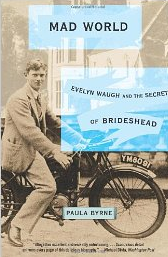
Cover for Mad WorldI found Mad World interesting, but I think it would have been very interesting if I was more familiar with Evelyn Waugh’s work. Paula Byrne’s biography seems to be mostly concerned with refuting statements and criticisms that were made about him, of which I was previously unaware.

The book traces Waugh’s life and career especially in terms of his relationship to the family who were partial models for the Flytes in Brideshead Revisited. The book describes just where the parallels lie and where they diverge.

Byrnes is at pains to refute the allegations that Waugh worshipped and toadied to the aristocracy and was ashamed of his own middle-class origins.

The book made me want to reread Brideshead. I found Waugh an interesting figure, although I couldn’t help feeling how boring and pointless the lives of many of his friends, who were hopeless drunks, seemed.

I apologize for my posts, which will be more sporadic than usual the next two weeks, as I am on vacation.

Day 119: Daphne Du Maurier: The Secret Life of the Renowned Storyteller

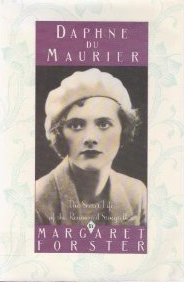
Cover for Daphne Du MaurierI have enjoyed reading Daphne Du Maurier’s books for many years, so I was interested to come across this biography by Margaret Forster. The main revelation of the biography is that Du Maurier struggled with bisexual and homosexual feelings all her life and always thought she was putting on a show of a normal life. She explained to others that she was two people, one with a female side–wife and mother–and the other with a male side–lover–that was the fuel for her creative energy.

The book examines Du Maurier’s life and works in terms of these feelings and how they conflicted with her roles as a wife and a mother. In fact, she seemed at times extremely self-obsessed and stunningly unkind to her children when they were young, as she was cold and immersed in her work. She was also unkind to her husband when he returned from service in World War II. By that time, she was living in the home in Cornwall that she never wanted to leave. Her husband “Tommy” Browning was asked to serve the royal family, which he had to do from London. He was obviously lonely, but she refused to move there or even visit. Instead, he made the trip out there every weekend for years after his strenuous, lonely weeks working for the royals. Until he didn’t. She eventually divorced him and later remarried.

The book also tells about Du Maurier’s long-time affair with the actress Gertrude Lawrence and her attraction to Ellen Doubleday, the wife of her American publisher.

Du Maurier tended to hide herself in her Cornwell home while she was writing. Although she became more sociable as she aged and many people remembered her as a warm and funny hostess, she eventually ended up almost a recluse who was devoted to her own daily routines.

The biography is interesting and well written.

Day 97: The Mystery of Lewis Carroll

Cover for The Mystery of Lewis CarrollThe Mystery of Lewis Carroll: Discovering the Whimsical, Thoughtful, and Sometimes Lonely Man Who Created “Alice in Wonderland” examines modern ideas about Charles Dodgson (Lewis Carroll) and attempts to debunk them. Jenny Woolf does a good job of providing evidence that his friendships with children, rather than being pedophilic tendencies as is interpreted today, were regarded by Victorians as innocent and probably were innocent. She also shows that the modern interpretation of his pictures of nude children was not one held by people of his own time, and that they regarded this pastime and the resulting pictures as harmless because children were considered innocent.

In fact, Woolf provides evidence that his friendships with young women were much more subject to question and talk. She posits that he cultivated a persona of being older than he actually was so that they would not be questioned, even though these relationships were almost certainly innocent as well.

Woolf depicts the Reverend Dodgson as a sensitive, artistic man who cared for his family and loved entertaining children. His position at Oxford did not at that time allow him to marry. A number of years during the time he was a young man are missing from his diaries and he refers to feelings of guilt in later entries, leading Woolf to conclude that something happened, possibly with a woman, that he regretted. Her theory is that he cultivated relationships with young girls as a return to innocence.

The book is interesting, but with a caveat. It is very short, almost shorter than the subtitle, but Woolf is so focused on one or two ideas that it often seems repetitive. A good deal of information about Carroll’s life is missing because he or his relatives removed pages from his diaries and his relatives destroyed a great deal of material after he died. Although this has often been interpreted as the family’s attempt to hide nasty secrets, Woolf is not convinced that there was much to hide. She blames a good deal of the current perception of Carroll on the initial emergence and misapplication of certain theories of psychology in the infancy of the science.

Day 79: A Mountain of Crumbs

Cover for A Mountain of CrumbsIn A Mountain of Crumbs, Elena Gorokhova has written an engrossing memoir about growing up in Soviet Russia during the Cold War. What makes it most interesting, besides the details of life in such a different environment from our own, is how, while misunderstanding many things about Western culture and not being brought up with an accurate understanding of history, even of her own country, she still learns to doubt what she is taught.

Gorokhova’s upbringing is fairly ordinary, although she is both slightly privileged (her family has its own two-room apartment instead of sharing with other families) and disadvantaged (she has to earn her own way by merit since she is not the child of a peasant). However, from an early age her interest in learning English makes her fascinated with the world outside the Soviet Union. At the same time, her cynicism and disillusionment with her country grows.

Most of the book is about Gorokhova’s inability to live in lock-step, both with the state and with her own mother, so that she always feels like she is lying. As she says, “they (the state) lie to us, we know they’re lying, they know we know.”

The book is beautifully written in the first person as if Gorokhova is currently of that particular age rather than as if she were recalling her memories. (For example, when she is telling about when she is five, she narrates it as if she is five.) I can’t completely accept this style of narration for sections about her childhood, because the thoughts she claims to have are too sophisticated for a small child. In particular, I am struck by one comment she makes about thinking something is ironic. Five-year-old children don’t have thoughts about irony–it’s hard enough to get teenagers to understand what it is. However, the same narrative style works very well when she recalls her thoughts as an older child and young adult.

(As a side note, I have to contrast the chapters narrated by herself as a child with Jennifer Lauck’s wonderful memoir Blackbird, which at the beginning employs a narrative style that is absolutely convincing as the thoughts of a small child, allowing the reader to understand things that the child Jennifer doesn’t.)

I have one frustration with the book. Gorokhova describes so many misunderstandings about American life and so much anticipation and anxiety about going to live in the States that I would have liked a chapter about what it was like when she finally arrived. Instead, the book ends as she leaves Russia and contains a short epilogue about her life more than 20 years later.

Day 67: Life Itself: a Memoir

Cover for Life ItselfWriters of memoirs and biographies have the same difficult problem to deal with. There is a fine line between giving too much detail for the work to be interesting or not telling enough. (I once read a biography of Aldous Huxley written by his niece that told everything he did every single day but gave absolutely no insight into him as a person, for example, his opinions or the conversations he had with other people.) When you are writing a memoir, you have the additional difficulty of drawing the line between what should remain private and keeping readers’ interest.

In reading Life Itself, Roger Ebert’s memoir, I admit to feeling a little frustrated at times about the level of information provided while at the same time recognizing Ebert’s intent to be open. I certainly wouldn’t want to read a tell-all, because I think the world is unfortunately losing its sense of privacy, but although his memoir forthrightly confronts some issues like alcoholism in the family and his own physical problems, it seems to skip over certain periods of his life.

Ebert chooses an unusual organizational approach to his memoir. Instead of going chronologically (although the book is roughly chronological), he writes each chapter on a different topic, as if it were a series of essays. And perhaps the book originated with some of the blog entries and articles he has been writing for years. This approach made it sometimes repetitive and sometimes seem like little more than impressions and lists of things and people. Of course, it has some delightful chapters, especially the nostalgic ones about his youth.

Perhaps because Ebert is trying to protect other people’s privacy, aside from his family he hasn’t written very much about ordinary people in his adult life but a lot about the famous ones, which gives a bit of an impression that Ebert is a name-dropper (even though I don’t think he is). For example, although the information about his adult ordinary life is limited (though he writes a lot more about his life since his illness), the book contains complete chapters about famous people he interviewed only once or twice. You can’t help having the impression, time after time, that Ebert has really gotten a kick out of hanging out with famous people.

Again, this skewing gives me another reason to suspect that many of these chapters originated as blog entries and articles he has written over the years. Because of this aspect of the book, it may be more likely to appeal to people who are fascinated by everyone in show business than those like me who think famous people are just ordinary people who happen to be famous and wish everyone would leave them alone.

(As sort of an anti-intuitive “proof” of this idea, I point out the reviews on Amazon. The people who disliked the book criticize it for spending too much time on his childhood and youth, which I thought was the interesting part, and not enough time talking about famous people. In other words, they want even more information about famous people than he provided, whereas I wanted more about him as a person. Perhaps they don’t understand the point of a memoir.)

The chapters on Gene Siskel and Ebert’s wife Chaz are touching. The book is, of course, very well written. We have a lot of sympathy for Ebert’s condition–a talker who is unable talk–and come away from the book believing he is handling it with dignity and an amazing optimism. My overall impression of Ebert from this book was that he went through a lot of his life being pleased with himself for his own intelligence (and must have been extremely annoying to some of his teachers in school and professors in college) and the luck he has had in his career, but that–as he himself admits–he has finally learned later in life about what is most important.

This review sounds like I did not enjoy the book. I enjoyed it but also found it frustrating at the same time.

Day 64: The River of Doubt: Theodore Roosevelt’s Darkest Journey

Cover for River of DoubtIn 1913, ex-President Theodore Roosevelt departed on a trip up an unknown river in the Amazon with a party that included his son Kermit, Brazil’s most famous explorer Candido Mariano da Silva Rondon, and the naturalist George Cherrie. Because the trip was originally planned to be less challenging and also because it was provisioned (by the leader of a failed arctic expedition) with more of an eye to comfort than practicality, the party soon found itself in dire straits, and by the end of the trip Roosevelt was near death.

In The River of Doubt: Theodore Roosevelt’s Darkest Journey, Candice Millard writes a compelling tale of this dangerous journey to a completely unexplored region, which ended by putting a 1000-mile river on the map of Brazil. In a hostile environment that the explorers found strangely lacking in food, they were at times very close to attack from the Cinta Larga Indians, who had only had a small amount of exposure to Brazilian rubber hunters–and that had been violent. The group also had to deal with boats that were unsuited to the rapids they encountered, disease, dangerous animals, and theft and murder by one of their party.

Whether Millard is explaining the scientific reasons behind the jungle’s apparent lack of food, the geology of the region, or the dramatic events of the trip, she writes with absolute clarity and interest. Although this book reminded me a great deal of The Lost City of Z, which I reviewed earlier and also enjoyed, I thought it was much more interesting and better written.