This week, the host for Nonfiction November is Liz at Adventures in Reading, Running and Working from Home, and the prompt is book pairings: This week, pair up a nonfiction book with a fiction title. Maybe it’s a historical novel and the real history in a nonfiction version, or a memoir and a novel, or a fiction book you’ve read and you would like recommendations for background reading. Or maybe it’s just two books you feel have a link, whatever they might be. You can be as creative as you like!
This year, I thought of several pairings, some of which aren’t that original, but maybe some of them show a little more thought. My first pairing is really obvious. I’m pairing the nonfiction Mad Madge by Katie Whitaker with its fictional counterpoint, Margaret the First by Danielle Dutton. Both are about Margaret Cavendish, Duchess of Newcastle. I read Margaret the First last year during Novellas in November!
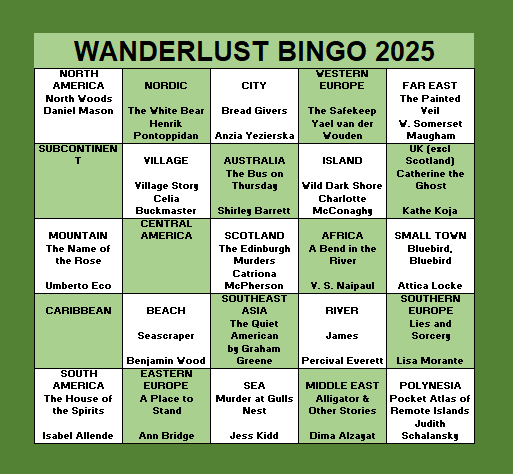
Next, I’m bringing up the Pocket Atlas of Remote Islands by Judith Schalansky again, and I’m pairing it with Island, a book of short stories by Alastair MacLeod. One is about the geography of islands, and the other is about living on one. (I also might have paired the Pocket Atlas with The Islandman by Tomás O’Crohan, a memoir by one of the last inhabitants of the Blasket Islands in Ireland, but then both would be nonfiction.)
Next, we have the memoir Girl Interruptedby Susan Kaysen, about a young woman who is incarcerated in a mental hospital for very little reason, and A Girl Is a Half-Formed Thing by Eimear McBride, about a girl being subjected to other kinds of violence.
Finally, I thought of two books by Barbara Kingsolver that kind of complement each other. One is the nonfiction memoir/food book, Animal, Vegetable, Miracle: A Year in Food Life, and the other is Demon Copperhead,her acclaimed novel about the difficulties of a life of poverty in Appalachia, the same setting for her farm in the nonfiction book (but a lot more prosperous).
It’s the first Wednesday of the month, so it’s time for WWW Wednesday, an idea I borrowed from David Chazan, The Chocolate Lady, who borrowed it from someone else. For this feature, I report
What I am reading now
What I just finished reading
What I intend to read next
This is something you can participate in, too, if you want, by leaving comments about what you’ve been reading or plan to read.
What I am reading now
I am reading What Happened to Nina? by Dervla McTiernan. It’s a departure from the other books I’ve read by her, because it’s set in Vermont, U. S., instead of Ireland. It’s billed as a thriller, although so far (I’m two-thirds of the way through), it’s not showing any evidence of that. It’s more of a psychological novel about what happens when a young woman goes missing.
What I just finished reading
My last book was one I read for Literary Wives, review coming up December 1. It’s The Soul of Kindness by Elizabeth Taylor. It’s more of a community novel, like Middlemarch, even though it has a main character. It’s about the effect of a woman’s actions on the people around her.
What I will read next
I just got this book out of the library, so I’ll probably read it next. It’s Jane Austen in 41 Objects, yes, nonfiction by Kathryn Sutherland. I read about it on another blog, and it sounded fascinating. I would say it is right in time for Nonfiction November, except that I probably won’t be posting my review until January or February.
For week two of Nonfiction November, the host is Frances at Volatile Rune. The prompt is Choosing Nonfiction: There are many topics to choose from when looking for a nonfiction book. For example: Biography, Autobiography, Memoire, Travel, Health, Politics, History, Religion and Spirituality, Science, Art, Medicine, Gardening, Food, Business, Education, Music. Maybe use this week to challenge yourself to pick a genre you wouldn’t normally read? Or stick to what you usually like is also fine. If you are a nonfiction genre newbie, did your choice encourage you to read more?
I’m not actively reading nonfiction this month unless something comes up in my pile. I usually use this month to read other people’s entries and get ideas for books to read in the future. I put a bunch of books on my To Read list last year, but so far, I have only managed to read a few of them. That doesn’t mean I don’t intend to read them.
As far as genres, although I tend to read mostly history and biography, particularly of literary figures, and a bit of true crime, I will read any topic if it seems interesting, even science, which in general I don’t have much interest in. About the only topics I won’t read are self-help and health, because I’m really uninterested in those topics. But psychology, for example, which is related, I find interesting. (I also won’t read business books, especially the “Ten Traits” type, because they are based on very little research and are generally stupidly thought through—and thank goodness, I’m no longer working.)
I thought I’d use this week to talk about some of the more unusual, for me, nonfiction books I read during the year. Unfortunately, I have only posted reviews of one of them so far.
Although I don’t tend to read about health, this year I read Animal, Vegetable, Miracle: A Year of FoodLife by Barbara Kingsolver. Now, granted, this book is partially memoir, but it also has lots of information on food topics and the importance of eating fresh food. I actually read this book because it filled a hole in my A Century of Books project that I was trying to get done last year. (It came over into this year by four months!) That’s because, although I tend to like Kingsolver and think she has written wonderful books, she can also be preachy. And she is, a bit, in this book. But it also has lots of information about food topics I hadn’t thought about, includes a bit of memoir, and has tasty sounding recipes!
Now, I like books about maps and mapmaking. I don’t often see one, but I think books about mapmaking and the related subjects, geography and geology, can be interesting. I haven’t reviewed it on my blog yet, but one of my best books, whenever it comes up (it may not make it until next year) will be Pocket Atlas of Remote Islands: Fifty Islands I Have Not Visited and Never Willby Judith Schalansky. This is a lovely book that I read about on someone else’s blog. I’d like to give them credit, but I can’t remember who they are. (I did a quick search hoping a familiar blog name would pop up, but it didn’t, although I saw lots of copies for sale on eBay, surprisingly.) This book is interesting not just because of the islands Schalanksy chooses to talk about but also because of the things she chooses to tell about them, including a topographical map, one story about each place, and the distance from other locations. This is probably the most unusual book about maps I have ever read.
Finally, another as yet unreviewed book for me is Fenwomen: A Portrait of Women in an English Villageby Mary Chamberlain. This is a sociology study from the 1970s, when feminism was just starting to make inroads in academia, but it was also the very first book published by Virago, and its reception was fairly astonishing, at least it would probably seem so to people nowadays. It simply interviews as many women in a small village in the fens as it can about their lives, their work, and so on. The updated version that I got includes an Introduction from 2010 that talks about what happened when it was published and includes about twenty pages of beautiful photos at the end.
I’m looking forward to getting new ideas for nonfiction this year.
Hi, all, it’s November, so it’s time for Nonfiction November, which I participated in the last two years. This year, it is hosted by the following bloggers:
Each week, the host posts a prompt for discussion and a linkup where you can link your posts. For this first week, the host is Heather at Based on a True Story, and the prompt is Your Year in Nonfiction. For more information about the prompt, see Heather’s blog. And here we go for mine.
What Did I Read?
Since November 2024, I read 16 books. I think this means that I have increased my nonfiction reading in number by one each year that I participated until now, when I went up by four (but I am not sure if I included the two books I read in November 2024 in my count last year—probably not). Last year I didn’t list them all, just totaled them by category, but sixteen isn’t so many, so I may as well, in the order that I read them. If I have reviewed them yet (I am behind posting), there’s a link to the review.
Pocket Atlas of Remote Islands: Fifty Islands I Have Not Visited and Never Will by Judith Schalansky
Shakespeare: The Man Who Pays the Rent by Judi Dench
The Novel Life of Jane Austen: A Graphic Biography by Janine Barchas and Isabel Greenberg
Fenwomen: A Portrait of Women in an English Village by Mary Chamberlain
As far as categorizing them, here goes:
Biography/Memoir: 10
Art and Language: 3
History: 4
Sociology: 1
Sports: 1
Food: 1
Science: 1
True Crime: 1
Maps: 1
Clearly, some of these fit into more than one category. The hardest to categorize are Animal, Vegetable, Miracle, which I have put under memoir but is as much about the importance of good food, and Shakespeare: The Man Who Pays the Rent, which I have not put under memoir, even though it includes lots of anecdotes, but under art and language, because it’s mostly about interpreting Shakespeare’s plays (which sounds dull, but it is not).
Just as a side note, when I look at my record of nonfiction reading from the past year, I see that I seriously went into it in the spring, reading half a dozen books between February and April, then sort of fell off for the summer, and picked up the pace a bit in the fall.
What Were My Favorites?
If I go by my ratings, my favorites were Life Among the Qallunaat, The Pocket Atlas of Remote Islands, and Shakespeare: The Man Who Pays the Rent. However, hands down, the one that made the most impression on me was Pocket Atlas of Remote Islands. I’m sorry, therefore, that I haven’t reviewed it yet. (It’s going to be a Best of Ten, which I tend to save up so as not to have too many in a given period, so I may not get to my review this year, because there are a bunch ahead of it.) I believe I read about it during last year’s Nonfiction November. Other books I read about last year were Cultish and Mad Madge (I think).
What Were My Favorite Topics?
Well, obviously and always, I like reading about people and history. I didn’t read anything this year that I wanted to follow up on, although I like to read about indigenous people, so probably will.
What Am I Hoping to Get Out of Nonfiction November?
Since I’m not a big nonfiction reader and don’t tend to read many blogs that focus on it, I hope to add a few more interesting books to my To Read list.
It’s time for another Classics Club Spin. To participate, post a numbered list of 20 books from your Classics Club list (here’s mine)before Sunday, October 19. Classics Club will announce a number on that day, and that determines the book to read before the 21st of December.
I no longer have 20 books left on my list, although I have neglected it shamefully, so I have to repeat titles. In fact, I have exactly 10 books left to read. Here’s my list for this spin:
The Tavern Knight by Raphael Sabatini
Love’s Labour’s Lost by William Shakespeare
The Deepening Stream by Dorothy Canfield Fisher
Tis Pity She’s a Whore by John Ford
The Methods of Lady Walderhurst by Frances Hodgson Burnett
The Princess of Cleves by Madame de la Fayette
Les Misérables by Victor Hugo
Cecilia, Memoirs of an Heiress by Frances Burney
The Three Musketeers by Alexandre Dumas
Our Mutual Friend by Charles Dickens
The Three Musketeers by Alexandre Dumas
Cecilia, Memoirs of an Heiress by Frances Burney
Les Misérables by Victor Hugo
The Princess of Cleves by Madame de la Fayette
The Methods of Lady Walderhurst by Frances Hodgson Burnett
Tis Pity She’s a Whore by John Ford
The Deepening Stream by Dorothy Canfield Fisher
Love’s Labour’s Lost by William Shakespeare
The Tavern Knight by Raphael Sabatini
Good luck to everyone! I hope you get a book you enjoy.
In a month, Novellas in November is starting up again, hosted by Cathy of 746 Books and Beck of Bookish Beck. Last year, I think I just plunged into Novellas in November by reading a bunch of novellas, but this year, I see Beck has already launched a Linky for planning posts. (Maybe they did this last year, too, and I just didn’t notice.) So, here I am throwing together a planning post.
I tend to read well before I publish unless something unexpected comes up, so I have already started reading for this event. Aside from a general post about what novellas I’ve read through the year, I have so far read two novellas that I will review in November, and I plan to read five more.
Here are the ones I have finished with a brief description:
The Sweet Dove Died by Barbara Pym: a woman of a certain age becomes a little too close with a much younger man.
Seascraper by Benjamin Wood: a young man is the only person left carrying on a traditional way of shrimping when he meets a film maker.
The novellas I haven’t read yet but plan to review in November are
The Buddha in the Attic by Julie Otsuka: in the early 19th century, a group of women are brought from Japan as “picture brides.”
For Thy Great Pain Have Mercy on My Little Pain by Victoria Mackenzie: two women meet in 1413 Norwich, one of whom has visions considered heretical.
Hex by Jenni Fagan: In 1591, Geillis Duncan, a convicted witch, receives a visit from a mysterious woman.
A Pale View of the Hills by Kazuo Ishiguro: a Japanese woman relives the events at the end of World War II.
Why Did I Ever by Mary Robinson: a woman is barely keeping it under control in this dark comedy.
It’s the first Wednesday of the month, so it’s time for WWW Wednesday, an idea I borrowed from David Chazan, The Chocolate Lady, who borrowed it from someone else. For this feature, I report
What I am reading now
What I just finished reading
What I intend to read next
This is something you can participate in, too, if you want, by leaving comments about what you’ve been reading or plan to read.
What I am reading now
I got on to Henryk Sienkiewicz quite a few years ago now, when I read his gripping novel With Fire and Sword, the first of a trilogy. When I was reading it, I learned from a friend who is first-generation British/American of Polish descent that his were the books Polish children grew up with, but these aren’t just books for children. He is a late 19th century/early 20th century writer of historical fiction, a Nobel Prize for Literature winner. His best-known book is Quo Vadis,my least favorite of his so far. Sometime back, I noticed that someone was selling a used copy of The Teutonic Knights by him, and it finally made it to the top of my pile. I have since read that he considered it his best book, and I’d say it’s a real page-turner. It’s also very long. All of his books that I’ve read so far are quite long except Quo Vadis. But somehow the time goes quickly. Almost finished!
What I just finished reading
I just finished a book sent to me by NYRB, The Sweet Dove Died by Barbara Pym. It’s about an attractive woman of a certain age, a “fragile” woman, who becomes friends with a much younger man and his uncle. Although friendship with the uncle is more suitable, she prefers the young man and slowly begins drawing him in so that he is dependent on her. At 207 pages, this one squeaks in for Novellas in November.
What I will read next
I usually have written quite a few reviews ahead of time, and I see that I should be reading things I will be reviewing in November, which means two things: Novellas in November and Nonfiction November. Since Nonfiction November tends to be more about the nonfiction people have read during the year, I have a pile of novellas on my bed table that it’s about time to start reading. And Seascraper by Benjamin Wood serves both the purpose of being a novella and of being a book that I’ve read about lately (and also a Booker Prize longlister). So, I’ll start reading my pile with it.