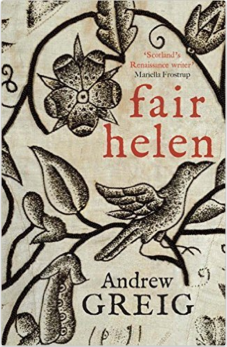
 Best Book of the Week!
I was completely entranced by Fair Helen from the first moments of reading it. It’s based on a 16th century ballad, “Fair Helen of Kirkconnel Lea.” Since one of my interests (although sadly not pursued for years) is early ballads of Great Britain, Ireland, and Appalachia, this is a good fit for me.
Harry Langdon is a city man, a scrivener from Edinburgh, the son of a craftsman, so the Borderlands seem wild to him when he answers the summons of his good friend Adam Fleming. Adam feels he needs his friend’s support. He fears his stepfather, his father’s brother, might be trying to kill him. And Harry is surprised to find Adam’s stepfather in the role of Heidsman instead of Adam after the recent death of Adam’s father. (If this sounds familiar, it’s supposed to.)
But Adam is more concerned about the disposition of his love affair. He has fallen madly in love with Helen Irvine, a beautiful and vivacious girl. But the Irvines and the Flemings have been feuding for years. (If this sounds familiar in a different way, it’s supposed to.) Helen’s parents want her to marry Robert Bell, a man with more prospects than a member of an unmade family.
We know from the beginning of the novel that none of this will end well, for we have the text of the ballad before us. And Harry in his old age is telling this story of the most important event in his life and the two people he loved most. For Helen is his cousin, and the two of them were very close as children.
The situation is complicated by the politics of the Borderlands. Harry finds himself summoned by Walter Scott of Buccleuch, a lord who frankly terrifies him (a very different Wat Scott of Buccleuch than the one depicted by Dorothy Dunnet), and is forced to spy on his friends. It becomes clear to him that there have been attempts at murder, if not of Adam, but who is behind them and why?
The novel is written in a mix of Scots and English, with a glossary provided. It is a strong style that goes well with its subject matter. At first, I was thrown off by the footnotes, which are all in the wrong places. I didn’t realize what was going on and thought they were simply non sequiturs. When I figured it out, I spent a lot of time flipping pages, trying to match them up. I honestly wasn’t sure if it was a printing error until I ran across the following passage:
I had aimed to set down plainly only what I witnessed concerning the events at Kirkconnel, to correct the folk haivers and bring some understanding. Yet already I find footnotes, asides and addenda have begun to run wild down the margins and among the lines. I like to think of them as bright wildflowers that border and run through the acres of turnip and kale by which we feed ourselves.
So, Greig is having some fun with us and in more ways than one, although this is in general not a light-hearted novel. It is lovely, though, full of yearning and regret, with a backbone of history for those who are interested.
In my recurring theme of quality printing, I have to say that this is the first modern book with properly bound signatures that I’ve seen in a long while, as opposed to the signatures being hacked off and glued. That’s great, and it means my book will stay together longer. However, the end papers were pasted down carelessly. They have creases, and some of the pages of the book stick out beyond the cover. So, Quercus Books, one big step forward and a few small ones back.
Related Posts
The Candlemass Road
The Disorderly Knights
Turn of the Tide


 What? Me Read?