Day 795: Pitcairn’s Island

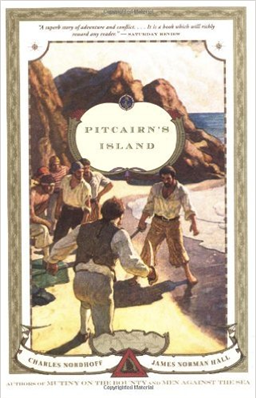
Cover for Pitcairn's IslandThis final novel in the Bounty Trilogy tells what happened to the mutineers from Mutiny on the Bounty. As explained in the introduction, the fate of the mutineers was not known until Pitcairn’s Island was rediscovered by an American ship in 1808. Although the mutineers arrived 18 years before, only one survived, surrounded by the wives and progeny of himself and others.

As the authors explain, the only information available about the fate of the mutineers was directly or indirectly from Alexander Smith, but those sources failed to agree and many accounts were improbable. So Nordhoff and Hall presented what they thought was the most likely version of events.

The mutineers and their companions arrive at Pitcairn’s Island in 1790. They have already tried to settle twice in Tahiti and once in the Friendly Islands (Tonga) but had to leave for fear of discovery or because of hostile natives. With the nine mutineers are six native men and twelve native women. Although all of the islanders get along well at the beginning while they are busy building their homes and planting their crops, the seeds of failure are already there, in the quality of some of the mutineers.

The first problems are caused by John Williams. He already has a woman named Fasto, but he lusts for Hutia, the wife of one of the native men, Tararu. When disputes over the woman reach the heights of disruption, Fletcher Christian allows Hutia to pick her husband. She picks John Williams, thus introducing the first tension between whites and native men.

But Christian’s biggest mistake is his egalitarian impulse to grant each man a vote on the future of their community. Although he wants to extend this vote to the native men, the whites do not agree, and it is this plus the votes extended to the less scrupulous whites that cause the problems. Eventually, some of the lowest of the men begin treating the native men as their slaves. The final break between whites and natives comes after a vote about ownership of the land, for the whites want to own the land and reduce the natives to servants.

Although most of the novel is peaceful, taking place in a tropical paradise, the worms in the apple are a few of the white men. A palpable tension brews throughout the novel.

If I have a criticism, it is that the final portion of the novel, presented as Alexander Smith’s story to the mate of the Topaz in 1808, goes on for a bit too long past the fate of the islanders into Smith’s discovery of God and the Bible. Other than that, the novel is gripping and a fine conclusion to the trilogy.

Related Posts

Mutiny on the Bounty

Men Against the Sea

Robinson Crusoe

Day 624: Men Against the Sea

Cover for Men Against the SeaMen Against the Sea is the sequel to Mutiny on the Bounty, and it accomplishes an interesting feat. While Mutiny on the Bounty depicts Captain Bligh as an enraged and irrational task-master, Men Against the Sea shows him as a consummate navigator and an able leader.

The novel takes up where the mutineers put the more loyal men adrift in a small boat. They have very little food and water and only a small tool box and a few weapons. Nineteen men are crowded into the 23-foot-long open launch.

Although the men make their way at first to one of the nearby Friendly Islands (present-day Tonga), they come close to being killed there by hostile natives. In fact, one of their number is murdered while they make their escape. They realize they will have to travel 3600 miles to the nearest European-occupied territory, in the Dutch East Indies (Indonesia).

Narrated by Thomas Ledward, the ship’s surgeon, the novel tells the story of this incredible journey. The men fend off hostile natives, battle storms, and survive on scanty rations and little fresh water, lead on by Captain Bligh.

This novel is well written and engrossing, although it lacks the suspense of the trial in Mutiny on the Bounty. I am looking forward to the final book in the series.


Day 424: Mutiny on the Bounty

Cover for Mutiny on the BountyMutiny on the Bounty did not seem like the type of book I would normally pick to read, but when my friend Karen learned I had never read it, she sent me a copy. Now that I have read it, I’m glad she did, for it is a true adventure story, extremely interesting and well written.

The story of the famous mutiny is told by Roger Byam, the only fictional character on the ship. At the beginning of the novel Lieutenant Bligh (not, apparently, a captain at the time) meets the young man socially and invites him along on the journey because of Roger’s facility with languages. One of Bligh’s directives for the voyage besides its mission to collect breadfruit trees is to draft a dictionary of the Tahitian language, a task for which Bligh does not feel competent.

Once aboard, Byam soon learns how ill-fitted Bligh is to command men. Byam commends him as an excellent navigator, but Bligh has no control over his temper and abuses all his men verbally, no matter their station. He is prone to order the most vicious punishments for slight or even imagined offenses. As time goes on, the men also come to believe that Bligh is cheating them out of their due rations with the connivance of Mr. Samuel, his clerk. Bligh even accuses his officers of the theft of cheeses that he himself had delivered to his own house before departure.

Bligh’s clash with Fletcher Christian is perhaps inevitable. Christian is one whom Bligh first views as a friend and promotes to second-in-command over the head of the ship’s master. However, Christian is an upright man whose attempts to soften Bligh’s behavior and whose rebukes in the name of fairness are not well received. And Christian is victim to his own passions. Nordhoff and Hall build slowly to the famous mutiny, which takes place shortly after the ship has departed Tahiti for home.

Although Christian is depicted more positively than Bligh, his fault lies in taking actions that affect the lives of the men who are innocent of the mutiny. Fully half the novel deals with the aftermath of the mutiny, culminating in the trial of eight men, three of whom are innocent.

The novel is carefully researched and the tale told is enthralling, from the details about shipboard life in the 18th century to the customs and culture of Tahiti. Even though the first chapter makes you aware of Byam’s fate, as he is tried for mutiny although entirely innocent, the suspense at the end of the novel still holds you to the page.

I was surprised to learn that this novel is the first of a trilogy. Men Against the Sea, which I had not heard of, tells the story of Bligh and the other men set adrift in a small boat, and Pitcairn’s Island, which I had heard of, relates what happened to the men who left with Fletcher Christian on the Bounty after they departed Tahiti for the second time. I will certainly read these other two novels.