Review 2250: The Wheel Spins

The Wheel Spins is the novel upon which the many versions of the movie The Lady Vanishes are based. Although I am familiar with the story in all its incarnations, I still found the book exciting.

Iris Carr is on holiday with a group of her friends in a Balkan country, possibly Romania. Rich and spoiled, the friends have been cheerfully disrupting their small hotel, leading the other English guests to dislike them. The last day, she finds she is tired of them herself, so she decides to stay a day longer than the others. When she does leave, she has a touch of sunstroke and has to be helped. The train is crowded, so the porter crams her into a compartment for six as the seventh person.

In the compartment are a commanding woman in black who turns out to be a baroness, a family of three, a cold blonde lady, and a nondescript middle-aged woman in tweeds. Iris isn’t feeling well because of her sunstroke, but the nondescript woman turns out to be English, Miss Froy, and takes her to the dining car for lunch. There she prattles about returning to England to her elderly parents and dog, her job as governess for the baroness, and her next job for the baron’s political opponent.

Back in the train compartment, Iris falls asleep. When she wakes up, Miss Froy is gone. When she doesn’t appear, Iris searches the train for her, but she doesn’t seem to be on it. In growing alarm, she finds her compartment companions denying that Miss Froy ever was there. On her way to the dining room, Miss Froy met some of the English people from the hotel, but when Iris speaks to them, some have not seen her and others lie for their own reasons. So, even though a young man named Hare and the professor with him try to help her, Hare believes she has hallucinated because of her sun stroke, and the professor thinks she is hysterical.

As the train nears Trieste, Iris begins to fear Miss Froy is in danger, but what can she do about it? This all makes an thrilling novel.

Missing from the movie adaptations are passages that visit Miss Froy’s elderly parents and dog as they await her coming. In a way, they are unnecessary, but they make the ending much more touching, especially the dog.

I received this novel from the publishers in exchange for a free and fair review.

Related Posts

Some Must Watch

Juggernaut

Twice Round the Clock

Review 2241: Suddenly at His Residence

The grandchildren of Sir Richard March gather together in London to drive down to Swanswater Manor for an annual remembrance of Serafita, Sir Richard’s first wife. They are driving down with Philip and his wife Ellen, but before others arrive, his cousin Claire forces an admission from Philip about his relationship with her. Philip tells his wife he wants to be with Claire. Ellen seems to take this lightly, but she is upset.

It’s clear that the young people behave brashly with each other and tease their grandfather. He, however, becomes offended and vows to disinherit them all and make his second wife, Bella, his sole heir. Peta is currently the principal heir, but Philip, Claire, and Edward are due to get some money.

That afternoon, Sir Richard insists on spending the night by himself in a lodge after summoning Stephen Garde, his solicitor, to change his will. During the afternoon, Bella and Peta go there to try to convince him to sleep in the house or accept company, and Ellen takes him his green pen. In the evening the gardener rakes and sands all the paths around the lodge.

In the morning, Claire goes to the lodge and finds Sir Richard dead. Her tracks are clearly the only ones on the path. The family assumes he died from his heart condition, but he turns out to be poisoned with his medication.

The family tries not to think the murderer may be 17-year-old Edward, whose mother’s fascination with psychiatry has lead him to fancy himself with problems and who allegedly goes into fugue states. Although Edward knows that some of his problems are feigned, sometimes he’s not sure what he has done.

Inspector Cockrill is not sure who committed the murder, but the inquest finds a verdict of murder against Ellen because of a silly theory that she could have injected the poison using his pen, but also because she is the only “foreigner.”

Aside from the ridiculous belief that looking up suddenly could bring on a fugue state, which I assume was a belief of the time, I liked the characterization in this novel, which is accomplished mostly by dialogue. I thought that one aspect of the solution was unlikely and that the motive was thin. However, generally I enjoyed this one.

I received this book from the publishers in exchange for a free and fair review.
Related Posts

Death of Jezebel

Green for Danger

The White Priory Murders

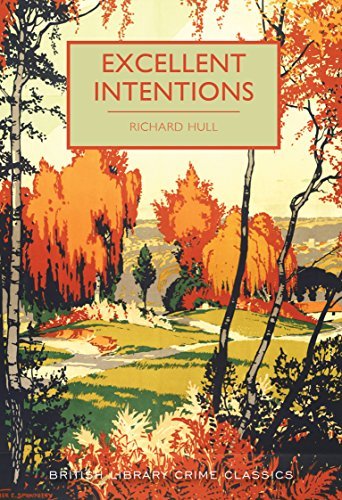
Review 2224: Excellent Intentions

Of the Golden Age mysteries I’ve been reading lately, Richardl Hull’s The Murder of My Aunt was one of my favorites. So, I looked for another by him and found Excellent Intentions. Like The Murder of My Aunt, it has a gimmick—that it begins with the trial but doesn’t tell who the defendant is until the end. However, with its time tables and finicky details, it is the kind of mystery that makes my head spin.

No one is at all upset when Henry Cargate dies of an apparent heart attack on the train. He was a wealthy man who bragged about how much he paid for things, refused to help the local economy by buying from them or employing locals, insulted servants and guests equally, forged stamps and then accused others of doing so, and liked to accuse people of stealing items he planted on them. But when it turns out a passenger saw him take snuff and immediately die, and there is a poison in the snuff box, well then.

So far so good. Inspector Fenby manages to narrow the time that the poison got into the snuffbox to a few hours the day before. But then we get into details like what time the poison bottle was on the windowsill versus the desk, where was the snuffbox, what color were the roses in the next room. Sigh.

Related Posts

The Murder of My Aunt

Death in the Tunnel

4:50 from Paddington

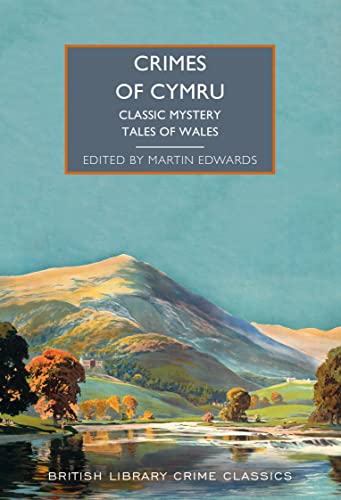
Review 2212: Crimes of Cymru: Classic Mystery Tales of Wales

This latest British Library Crime Classics collection features mystery and crime short stories written by Welsh authors or located in Wales. The stories were written from 1908 to the mid-1980s, and some of them are quite eerie in nature.

For example, in the 1936 story “Change” by Arthur Macken, holiday makers scoff when Vincent Rimmer tells them lights are on all night in the cottages of Tremant to keep the fairies away. Yet later a child is apparently exchanged by the fairies. Or is he?

In “The Way Up to Heaven,” Roald Dahl (born in Wales) tells the story of Mrs. Foster, whose husband purposefully torments her by being late even on the way to her flight to Paris to see her grandchildren for the first time. She figures out a way to take care of that problem.

In “No More A-Maying” by Christina Stead, the lies of two children with a guilty secret create an injustice in rural Wales.

Although most of the earlier stores are more traditional, “Water Running Out” by Ethel Lina White explains how Harvey deals with his aunt, who has been preventing his marriage to Annie for years by blackmail.

And another attempt to prevent marriage is perpetrated in “The Chosen One” by Rhys Davies. Rufus, whose family has occupied his cottage for hundreds of years, gets a note from his eccentric landlady, Audrey P. Vines, telling him his lease is up and she’s throwing him out.

This was one of the more entertaining and atmospheric of these collections that I have read. I usually like them, but prefer getting into a longer work.

I received this book from the publishers in exchange for a free and fair review.
Related Posts

The Edinburgh Murders and Other Tales of Scottish Crime

Final Acts: Theatrical Mysteries

Murder at the Manor

Review 2202: Twice Round the Clock

Young Helen Manning is astonished when Anthony Fane asks her father for her hand and he agrees. Not only does he agree, but he invites the Fanes and their friends over to celebrate.

The reason Helen is astonished is because she has always been terrified of her father. But her friends, Sir Anthony and his wife, daughter Kay, friends Doctor Henderson, Teddy Fraser, and Bill Brent, accompany Tony to the Mannings for dinner.

All the guests find Manning disturbing, especially when the famous scientist shows them an experiment where he brutally poisons a kitten belonging to the cook, Mrs. Geraint. Unfortunately, a tremendous storm strands them all there for the night.

Bill Brent is awakened at four by a noise downstairs in Manning’s office. When he goes down, he finds Manning dead at his desk with a carving knife between his shoulder blades. The French doors behind him are broken, and the room is in chaos.

This is a lively novel that goes some surprising places, including espionage and hidden family relationships. It has some unlikely plot points, and why everyone’s tires are slashed is never explained. But it’s a quick, fun read.

I received this book from the publishers in exchange for a free and fair review.

Related Posts

Jumping Jenny

Death of Jezebel

Thirteen Guests

Review 2174: The Black Spectacles

Detective Inspector Andrew Elliot is vacationing in Italy when he overhears an English party discussing some poisonings in a town back home. He is struck at first sight by Marjorie Wills. This proves to be unfortunate, because when he returns home, he is assigned the poisoning case and Marjorie is a suspect.

The poisoning case involves someone substituting poisoned chocolates for harmless ones in a local shop. One boy has died. However, this case is soon overshadowed by the murder of Marcus Chesney, Marjorie’s uncle, under bizarre circumstances. Chesney has a hobby horse that people aren’t observant, so he designs a demonstration of his point. During the demonstration, a bizarrely dressed man comes in to the room where Chesney is manipulating objects at a desk and forces a capsule down his throat. Although this is part of the demonstration, it is not part of it for the capsule to be poisoned. Chesney dies and his assistant is found outside bashed over the head. Later, the unconscious assistant is also poisoned.

Present are Chesney’s friend Dr. Ingram, the assistant, Marjorie, and Marjorie’s fianceé, George Harding, whom she met on the trip. Not present is Dr. Joe Chesney, Marcus’s brother, out on a house call.

As Elliot investigates, things keep pointing to Marjorie, but he can’t prove anything. Finally, he asks Gideon Fell for help.

The Black Spectacles is supposedly Carr’s most popular book, even though it doesn’t feature a locked door mystery, his specialty. I enjoyed it a lot, more than the other books I’ve read by Carr, although I immediately picked out the killer and never wavered. Still, I never figured out exactly what was going on during the demonstration.

I received this book from the publisher in exchange for a free and fair review.

Related Posts

The Seat of the Scornful

The Lost Gallows

Sad Cypress

Review 2143: Death of an Author

Death of an Author wasn’t my favorite book by E. C. R. Lorac, but it certainly is a clever one. And Lorac airs that recurring question, Can a women’s writing be differentiated from a man’s? in her book set in the publishing world.

Andrew Marriott, the managing editor of a publishing company, is asked by one of his best-selling authors, Michael Ashe, to invite another of his authors, Vivian Lestrange, to dinner along with himself. Since Lestrange is a recluse, this subterfuge is necessary if Ashe is to meet him. Lestrange accepts, and Ashe is astonished to meet a self-possessed young woman.

A few months later, the same young woman goes to a police station. There she explains that she is Eleanor Clarke, the secretary for the author Vivian Lestrange, and she fears something has happened to her employer, as when she tried to go to work, no one answered her knock.

The police find the house impossible to enter except through a walled door and have to climb a ladder to get in. They find a perfectly cleaned house with no one inside but open French doors with a bullet hole through one. Miss Clarke says that not only is her employer missing but his housekeeper, Mrs. Fife, is not even known at the address she gave Clarke.

Inspector Bond is suspicious of Miss Clarke, and after some investigation shows no proof that Lestrange even existed, he theorizes that she was the author of the Lestrange books and is for some reason spoofing the police. However, Chief Inspector Warner is inclined to believe her, and his belief seems justified when a body with Lestrange’s notebook in his pocket is found burned up in a remote cottage.

After learning about Michael Ashe’s interest in Lestrange, the police look for him, but he appears to be out of the country. However, the timing of his departure makes it feasible for him to be the killer.

The detectives find a possible connection to two brothers, one of whom embezzled funds from a trust both were responsible for and escaped, while the other served in prison for it claiming he was innocent. Could one of the authors be one of these brothers? or both?

Although I had a feeling that the police made a mistake about the brothers, I did not figure out exactly what happened. I’m not quite sure why I didn’t enjoy this one as much as some others by Lorac, though.

I received this book from the publisher in exchange for a free and fair review.

Related Posts

Post after Post-Mortem

Checkmate to Murder

Death of a Bookseller

Review 2132: Death of Mr. Dodsley

On his rounds, a young police constable encounters a drunken young man late one night. The man tells him he saw a door opened and closed by a cat, so after the man leaves, the constable goes ahead checking doors and finds the door to a bookstore open. When he looks into the store, he finds a man shot to death in the office. It’s Richard Dodsley, the owner.

Inspector Mallet’s team finds that someone, possibly two people, waited in the store while Dodsley was out and shot him when he returned late to work on a sale catalog. They also learn that a mystery was recently published by Margery Grafton, the daughter of a prominent politician, the circumstances of which closely match those of the murder. It seems more than a coincidence that Margery Grafton is keeping company with Dick Dodsley, the dead man’s nephew, who worked in the shop.

The police find that Dodsley hired a private investigator, MacNab, to find out who has been stealing rare books from his store. MacNab has not been successful, but he gets more closely involved when Margery Grafton hires him to find the murderer because she thinks the police suspect Dick.

Death of Mr. Dodsley does not present us with a super-complicated puzzle , which is a point in its favor. On the other hand, characterization isn’t super important and there are a few important characters that we see almost nothing of, such as Dick Dodsley, the prime suspect. MacNab himself is a fairly laid-back character, and at times the plot seems to be moving very slowly.

Although it’s possible to guess the murderer, there is a surprise at the end that I didn’t see coming. It’s also fun that British Library has been lately publishing these “bibliomysteries.”

I received this book from the publisher in exchange for a free and fair review.

Related Posts

Death of a Bookseller

The White Priory Murders

Death in the Tunnel

Review 2122: The Mysterious Mr. Badman

The Mysterious Mr. Badman starts out with an intriguing premise. Athelstan Digby is on holiday in Keldstone waiting for his nephew, Jim Pickering, to be free for a walking trip through Yorkshire. His landlords have to attend a funeral, so Digby offers to watch their bookstore. During the afternoon, three men come in at separate times looking for John Bunyan’s Life and Death of Mr. Badman—the rather shifty looking Reverend Percival Offord, a foxy looking man, and a genial chauffeur. Shortly after Digby has disappointed them, a boy comes in with books to sell, including Life and Death of Mr. Badman.

Naturally, Digby takes the book home. Later that night, someone breaks into the bookstore. Digby confides in his landlord, Mr. Lavender, who suggests they put a note in the bookstore window asking the person who accidentally took the book to return it. That will prevent further break-ins.

The boy who brought the books in says they were given to him by Miss Diane Conyers. Before Digby and Jim have a chance to talk to her, Digby finds a letter in the book that brings to mind a recent crime. A man named Neville Monkbarns was to be hung for murder but he was reprieved and sent to a mental hospital. However, the letter shows that Neville Monkbarns is actually the estranged son of the Home Secretary, Sir Richard Mottram. Sir Richard is Diane’s father, and it’s clear that the letter was going to be used to blackmail him.

Then, the body of the foxy looking man is found on the moor.

If you ignore the unlikelihood that any of the unsavory characters would know about the letter, this situation kicks off a lively and adventurous investigation, with Digby and Jim trying to help Diane protect her father. The main characters are likable and interesting, the dialogue is often amusing, and the book is light and fast-moving. I would like to read more of Digby’s adventures.

The cover explains that the original novel has been exceedingly rare, so I’m glad British Library Crime Classics chose to reprint it.

I received this book from the publishers in exchange for a free and fair review.

Related Posts

Death of a Bookseller

The Murder of My Aunt

The Iron Clew

Review 2091: Final Acts: Theatrical Mysteries

British Library Crime Classics’ latest collection of mystery short stories has some connection to the theater. Some stories are only peripherally connected—feature an opera singer, perhaps—while others are set there and show a deep knowledge of that environment. As usual, the stories are ordered chronologically, beginning with a 1905 story by Baroness Orczy and ending with one from 1958 by Christianna Brand.

Baroness Orzcy’s “The Affair at the Novelty Theater” is a complicated story about the disappearance of some priceless pearls.

“The Affair at the Semiramis Hotel” by A. E. W. Mason is one of the super-complicated crime stories common in the earlier years involving people in costumes, a robbery, and a burglary.

“In View of the Audience” by Margarite Steen is a creepy one about a young man who gets on the wrong train and ends up accompanying a strange man to a derelict theater, where he hears about an old unsolved murder.

“Blood Sacrifice” by Dorothy Sayers leaves the reader to decide if there is a crime or not. Young playwright John Scales is furious with Mr. Drury, who has bastardized Scales’s play to make it a success. Then an accident places Drury in Scales’s power. This is the first story in the book in which characterization plays much of a role.

“The Blind Spot” by Barry Perowne is about a playwright who had a brilliant idea for a locked room mystery when he was drunk but can’t remember it sober.

“I Can Find My Way Out” by Ngaio Marsh probably shows the most knowledge of the theater, as a leading man is murdered in his dressing room.

“The Lady Who Laughed” by Roy Vickers is a strange story about a clown who murders his wife for finding him funny.

I enjoyed the satisfying surprise ending of “The Thirteenth Knife” by Bernard J. Farmer.

In “Credit to William Shakespeare” a poisoning onstage is solved through a man’s knowledge of Hamlet.

I think my favorite story was “After the Event” by Christianna Brand, where her detective, Inspector Cockrill, ruins the Great Detective’s favorite story by explaining how he got it wrong.

I received this book from the publishers in exchange for a free and fair review.

Related Posts

The Christmas Card Crime and Other Stories

The Edinburgh Mystery and Other Tales of Scottish Crime

Silent Nights