Review 2171: Stories for Christmas and the Festive Season

Although May is an odd time to review a collection of Christmas stories, I didn’t receive a copy of this book until much after the season. This entertaining collection is ordered by when the story occurs during the festive season and includes works by women published during the 20th century. Some of the authors are well known and others are only remembered now for a specific work. The introduction by Simon Thomas discusses each story in turn and tells something interesting about it.

The first story, “The Turkey Season” by Alice Munro, provides insight into a side of the holidays we may not have considered, factory workers processing turkeys. As usual, Munro is a masterly storyteller.

Some of the stories are amusing, such as “This Year It Will Be Different” by Maeve Binchey, about a housewife who goes on strike during the holidays, or “Skating” by Cornelia Otis Skinner, about a woman’s attempt to learn ice-skating. Others start out amusing but have a deeper meaning, for example, “The Christmas Pageant” by Barbara Robinson, about what happens when “the worst children in the world” get involved in the pageant or “Christmas in a Bavarian Village,” which subtly foreshadows World War II.

I especially liked “The Little Christmas Tree” by Stella Gibbons, about how a solitary woman’s Christmas plans are changed with the arrival of some children and “The Christmas Present” by Richmal Crompton, about an unusual gift passed down in the family from mother to daughter. The book finishes with a sprightly monologue by a black maid in “On Leavin’ Notes” by Alice Childers.

I received this book from the publishers in exchange for a free and fair review.

Related Posts

The Mistletoe Murder and Other Stories

A Christmas Carol

A Christmas Party

Review 2157: War Among Ladies

The staff at Besley High School are choosing up sides. Not only has the ineffective head, Miss Barr, appointed the steely Miss Lexington as second head, favoring her superior degree over the years of experience of Miss Parry, but then there is the problem of Miss Cullen, the French teacher.

The staff has been frantically preparing for exams. Miss Cullen used to be a good teacher, but her methods are out of date and her students don’t respect her or pay attention in class. Unfortunately, the system is structured so that failure in French (for some incomprehensible reason, and I assume for some other subjects, too) means that the student fails the exams as a whole, no matter what her other scores are. The result is that only four students pass the exam, which reflects on the whole school.

Further, Miss Cullen has taught for 26 years, but if she quits or is fired before she puts in four more, she loses her pension, including any money she has put into the fund herself. She can’t afford to quit.

All the other teachers are more or less in the same boat. If the school is closed or they lose their jobs, they are unlikely to be hired elsewhere because of the school’s poor reputation. Miss Parry begins actively trying to drive Miss Cullen out, suspecting that Miss Cullen will blame her inability to teach the students on Miss Parry’s failure to prepare them in Beginning French.

Into this hotbed come three new teachers, particularly idealistic Viola Kennedy. She does not understand that Miss Cullen’s attempts to befriend her are misunderstood as her joining Miss Cullen’s side in the school brouhaha.

This book was written to show how hard teachers work and how unfair the system is that forces teachers to work beyond their effective years (also how unfair the pension system is). However, it certainly makes women at work look bad. Although even the most badly behaved have flashes of sympathetic impulses (except maybe the despicable Miss Parry), they are relentless gossips and many of them are petty and vindictive. Women at work, at least here in the States, were stigmatized for years (as masculine or man-traps, and the word “unnatural” is used several times), and this book doesn’t do them any favors. Only Viola mostly keeps above the fray, but that doesn’t keep her from being dragged down by some of the others.

I received this book from the publishers in exchange for a free and fair review.

Related Posts

The Headmistress

Summer Half

Miss Bunting

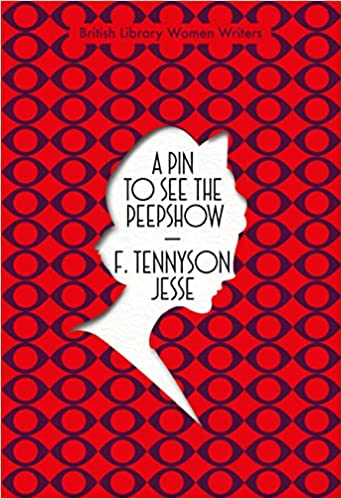
Review 2090: A Pin To See a Peepshow

A Pin to See a Peepshow is a fictionalized retelling of a famous British true crime. Jesse, who was a contributor to the Notable British Trials series, chose to make the life of her main character and the details of the crime slightly different from the actual events.

Julia Almond is an unusual girl who projects the assurance that her life is going to be different from that of the others around her. She has a sense of style and after finishing schooling, is able to find work at a small dressmakers.

Julia has lived mostly in a daze of romantic daydreams except for her work at the shop, where she thrives and is promoted. But she finds her real life boring and seems to care only for her dog, Bobbie. She is waiting for a great love.

What she gets is Mr. Starling, a friend of her father’s. During the First World War, her father dies. Her mother can’t afford the house even with Julia’s small salary, so her uncle, aunt, and cousin move in and begin to order things as they want. Julia’s bedroom, which has been her sanctuary, is invaded by her cousin Elsa. Julia is told that Bobbie can’t sleep in her room. She kicks up enough of a fuss to get that changed but finds Elsa trying to lure Bobbie away from her. When Julia finds living at home unbearable, she decides at twenty to marry Mr. Starling, whose wife has died and who looks a lot more handsome in his uniform. This, of course, does not work out well, but she gets along for years until she meets Leonard Carr, a sailor seven years younger, who begins pursing her.

Jesse’s message is that Julia would not have ended up as she does if she had not been lower class and financially insecure. Any poorer and she would have just left with her lover. Richer and divorce would have been commonplace, but to her it was a scandal. Further, although she was innocent of murder, she was convicted because of her adultery and the difference in age between her and her lover.

Jesse paints an open-eyed but sympathetic picture of Julia. Although I could have done without some of the sections at the end where others reflect on the execution, it is a powerful and affecting piece of writing.

Related Posts

Famous Trials

The Suspicions of Mr. Whicher

The Wicked Boy

Review 1891: Keeping Up Appearances

I’m not sure if it was because I was on vacation while reading Keeping Up Appearances, but it took me much longer to read it than usual for a novel its size. I did notice I occasionally had a hard time paying attention to it while at other times felt I was reading a script for I Love Lucy.

Daphne and Daisy are opposites in personality, but they’re constantly together. Daphne is confident, witty, and brave, perhaps a higher class than Daisy, while Daisy is shy, unsure, and not always swift on the uptake. Daisy is ashamed of her class origins and the circumstances of her birth, even though she has been raised by higher class family members. Daphne could care less about all that.

At the opening of the novel, both young women are vacationing with the Folyot family on an island in the Mediterranean. Mrs. Folyot works against tyranny and reminds me of Mrs. Jellyby. She is obsessed by her causes and so later has a hilarious scene of talking at cross-purposes with Daisy’s mother.

Both girls care for Raymond, the Folyot’s oldest son, a biologist. Although Daisy doesn’t like to look at the little animals Raymond shows her as much as Daphne does, Daisy fears she cares for Raymond more than Daphne does, but he likes Daphne more than her. Unfortunately, an incident with a wild boar makes Daisy too embarrassed to stay, and Daphne goes, too.

Daisy doesn’t think the Folyots would approve of her profession. Not only is she a successful author of middlebrow novels, but she takes assignments from a newspaper to write silly articles about women that the paper assigns her. Daisy is a snob, and she is proud of neither activity even though we suspect she is a better novelist than she thinks.

Macaulay obviously had fun skewering the newspapers, because the ideas for articles are ridiculous and sexist, as is clearly the attitude toward Daisy’s novels.

Although this novel satirizes the publishing industry, it is really about identity and self-image. Most of the characters are not quite likable except Daisy’s mother, who is a hoot.

I received this novel from the publisher in exchange for a free and fair review.

Related Posts

Dangerous Ages

The World My Wilderness

The Towers of Trebizond

Review 1862: Strange Journey

Polly Wilkinson, a middle-class suburban housewife and mother, is leaning on her garden gate, tired from housework. She sees a woman in a Rolls Royce stopped in traffic and wishes she was that woman. For a moment, she is, but it doesn’t last long and she thinks the experience is a daydream.

After that, Polly is periodically removed from her life and takes the place of aristocratic Lady Elizabeth Forrester. After some initial confusion about what is happening, she believes Elizabeth is causing this exchange, and she is put in some awkward positions, such as finding herself in the middle of a fox hunt when she can’t ride. She purposefully makes Elizabeth do things she doesn’t usually do, such as play bridge brilliantly, in a sort of revenge. She also returns home to find the furniture moved and her children demanding stories she’s not familiar with. What could be causing these body exchanges?

I wasn’t sure I was going to like this novel, which reminded me of The Victorian Chaise-Longue, but it grew on me. It wasn’t as dismal as the other novel, and I liked how Polly’s more open and positive personality had an effect on Elizabeth’s life while Elizabeth’s confidence helped Polly and her husband’s career.

Of course, the novel comments on class issues, but Cairnes’s representation of Polly’s suburban life is so realistic that I was surprised to find Cairnes came from a background closer to Elizabeth’s. She doesn’t skewer or patronize the suburban characters. If anything, Polly’s frank kindness opens Elizabeth’s eyes to some truths. Sadly, (small spoiler) the class divide is still strong enough in 1930’s England that the women can’t remain friends in the future.

I received this novel from the publishers in exchange for a free and fair review.
Related Posts

The Victorian Chaise-Longue

The Squire

Mamma

My latest haul (finally) from the British Library Press

After several requests, I finally got another package of review copies from the British Library Crime Classics and Women Writers series. I’m not sure what went wrong with the first few requests, as each time they said they would send some books. Unfortunately, I got more Crime Classics than Women Writers books, when I thought it would be the other way around. However, I am looking forward to some delicious reading.

Review 1690: Tension

When Sir Julian, who is on the board of the local commercial and technical college, mentions the name of the new Lady Superintendent to his wife, she recognizes it. She believes Miss Marchrose is the young woman who jilted her cousin.

Lady Rossiter’s belief in her own kindness conceals her meddlesome and ill-natured personality even from herself. She dislikes Miss Marchrose on sight. When she sees a friendship growing between Miss Marchrose and Mark Easter, the popular Superintendent, she makes it her business to spread insinuations about Miss Marchrose’s character.

Sir Julian likes Miss Marchrose and disapproves of his wife’s interference in the running of the college. I kept waiting for him to step in and stop her.

This novel, while it sparkles with wit and contains several comic characters, is about the serious subject of the damage of loose talk and gossip. Don’t look for a silly romantic novel here. I was rapt by this novel, as I found Miss Marchrose gallant and detested Lady Rossiter’s hypocrisy and self-deception.

That being said, the novel contains some very funny characters, for example, silly Iris Easter, the author of a novel entitled Why Ben! A Story of the Sexes, and her pseudo-Scottish lover, Douglas Garrett, or Mark Easter’s horrendously behaved children, Ruthie and Ambrose, alias Peekaboo. This is another excellent book from the British Library Women Writers series.

I received this book from the publisher in exchange for a free and fair review.

Related Posts

Consequences

Diary of a Provincial Lady

The Provincial Lady in London

Review 1681: Mamma

Diana Tutton only wrote three books. All of them feature dysfunctional families, although Guard Your Daughters is a quirky but relatively traditional romantic novel. Mamma is more unusual.

Joanna has been a widow for 20 years, because her husband died unexpectedly in the early days of their marriage. Although only 41, she has a 20-year-old daughter, Libby, with whom she has a close and loving relationship.

Joanna has just moved when Libby comes for a visit and informs her that she is getting married—to an Army major named Steven. The marriage is to be soon, because Steven expects to be deployed overseas within a few months.

At first, Joanna is not sure what attracted Libby to Steven. She finds him unattractive, and at 36, he is closer to her age than Libby’s. However, circumstances throw them together to live with her, and she begins to understand that she and Steven have more in common than Steven and Libby. With her feelings for Steven growing, Joanna must figure out how to navigate this emotional situation.

Tutton depicts these relationships skillfully, in a way that makes you feel only sympathy for the characters. It is an empathetic and emotionally astute portrayal.

I received a copy of this novel from the publishers in exchange for a free and fair review.

Related Posts

Guard Your Daughters

Expiation

Mary Lavelle

My latest haul from British Library

I’ve been doing my best to get on the list for review copies for several of my favorite reprint presses. One is the British Library, and last week I just received two each of the latest books from British Library Crime Classics and British Library Women Writers. I am so excited!

My review copies from British Library!

The books from the Crime Classics series are two by women, one by an author I haven’t read before, Marie Belloc Lowndes, and one by E. C. R. Lorac, who is becoming one of my favorites.

The books from the Women Writers series are by two old favorites, Diana Tutton and E. M. Delafield.

Thank you, British Library!

Review 1613: O, The Brave Music

Seven-year-old Ruan Ashley leads a bleak existence. Her unhappy mother seems to care little for her, preferring her sister Sylvia. Her father is a dour nonconformist minister. They have little money and live in a poor area of a Yorkshire factory town. Ruan is misunderstood, a dreamer who loves reading, especially poetry, and thirsts for beauty.

Things look up when Rosie, the daughter of a wealthy factory owner, comes to visit with David, a boy Rosie’s father has adopted. They take her for a visit to their home up in the moors, where she and David run wild. Family illness calls for her to remain there for the summer.

Ruan’s life becomes one of loss, but it is also mixed with some times of great contentment. Daring it all, she remains herself, a person who refuses to conform to expectation.

This novel is touching as well as lyrical. It is a true ode to life, written in 1940 and looking back 40 years.

I received this book from the publishers in exchange for a free and fair review.

Related Posts

Lolly Willowes

Stoner

They Were Sisters