Day 543: The Royal Succession

Cover for The Royal SuccessionThe recently married Queen Clémence of France is already a widow and expecting a child at the beginning of this fourth book of The Accursed Kings series, The Royal Succession. Her husband Louis X reigned for only 18 months and in that short time managed to create chaos in France and impoverish the country.

Louis’ older brother, Philippe of Poitiers, is occupied in Lyons with the problem of the election of a pope when he hears of his brother’s death. The cardinals seem to be hopelessly deadlocked, and France wants a pope who will be friendly to its interests. Philippe is caught between his desire to finish his mission and his ambition to be appointed regent to the unborn child. Finally, he locks all the cardinals inside the Church of the Jacobins, telling them they will not be freed until they elect a pope. Then he rides to Paris to claim the regency.

Philippe is unaware that he has come into power with the help of his mother-in-law Mahaut of Burgundy, who had his older brother poisoned. Hugue de Bouville, the queen’s protector, is keenly aware of the threat to the queen and her child. Later in the novel, his and his wife’s fears cause them to make a fateful decision.

As usual, Robert of Artois is creating as much havoc as possible for his aunt Mahaut. He is supported at a distance by Philippe’s uncle Charles of Valois, who wanted the regency for himself.

Although Guccio Baglioni spends most of the novel locked up with the cardinals, the Cressay brothers bring his wife Marie to Guccio’s uncle in disgrace. They do not believe the couple is married, and in any case won’t accept their sister’s marriage to a merchant. Marie is expecting, so Uncle Spinello Tolomei takes her to a convent. A twist of fate makes her the wet nurse to the baby King Jean.

Druon relates the story of complex politics, venality, chicanery, and outright evil in his usual acid tones. We sympathize with Philippe, who is plainly more able and upright than his brother, but he is already finding that the path to power corrupts, even those with the best intentions. This series continues to be terrific.
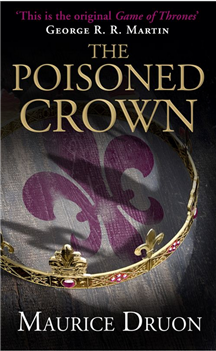
 

Day 502: The Poisoned Crown

The PoCover for The Poisoned Crownisoned Crown begins with the beautiful and devout Clémence of Hungary on her way into a pit of vipers, the court of Louis X of France, and marriage with the king. Louis has managed to rid himself of his inconvenient first wife. His attention span is short, however, so by the time Clémence arrives after a horrendous journey he is more involved with an ill-conceived siege against the Count of Flanders than with arrangements for the wedding. Still, the new queen is soon esteemed for her gentleness and generosity, even by her horrible husband.

During Louis’ short reign, France has already descended from relative prosperity to famine, and the progressive steps taken by his father have all been rescinded. Robert of Artois, always trying to cause trouble for his aunt Mahaut, has provoked her barons to rise up against her in Artois. The cardinals have still not settled on a new pope. In short, France is in chaos. Louis’ younger brother Philip of Poitiers has striven to dissuade his brother from his poorer decisions, but Louis sends him off to the papal conclave.

Another character who has served in previous books as almost comic relief will soon become more important. This is Guccio Baglioni, the very young nephew of a rich Lombardi merchant. He has fallen in love with the daughter of impoverished nobility, Marie Cressay, and hopes to marry her, without understanding how much beneath them her family considers him. He has just helped escort Clémence of Hungary to France when he is badly injured.

The curse against the Capet kings of France continues in this third book of Druon’s excellent series The Accursed Kings. Those who are following it will not be surprised to learn how short Louis X’s reign will be.

Day 483: Reread: The Strangled Queen

Cover for The Strangled QueenThis article is a repeat review of the second book in Maurice Druon’s excellent Accursed Kings series. I wrote my initial reviews years after I read the books, from memory. This review is from a recent reread in preparation for my first review of the third book in the series.

The name of Philip the Fair would glow down the centuries only by the flicker of the faggots he had lighted beneath his enemies and the glitter of gold he had seized. It would be quickly forgotten that he had curbed the powerful, maintained peace in so far as it was possible, reformed the law, constructed fortresses that the land might be cultivated in their shelter, united provinces, convoked assemblies of the middle class so that it might speak its mind, and watched unremittingly over the independence of France.

So says Druon in his prologue to The Strangled Queen about Philip IV of France (Philip the Fair), whose death in 1314 begins the action of the novel.

Marguerite of Burgundy has not heard of Philip’s death. She and her sister-in-law Blanche, Philip’s daughters-in-law, are imprisoned in the Château-Gaillard for adultery, and she does not know that her husband has become the king of France, Louis X. When her cousin Robert of Artois comes to tell her, she naïvely believes he wants to help her, unaware how he has assisted in her downfall. What he actually wants is for her to agree to an annulment, as now she poses a big problem to the succession.

But Marguerite doubts when she should not. Although she would gladly exchange her harsh prison for a convent, she is afraid that once she signs, those in charge of her will leave her where she is. She also does not want to declare her daughter a bastard, the other requirement of her release.

Louis X soon sets his sights on marrying Cleménce of Hungary. To do so, he must get a pope installed who will agree to give him an annulment. However, the cardinals have been arguing ever since the death of Pope Clement V, who with Philip the Fair was a victim of the curse of the Grand Master of the Knights Templar (whose death by burning at the stake is referred to in the quote at the beginning of this review).

The weak and stupid Louis is faced with a battle between the forces of order and progress, represented by Enguerrand Marigny, his father’s coadjutor, and the old ways of feudalism, represented by his uncle, Charles of Valois. Whoever can get Louis a pope or his marriage with Cleménce will ultimately win, but in the meantime he begins stripping away all of the governmental reforms instituted by his father.

Bitingly told, about a fascinating period of French history, these novels introduce us to a world of complicated alliances, treachery, and politics, as well as murder and mayhem. Lately the novels are being marketed as the original Game of Thrones. There are certainly strong similarities.

Day 470: Reread—The Iron King

Cover for The Iron KingI already reviewed The Iron King during my first year of blogging, but that review was based on my memory of the novel, having read it several years before. I recently re-read it and would just like to mention it again, as it is so good and easier to find now that the first three volumes of the series have been republished.

The Accursed Kings series concerns the history of the last Capet kings of France. The first in the series, The Iron King, begins with some fateful acts that eventually affect the future of the kingdom.

The novel begins in England with Queen Isabella plotting with her cousin, Robert of Artois, against her three sisters-in-law. Queen Isabella, the daughter of Philip IV of France (known as the Philip the Fair or the Iron King), is unhappily married to Edward II of England, who disdains her and lends the power of his throne to the Despensers, the family of his male favorite. Isabella is disposed to make trouble. Her cousin has brought her his conviction that at least two of her three sisters-in-law are being unfaithful to their husbands, her brothers, the princes of France. Isabella and Robert hatch a plot to expose them.

Robert of Artois has his own reasons for the plot, for his father’s property was awarded to his aunt Mahaut instead of to him so that it would pass into the hands of King Philip the Fair’s two younger sons when they married Jeanne and Blanche, Mahaut’s daughters. Robert is only too happy to ruin Marguerite, Queen of Navarre and wife of Philip’s oldest son, along with the two other girls, as she is Mahaut’s cousin.

Awaiting their own fates are the last four members who are not in hiding of the once wealthy and powerful Knights Templar. Years before they had refused to admit Philip the Fair as a member, as it was against the rules of their order to admit royalty. Since then, Philip has plotted their ruin, assisted by Pope Clement, who covets the riches of the order. Now they have been condemned of heresy, largely on trumped up charges.

Early in the book, Jacques de Molay, Grand Master of the Knights Templar, is burned at the stake. During his burning, he curses the King, Pope Clement, and Guillaume de Nogaret, Secretary-General of the Kingdom, to their thirteenth generation. The Pope is dead within 40 days, de Nogaret soon after. Thus the name of Druon’s fantastic series, The Accursed Kings, for you can be sure that Philip the Fair will be dead by the end of the novel.

This series is being marketed as the original Game of Thrones. Perhaps there are some similarities. The court is a nest of vipers—those in power are constantly engaged in political machinations and those not in power in other kinds of plots. The world Druon presents is fascinating, depicted with cynicism and wry observations. The novel is extremely well written, about an extraordinary time in French history.