

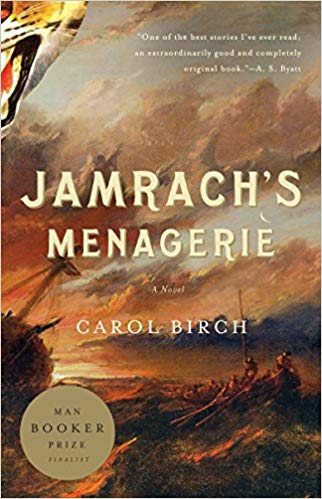
After reading Carol Birch’s Jamrach’s Menagerie, I had high expectations for Orphans of the Carnival, especially as it had in common the carnival setting. However, my reactions to this novel were much more mixed.
The subject of the novel is a woman who really existed, Julia Pastrana, a 19th century performer. Julia was more than a performer, though. She was a famous “freak” at a time when such shows were popular. She is described only here and there and in pieces so that we slowly get an idea of what she looked like, but she was labeled an ape-woman, among other names.
The novel opens as Julia has decided to take up a showman’s offer and leave her home in Mexico, where she works as a servant, to travel to New Orleans to work in a sideshow. But her hunger for travel and adventure is stifled, because her boss wants her to stay out of view except when she’s on exhibit, discouraging her from even walking around heavily veiled, as she usually does.
Julia eventually changes agents and quickly becomes world famous, being an accomplished performer and speaking several languages. But she yearns for a fulfilling private life.
The trouble is, Birch didn’t succeed in making Julia an interesting personality. This problem may be because she was a real person and Birch didn’t want to take too many liberties, but sometimes I want to say to authors, “Your characters aren’t inherently interesting even if you put them in interesting situations. You have to make them interesting.” Further, she doesn’t do much with the carnival setting.
Birch also uses at least one anachronism when she puts Julia in pantyhose. Pantyhose wasn’t actually invented until 1959 and was called “panty legs” at first. The term “pantyhose” didn’t become common until the mid-1960’s.
There is also a present-time story about a woman who fills her apartment with lots of odd objects she’s picked up. There seems to be no connection between the two story lines until the very end of the book. However, when they do link up, the connecting is haunting.
The end of the novel is very much the best part of the book, but otherwise I had trouble staying with it and read two other books in between starting and finishing it. This for me means I am having trouble concentrating on the one I’m reading.
 What? Me Read?