
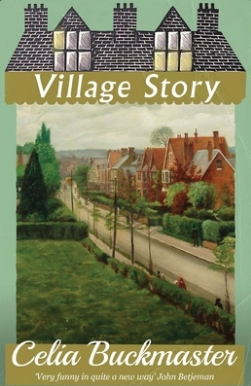
Like Buckmaster’s Family Ties, Village Story presents us with lots of characters and we begin slowly to sort them out and differentiate them. Buckmaster, who frequently speaks directly to the reader, states that Mrs. Ethelburger is her heroine, but Mr. Noyce gets more attention.
The novel begins with the Darlingtons because they have the nicest garden in the village, but it’s only their daughter Linda who has a minor role in the story. Linda, we’re told, having been pronounced “gifted” in school, has been spoiled. Hoping to keep her out of trouble, Mrs. Darlington takes her up to the big house in the village, the Noyce’s house, and gets her a job as a housemaid. There, she proceeds to make trouble by telling everyone that Mr. Noyce has been making love to her in the drying cupboard. This is a lie. In fact, Mr. Noyce is hardly even polite to her. But from a 21st century viewpoint, this minor plot is troubling on lots of levels, not least of which is the author’s attitude toward girls’ education. We must try to view it in the context of its time, where these views were not unusual.
Next, we briefly meet Mr. Noyce, who led a cosmopolitan life before settling down in the village on the family estate after his father died. Mrs. Noyce is an artist, one whom Mr. Noyce believes could become great, so he encourages her to keep painting. Even though that’s what she wants to do, her relationship with Mr. Noyce is on edge, and she seems to be rude to everyone. Of course, the village thinks she shirks her household duties.
Mrs. Ethelburger isn’t much interested in household duties, either, and since she has several small children, her house shows it. We’re told she and Mr. Ethelburger love each other, but he isn’t much of a character in the novel, and she is just breaking off an affair with Mr. Browning, a young businessman who lives with his mother. Mrs. Ethelburger used to visit old Mr. Noyce, so one day she wanders onto the property—now much more private—and strikes up a friendship with Mr. Noyce.
Also in the village are the Sparks, the rector and his wife, an elderly couple. He tends to be studious while she has decided to become a Communist without really understanding anything about Communism.
The novel only has the suggestion of a plot, mostly about the party the Noyces decide to have and the fate of the Noyce’s marriage. But somehow Buckmaster ties it all in with the fate of the village itself. I was interested in the story but sometimes couldn’t remember who all the characters (many more than I described) were and wondered where it was going.

 What? Me Read?