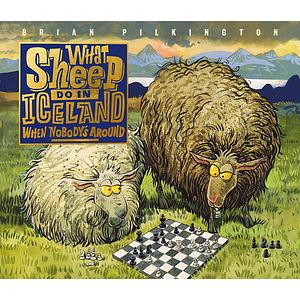
Review 2559: What Sheep Do in Iceland When Nobody’s Around

A friend of mine has family in Denmark, and she brought back this little novelty book that came from Iceland. It has great illustrations and is silly and funny, and very imaginative.

The tone of the book is set right away by the cover and title page. I took a photo of the title page, and here is its caption, in case it’s unreadable in the photo, “Because of their herding instinct, they find it very hard to resist a conga line.”
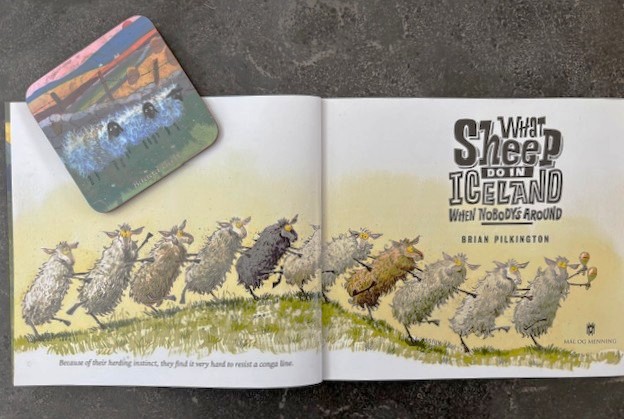
The book starts out with a more-or-less straightforward history of how sheep got to Iceland and of Icelandic sheep-keeping details, but then it just becomes silly and full of puns, with great illustrations. Perfect for a lighthearted quarter hour of reading.

I jumped into this book from a great pile of tomes I accumulated for my A Century of Books project. In fact, I interrupted my reading of Angle of Repose because I was so behind in my number of books read (I usually am reading at least 20 books ahead of my blog, and I was only in at about 13) that I wanted to dash something off and also relax. Angle of Repose is good but for some reason I kept getting distracted from it, so it took me more than a week—an unheard-of rate for fiction, even at 600+ pages.

The bad news about this book is that from the U. S. I ended up ordering it from Iceland! I assume my friend got it in Denmark, so maybe European readers will be able to find it. Anyway, it’s a hoot! I’m categorizing it as children’s literature, because I have no other suitable place for it, but I think it is probably just as funny for adults. Maybe even more so.
Related Posts

Moominsummer Madness

Summer Lightning

The Flying Books of Mr. Morris Lessmore

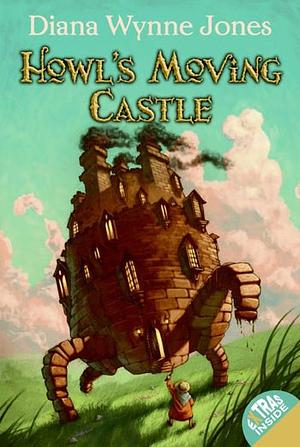
Review 2547: Howl’s Moving Castle

I noticed that this book filled a hole in my A Century of Books project. I found the images from the movie fascinating when it came out years ago. So, although I don’t often read children’s books, I got a copy from the library.

Sophie lives in a sort of fairytale world of wizards and spells and witches. Because she is familiar with fairy tales, she knows that as the eldest sister, she would fail at any attempts to find her fortune. It’s always the youngest who is successful. So, when the family fortunes falter, she agrees with her stepmother’s plan to apprentice in her hat shop, while one of her sisters is apprenticed to a baker and the other to an herbalist.

Sophie has a talent for trimming hats, but she is still finding life a bit dull until she has an encounter with the Witch of the Waste about one of her hats. The witch puts a spell on her and turns her into an old lady.

All the girls in the country are afraid of Wizard Howl, who lives in a moving castle. He is reputed to kidnap girls and steal their souls. But Sophie thinks the only way to throw off the curse is to get help from Howl. The castle is in the area, so she bangs on the door until Howl’s apprentice Michael opens it, and then she makes herself at home as a housekeeper.

Howl has imprisoned a demon in his fireplace to move the castle, so she makes a deal with the demon. If she can break his contract, he’ll break her spell.

Otherwise, things in the castle seem quite different than she expected.

I think some of the ideas in this novel are imaginative, but otherwise, it seemed as if everyone was running around aimlessly most of the time. There is a contract to be broken, for example, but Sophie and Michael only make one attempt to break it, and the rest just seems to happen. I’m sure children would find the novel fascinating, but to me it seemed too loosely plotted and could have been about half as long.

Related Posts

The Golden Compass

A Stranger Came Ashore

Victorian Fairy Tales

Review 2438: A Stranger Came Ashore

I don’t often read children’s books, but I’m a sucker for a selkie story. This fun little book is set in the Shetland Islands and based on their folk tales and customs.

There is a terrible storm on the night that the Hendersson family hears a knock on the door. A stranger arrives, Finn Learson, who seems to be a sailor from a wrecked ship in the bay. The Hendersson’s dog Tam growls at him, but the family takes him in.

That night, young Robbie Hendersson hears someone playing his father’s fiddle. It is making strange music that he’s never heard before. He goes to look and sees Finn Learson playing it. Tam is still growling, but Finn stares at him as if doing magic and Tam stops.

Robbie begins to suspect that Finn is a selkie. He remembers his grandfather’s tales of the selkie king, who lures girls away undersea to marry him and how they drown when they try to leave. He is afraid that Finn is after his sister, Elspeth. But no one believes him.

Robbie finally finds someone to help him against the selkie. But he’s almost as afraid of his helper as he is of Finn.

This book is probably meant for children around 8-12, and I think they would enjoy it, especially if they are interested in old stories. I liked how it managed to incorporate other old customs of the Shetlands.

Just as a side note, there was a Scottish singer named Jean Redpath. As a young woman I had several of her albums, and I believe it was a song she sang, “Lassie Wi’ a Yellow Coatie,” that referred to a but and ben. I had no idea what one was until I read this book, some fifty years after encountering the term.

Related Posts

Doll Bones

Sealskin

The Sea House

Review 2096: The Raven’s Children

I thought Yulia Yakovleva’s Punishment of a Hunter was an excellent 1930’s-era Russian mystery, so I looked for more. But all I could find was The Raven’s Children, a children’s book.

In Stalinist Soviet Union, seven-year-old Shura lives with his older sister Tanya, his baby brother Bobka, and his parents. All of them are patriots, but one night his father disappears. The next day, their mother behaves oddly, packing a suitcase, saying she quit her job, but she doesn’t tell them anything. The family unusually has a two-room apartment with Shura and Tanya’s bedroom accessed by a wardrobe so the second room is not obvious. That night Shura is awakened to see someone being taken away in a black car. The next morning, their mother and Bobka are gone, and Shura overhears a neighbor saying that they were taken away by the Black Raven. Their neighbors won’t speak to them except the timid old lady down the hall, who gives them a purse of money from their mother with instructions to go to their aunt.

Neither child wants to go to the aunt, so they spend the day wandering around talking to the birds (who talk back), trying to find the Black Raven. Gradually, they understand that their parents are thought to be spies and traitors. They think there must be some mistake and if they find the Black Raven they can tell him so. Then when they arrive home at their apartment that night, they find their neighbor living in it.

I always go under an assumption that the age of the protagonist in a children’s book is roughly the age of its intended audience. That being said, I think that children that age would understand very little of this book and be terrified by some of it. And I’m not a person who thinks children shouldn’t be scared by books.

For one thing, Yakovleva slowly brings in an element of magical realism. The talking animals and even Shura becoming invisible and having people walk through him was okay. But Yakovleva makes metaphors become real, so ears and eyes appearing in the walls are really creepy. But the worms are the worst. And I don’t want to spoil anything, but some characters, once disappeared, stay disappeared.

Yakovleva wrote this novel because her grandfather had similar experiences as a child during Stalin’s Reign of Terror. This novel might work as a teaching tool, but I would advise it to be with discussions with an adult who has read up on the period. Otherwise, I don’t think children are going to understand this novel.

By the way, several adult Goodreads readers complained that they didn’t understand what was going on, and at least one of them said she was from a former Soviet country.

Related Posts

Punishment of a Hunter

Sofia Petrovna

Mastering the Art of Soviet Cooking

Review 2060: Moominsummer Madness

I intended to read Moominsummer Madness for the 1954 Club last spring, but it didn’t arrive from the library in time. So, I read it when it did arrive.

The Moomin family are on holiday when a huge tidal wave floods the valley. Their house gets flooded and they end up taking refuge on what they think is a floating house but is actually a theater.

Moomintroll and his friend Snork Maiden are separated from the others when they camp out for the night in a tree and the theater is cut loose. And Little My also gets lost when she falls through a trap door.

I usually try to review children’s books in terms of how attractive they might be to both kids and adults. Kids like books with lots of silliness, which is probably why these books are so popular. They don’t have much internal logic, though. I thought the book was only slightly interesting.

Related Posts

The Mischievians

Tumford the Terrible

The Full Moon at Napping House

Review 1835: Kidnapped

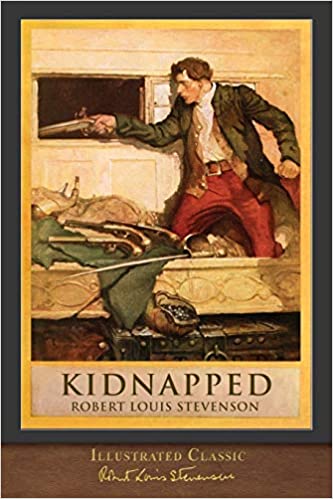
His mother long dead and his father recently having passed away, young David Balfour is ready to set out to seek his fortune. But family friend Reverend Campbell gives him a letter from his father to take to an Ebenezer Balfour of Shaws near Edinburgh. David hopes that if he has a wealthy relative, the man will help him to a career.

When David arrives at Shaws, he finds it incomplete, almost a ruin, and Ebenezer Balfour to be unwelcoming. He is David’s uncle, but right away he sends David up a ruined staircase almost to his death. Then, once his uncle has agreed to go with David to a lawyer, Mr. Rankiller, to discuss David’s inheritance, he has David kidnapped by an unscrupulous sea captain, who is supposed to take him to work as a white slave on a plantation.

North of Scotland, the ship David is on runs over a small boat in a storm, and the only survivor of the boat is Alan Breck Stewart, a Highland Jacobite who has been collecting money for his exiled chief. He has saved his belt full of gold, but David overhears the ship’s officers planning to kill the man for his money. David alerts Stewart, and the two hold off the crew in the roundhouse, ending with a much-depleted crew. Ultimately, this results in a shipwreck.

Beached in the far northwestern Highlands, David and Alan must avoid capture by the English army while they journey to Edinburgh to reclaim David’s inheritance and find Alan another ship for France.

This novel was my favorite Stevenson book as a child, so I was curious how I would view it now. I enjoyed it very much. David and Alan are interesting contrasting characters, and the novel gives a good idea of living in the Highlands in 1751. It’s full of adventure, too, a fun read.

Related Posts

Treasure Island

The Black Arrow

Travels with a Donkey in the Cévennes

Review 1815: The Black Arrow

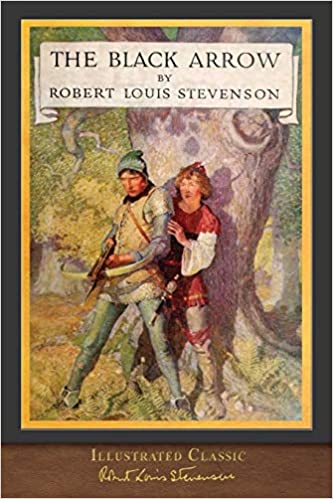
I occasionally collect children’s books, mostly those with good illustrations, and a few months ago I started thinking about the books that used to be readily available, all adventure stories by various authors but illustrated by N. C. Wyeth. I decided to look for some of those, and the ones I bought were both by Robert Louis Stevenson, Kidnapped (my personal favorite) and one I’d never read, The Black Arrow.

Young Dick Shelton has lived under the wardship of Sir Daniel Brackley for most of his life and is loyal to him even though he seems to switch sides in the Wars of the Roses rather frequently. But mysterious attacks against his men by a group calling themselves the Black Arrow begin to awaken Dick to feelings of just resentment against Sir Daniel. For he has used the war and his position to cheat people out of their property.

Dick is on his way from Sir Daniel’s encampment when he encounters a boy named Jack Matcham whom he met in the camp. The boy (who everyone but Dick can see is really a girl) asks Dick for his help to get to Holywood. Dick helps Jack, but they fall back into Sir Daniel’s hands. Once there, Dick begins asking about the death of his father, for he has heard rumors that Sir Daniel was responsible.

This is an entertaining adventure story, and I’m not sure why it isn’t as highly regarded as Treasure Island (which has never been one of my favorites). The only thing I can think of to make it not as popular is the archaic speech Stevenson uses, which, while probably not that authentic, did not strike me as inauthentic, if that makes any sense. The novel features plenty of action, some appealing characters and some villains, and Richard of Gloucester (eventually to become Richard III) even makes an appearance as a young man.

Treasure Island

Witch of the Glens

Richard III, England’s Black Legend

Review 1762: The Christmas Wish

Last year, I saw pictures from The Christmas Wish on TV and thought they were so beautiful that I bought a copy of the book. This little children’s story is illustrated with photos, some of which have been doctored to create the effects. This book is written by Lori Evert, and the photography is by Per Breiehagen.

Anja is a little girl who wants to be Santa’s helper for Christmas. So, after doing her chores and helping out a neighbor, she puts on her skis and heads north. On the way, she is helped by a cardinal, a draft horse, a musk ox, a polar bear, and a reindeer, each giving way to the next as she goes farther north.

The little girl is dressed in a traditional Norwegian outfit, and the photos are just wonderful. The story is simple but sweet. This is a book that could be passed down as a family heirloom.

Snow

Premlata and the Festival of Lights

Red Knit Cap Girl

Review 1740: Premlata and the Festival of Lights

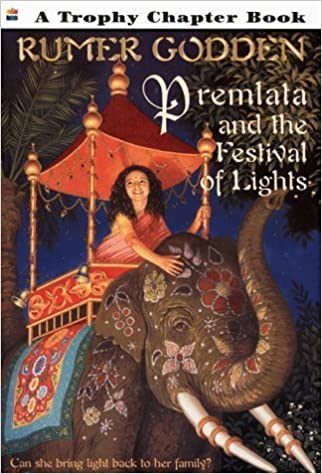
Premlata and the Festival of Lights is the first children’s book I’ve read in my mission to read all of Rumer Godden’s India novels.

Since seven-year-old Premlata’s Bapi died, her family is very poor. With all the village families preparing for Diwali, Premlata is shocked to find out that her mother has had to sell all their deepas, the little oil lamps that families put around their houses to help the goddess Kali battle the demons of darkness.

Premlata’s mother sends her up to the Big House to deliver some sweets to the housekeeper. While she is there, she goes to visit her friend Rajah the elephant and finds him being painted beautiful colors for the festival procession. This reminds her of the problem of the deepas, and she begins crying in front of Bijoy Rai, the kind owner of the Big House. Once she explains that her house will be the only dark one in the village for Diwali, Bijoy Rai gives her some money for her mother to buy deepas.

Premlata has a better idea, though. She will go to the town, three miles away, see Rajah in the procession, and buy the deepas herself.

This is a charming chapter book for children who are old enough to read. It introduces them to another culture and is a gentle story about good intentions gone slightly amiss. It includes a realistic adventure with elements of danger. I don’t know how easy it would be to find a copy, but I recommend it.

Related Posts

Alexander and the Terrible, Horrible, No Good, Very Bad Day

Kingfishers Catch Fire

The River

Review 1707: The Case of the Missing Marquess

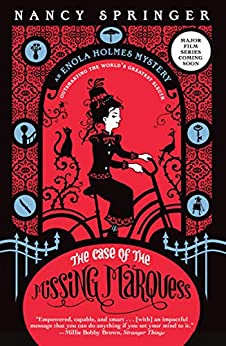
My husband and I enjoyed watching Enola Holmes over the Christmas holidays, so I decided to give the first book in the series a try. I had assumed it would be YA, but it is actually marked for middle grades.

Enola Holmes, who is the younger sister of Mycroft and Sherlock, finds that her mother has disappeared on Enola’s 14th birthday. When her brothers, who have not come home for 10 years, respond to her telegram, they have some unpleasant surprises in store—Enola that Mycroft is more interested in sending her to boarding school than in finding their mother and Mycroft that the money he’s been sending for the upkeep of the estate has clearly not been spent on the estate. Sherlock is just determined to find their mother.

Enola is offended at some slighting remarks Sherlock makes about her intelligence and is determined not to go to boarding school. Having figured out that her mother has left her some clues and hidden some money, Enola disguises herself as a widow and leaves the house to search for her mother. On the way, she hears that the 12-year-old Marquess of Tewksbury has disappeared and finds the first clues to his disappearance.

I always judge books by how much they entertain me, and I have to say, this one is probably very entertaining for a 12-year-old but was lacking for me. I can’t tell whether this is because I recently saw the movie—which really only borrowed the concept from the book—or not. Certainly, I found the movie sharper in wit, more full of adventure, and more likely, at least in its conclusion. I also couldn’t help comparing this book to the Flavia de Luce series, which has a much more distinctive voice and is much funnier. However, as reading for kids this is good fun.

Related Posts

The Sweetness at the Bottom of the Pie

A Red Herring without Mustard

I Am Half Sick of Shadows