Day 834: Three Board Books

As I often do when I buy my young relatives a book, I read it quickly to include a review on my blog. Today I have reviews of three board books I bought for my two-year-old great-nephew.

Cover of Hooray for FishHooray for Fish! by Lucy Cousins
Of the three, Hooray for Fish! has the simplest vocabulary. It seems intended for babies or new readers. It has cheerful pictures of different types of fish, but it doesn’t really have a plot.

Cover for TumfordTumford the Terrible by Nancy Tillman

Tumford is a cute, chubby cat who gets into trouble. This book contains a moral about saying you’re sorry for your mistakes. The text is a little more complicated than that of Hooray for Fish, including some short, rhyming paragraphs. The pictures are beautiful.

Cover for Secret SeahorseSecret Seahorse by Stella Blackstone and Clare Beaton
Secret Seahorse has cute, bright pictures and rhyming text. A seahorse is hidden in each picture, providing some extra fun. These undersea pictures are also bright and appear to be photographs of scenes made from cloth, buttons, and sequins.


The creativity of these books is more in the artwork than any originality or deftness of the story. I might compare these books to Little Bird, which had almost no words but is bright and funny. It’s true that Little Bird is a picture book rather than a board book, though. I have some pictures books to review at a later time, and the authors seem to be able to do more with them.

Related Posts

Little Bird

Red Knit Cap Girl

The Leaf Men


Day 817: The Hornet’s Nest

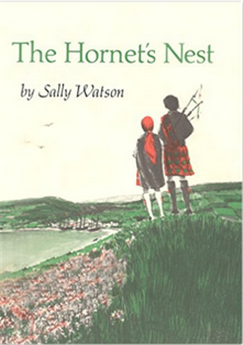
Cover for The Hornet's NestIt is 30 years after the Battle of Culloden, but Highland Scots are still forbidden by their English overlords to wear the plaid, play bagpipes, or honor their heritage in other ways. Rebellious Lauchlin MacLeod and her brother Ronald, teenage children of Laird Kildornie, are always finding themselves in trouble.

So it is on the day they meet their cousin Matthew Lennox, a gentleman from Virginia journeying to visit his English and Scottish relatives. Lauchlin is marveling that this Sassenach is related to her family and doesn’t realize he has been escorted there by a troop of redcoats. She just barely avoids being caught wearing a kilt while her brother hides in the bushes with his bagpipe.

In town showing Cousin Matthew the sights, Ronald and Lauchlin attack some boys who are torturing a kitten. Later Sergeant Tucker arrives at their home to tell them that the boys are the children of Captain Green, the new area commander. The boys have lied about the cause of the attack, and Captain Green isn’t as likely as the previous commander to overlook their behavior. The next incident could be serious.

Cousin Matthew has a solution. Lauchlin and Ronald can travel to Virginia and live with his sister Lavinia until things calm down. Secretly, he enlists them to send news and drawings, for Lauchlin is a gifted caricaturist, about doings in the colonies for a paper he is founding in London called The Gadfly.

So, Lauchlin and Ronald set out for the colonies accompanied by their kitten Haggis. They arrive in Williamsburg in 1773, just in time to witness the lead-up to the American Revolution. It’s not too difficult to imagine where their sympathies lie.

This novel effortlessly mixes the viewpoints from both sides of the revolution, for their Lennox relatives are Loyalists, and some are charming characters. Lauchlin is an ebullient scamp, Ronald a boy who must learn that all Sassenachs are not the same. Their many Virginian cousins dislike them at first but then most of them learn to love them. And Haggis has his own distinctive personality.

This novel is one of my favorites so far of the Watson books I’ve newly discovered, because it is less unlikely than some of them and has really enjoyable characters. Plus, it provides an unusual viewpoint of the American Revolution. Young teens and tweens should love this book.

Related Posts

Witch of the Glens

Lark

Mistress Malapert


Day 811: Linnet

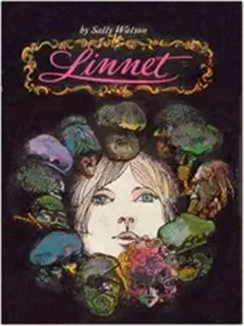
Cover for LinnetLinnet is another sprightly Sally Watson novel for tweens and younger teens set in the Elizabethan era. We first meet Linnet Seymour on the road to London. She has run away from her aunt’s house because she never has any adventure, planning to visit some cousins in London whom she doesn’t really know.

Unfortunately, she meets a rascal on the road, calling himself Sir Colin Collyngewood. He offers her a ride to her cousin’s house. A naive girl, she accepts. Instead of taking her to the Seymours, though, he delivers her to a filthy thieving ken to live with a bunch of child pickpockets and cutpurses.

Linnet has a tendency not to learn from experience, so when Colley tells her he wants to use her to trap some Papists in a plot against the Queen, she believes him. In the meantime, Linnet’s cousin Giles is the only person who believes she is missing. His parents think she returned home. Giles goes to London to look for her.

Like some other of Watson’s books, this one is a bit far-fetched and also has some lessons for Linnet about treatment of the poor. Still, it is an enjoyable romp.

Related Posts

Mistress Malapert

Lark

Witch of the Glens

Day 790: Jade

Cover for JadeOf the Sally Watson books I rediscovered, Jade is one I haven’t read before. I’ve mentioned that Watson wrote several of her novels around a person from her own ancestry, but it is not clear to me if the outlines of each story are based on family legend or are just invented around the events of the time. This question becomes of special interest in regard to Jade, which is the least likely of Watson’s books to date, even if part of it is based on history.

Jade’s real name is Melanie Lennox, but she much prefers her old nickname. She is a rebellious girl completely taken up by her own ideas of right and wrong. She is especially incensed by slavery and women’s lack of rights, which makes early 18th century Williamburg an uncomfortable place for her and for her family, who doesn’t know what to do with her.

The last straw for Jade’s father is when he finds she has been sneaking off to meet Monsieur Maupin, an elderly Frenchman, for fencing lessons. Tired of beating her, her father ships her off to Jamaica to live with her aunt and uncle. With her goes her slave Joshua, whom she’s been trying to free since she was 10.

In Jamaica, she is disgusted by the slave market and the treatment of field slaves, so her aunt and uncle are surprised when she wants to buy a proud untamed African woman, whom she names Domino. But Jade sees something in Domino that reminds her of herself. In fact, Jade isn’t really getting along any better in Jamaica, but doesn’t stay there long.

Jade’s aunt and uncle hear of yellow fever on the island, so they dispatch Jade and her two slaves back to Virginia. They return on the same ship they came on, but this time it is loaded with slaves. Jade decides to try to free the slaves, in which effort she doesn’t realize she’s assisted by the sardonic second mate, Rory McDonald (whose grandmother was Kelpie from Witch of the Glen).

I wasn’t quite prepared for what happens next, but maybe I should have been. Their ship is attacked by pirates and she and Rory and some other crew members and the slaves decide to join the pirates. Well, Jade and Rory are taken on board unconscious, but like Elizabeth Swann of Pirates of the Caribbean, Jade at first decides it’s “a pirate’s life for me.” Only later does her view of the life become more nuanced.

The novel’s plot is unlikely, even though it is based on the life of the famous pirate, Anne Bonny (spelled Bonney in the novel), whose ship our characters end up on. And Jade is not strictly likable, her character being so full of self-righteousness and so unbending that she can’t tell a polite lie. Also, the novel tends much more to the preachy than those I’ve read so far of Watson’s.

Still, this novel is probably a good one for insights into the abuses of the time, while still providing plenty of adventure. Little feminists in the making will be sympathetic to the restrictions Jade struggles with, such as her dislike of what she must wear, her lack of rights as a woman, and the limits to what she’s allowed to do. I personally think she’s too much of a 20th century girl, but young girls won’t even think of that.

Related Posts

Witch of the Glens

Lark

Captain in Calico

Day 765: Mistress Malapert

Cover for Mistress MalapertMistress Malapert was my favorite of Sally Watson’s books years ago, the rediscovery of which I discussed in my review of Lark. The only thing that might keep it from still being my favorite is its attempt at Elizabethan English, not entirely convincing although not horrible, even used sometimes in the narrative parts of the book. Watson in her updated notes at the end of the book says she wishes she hadn’t used so much of it but that she was inexperienced as it was her second book. Still, as a young reader, it clearly didn’t bother me. I’m not even sure I noticed it.

Valerie Leigh has been raised for years by her wealthy, childless aunt and uncle, who have given her everything she asks for. Now she is back with her own family, and they don’t know what to do with her. At fourteen, she has a nasty temper that appears whenever she doesn’t get what she wants. Her temper is over quickly and she always sincerely apologizes, but that doesn’t stop her from behaving in a truly outrageous manner when she is angry.

When Valerie’s parents are dispatched by her mother’s distant cousin, Queen Elizabeth, on a foreign embassy, they leave Valerie and her sister Audrey in the care of their stern Uncle Gil, who is determined to tame Valerie. Of course, she isn’t going to put up with much of this.

At a fair, she is fascinated by a troupe of players, especially the boy who plays the part of the princess. She decides it is unfair that girls aren’t allowed to act. Later, when Uncle Gil punishes her for fighting, she decides to run away. She disguises herself as a boy and runs off to join the traveling players, a plot straight from Shakespeare.

Val finds she has a talent for the stage, but her adventures on the stage aren’t all this novel is about. Slowly, she learns some lessons about her responsibilities to the other players and about the kind of person she really wants to be. To be that person, she must learn to control her temper and think of others.

I found this book quite enjoyable and think that many preteens and young teens might like it as well. Val has the opportunity to meet Shakespeare and even Queen Elizabeth by the end of the novel, and although I am not generally fond of historical novels where the main, invented character somehow meets lots of famous people, in this novel it seemed perfectly reasonable. And by the way, I recently criticized the depiction by another writer of Shakespeare’s dialogue in her book for its lack of playfulness. When Val meets Shakespeare, his response is a little clumsy, but much more what I would expect:

Here be a valiant Val to have with us for a valediction. Be you a valid Valentine? Can ye play a valet? Put down your valise, valiant Val, and be you proved valuable, we’ll keep you till you be valanced with a white beard.

Don’t worry, it’s not all like this.

Related Posts

Lark

Witch of the Glens

The Secret Life of William Shakespeare


Day 749: Charlotte’s Web

Cover for Charlotte's WebBelieve it or not, I’ve never read Charlotte’s Web before. I bought it for my niece’s birthday and read it quickly before I wrapped it. It’s a charming story with the bit of pathos that all children’s books should have.

Fern is devastated to learn that the runt from the latest litter of pigs is to be killed, so she begs her father to keep him. He allows her to hand-raise the piglet, and she names him Wilbur.

When Wilbur is a month old, he goes to live in a nearby farmer’s barn. After spending most of his time during the previous month playing with Fern, he is lonely, although Fern visits him often. No one in the barn seems interested in being his friend, though. After he asks each animal to be his friend, someone he has not even noticed says she will. She is Charlotte, a spider whose web is right in the doorway above his sty.

This is a delightful tale full of the smells and sights of rural life. Although the story starts with Fern, it is soon about how Charlotte and the barnyard animals try to figure a way to save Wilbur from being Christmas dinner. Although it doesn’t shy away from the basic truths of farm life, it is calm and gentle in tone and has lessons about friendship. It’s a wonderful book for reading to smaller children or one that slightly older children can read themselves. I think many modern children may envy the freedom eight-year-old Fern and her older brother Avery find in their rural life.

Related Posts

The Secret Garden

Anne of Green Gables

Doll Bones


Day 742: Witch of the Glens

Cover for Witch of the GlensKelpie is about fourteen or fifteen and only remembers a gypsy life traveling with Mina and Bogle. They use her to steal and read the crystal, for she has second sight. Mina keeps promising to teach her witchcraft without actually showing her any. Still, they are often accused of being witches and hounded out of town.

Then one day she pretends to fall in front of a party of young men only to find she has actually injured herself. Although they catch her stealing from them, they are amused by her and take her home with them. The young men are Ian, Cameron, and Alex, returning from Oxford to their home north of Inverlochy.

Kelpie stays at Glenfern with Ian’s family, eventually as a servant, but they treat her kindly. She begins to feel affection for the children, especially little Mairie, and is dismayed when Mina and Bogle reappear. Mina threatens to curse the family if Kelpie refuses to come with them, and since Kelpie believes in Mina’s power, she goes.

The Highlands are in turmoil because Argyll has been commissioned to secure the area for the Calvinist Covenant against King Charles. Argyll’s troops are more prone to burn villages and murder innocents than to fight armies. But Montrose is trying to raise men to fight for the king. Mina sends Kelpie on a perilous task, to steal some hair or a personal possession from Argyll so he can be hexed.

Kelpie’s adventures take her all over the Highlands. When she joins the followers of Montrose’s army, she is happy to meet Ian and Alex again, but she has seen Alex strike Ian down in the crystal, so she is wary of him.

This is an enjoyable novel for tweens and teens full of likable characters and nasty villains, some history, lots of adventure, and another feisty Watson heroine. Kelpie begins re-evaluating her moral choices through the examples of others and the kindnesses she receives during her travels.

Related Posts

Lark

The Loon Feather

Treasure Island

Day 733: Little Women

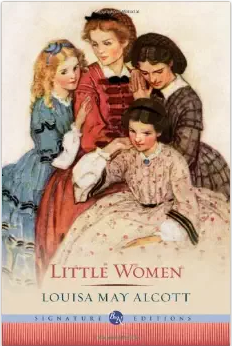
Cover for Little WomenOver the past months I have occasionally reread a childhood favorite to see what I think about it now. The Secret Garden and Anne of Green Gables, for example, came through with honors. Not only were both beautifully written, but I found them as entertaining as an adult as I did as a child.

Little Women doesn’t fare quite as well. I found some of the same parts of it affecting as I did when I was young. Who wouldn’t sympathize with these girls, bravely coping without the things their friends have, doing without their father for over a year, getting along as cheerfully as they can? However, as a child reading the book, I didn’t notice that almost every chapter ends with a moral lesson.

The novel covers about 12 years in the lives of the March family, beginning during the American Civil War. For the first half of the novel, Mr. March is away as a chaplain for the Union army. The main character is Jo March, at the start of the novel a tomboyish, gawky 15-year-old who loves writing and putting on plays, reading, and writing stories.

Her older sister Meg is more ladylike and laments having to wear old things to parties. Beth is the third sister, who is too shy to go to school. Amy is the youngest and a little spoiled. Although there are certainly events in their lives, the story is about how Marmee, their mother, raises them all to be good, productive women.

One of the closest relationships in the novel is the friendship between the family and their neighbor Laurie, a rich young man being raised by his grandfather. This and other relationships are warm ones, and the Marches all seem like real people, as do their friends.

If Alcott could have let up a bit on the moralizing, I would have enjoyed the novel more. The other two novels I mentioned earlier also have moral messages, but they leave the reader to figure them out themselves. Still, I’m sure any young girl reading this novel would be as drawn by it as I was years ago.

My comments have made me wonder what I would think of Eight Cousins, which was actually my favorite book by Alcott when I was a child. I’m a little afraid to find out.

Related Posts

Anne of Green Gables

The Loon Feather

Neverhome


Day 706: The Devil’s Backbone

Cover for The Devil's BackboneThe Devil’s Backbone is a western adventure tale related in an unsophisticated vernacular style in both first person and third person. It is an unusual novel but reminds me most of, perhaps, True Grit or The Adventures of Huckleberry Finn. The third person narrator is barely there but relates the first person story his father told him. The book is illustrated by Jack Unruh.

Papa, as the third-person narrator calls him, is a young boy growing up in the Texas Hill Country when his father Karl kills a horse after a dispute about it with his wife Amanda. Amanda saddles up her horse Precious with the concho-decorated saddle her father gave her and leaves. After Karl has gone off for a few days and returned, a neighbor, Miz Choat, arrives to tell Karl that she has promised Amanda to send the boys to school, so she takes Papa and his older brother Herman back with her. But after Herman has attended school awhile, he takes off.

Papa enjoys his time with the Choats, but after a few months his father arrives to take him back. At home he has installed another woman, Miss Gusa, who is pregnant.

Papa has clearly been brought home as a cheap source of labor. Eventually, Karl’s brutality makes Papa decide to leave and look for his Mama. On his journey he encounters outlaws, a dying Indian, a prematurely born baby, a family of Mexican migrant workers, and several loyal friends, including the cowboy Calley Pearsall.

I enjoyed this tale. At first, I thought it might become a series of tall tales, but nothing happens in it that seems wildly exaggerated. However, it does have the flavor of a folk tale. The only thing I found a little irritating was the double narration. We learn nothing at all about the narrator, so I don’t really see the purpose of that approach, which leads occasionally to such confusing constructions as “I said, Papa said.”

Although this novel may sound like children’s fiction, I don’t think I would recommend it for younger children because of some of the events. Older children would probably like it, as it has lots of adventure. Some of the subject matter may be inappropriate, however, as there are events such as murders and death in childbirth, so use your discretion. This book was a choice of my book club, all adults, and we all enjoyed it.

I have been on the Devil’s Backbone (pictured on the cover). These days it is a narrow two-lane highway across a ridge with spectacular views on each side. I heard it had been widened, but to think it was once so narrow is amazing.

Related Posts

True Grit

Appaloosa

Treasure Island


Day 683: By a Woman’s Hand: Illustrators of the Golden Age

Cover for By a Woman's HandBy a Woman’s Hand is essentially a picture book for adults. It does not have much in the way of written content, but it has many lovely illustrations.

A short preface tells about the prevalence of woman illustrators toward the end of the 19th century and the beginning of the 20th. Then the book provides a very brief, one paragraph or so, biography of about 20 illustrators, surrounded by several pages of their work.

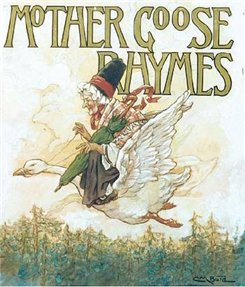
Mother Goose by Clara Burd

Although there are lots of chubby children, the illustrations show influences from several different art movements—Art Nouveau, the Pre-Raphaelites, for example. Some of the illustrations are complex and others look almost like paintings. Clara Burd also trained at the Tiffany Studios and designed stained glass windows.

I have been interested in illustrations for children’s books for a long time, although I have not made a study of it. This book is a nice little addition to my collection of children’s books with nice illustrations.

Related Posts

Clara and Mr. Tiffany

The Last Pre-Raphaelite

Studio St.-Ex