Day 628: Anne of Green Gables

Cover for Anne of Green GablesI have not read Anne of Green Gables since I was about ten, and I’m delighted to report that it is a book that offers as much enjoyment to an adult reader as to a child. As a child, I threw myself wholeheartedly into Anne’s delights and misfortunes, but as an adult, I am more able to appreciate the abundant humor of the novel.

Matthew and Marilla Cuthbert are an elderly brother and sister with a farm in Avonlea on Prince Edward Island. They have taken a momentous decision to adopt an orphan boy to help Matthew on the farm. They sent word to an acquaintance who went to adopt a girl, and she has brought an orphan back for them on the train.

But when Matthew arrives at the station, he finds not an orphan boy but a girl, a funny looking, skinny, red-headed girl. Matthew is a shy and reticent man, and he sees nothing to do but take the girl home and let Marilla break the news that there’s been a mistake. So, they set off home for Green Gables, the excitable Anne Shirley prattling all the way back.

When Anne learns she isn’t wanted after all, she is devastated. But when Marilla takes her to see another woman who might want an orphan girl, she can’t quite bring herself to leave Anne with the mean-mouthed woman with a reputation for mistreating the help (as an orphan would often be regarded at that time, not as a member of the family). Despite her better judgment, Marilla decides to keep Anne.

Thus begins this delightful novel about a young, imaginative girl who is always running into trouble. For Anne is romantic and dreamy and full of big ideas that often go wrong. The delight for me as an adult in reading this sentimental tale is the dry humor of Marilla, as she learns to love Anne and all her mischief. This is a lovely and fun book to read, particularly if you love any other volatile little red-headed girls.
Day 621: Smith, The Story of a Pickpocket

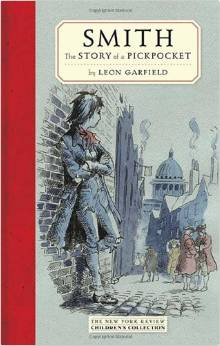
Cover for SmithI did not understand from the reviews I read for this book that it was a children’s book until I noticed its sprightly and simple tone. (My copy did not have this cover.) However, it is not suitable for just any child, because it begins with a murder and includes other violent acts. When I read in the introduction that Garfield wanted to write books full of adventure, like those by Robert Louis Stevenson, that made sense to me. The book is also described as Dickensian, but whereas some of Dickens’ and Stevenson’s books appeal to both adults and children, Smith does not have as much to offer adults.

Smith shares some plot elements with Oliver Twist, if the hero of the latter had been the Artful Dodger instead of the more innocent Oliver. For Smith is a twelve-year-old pickpocket. His adventures start when he picks the pocket of an old gentleman. Right after he does that, he sees the man murdered by two men dressed in brown. These men chase after Smith, but he eludes them.

Smith finds that all he has stolen is a paper that he can’t read. He is smart enough, though, to figure out that the paper must be important, since the men in brown are looking for him. Soon he finds he must leave the cellar where he lives with his two sisters and flee for his life. He goes looking for someone to teach him to read.

Smith’s adventures lead him to meet lots of characters who are vaguely Dickensian but somehow not as fully drawn as Dickens’ own. He finds shelter with a kindly blind man and his gruff daughter, is friends with a boastful highwayman, and meets an untrustworthy lawyer.

I found Smith only mildly entertaining but think that a child of the right age could be fascinated with this book—both by the life of a Victorian street urchin and by Smith’s adventures.

Day 538: Treasure Island

Cover for Treasure IslandIf I had to guess which of Robert Louis Stevenson’s books is the most popular, I’d pick Treasure Island. My own favorite is Kidnapped, though, and I probably wouldn’t have reread Treasure Island except that it came free with a reading app for my iPad. Still, it’s a pretty good adventure story.

The plot is familiar to everyone. Jim Hawkins and his parents run the Admiral Benbow Inn in an isolated location near the English seashore. A shifty old sailor comes to stay. He seems to be on the watch for someone, and asks Jim to alert him to strangers. Soon more shifty sailors arrive looking for him. The Hawkins’ guest is drinking himself to death, though, and he dies soon after Jim’s father does. In his sea chest is a treasure map.

Jim has gone for help to the Squire Trelawny and Dr. Livesey. Soon they prepare a ship to go collect the treasure, taking Jim with them. A crucial misstep occurs when the Squire hires the crew without waiting for the captain (something that seemed not only improper but stupid to me). He hires as the cook a one-legged man named Long John Silver. Silver and a good part of the crew turn out to be pirates who know about the map and want the treasure.

I was struck by a few cases when the protagonists behave nonsensically, the biggest being abandoning the ship when they find out a mutiny is afoot. Almost all the sailors are ashore at that point. It seemed like they should just sail away to another part of the island.

Still, the novel is written really well, and Stevenson is good at building suspense. I’m sure that successive generations of young people are thrilled to discover this adventure story.

Day 510: Red Knit Cap Girl

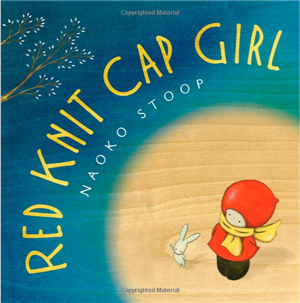
Cover for Red Knit Cap GirlRed Knit Cap Girl is interested in all the plants and animals in the forest. But she is most interested in getting to know the moon.

She asks her animal friends how she can get close enough to talk to the moon. Apparently, Mr. Owl knows. Accompanied by her friend White Bunny, Red Knit Cap Girl goes to visit Mr. Owl and find out how to talk to the moon.

The illustrations for this picture book are simple and cute. The background makes them look as though they are drawn on wood.

Small children will probably enjoy this simple story. Perhaps it is not as interesting for their parents, but it is a nice, gentle tale.

picture from book
Trying to reach the moon

Day 500: Little Bird

Cover for Little BirdLittle Bird is a simple picture book about small things. A man drives a big red truck up to the edge of a cliff and lets out a flock of brightly colored birds.

“Some days are different,” the book tells us, and the man finds one small black bird still in the truck. He tries to get the little bird to fly away with the others.

The illustrations by Albertine are simply drawn and brilliantly colored. They are a joy to look at.

illustration from Little Bird
Getting the bird to fly

The text is sparse, perhaps less than 50 words in the entire book. “There are no greater treasures than the little things,” it says.

This book is a gem for small children, who will love the pictures and the charming story. Adults will enjoy reading it to them.

Day 491: The Here and Now

Cover for The Here and NowI know that Ann Brashares is a popular author of books for teens and young adults, although I have not read her before. The Here and Now is a departure for her, though, because, although set in the present, it is in the science fiction genre.

Prenna and her people are from the future. They migrated back, fleeing from horrible conditions in our future, including a starving planet and a virulent disease called the blood plague that kills virtually everyone who is exposed to it. Prenna and her mother live with the others who came with them, and although they interact with “time natives,” they must obey stringent rules about staying uninvolved with them. Prenna finds this irksome and is aware of people being sent away for innocent mistakes.

Although she flies below the radar at school, Prenna has one friend, Ethan, who behaves sometimes as if he knows something about her. He does. She does not remember, but he witnessed her arrival a few years before. Prenna likes Ethan, but she is forced to keep their friendship on a superficial level.

Prenna’s contact with a homeless man sets up an unexpected chain of events. While trying to discover the cause of the man’s death, she and Ethan begin to believe they can change the course of the future by preventing one act.

I have written before about some characteristics of much young adult/teen fiction that I find annoying. One is a certain style of first-person narration that sounds too much like an adult trying to sound like a teen. It is used in this novel, only it is made worse by the preponderance of choppy sentences, especially in the dialogue. If Brashares believes teens can’t think and talk in complex sentences, she should read the dialogue in The Fault in Our Stars (which admittedly may be too sophisticated but strikes me as authentic). This tendency is worsened by the use of the present tense, almost always a poor choice for fiction.

But let’s look at the plot and characters, since those are what teens will think about. The only characters who are more than moderately developed are Prenna and Ethan. Brashares makes the mistake of believing we will automatically care about Prenna before we really get to know her. As for the other characters, Prenna’s mother is a total enigma who won’t even eat dinner with her daughter, although that is never explained. The other adults in Prenna’s group are basically cartoon villains.

http://www.netgalley.comWhether you can enjoy the plot depends on how much you can suspend your disbelief. I will just point out two things, as vaguely as possible. The first is the unlikelihood of Patient #1 of the blood plague being the same person whose totally separate act causes potential massive efforts to stop the horrible effects of global warming to be stillborn. (And by the way, I didn’t really appreciate the lecture about global warming that suddenly pops into the dialogue.) The second is the completely unbelievable results of Prenna and Ethan’s adventure.

I frankly had a very difficult time getting through this short novel. Teens may enjoy it, but I did not.

Day 487: The Book Thief

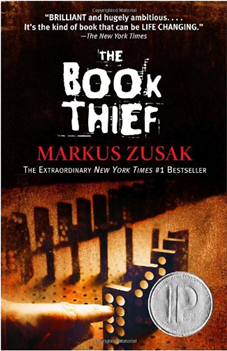
Cover for The Book ThiefLiesel Meminger is nine years old when she arrives at a house in a poor street near Munich. Her mother has given her and her brother up to a foster family because she cannot support them, but her little brother died on the train on the way there. She is dirty and illiterate, and when she arrives at the house of Hans and Rosa Hubermann, she has to be coaxed to come inside.

Although the Hubermanns prove to be loving parents and Hans eventually teaches Liesel to read, it is 1939 in Nazi Germany. Slowly, the difficulties of living in the Third Reich and the hardships of war will affect everyone she knows.

Liesel has already stolen her first book, when a grave digger dropped it the night her brother died. She steals her second book from a fire on the night of a book burning, for small and even large acts of defiance have become a part of her nature.

Zusak depicts a vivid life within Liesel’s little community. The boy that becomes her best friend, Rudy Steiner, has already distinguished himself before they meet by covering himself with soot and pretending to be Jesse Owens during the 1936 Olympics. Hans Hubermann is a failing painter and virtuoso accordion player who is ultimately too kind for his own good. His gruff wife Rosa shows her inner kindness by forcing people to eat her dreadful soup.

The novel is told by Death, which acts as an omniscient narrator, sometimes telling the back story, sometimes giving a glimpse of the future. At the beginning of the book, I thought I was going to find this irritating. By the middle of the book, I was wondering if it added anything that a traditional narrator wouldn’t provide. By the end, I thought it was effective. One little quirk of style that bothered me a little, though, was that Zusak occasionally creates his own words when perfectly good ones that are very similar already exist, like lovelily instead of lovely. I think this is an affectation that adds little to the novel.

The Book Thief accomplishes an unusual goal—to show that there were decent Germans during World War II. One of the kind and dangerous things that Hans Hubermann does is shelter a Jew, Max Vandenburg, in his basement for months. Liesel’s relationship with Max forms a core part of the story.

This novel is involving and affecting. It does have a few difficult scenes, but I think that it is a very readable experience for tweens, teens, and older readers. It has been wildly popular, so obviously readers are enjoying it.

Day 481: St. Lucy’s Home for Girls Raised by Wolves

Cover for St. Lucy'sDifficulties of youth and adolescence are the themes of Karen Russell’s unusual collection of short stories. Many of them are set in the Florida Everglades among bizarre and tacky theme parks or tourist destinations, where children sled through the sand on crab shells or visit enormous conches.

The first story, “Ava Wrestles the Alligator,” provides an introduction to the two sisters who are more fully developed in Russell’s later novel Swamplandia! Abandoned momentarily at their Everglades theme park home, Ava has a murky encounter with the Bird Man and tries to rescue her sister Osceola from her ghost lover. That story is expanded in the novel, which I really enjoyed.

Although certainly all are unusual, some of the stories are more bizarre than others. In “from Children’s Reminiscences of the Westward Migration,” a 19th century family makes a difficult crossing west, their wagon pulled by their father, the Minotaur. In the title story, human children of werewolves are sent away to be raised by nuns so that they can have a better life than their parents.

Russell’s stories are at once peculiar and oddly touching, full of young misfits who are even more out of place than all adolescents think they are. At times funny, such as the descriptions of the wolf-girls’ canine behavior when trying to adjust to their new school, the stories all reverberate with longing. Russell’s writing is brilliantly fierce and original, sparked by her own peculiar vision.

A few of the stories felt to me as if the author was just trying to think of the strangest ideas possible, and she almost lost me in “Lady Yeti and the Palace of Artificial Snows.” But ultimately, I enjoyed the stories, although I prefer the more developed characters and plot of Swamplandia!

Day 472: Miss Peregrine’s Home for Peculiar Children

Cover for Miss Peregrine's Home for Peculiar ChildrenThe inception of this novel is extremely creative. Ransom Riggs began collecting unusual old photos from bins in resale shops. Then he became acquainted with similar collections owned by other people. He noticed that many of the more interesting photos were of children and decided to write a story around them (some having been lightly edited).

Jacob Portman has grown up hearing his grandfather Abe’s stories about life in a children’s home during World War II after he escaped the holocaust. These stories featured children with seemingly magical abilities all staying in a lovely school on an island off Wales. As he grows older, he dismisses these stories as fairy tales.

Now Abe is getting paranoid and senile, and 16-year-old Jacob is trying to keep his parents from putting him in a home. One day Abe calls Jacob demanding the key to the arsenal of weapons he keeps in his shed. Jacob’s father has hidden the key for fear his father could be dangerous. When Jacob arrives at his grandfather’s home, the old man is dead, and in the woods Jacob thinks he sees a monster with tentacles in its mouth.

Jacob suffers from horrible nightmares after this incident, so his parents put him into treatment with a Dr. Golan. Not so sure he was hallucinating, Jacob decides he wants to travel to the island in Wales and try to find out about his grandfather’s past. His father agrees to take him only after Dr. Golan decides it is a good idea. When Jacob arrives on the island, though, all he can find is a ramshackle old house destroyed in a World War II bombing containing a chest full of odd photographs of children.

Of course, there is more to it than that, and eventually we find ourselves back in the past and in the requisite battle of good against evil. That’s where the creativity of this novel breaks down for me. I love the Harry Potter books, which also have this theme, but they have a richness of detail and originality that is lacking in many other works in this genre. Perhaps I am a poor audience for books written for teens, too, for I often feel they lack fullness of characterization and have a certain first-person teenage narrative style that I find irritating (adult author pretending to be a teenager). This novel also callously discards Jacob’s parents, those too cumbersome quantities for fiction for this age. First, the parents are flat ciphers, and finally we leave them behind altogether.

This is not to say, though, that older children and teens won’t enjoy this novel. I think they will, and they’ll be entertained by looking at the pictures. I think young children could get nightmares from some of them, though.

Perhaps this is unfair, but I’m an adult, and I’m only going to give the best reviews to books that entertain me as an adult, even if they’re for younger people. That’s a high standard but one that is possible to meet and that is a characteristic of the best children’s and young adult fiction.

This book was written to have a sequel, by the way, so don’t expect the ending to be neatly wrapped up.

Day 469: Nicholas St. North and the Battle of the Nightmare King

Cover for Nicholas St. NorthA moonbeam goes to earth and into a cave and accidentally frees a spectral boy trapped in the heart of Pitch, the Nightmare King. The spectral boy was the only thing keeping Pitch prisoner, so now he and his Fearlings are free to haunt the nights of children.

Away in the far north, the last of the great wizards Ombrik Shalazar protects a village from the bad influences in the world. Pitch almost invades the village, but he is fought off by North, a young man who was formerly a bandit and happens to be in the village to protect the children. This is the beginning of a battle that will involve flying reindeer, mystical lamas, yetis, and the Man in the Moon.

This story is the first of the series called The Guardians, a franchise that also includes the movie The Rise of the Guardians. It is written to be read to younger children or read by children who are slightly older, maybe up to eight or nine years old. It is straightforwardly told in a fairy tale style, and although it has imaginative ideas, the writing style is not distinctive. There is not much to interest an adult, humor for example, but kids will certainly enjoy it.

ombrik
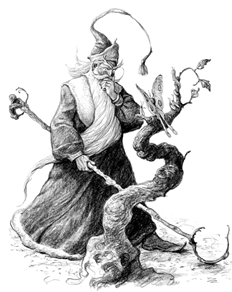
The Great Wizard Ombrik Shalazar

The book is illustrated by William Joyce in black and white pictures, which although interesting, do not have the charm of some of his brightly colored picture books. The style is a bit on the steampunk side, and I’m sure the pictures would have been more interesting in color. Many of them seem dashed off, although others, such as this one of Ombrik, are beautifully detailed. In reading part of the story about the Man in the Moon, I realized I had read the precursor to this book, which was a lovely picture book for younger children with pictures in a steampunk style.