Day 443: The Mischievians

Cover for The MischieviansThe Mischievians is a charming little book. It doesn’t have much of a plot but is entertaining nonetheless.

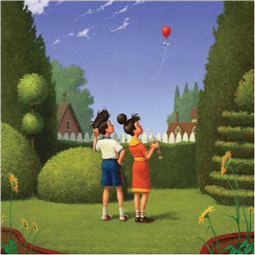
Two children send up a balloon asking for help. Their homework keeps disappearing, so they are in trouble with their parents. Next, a hole opens up in the earth and they fall through into the laboratory of Dr. Zooper, who tells them all about the little monsters lurking in their house.

What do the monsters do? Steal just one sock, hide the remote control, create belly button lint, and of course steal homework, among other serious crimes.

The book is breezily written with just a bit of gross humor that kids like.

Picture from the book
Sending up a message for help

As usual with Joyce, the illustrations are beautiful. The pictures featuring the children are charmingly retro, and the little monsters are cheerfully grotesque. Letters in the text are occasionally tweaked out of place by a mysterious hand. The cover is designed to look like an old, worn out book.

This book is for a little older kids than The Leaf Men, probably suitable for six- to eight-year-olds, although smaller kids will enjoy it, too.

Day 427: The Leaf Men

Cover for The Leaf MenEven when I was a small child, I looked for beautiful pictures in children’s books (or bunnies–bunnies were good, especially fluffy ones). I had some books that had belonged to my mother, and I used to spend hours looking at Arthur Rackham’s illustrations of fairies and twisted trees full of goblins. As a young adult, I collected children’s books that combined good stories with illustrations by artists such as Rackham, Kay Nielsen, or Mercer Mayer.

A few weeks ago I saw a feature on William Joyce and decided to buy some of his books for my young nieces and nephews. The first one that arrived was The Leaf Men, which I had to order used in hardcover, as it is older. It is written for a young child and is a simple story about the brave bugs who climb to the top of a tree to summon the leaf men in an attempt to save a dying garden and an old woman. (I have seen some editions of this book called just The Leaf Men but the one I purchased was called The Leaf Men and the Brave Good Bugs.)

The pictures are beautifully retro, with a 30’s or 40’s appearance. One of the things that attracted me to the book was the huge man in the moon on the cover, which was one of my favorite childhood images.

Good Bugs
The Brave Good Bugs

This is a lovely book. I think it is readily available new in paperback, but it is easy to find good used copies of the hardcover edition online. (I always think paperbacks are going to be totally destroyed, so I prefer to buy hardcover children’s books.)

People who have older kids are probably familiar with Joyce’s work, perhaps through the Guardians of Childhood series (several of which I have also bought for my older nephew). An animated movie called Rise of the Guardians was made from this series in 2012.

Day 418: Old Possum’s Book of Practical Cats

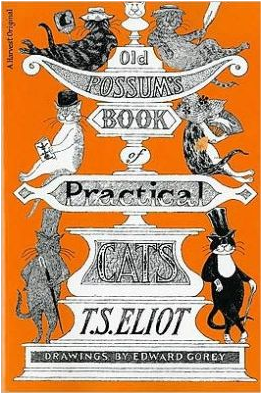
Cover of Old PossumIt took me longer to find this wonderful book than to read it. I came across it months ago in a used book store, bought it, and immediately opened it up. After I read the first poem, I got interrupted and put it down. Shortly thereafter, my husband, in a fit of tidiness, put it “somewhere safe.” He finally found it again, months later.

Some of you may know that T. S. Eliot’s Old Possum’s Book of Practical Cats is the source material for the musical Cats. Since the book is not as well known on this side of the pond as I assume it is on the other, I had not read it until lately and was frustrated during the musical at not being able to understand most of the words, much less which cat was which.

But these poems are delightful. They zip along with the kind of rhythm and rhyming that smaller children adore, and although I don’t think they’ll understand all the vocabulary, that can be explained to them. I was wondering whether modern children would understand or care about things like the clubs along St. James, but I decided that was unimportant. They would focus instead on Macavity, who isn’t there (I have a cat like that), on the names like Rum Tum Tugger that roll around in your mouth awhile, and on the proper way to address a cat (“O Cat”).

A comment on the cover I have shown here. This cover is not for the copy I bought, which was illustrated by Axel Scheffer. I thought Scheffer’s illustrations were cute, but it was hard to tell one cat from another. The reason I’ve attached the cover with Edward Gorey’s illustrations to my review is that Gorey’s version was the one I chose to buy for my young niece.

Day 413: Doll Bones

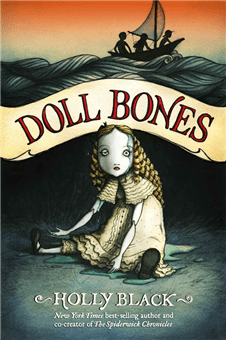
doll-bonesI just realized I had inadvertently reviewed a slew of historical novels in a row, so here’s something contemporary.

I really appreciate a children’s book that has as much to offer an adult as a child. I’m thinking of those books of Frances Hodgson Burnett, Philip Pullman, J. K. Rowling, or Robert Louis Stevenson as examples. Doll Bones doesn’t actually fit into that category, but I’m sure that tweens and younger kids will enjoy it.

Zach Barlow is growing up. He’s put on enough height this year to join the middle school basketball team. What he still enjoys most, though, are the games he plays with his best friends Alice Magnaye and Poppy Bell, where they use dolls and action figures to act out elaborate stories. However, they never touch one doll belonging to Poppy’s mom that they call the Queen, an old porcelain doll that seems very creepy.

Zach’s dad left him and his mother for a few years, but now he has returned to them and is still trying to figure out how to be with them. One afternoon Zach comes home thinking about what will happen next to Pirate William, only to find his dad has thrown away all his toys and dolls. Zach is too upset even to explain to Alice and Poppy why he won’t play anymore. The two girls are devastated.

One night the girls come to see him. Poppy explains she’s had a ghost visitor who says her ashes are inside the Queen. The ghost girl has asked them to bury her ashes in her grave in East Liverpool, Ohio. Poppy believes the ghost and wants to go on a quest to return the bones, which are in the bag that makes the doll’s body. So, despite their fears of getting into major trouble, the kids get on a bus in the middle of the night to travel from Pennsylvania to Ohio.

Of course, on this trip they run into difficulties, including getting scared off the bus part way and having to make their way on foot or any other way they can find through a landscape of urban blight. On the way, some adults creepily seem to believe there are four of them. Eventually, they solve the mystery of who the girl is and what happened to her. As they meet these difficulties they grow up a little and figure out better how to handle their changing relationships.

I think kids will relate to the problems of Zach, Alice, and Poppy. I also think they’ll like the spookiness of the story. Doll Bones falls among the more innocent of contemporary books for tweens and younger teens, with a few chills but no violence or bad language. It would make a good story for any kid from ages eight or nine to, say, twelve or thirteen.

Day 408: Folktales of the Native American

Cover for Folktales of the Native AmericanI have read some of the folk tales of the Celtic peoples (mostly Irish and Welsh) and the Norse and Russians as well as the more recent ones of the Grimm brothers. Last year, I reviewed Robert Graves’ book about Greek myths. Except for the really amusing and cynical fairy tales of Charles Perrault, I find them almost uniformly violent–full of murders, rapine, and theft. (Of course, kids love that kind of stuff.)

What strikes me about the Native American tales assembled and retold by Dee Brown is that even though some are about battles, they do not focus on the gruesome, as European tales are prone to do. More of them are about how things were created or how some animals got their markings, or they are comic tales about trickery and deceit. The stories seem to be more similar to the few African ones I have read than to European myths.

The tales are simply told, most of them no more than two or three pages long. I think in general folk tales suffer from not being told aloud. In print they lack the tale teller’s expression and gestures.

Day 373: Tell the Wolves I’m Home

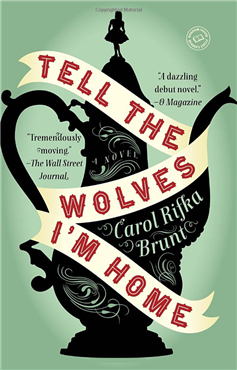
Cover for Tell the Wolves I'm HomeBest Book of the Week!

Although I think Tell the Wolves I’m Home is classified as a young adult novel, it has much to offer adults, too, in reading pleasure. Carol Rifka Brunt gives us a novel in which the voice of the narrator is so strong and the sense of her personality so developed that it is really outstanding.

Fourteen-year-old June Elbus is an unusual girl–a loner who likes to go to the woods and pretend she is living in the middle ages. She loves her Uncle Finn more than anyone and believes he is the only person in the world who understands her. She used to be close to her older sister Greta, but for some reason Greta has started treating her badly. So, when Finn dies of AIDS, June feels as if she has no one. The situation is made worse because it is the 1980’s, and no one understands the virus.

Something strange happens at Finn’s funeral. A man June has never seen before appears and tries to get her attention, but her sister hustles her away. Days later her uncle’s favorite teapot arrives for her with a note in it. The writer explains that he is a friend of Finn’s and asks to meet her. But Greta has told her that this friend, Toby, killed Finn.

A problem is posed by the portrait Finn spent the last months of his life painting. It is one of June and Greta, although Greta acted as if she didn’t want to sit for it. The Elbuses have the portrait in their living room until an article appears about lost works of art, including a picture of the portrait and reporting that its title is “Tell the Wolves I’m Home.” Until then, June didn’t even know her uncle was a famous artist. And who could have photographed the portrait and sent the article to the magazine?

June agrees to meet Toby but becomes jealous of him when she realizes how close he was to Finn. She is shocked to find they were partners for nine years, and she never knew he existed. June is torn because of her ambivalent feelings about Toby and the fact that they are keeping their acquaintance a secret from her parents, until she finds a note to her from Finn in a book, asking her to take care of Toby because he has no one.

Infused throughout with the voice of its teenage narrator, a girl like so many others struggling with feelings of self-doubt, trying to figure out what is right, this novel is beautiful and moving without being in the least sappy. It is really a wonderful book.

Day 349: The Silver Sword

Cover for The Silver SwordThe introduction of my edition of The Silver Sword says it is a beloved British children’s book that has not been out of print since it was published in 1956. When I began to read it, the names of the characters seemed vaguely familiar, and when I read that it was published in the US as Escape from Warsaw, I realized that I too had read it as a child.

Joseph Balicki is taken away from his family in Warsaw during the Nazi occupation of World War II for the crime of turning Hitler’s picture to the wall during a scripture lesson. He eventually manages to escape from prison and make his way back to Warsaw, only to find his house destroyed, his wife imprisoned, and his children missing.

Since the first days of the war, the family planned that if they ever got separated, they would meet in Switzerland at his wife’s parents’ house. Joseph decides to head for Switzerland, but first he befriends a street urchin named Jan. Joseph gives Jan a trifle belonging to his wife, a silver sword, and asks him if he ever meets his children to tell them to go to Switzerland.

The novel flashes back to when the Balicki’s mother was arrested. After the arrest, Ruth, Edek, and Bronia take to the streets and live through the war in cellars or in the woods outside the city. Edek is taken away to a German labor camp. Finally, at the end of the war, Ruth meets Jan and decides to make the trip to Switzerland. But first, she and Bronia, and Jan, for he comes too, must travel to Germany to find Edek.

The story goes quickly, narrated in a simple manner that does not focus much on emotion or characterization. Serrailler was cognizant of the sensibilities of children and also wanted, in the postwar years, to focus on reconciliation, so there are good people among all the nationalities the children encounter. He tries to show the horror and destruction of war without being too violent.

Perhaps Serailler was unaware that the Russians waited outside of Warsaw hoping that the Polish resistance would be completely wiped out by the Nazis. In any case, he did not express at all how much the Poles feared the arrival of the Russians. The story is probably not going to be very satisfying for an adult to read, from this standpoint and that of the style, but I remember being riveted by it as a child.

Day 325: Over Sea, Under Stone

Cover for Over Sea, Under StoneOver Sea, Under Stone is a charming children’s story with an Arthurian theme. Simon, Jane, and Barney Drew are vacationing with their parents and great uncle Merriman Lyon in a fishing village in Cornwall. While exploring the attic of the old house they rented, the children discover an ancient map of the local coast line. Barney realizes that the map refers to King Arthur.

The children’s parents are befriended by a Mr. Withers and his sister Polly, who invite the entire family to go fishing on their yacht. Jane is reluctant to go, though, and while everyone else is out, discovers a guide book that is similar to the map. It soon becomes clear that the Withers and perhaps other parties are looking for the secret that the documents reveal.

After a robbery, in which the robbers only rummaged through books and documents, the children decide to confide in great uncle Merry. They all figure out that the map and guide book may hold the secret to the Holy Grail. The children and their uncle become forces of the Light, while the others are forces of the Dark.

Over Sea, Under Stone is an entertaining book that should appeal to older grade school and middle school children. As an adult, my only quibble with it is the coincidence that other people suddenly begin looking for the map in the house just after the children find it. However, that is something that most kids wouldn’t think of.

The novel is well written and packed with adventure. I believe it is the first book in a series called The Dark Is Rising.

Day 287: The Dragonriders of Pern

Cover for Dragonriders of PernAnne McCaffrey’s fantasy books about Pern were a guilty pleasure for me starting in high school. For years, I picked up every one of the books, until it seemed as if she was simply dashing them off. I understand that the series is continuing, written by McCaffrey’s son Todd.

I recently reread The Dragonriders of Pern for old time’s sake. This book incorporates three of McCaffrey’s Pern novels: Dragonflight, Dragonquest, and The White Dragon.

Dragonflight was my introduction to and the first novel in the series, and I still enjoyed the tale of Lessa, revenge, and a new life. Lessa has been living as a kitchen drudge in the hold that Lord Fax invaded when she was a child, murdering the rest of her family, who had been the hold’s rulers. For years she has been nursing her thirst for revenge, and sees an opportunity when F’lar, a dragonrider, comes to the hold in search of female riders for the as-yet unhatched dragon queen. Soon, she finds herself renouncing some of her plans and going off with the weyrfolk. This novel still has all its original magic, featuring a fully realized fantasy world, an immanent threat, and an engaging hero and heroine.

Dragonquest begins seven “turns” after Dragonflight. F’lar and Lessa are now weyrleaders, and they are trying to unite all the weyrs in the battle against thread, which looks as if it might consume their planet. At the end of Dragonflight, Lessa went back in time to bring forward the weyrs from the past for help. Now those weyrs are behaving like a bunch of feudal lords, and F’lar and Lessa are searching for solutions to the problems. This novel was also just as good as I remembered.

The White Dragon seems much more of a children’s novel. Lord Jaxom is the son of Lord Fax, whom Lessa got F’lar to kill in a duel in Dragonflight. As a lord holder, he is expected to take on duties that have nothing to do with weyr life, but when he is a boy, he accidentally impresses a white dragon. The dragon never grows very big and seems to be unsuited to the regular tasks of weyr life. But Jaxom is convinced that his Ruth can fight thread and act just like any other dragon. This novel seems much more juvenile than the other ones, and I find it much less interesting.

I should also say something about the edition, which is cheaply constructed and poorly edited. I found many typos that I don’t think I encountered in the original versions of the novels.

Day 283: My Alsace

Cover for My AlsaceDuring a visit to Alsace several years ago, I was fascinated by this book, especially by the pictures, but I could only find it in French. Then, awhile back, I found it on Amazon in English.

My Alsace was written by Hansi (Jean-Jacques Waltz), a beloved Alsatian poster and children’s book artist who grew up in the late 19th century under German occupation. In the 19th and early 20th centuries, the region of Alsace, which identifies itself as French, changed hands between Germany and France four times. In the German school at Colmar as a boy, Hansi only learned about the great Prussian victories and the defeat of Alsace in his history classes. He deemed this period the worst in his life and wanted Alsatian children to know that Alsace has a prouder history.

My Alsace is a selection from the history he wrote in 1912 and some writings from after World War I. The latter section of the book goes on to tell about the trouble he got into with the German authorities during World War I because of his jokes about Germans in the earlier book. He was originally fined and later he was given a year’s prison sentence for insulting a German officer. He published the latter part of the book in 1919 to celebrate the region’s liberation from the Germans.

Hansi’s drawings are wonderful. He was well known for his pictures of Alsatian villages, people in traditional costumes, and celebrations of Alsatian life from an earlier time. The text is amusing, although it is full of anti-German satire. Written for children about eight years old, it is also entertaining for adults.