Day 270: The Secret Garden

Cover for The Secret GardenBest Book of the Week!
The Secret Garden was one of my favorite books as a young girl. I recently had occasion to reread it and was surprised to find it just as entertaining as I remembered. I also noticed for the first time how beautifully written it is.

We might be inclined to sympathize with ten-year-old Mary Lennox at the beginning of the novel. After all, she has survived a cholera outbreak in India that killed her parents, and she was left alone when the remaining servants abandoned the house. But Mary is spoiled and bad-tempered. She goes to live with her uncle, Archibald Craven, in Yorkshire, and she doesn’t like anything she sees. The food is horribly bland. The house is located on a desolate stretch of moor, and her uncle isn’t even there, so she is to be kept by servants. Well, she knows how to handle servants.

To her surprise, the English servants are not afraid of her temper; they expect her to do as she’s told. Largely left to her own devices, she explores the huge, rambling house and the gardens around it. Her young maid Martha tells her the story of a secret garden that used to belong to Uncle Archibald’s wife. His wife died, and he had the garden locked and the key buried.

Running around outside, Mary starts to improve her health and temper. She makes friends with a robin, and Martha’s mother sends her a jump rope. Soon she is rosy-cheeked and stops turning her nose up at the food.

Mary makes the acquaintance of the taciturn gardener, Ben Weatherstaff, and eventually finds the door and the key to the secret garden. The plants are dead, because it is early spring, but she wonders if the garden can’t be revived with a little help. She gives Martha some of her allowance to buy gardening tools, and Martha’s young brother Dickon delivers them. Dickon is a fascinating boy who roams the moors and makes friends with the animals, and with Mary. Soon, both Mary and Dickon are working every day in the secret garden.

Her nights have occasionally been disturbed by someone crying. One night she follows the noise and finds that a boy is living in the house, her cousin Colin. He is an invalid who has not been out of his bed for years, and he is even more spoiled than Mary. After putting him in his place, Mary begins to feel sorry for him. She reads him stories and tells him about the secret garden as if it were story, but he soon figures out that it is true. Eventually, she and Dickon take him out into the garden in a wheelchair.

This book is a tale about how living things can heal bodies and minds. As Mary’s health improves and she works in the garden, her temper improves. The magic of the garden brings Mary together with her friends and eventually reunites the Craven family.

Day 202: The Lantern Bearers

Cover for The Lantern BearersIf you are historical fiction lover and are not familiar with Rosemary Sutcliff, I recommend that you try one of her books. She is best known for her novels about the Roman occupation of Britain and the interaction between the Romans and the various British peoples. Although many of her books are classified as children’s literature, the ones I have read are just as suitable for adults. My review today is of a Sutcliff book I read most recently, which unfortunately is the third book of her acclaimed Eagle of the Ninth trilogy, The Lantern Bearers. Although she wrote a series of eight books about the Aquila family, three are usually grouped together and sometimes can be purchased as one book. The other two are The Eagle of the Ninth and The Silver Branch.

The Lantern Bearers is about the desertion of Britain by the Romans and its subsequent inundation by marauding Saxons. Aquila is a soldier with the last battalion on Britain. He is recalled to his regiment to withdraw from Britain and leave his father and sister behind in the home they have occupied for generations.

Aquila finds that his heart is with Britain, so he deserts his regiment and returns home. However, the day after he arrives, his home is attacked by the Saxons, his father is killed, and he and his sister are enslaved.

Without giving too much away, I will say that the story eventually focuses on the rise of the British ruler Ambrosius and his adopted son Artos, from whom we get the stories of King Arthur.

I think these books are fascinating, although of the three in the trilogy, my favorite is The Eagle of the Ninth (which, by the way, was recently made into a very good movie that no one apparently went to see; I recommend it). If I had any criticism of this book, which is carefully researched, well written, and full of action, I would say that sometimes it seems as if Sutcliff thinks the Roman occupation of Britain was completely positive. I doubt if the Britains felt that way when they were conquered. However, even though her heroes are often Romans, her ideas are more nuanced than that.

If you decide to read this trilogy, I suggest you start with The Eagle of the Ninth, although the books are far enough separated in time to be read as stand-alones.

Day 170: The Subtle Knife

Cover for The Subtle KnifeA few months ago, I reviewed The Golden Compass, the first book in Philip Pullman’s trilogy, “His Dark Materials.” I thought it was about time to review the second book, The Subtle Knife.

As I have said before, it’s most difficult to review the second book in a trilogy, because everything is building up toward the third book. Lyra follows her father, Lord Asriel, through a window to another world. There she meets Will, a boy from our world.

Will has taken care of his mentally ill mother since his father disappeared on an expedition years before. Recently men have been breaking into their house trying to find his father’s papers. Will kills one of them accidentally and flees into the other world through a window, where he meets Lyra.

Lyra is trying to find out about dust, but the alethiometer tells her to help Will find his father. What they find first is the subtle knife, which can cut through anything, even the fabric between worlds. Will becomes the knife’s keeper.

Although the concept of the knife cutting the fabric between worlds is interesting, I really loved the whole feel of the world and the characters in The Golden Compass. Some of the characters are still with us in the second book, but we are moving away from that world. However, I enjoyed The Subtle Knife. I just don’t think the rest of the trilogy stands up to The Golden Compass in imaginative power and characters you feel really invested in.

Day 151: Moonfleet

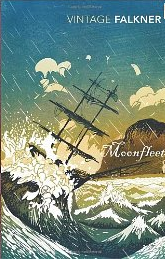
Cover for MoonfleetMoonfleet is a boy’s adventure story similar to Kidnapped or Treasure Island. Written by J. Meade Falkner in 1898, it was very popular for many years. I had actually never heard of it but picked it up out of curiosity a couple of years ago.

John Trenchard is an orphan boy who lives with his aunt in the small village of Moonfleet in the south of England in 1757. The village has been dominated by the Mohune family for centuries. There is a legend that Colonel John “Blackbeard” Mohune stole a diamond from King Charles I and that his ghost roams the crypts looking for it.

One day John hears noises from Mohune’s crypt, and when he goes to investigate, finds the landlord of the local inn, Elzevir Block, and Mr. Ratsey, the sexton, who say they are looking for damage from a storm. John assumes they are looking for Blackbeard’s ghost. He finds his way into the crypt through a large sinkhole and gets inadvertantly trapped there overnight. While he is trapped there, he overhears enough to realize that Block and Ratsey are actually smugglers.

John’s aunt assumes he has been up to no good when he doesn’t come back for the night, so she throws him out of the house. Fortunately, Block takes him in. But when Block’s lease expires, the lease goes up for auction and is purchased by Maskew, the unpopular local magistrate. Before Block leaves the area, John accompanies him on one last smuggling venture, during which Maskew, who has lain in wait for the smugglers with the excisemen, is accidentally shot by the excisemen. John is wounded and is falsely accused in absentia of murdering Maskew, so he must flee to the continent.

The rest of John’s adventures include diamond hunting, being imprisoned for theft when he is cheated by an avaricious diamond merchant, working as a galley slave, and shipwreck. Moonfleet is an exciting book with a gripping story line that is still popular with children.

Day 70: The Golden Compass

Cover for The Golden CompassThe Golden Compass is the first book in Philip Pullman’s trilogy His Dark Materials, a children’s book that appeals as much to adults because it is just plain exciting.

Lyra is an adventurous eleven-year-old orphan brought up by the scholars of Oxford in a world that is similar to ours in a previous century. In this world, every person has a daemon, an animal creature who is always with the person and who shares the person’s feelings. Until a child reaches puberty, the daemon changes from one animal to another.

Lyra is a bit of a wild child who spends most of her time clambering on the college roofs with her friend Roger, the kitchen boy, and getting into fights with the town kids. She has heard rumors of the Gobblers, a group who steals children, but she hasn’t paid much attention to them. Her real adventures begin the day she sneaks into the scholar’s room, where she is not supposed to be. She is hiding when she overhears a mysterious conversation about something called “dust” and sees the Master poison her Uncle Asriel’s wine. She is able to warn her uncle in time.

After her uncle departs on an expedition to the north, her friend Roger is stolen by the Gobblers. Then Lyra and her daemon Pantalaimon are removed from Oxford by the beautiful and mysterious Mrs. Coulter and taken to London. Before she leaves, the Master gives her the golden compass, a device that can tell the future, and says she should hide it from Mrs. Coulter.

Lyra flees from Mrs. Coulter’s house when she learns that Mrs. Coulter’s monkey daemon has been spying for the compass and also figures out that Mrs. Coulter is one of the Gobblers. She throws her lot in with a gang of the gyptians, a tribe of wanderers who have joined forces to go north and fetch back the stolen children.

The Golden Compass is wonderfully inventive. Just as a side note, I also greatly admired the movie, with its cool steampunk look. Lyra is a great heroine, you just love Pantalaimon, and you get very attached to many of the other characters. Full of action and suspense, The Golden Compass is a great book.

Day 42: The Invention of Hugo Cabret

Cover for The Invention of Hugo CabretI got interested in reading the Invention of Hugo Cabret by Brian Selznick after I saw the marvelous movie Hugo, which is based upon it. The book has been called a masterpiece, and it really is. A combination of graphic novel and children’s book, about two thirds of it is told in beautiful charcoal drawings that drive the narrative forward.

Hugo is a mechanically gifted boy living secretly in the Paris train station. He keeps the clocks in the train station running in the hopes that no one will discover the absence of his uncle, who is supposed to do the work. He supports himself by stealing food from the cafés in the train station. He doesn’t go to school.

In his spare time he works on an automaton that his father brought home from the museum where he worked shortly before he died. The automaton can write a message, and Hugo believes that if he makes it work, he will receive a message from his father. To get parts for the automaton, he steals toy parts from a stern old toy maker. But one day he is caught.

I did not actually try to use the drawings as a series of flip books but understand that you can, to create black and white movies. And that is a suggestive way of hinting at one beauty of this novel. In the beginning you think you are reading a more or less traditional children’s story but then it shifts to tell a story about the history of the movies. The book is inventive–a graphic novel, a children’s story, a flip book, almost a movie, and a real delight.