Day 161: Peony in Love

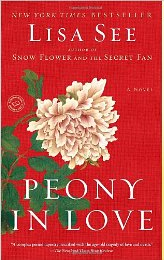
Cover for Peony in LoveI’ll start out right away by saying that after reading the touching and engrossing Snow Flower and the Secret Fan, I was disappointed by Lisa See’s Peony in Love. The innocuous description on the back of the book gives you no warning of the subject of the novel. I think that is unfortunate, because not very many readers of See’s other books will be prepared for it.

Peony’s sixteenth birthday is approaching. In six months she will “marry out” to the man who has been her fiancé since she was a child, although she only knows his name. She is excited because that night her family will begin hosting an epic opera by Tang Xianzu that she loves, and the secluded women will be allowed to watch it through a screen.

The story of the opera is important to the novel. It is about a girl who dies for love and haunts her lover until she is eventually brought back to life in honor of her steadfastness.

That evening, Peony peeps out from behind the screen and spots a handsome young man, with whom she falls instantly in love. Later in a brief absence from the performance she encounters him accidentally, and he begs her to meet him the next night. Such behavior is strictly forbidden. She has never been alone with a man outside her family, but she meets him anyway.

I usually try not to give away important plot points, but I will tell you one thing that happens in the first third of the book because I don’t think you can make a fair decision about reading it without knowing. So, this is my spoiler warning. Unfortunately, I don’t see any way to impart my objections without revealing this key plot point.

Convinced that she will be forced to marry a man she does not love even though she doesn’t know who her fiancé is, Peony starves herself to death, like the heroine in the opera. Just before she dies, when it is too late to save her, she finds out that her beloved actually is Ren, her fiancé (a twist that I found predictable). Presumably, she spends the rest of the novel as a ghost. I say presumably because after another 100 pages or so I quit reading.

I was already fed up with Peony because she wastes two opportunities to avoid the misunderstanding that causes her death. As in many movies, a few words could have cleared things up. That is, she and her lover never bother to exchange names. In addition, after the opera, when she is still in the audience, her father introduces her fiancé to the company. She is so convinced he is a stranger that she shuts her eyes. How likely is that?

Peony is already an extremely foolish girl even before she begins starving herself. I continued reading out of interest in Chinese beliefs about the afterlife, but when Peony begins manipulating Ren’s wife, I found this development too distasteful to continue. I regret that I cannot recommend this book, although I am still eager to try other books by Lisa See.

Day 142: The Man from Beijing

Cover for The Man from BeijingBefore I read The Man from Beijing, I heard it was really good, but I personally think Henning Mankell is better when he restrains the scope of his novels and refrains from long political discussions. This novel is not one of Mankell’s Kurt Wallander mysteries, but a stand-alone.

Almost everyone in a small village in remote Sweden is brutally murdered. Judge Birgitta Roslin figures out that one elderly couple was her mother’s foster parents, so she decides to go to the village and investigate.

The police are quickly convinced that the murderer is a local petty criminal, but Roslin finds diaries written by an immigrant ancestor of one of the elderly victims that she thinks may provide clues to the crime. Roslin’s story is periodically interrupted by a flashback describing the events following a man’s kidnapping in China in 1863 after he is brought to America to work on the railroad.

In the meantime, Ya Ru, a powerful Chinese businessman, is plotting a further acquisition of power and waiting to hear about the revenge he planned against the family of a man who harmed his ancestor. The novel travels to China, London, and Africa. It involves political plotting and maneuvering, corruption, and racism.

I thought the motive for the original murders was ridiculous. I also found many of the characters to be one-dimensional.

This novel is the second stand-alone I have read by Mankell, but unusually for me (because I often tire of series mysteries), I have preferred the Wallander novels. Both stand-alone novels are set partially in Africa, where Mankell lives part of the year. This novel is an improvement on the other one, which I thought was poorly written and extremely depressing, but it still has major flaws.

Day Eleven: Snow Flower and the Secret Fan

Cover for Snow Flower and the Secret FanBest Book of Week 3!

Lisa See, the author of Snow Flower and the Secret Fan, explains that she was inspired to write the novel after learning about nu shu, a secret, simplified writing used by women in a remote area of China to communicate with each other for centuries. The writing was suppressed for years after the Japanese invasion of China and during the Cultural Revolution, so it is now known only by a few scholars who learned it from the last women who knew it.

Snow Flower and the Secret Fan is a beautifully written story about the love between two women in 19th century China. Near the beginning of the novel, Lily’s mother delays the date of her foot binding a year from the traditional age of six so that she can enter into a special relationship, called laotong, with another girl named Snow Flower. Laotong, or “old same” girls must match each other as closely as possible in birth date and time, height, and other qualities, including the date of their foot binding. Snow Flower sends Lily an invitation to enter into this relationship written on a fan in nu shu. This relationship is supposed to be advantageous to Lily, the daughter of a farmer, because Snow Flower comes from a family that is higher in status and can teach her to be more refined. The end purpose of all this is to find her the best husband possible when the time comes.

The foot binding itself is horrifically described near the beginning of the novel, when Lily’s short life as a free child is ended by this process of trying to bend the foot so that all but the big toe meet the heel and it ends up as close to three inches long as possible.

At lot of the novel is about suffering. The way of life was circumscribed in many ways, with the women spending most of their lives in one room. As children and young women they are considered worthless burdens to their family until they “marry out.” Then they are considered burdens by their husbands and mothers-in-law until they justify their existence by having sons.

Lily’s relationship with Snow Flower opens up her world a bit. They visit a shrine together every year. Snow Flower comes to visit Lily, and they spend days and nights whispering, telling their secrets and hopes. They send messages to each other on their fan.

The hardest thing for me to explain is the extent of the innocence of these girls, how they are full of good will, despite their difficult and painful lives. How they try to do their best even though they are constantly criticized. How even the aphorisms and songs that they hear every day tell them their purpose is just to serve others, yet they try to be cheerful.

Lily relates the story from the viewpoint of an old woman to explain something that she did that she will always regret. Eventually, Lily’s successful marriage and good luck and Snow Flower’s loss of status lead to a divide between the women and then an apparent act of betrayal. The story effectively explores the linkage between love, hurt, and jealousy.