Day 655: The Night Inspector

Cover for The Night InspectorWilliam Bartholomew is a survivor of the American Civil War, but in many ways he is also a casualty. His face was destroyed, so he wears a mask, but he also bears less discernible scars from his work as a sniper for the Union army.

Bartholomew is working as a commodities trader when he meets the writer Herman Melville. He has read and admired Moby Dick, but the novel was mostly met with mockery by the critics and ignored by the public. Unable to take care of his family with his earnings as a writer, Melville takes a job as a deputy customs inspector.

Bartholomew has a relationship with a Creole prostitute that he considers deeper than the usual one of client. She asks for his help in a venture that seems laudable but is illegal. To pull it off, he must involve Melville.

At first, I wasn’t sure where this novel was going. It is dark and sometimes disturbing, and I even thought it might become a mystery. It does not, but it fully captures the consciousness of a man who is tough but has had to fight to keep from being shattered by circumstances, his own actions, and his conscience.

It is also a vehicle for depicting Melville. There, I was not so sure it was going to be successful in making Melville interesting until the denouement of the novel.

Related Posts

Moby Dick

Ahab’s Wife, or The Star-Gazer

The Invention of Wings

Day 597: Neverhome

Cover for NeverhomeBest Book of the Week!
After some personal tragedies, Ash Thompson leaves the farm in Indiana to join the Union army and fight in the Civil War. Although the truth about Ash is not immediately apparent, I feel little hesitation in revealing that Ash is a woman, because the publicity for this novel makes that clear. Why she has chosen to leave her husband Bartholomew and go off to war is another matter.

Ash, who is tall and strong, shows herself to be a brave and obedient soldier, resourceful and a good shot. No one knows her for what she really is except a few women she sees in passing and her colonel.

This story is told by Ash herself in a very understated way. In fact, it is the voice of this novel, so distinctive, that makes it stand out. It is not until the end of the novel that we learn that Ash is not always a reliable narrator.

http://www.netgalley.comThis novel is beautifully spare and compelling, a wonderful portrait of a person who is more disturbed by violence and her personal tragedies than she appears to be.

Day 260: Team of Rivals: The Political Genius of Abraham Lincoln

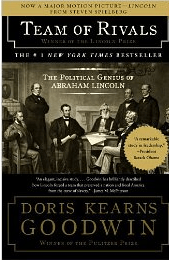
Cover for Team of RivalsBest Book of the Week!

Doris Kearns Goodwin begins her examination of Lincoln’s administration by remarking that because so much has been written about him, everything might be thought to have been said. However, by examining his career in terms of the team he put together to run the country, she found much more to write about.

This team consisted of his rivals in politics. Edwin Stanton, who treated Lincoln with contempt on their first meeting and who Lincoln made Secretary of War, was griefstricken at Lincoln’s death. Salmon P. Chase, eternally Lincoln’s rival for the presidency and a frequent undercutter, was an extremely competent Secretary of the Treasury. William H. Seward, the favorite for the Republican presidential nomination that Lincoln won, was at first inclined to underestimate Lincoln but became his closest friend and advisor as Secretary of State. Edward Bates, the Attorney General, was a homebody who was not sure he wanted a public life and at first looked upon Lincoln as well-meaning but incompetent, but ended up thinking he was very nearly perfect.

Team of Rivals begins on the day of the Republican convention of 1860, in which, of the rivals who had some expectation of winning the nomination of the party, Lincoln would seem to have the least. Seward was the odds-on favorite, but he had made many enemies in the party. Chase’s overwhelming ambition for the presidency lead him on several occasions to ignore the warning signs that he would not be the nominee. Bates was willing to act if nominated but made no extraordinary efforts because he preferred his home life.

Goodwin’s narrative then turns farther into the past to trace the men’s respective careers. In this examination she shows how Lincoln cleverly set himself up to be everyone’s second choice for the Republican nomination.

The book follows Lincoln’s nomination, campaign, and stunning victory, but the bulk of it concerns the compelling story of how he put together a cabinet containing these men, who were not only rivals for the office but who were from different regions of the country and who had different views on the important issues of the day. He then managed to work with these men and run the country during one of its most difficult times. It was frequently rumored that Seward actually held the power, but Goodwin shows us that Lincoln was always in charge.

Through an examination of the diaries of the men, letters, and other sources, Goodwin provides us with the fascinating details of political machinations, the conduct of the war, the fights among the generals, the alliances and friendships, and the story of how several men, who began with no esteem of Lincoln at all, grew to respect and love him.

Goodwin’s book is one of the most absorbing history books I have read. Although it is long and takes awhile to read, it explains each issue in completely lucid terms and interesting detail. The most important thing I got from the book was a fuller understanding of Lincoln’s greatness, his humor, kindness, and magnanimity–and what a disaster for the country his death was.

Day 25: Shiloh

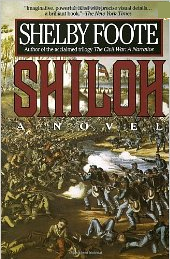
Cover to ShilohIn Shiloh, the historian and novelist Shelby Foote has written an interesting fictional account that describes the battle from the points of view of several different narrators, some on the Union side and some on the Confederate. Each narrator has his own chapter. In these brief narratives you get a sense of the character while being able to trace the larger movements of the battle.

Foote manages to work into the narratives the major events, such as the death of General Johnston; the surviving Confederate leadership’s failure to follow Forrest’s recommendation of attacking again at night, which probably would have ended in victory for the Confederates; the 10,000 Union “shirkers” who hid along the riverbank after they became dispirited from having to pull back time after time; and the river crossing by Buell’s troops, which turned the tables in the Union’s favor.

Lieutenant Palmer Metcalfe is marching with the Confederate army under Johnston as it prepares for a surprise attack on the Union troops. He thinks back with satisfaction to the complicated plan he helped draft, as he is a staff officer under Johnson. The noisy troops may have lost the element of surprise, but Johnston insists upon attacking.

Captain Walter Fountain is a Union soldier writing a letter to his wife Martha during a Tennessee evening when the Confederate troops burst out of the woods and charge the Union army.

Private Luther Dade is wounded in battle and is sent to a triage area to wait for a doctor. After hours pass and no doctor shows up, Dade begins to show signs of infection. He stumbles around across a large swathe of the battle area and finds himself witnessing the death of the Confederate commander Johnston.

So the novel proceeds in short chapters that culminate with a return to Lieutenant Metcalfe as he reviews the results of the battle. The characters are briefly drawn but have distinct personalities. Through following the peregrinations of the various characters and with the assistance of the maps in the book, you can get a good understanding of the complex battle and why the initially successful attack ultimately failed.