Day 552: Dracula

Cover for DraculaHaving experienced other gothic classics of the 18th and 19th century, I was delighted to find Dracula unexpectedly readable. I was also surprised to find how little it resembles its many theatrical and movie productions, even those that attempt to stay closer to the original work.

All versions begin the same, however, with poor Jonathan Harker sent out by his office to Transylvania to complete a property deal with his client, Count Dracula. While staying at Dracula’s castle, he begins to suspect something is badly amiss and eventually fears for his life.

Back in England, his fiancée Mina Murray corresponds with and later stays with her good friend Lucy Westerna at a seaside town. In one day, Lucy has received proposals from three different young men, who all feature strongly in the novel. Dr. Jack Seward is in charge of a local insane asylum. Quincy Morris is a manly, amiable Texan, whom I feared all along was designed for a ghastly death. Lucy’s chosen is Arthur Holmwood, another manly young man who is soon promoted to a lordship by the convenient death of a benefactor. (I don’t think these things work this way, since Arthur is not his benefactor’s relative, but never mind.)

After a freakish storm, a Russian ship arrives unmanned at the port where Mina and Lucy are staying with Mrs. Westerna, who is gravely ill. As it arrives, a large dog jumps off it and runs ashore. Aboard is not a single live human. We horror aficianados know that Dracula has arrived.

While Mina waits for news of Jonathan, Lucy begins sleepwalking and behaving oddly. Dr. Seward makes notes about a patient who eats bugs and babbles about his master. Soon Van Helsing will be needed.

Unlike in most of the spin-offs, except for Jonathan Harker’s experiences at the beginning, Dracula is mostly an unseen menace for much of the novel. I’m guessing that the original readers did not necessarily realize the identity of that bat fluttering outside Lucy’s window.

In any case, the novel covers a lot more ground than does the standard remake. It is epistolary, written entirely as letters and journal entries. It is well written and moves along nicely except for the occasionally long-winded expulsion of pseudo-scientific mumbo-jumbo by Van Helsing or Seward. In the true gothic fashion, it is a classic battle of good versus evil, with the prize the soul of our heroine Mina.

Modern readers may be bothered by the depiction of the two women. Lucy is supposed to be a modern woman—who else would have three suitors at a time? She is both innocent and pure in herself and quite the seductive vamp when under the spell of Count Dracula. The men do a lot of harm to both her and Mina by trying to protect the “little women” from knowledge of what is going on. Again, try to judge the novel’s attitudes by the standards of its own time, when it was simply considered a whomping good tale.

Day 551: Mrs. Dalloway

Cover for Mrs. DallowayMrs. Dalloway is preparing for a party at her home. She goes out herself in the morning to pick up the flowers.

Clarissa Dalloway enjoys her walk. She loves the air, the invigorating city of London, the people. As she walks, she thinks about events from her past, particularly a summer when she was being courted by Peter Walsh at her home of Bourton.

On her walk, Mrs. Dalloway briefly encounters an old friend and we follow him and his thoughts for awhile. So through the day, the novel moves from the consciousness of one character to another, culminating in Mrs. Dalloway’s party. Thoughts and memories are triggered by random images, as Woolf tries to replicate human consciousness.

Woolf’s express purpose in writing this novel was to depict one day in a woman’s life. She also does a turn on the marriage plot—for we see thirty-some years later how that plot worked out.

Mrs. Dalloway harks back to her youth, when it seemed possible she would marry Peter. They argued a lot, though, and it seemed to her that he criticized her. We learn from Peter’s memories that he suddenly had the flash of a thought that she would marry Richard Dalloway. Convinced of this, he left for India. Now, he has returned to tell her he is in love again—with a much younger married woman who has children and is not of his class. Still, by the end of the novel it is as if he has forgotten his new love.

Clarissa married comfort and stability in Richard Dalloway. Instead of a challenging and more bohemian existence with Peter, she has a very structured life. But she is recovering from illness and sleeps in a narrow, prim bed in the attic. It is unclear whether she is happy, except in the delight of living she feels by her nature.

Septimus and Rezia Smith are a couple unknown to Clarissa who are also important to the novel. Septimus is suffering from a delayed shell shock and hallucinations from his experiences in World War I. Rezia, the wife he brought back from Italy, is taking him to see Sir William Bradshaw. Bradshaw is a Harley Street specialist who appears later at Mrs. Dalloway’s party.

As with other modernist novels, I sometimes felt I was missing something. At other times, though, I felt that my reaction was supposed to be something like “This is what life is.”

Having recently read The Hours (wrong way around, I know), Michael Cunningham’s tribute to the novel, I was fascinated by how, with slight adjustments of character and by breaking the novel into three time periods, he invokes even stronger feelings and gives us a fresh look at the material.

Day 549: Classics Club Spin #6! Herland

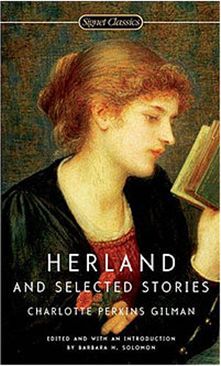
Cover for HerlandHerland is the novel chosen for me from my Classics List by the Classics Club Spin #6!

******

I guess most of my reaction to Herland is based on a dislike of utopian fiction, which seems to be more than ordinarily didactic. I like the occasional dystopian novel, but in my experience the dystopian writers are a bit more subtle about their lessons. Or in the case of Margaret Atwood’s Maddaddam trilogy, if not subtler, funnier. I chose this novel for my list just because I thought I had never read it and I was trying to make sure I selected quite a few notable works by women.

Vandyck Jennings, Jeff Margrave, and Terry Nicholson are traveling when they hear of a land of only women and female children. They hear that men are not welcomed, so of course, they decide to go there. The land is isolated at the top of an unclimbable mountain, but the three fly up in Terry’s plane. There they are taken prisoner by the women, who educate them in their customs before allowing them to mix freely with the inhabitants. It is this education and subsequent discussions that make up the bulk of the novel.

These women have been isolated for thousands of years and began to reproduce asexually through parthenogenesis. Their world is a garden, perfectly peaceful, with no disease or strife. Although two of the men are sympathetic characters (the third is a first-class chauvinist), the implicit message is somewhat misandrist—that women can get along perfectly well, better really, without men.

The book is funny at times, as these bewildered males take in the lessons of Herland. The funniest scene is after the men marry, and Van is trying to get his wife Ellador to understand the pleasures of having sex more often than when she’s scheduled to reproduce. But most of the charm the novel has is overridden for me by its didacticism, even while I believe Gilman brings up some important issues.

Development of character is not something Gilman is very interested in for this novel. The men all have distinct but pretty much one-dimensional personalities, and the women are virtually indistinguishable except for older versus younger. Science and psychology must have been hot topics at the time (1912), because terms from both are thrown around quite a bit. Unfortunately, there is also an implicit advocacy for some of the theories of eugenics.

What I was most interested in was what happened to Ellador after she and Van escort the exiled Terry out of the country. But Gilman doesn’t say.

In Gilman’s time, many of the ideas that don’t seem so revolutionary now—like the need of all people to have a sense of purpose and the idea that subordination results in stunted humans—were probably revelatory and maybe even shocking. Some of them still are. Gilman certainly deserves to be read, but I prefer some of her other works, notably The Yellow Wallpaper.

Day 544: Death in Venice

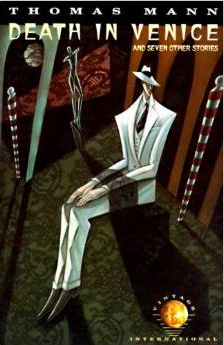
Cover for Death in VeniceGustave Aschenbach is a renowned author who has devoted his life to intellectual pursuits and his art. He leads an orderly life, conscientiously applying himself to his work.

One day when he is feeling over-taxed, he goes out for a walk and spots a red-haired man dressed as a traveler. Although the man appears to view him with disdain, at the sight of him Aschenbach is suddenly possessed with the desire to travel.

After stopping a few days on an island in the Adriatic, he decides to go to Venice. The city is gray and unwelcoming. The air is miasmic, and he wonders if he should have come. Then at the hotel he sees a beautiful boy. At first he simply enjoys looking at him, but eventually he becomes erotically fixated.

In writing this novella, Mann wanted to examine the relationship between art and the mind, a life of the senses and a life of intellect. At first, Aschenbach tries to rationalize his obsession by philosophizing about it. Mann makes many allusions to Greek mythology and calls the boy’s beauty godlike. But Aschenbach is lead inexorably into mental degradation. On the boat to Venice he was repelled by an older man, hair dyed and face rouged, who was traveling with a bunch of students. By the end of the novella, he has become that man.

While respecting the merits of the novella, I found Aschenbach’s obsessions and rationalizations repulsive, but I believe that is what Mann intended. In many ways, the story has similarities to Nabokov’s Lolita. However, while Nabokov’s language was beautiful enough to make me somehow grasp what Humbert Humbert felt, Mann’s was written with a different intent, I think.

Day 539: The Hours

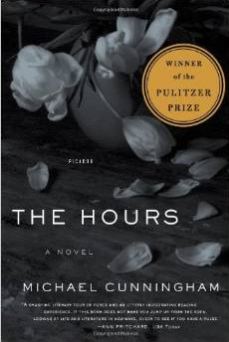
Cover for The HoursBest Book of the Week!
One of our Pandora channels repeatedly plays Philip Glass’s music from the movie soundtrack of The Hours. So, as soon as I began reading it, the intricate notes of the score became a mental accompaniment to the novel. That is, I got an ear worm.

I came to the novel with the slight disadvantage of being unfamiliar with Mrs. Dalloway, having been traumatized by To the Lighthouse in a college English class. But you don’t have to be familiar with it to appreciate this lovely, cleverly constructed novel, an homage to Woolf’s own.

The novel begins with Virginia Woolf’s suicide. But later it returns to 20 years before, when she is writing Mrs. Dalloway.

First, though, we meet a middle-aged woman, Clarissa Vaughn, whose best friend calls her Mrs. Dalloway. Like her namesake, Clarissa is eagerly going out into a crisp, clear morning to buy flowers for her party. This is New York, though, in the late 1990’s, and Clarissa’s party is for her dearest friend Richard, a poet who is dying of AIDS. He has recently been chosen to receive a prestigious prize for poetry, and the ceremony is that night.

Back in 1920’s Richmond, England, Virginia Woolf is trying to decide the plot of Mrs. Dalloway. Someone will die, she thinks, but will it be Mrs. Dalloway herself? Woolf also copes with her own fears about her mental state, her yearning to return to living in London, and a visit from her sister Vanessa Bell.

In 1950’s Los Angeles, Laura Brown struggles with being a suburban housewife and mother. Although she loves her husband and small son, she feels unsuited to this life.

Cunningham presents us with three stories, and a theme of threes recurs. Woolf has bouts of mental illness, Richard suffers from dementia caused by his illness, and Laura is struggling with depression. The jellyfish shapes and voices of Woolf’s migraine visions appear in Richard’s episodes of dementia. And Laura briefly sees a grayish jellyfish cloud floating over her son’s head. A forbidden kiss and the color mustard feature in more than one story. And other links that I will not name are more intrinsic to the plot. The three stories are so cleverly interwoven, we’re not sure if the events of one cause the events of the other.

This is a novel of astonishing beauty, cleverly constructed and entertaining. I’m going to find a copy of Mrs. Dalloway.

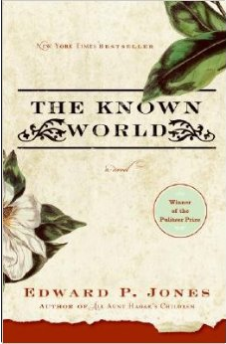
Day 535: The Known World

Cover for The Known WorldBest Book of the Week!
I found The Known World disorienting for some time. I think this was because the standard blurb describes it as being about Henry Townsend, an African-American owner of slaves who is mentored by his white owner. The novel starts with Henry Townsend’s death, and I kept waiting for it to circle back around and cover his history. But it’s not so much about him as about the world around him. Once I settled in to the world Jones creates, I began to appreciate the novel.

Henry Townsend’s act of becoming a slave owner is so shocking to his parents that they refuse to stay in the house he built with his slave, Moses. His parents, Augustus and Mildred Townsend, worked hard to buy themselves and their son free. Augustus at one point muses that he may have made a mistake in buying Mildred first, leaving Henry too long under the influence of William Robbins, his white master and the richest man in the county. We actually don’t see much mentoring going on between Robbins and Henry, except when Robbins chides Henry for rough-housing with his new slave Moses.

Jones’ focus is on a larger story than that of one man. His story is about the life on Henry Townsend’s plantation and in the county and how it is affected by slavery—particularly by the decision of African-Americans to own slaves.

At first, I found it difficult to keep all the characters straight—or even the timeframe—for Jones has a habit of fixing on a character for a brief moment and telling about that character’s entire life. He also interjects facts and census details about Manchester County. These details are so convincing that he had me believing it was a real place. It is not.

This nonlinear narrative means we don’t fully know any one character. Henry himself is one of the biggest enigmas, and we see more of his slave Moses than we do of Henry himself. Certainly, a handful of characters are more important than others, but that handful keeps changing. Still, some threads of the people’s stories are captivating, and even surprising. Does Augustus, kidnapped by unscrupulous slave dealers when he is returning from a job, ever see his home again? Did Moses actually murder his wife Priscilla in hopes of marrying Henry’s widow?

If I had to state briefly the theme of this unusual novel, I would say that slavery corrupts. Characters who start out with good intentions do despicable things because they have absolute power over other people. When we see the effect of the “institution” of slavery on people, especially upon Henry’s blameless parents, it is sometimes shocking.

There are true villains in this novel but no heroes. Some of the characters are doing the best they can; others are not.

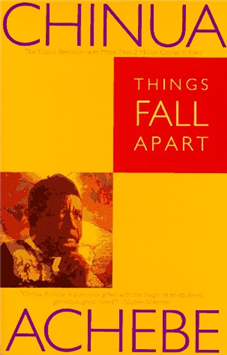
Day 524: Things Fall Apart

Cover for Things Fall ApartThis book is another one for my Classics Club list. It is the late 19th century, and at the beginning of Things Fall Apart the Nigerian villagers have only heard of white men. They lead their agrarian life, counting wealth in yams and cowrie shells, and occasionally go to war.

The main character of the novel is Okonkwo. He is a proud man, once a great wrestler, who is intent on accumulating wealth and honor. His father preferred playing his flute to cultivating yams. Okonkwo did not respect him and has a secret fear of ending like him. To compensate, he is occasionally brutal and rigidly observant of the village customs, especially the “macho” ones.

After a woman from their village is murdered while visiting another village, the elders go to negotiate a settlement. They return with a hostage, a boy named Ikemefuna. He is handed over to Okonkwo and becomes part of his household. Okonkwo grows to care for him like a son and thinks Ikemefuna is a good role model for his own son Nwoye, in whom he fears weakness. After three years, though, the elders decide to kill Ikemefuna. An old man advises Okonkwo not to take part, but he does not want to look weak.

After Ikemefuna’s death, things begin to go wrong for Okonkwo. First, he is banished from his village for seven years for accidentally killing a man. Although he fares well in his mother’s village, he just wants to return home. While he is gone, though, missionaries arrive in his home village and a colonial government is set up. Nwoye and others convert to Christianity. Tragic cultural misunderstandings ensue between the Europeans and the villagers.

I was sympathetic to Okonkwo at times, but I did not like him. He is not fleshed out as a character, because he is more of a symbol for his culture. His tragedy stands in for the clash of cultures between the whites and the villagers. Certainly, the colonial government is arrogant and more interested in enforcing European concepts of law and morality than in trying to understand the local customs.

Things Fall Apart is a sparely written novel that is one of the most widely studied in African literature. Although I recognize its merits, I sometimes had difficulty staying with it.

Classics Club Spin #6

Cover for Snow CountryClassics Club Spin #5 was fun. It’s nice leaving your reading choice up to fate occasionally. So, I decided to participate in Classics Club Spin #6! Here is my short selection from my Classics Club list, numbered but in no particular order. On Monday, the club will pick a number, and I get to read that book sometime in May or June. The club suggests grouping your choices in some way, such as books you have been dreading to read. I prefer to put those off by not including them on this list!

  1. Herland by Charlotte Perkins Gilman
  2. Stoner by John Williams
  3. Night by Elie Wiesel
  4. The Scottish Chiefs by Jane Porter
  5. The Vicar of Wakefield by Oliver Goldsmith
  6. Beowulf (Seamus Heaney translation)
  7. La Reine Margot by Alexandre Dumas
  8. The Perpetual Curate by Margaret Oliphant
  9. Troy Chimneys by Margaret Kennedy
  10. Brave New World by Aldous Huxley
  11. Greenbanks by Dorothy Whipple
  12. Snow Country by Yasunari Kawabata
  13. The Moonstone by Wilkie Collins
  14. The Call of the Wild by Jack London
  15. Their Eyes Were Watching God by Zora Neale Hurston
  16. Ada by Vladimir Nabokov
  17. The Idiot by Fyodor Dostoevsky
  18. Sisters by a River by Barbara Comyns Carr
  19. Selected Poems by Edna St. Vincent Millay
  20. The Beggar Maid by Alice Munro

Day 515: Robinson Crusoe

Cover for Robinson Crusoe Here I am with my third review for the Classics Club. Robinson Crusoe is a difficult novel for the modern reader. It is one of the earliest novels and as such lacks some of the characteristics we associate with the form. It has no chapters—just a few breaks here and there—little dialogue, minimal characterization, and a primitive plot structure. If you think of the novel as a children’s story, you are wrong (although when I was looking for a cover for this article, I saw that it is marketed as such).

In fact, the story that has made several exciting movies is related in a mundane manner with little notion of building suspense and would probably bore most kids silly. Instead, Crusoe’s novel is an expression of the importance of self-reliance and an assertion of Defoe’s religious faith.

The story is familiar, although I was surprised by just how much happens before the famous shipwreck and after the rescue. As a young man, Robinson Crusoe is in a position where he could live a good life at home. His father urges him to be content, but he determines to be a sailor. He makes several voyages, ending in Brazil, where he accumulates property and an estate. But he is not satisfied to stay at home. He takes on an errand from neighbors to travel back to Europe for business, and that is when he is shipwrecked.

The rest of the novel is about his efforts to survive and make himself a home, his religious musings, and (after years of being alone) his encounters with other people. As I mentioned before, none of the characters are fully realized. In fact, aside from Crusoe, only Friday even has a name. Everyone else is just called by his station. (I say “his,” because there are no female characters.)

Modern readers may also have problems with such issues as racism or sexism in the novel (sexism only in the sense that Defoe ignores women—he mentions a few, but they are clearly unimportant). I don’t think that works should be judged outside the standards of their time, though. By the standards of his own time, Crusoe probably treats Friday pretty well.

The only other novel I have read by Defoe is Moll Flanders, which has the advantage of being bawdy. I think the way to approach this novel is not as an adventure story but as an example of an early novel and as a story about self-reliance.

Day 512: Troubles

Cover for TroublesBest Book of the Week!
It is the summer of 1919. Major Brendan Archer has just left the hospital after his experiences in the trenches of France. When on leave in 1916, he met Angela Spencer. Although he has no recollection of having asked her to marry him, she has ever since then written him exhaustive letters signed “Your loving fiancée.” Determined to find out if he is engaged, the Major travels to the Majestic, Angela’s family hotel in County Wicklow, Ireland.

Troubles is about the decline of the once powerful Anglo-Irish aristocracy. Nothing symbolizes this decline quite as effectively as the state of the Majestic. Once a grand resort hotel, the Majestic is now the crumbling permanent home for a handful of old ladies who knew it from their heyday.

The Palm Court is so overgrown that it gets more and more difficult to find the chairs. No staff is visible when Archer checks in, and he is finally vaguely shown around by Ripon, Angela’s brother, who urges him to pick a room. When Archer retires, he finds his bed has no sheets, and his investigation of a sickly smell leads to the discovery of a sheep’s head in a pot in his room. Most frustrating, though, is that he can find no opportunity to speak to Angela, who shortly after his arrival shuts herself up in her room.

Major Archer soon finds himself drawn into the activities and personalities of the household. Angela’s father Edward seems unconcerned about the increasing decrepitude of the house. He occupies himself with projects such as raising piglets in the squash court or conducting bizarre experiments in “biological research.” He is most concerned with preventing Ripon from marrying the daughter of a merchant, whom Ripon has made pregnant. Edward’s objection? She is Catholic.

It is the time leading up to the partition of Ireland, with events that 40 years later will result in The Troubles. To Edward’s way of thinking, along with most of his class, those who want independence from Britain are nothing but hooligans. He refuses to recognize that his impoverished and desperate tenants have legitimate grievances.

The growing sense of dissolution both in Ireland and—periodically interjected by newspaper articles—in other parts of the British Empire keeps the novel from being simply a comedy such as Cold Comfort Farm. That, and Farrell’s writing style of cool and precise satire. As poor Major Archer bumbles in a well-meaning way through the political briars and Edward becomes more detached from reality, the Majestic slides perceptibly into ruin.

This is another book from my Classics Club list.