Best Book of the Week!
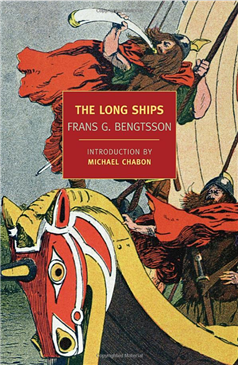
Today I’m posting my first review for The Classics Club, the one chosen for me by the Classics Club Spin #5! The Long Ships is a great start to the Classics Club for me. I found it to be a rousing adventure story full of deadpan humor.
This book is the result of Bengtsson’s desire to write a realistic novel about the Vikings. A poet, Bengtsson also wrote essays and a biography of Charles XII, but he became more widely known for The Long Ships.
His protagonist Orm Tostesson is only a boy when the novel begins. Orm is eager to go a-viking to Ireland with his father and older brother, but his mother tends to be protective of him, so he stays home. Shortly after the men leave, he attempts to stop some sheep stealing on the part of a group of Vikings from Lister and is kidnapped by them. The Vikings soon find him an able and intelligent companion, so he becomes part of their crew rather than being kept a slave.
In the course of their adventures down the western coast of Europe, they are initially successful but eventually are captured and sold as galley slaves. In return for a service they performed for a Jew from Córdoba, they are freed to serve as bodyguards for lord Almansur, the regent and imprisoner of the young Caliph of Córdoba. There they serve for years until circumstances force them to flee for home.
This voyage is the first of three related in the novel, during which “Red” Orm meets his bride to be, loses her when his best friend Toke steals her father’s concubine, goes a-viking to England to try to retrieve her from English priests, and many years later travels down the Dnieper to bring back a stash of hidden gold. Even when he is settled at home, he is involved in tiffs with his neighbors, attempts to murder him on the orders of the evil King Sven, visits from unusual acquaintances, rowdy celebrations, and a Thing, a convocation of various groups of Vikings for settling their differences.
There is plenty of action in this novel, but what I find most charming are its air of insouciance and its ongoing (although somewhat grisly) humor. It has a sense of playfulness, especially about the differences between the Norsemen’s old religion, Christianity, and Islam, to which Orm and his fellows are temporarily forced to convert. Take, for example, this passage from the prologue, about the arrival of the shaven men, or priests, in Skania:
They had many strange tales to relate, and at first people were curious and listened to them eagerly, and women found it pleasant to be baptized by these foreigners and to be presented with a white shift. Before long, however, the foreigners began to run short of the shifts, and people wearied of their sermons, finding them tedious and their matter doubtful . . . . So then there was something of a decline in conversions, and the shaven men, who talked incessantly of peace and were above all very violent in their denunciation of the gods, were one by one seized by devout persons and were hung up on sacred ash trees and shot at with arrows, and offered to the birds of Odin.
To give you another idea of the humor in this novel, a Viking tells a story of a wedding that broke up into a fight. When the bride sees the groom’s friends beating up one of her relatives, she hits the groom with a torch, which starts his hair on fire, beginning another fire in which 11 people are killed. Everyone agrees that it was the best wedding they ever attended.
The story of Red Orm is told in a detached manner but by a truly talented storyteller. It is full of sly humor and observations of human folly. I really enjoyed it.

 Classics Club Spin #5 was fun. It’s nice leaving your reading choice up to fate occasionally. So, I decided to participate in Classics Club Spin #6! Here is my short selection from my Classics Club list, numbered but in no particular order. On Monday, the club will pick a number, and I get to read that book sometime in May or June. The club suggests grouping your choices in some way, such as books you have been dreading to read. I prefer to put those off by not including them on this list!