Review 1670: Classics Club Spin Result! The Brothers Karamazov

I selected The Brothers Karamazov for my Classics club list because I read it many years ago for Russian Literature and found it fascinating. I was curious how I would regard it now.

The plot of the novel is seemingly straightforward, but it is complicated by the characters’ relationships and several subplots, some of which are only tangentially related. Fyodor Karamazov has three sons whom as children he left to be raised by the servants. The oldest, Dmitri (or Mitya), is an ex-soldier whom Fyodor has cheated of part of his inheritance from his mother. Now, although Dmitri is engaged to Katarina, a girl of high moral values, he has fallen madly in love with Grushenka, a girl with an unsavory past, and Fyodor is trying to compete for her. The second oldest, Ivan, is a cold intellectual atheist. The third son, Alexei or Alyosha, is studying to be a monk.

In my old Penguin Classics edition, the novel is split into two volumes. It is not until the second volume that the action takes place that is the centerpiece of the novel. Fyodor is murdered. Mitya has been working himself into a frenzy and making threats so is immediately the prime suspect. Did Mitya kill his father or was it someone else? If so, who?

We readers know what Mitya did that night, so we can answer the first part of that question but not the second part, at least not right away. Dostoevsky (I’m going to use the spelling of his name that I’m accustomed to, and that indeed is on my old Penguin copy rather than the one shown on the title page above) isn’t interested so much in that but in what happens next. And ultimately he is engaged in pitting atheism against belief in God.

In my student days, I found the long philosophical passages in this novel fascinating. These days, I don’t have as much patience with them and I actually skipped a couple of chapters once I got their drift. The amount of time spent on Father Zossima, for example, a relatively minor character who dies in Book One, is a little inexplicable to me now. I can’t help feeling he might have been based on a real person whom Dostoevsky revered, but his presence in the novel doesn’t seem important enough to warrant several chapters being devoted to his life and sayings.

This is not to say that I didn’t find the novel compelling. Although it is long and sometimes difficult, there was something about it that made me want to keep reading it.

The novel is written with an unusual approach to point of view. The narrator is an unidentified person from “our town.” But the narrator is privy to scenes he could not possibly have witnessed. Yet, the point of view is not omniscient. For example, we see what Mitya does on the night of the murder even though there is no actual witness to that, but we don’t see the murder.

As usual with Dostoevsky, most of his characters are in a frenzy. Were 19th century Russians really this excited? Well, they’re not in Tolstoy, but most of Tolstoy’s characters are upper class, while Dostoevsky’s are not. So, I don’t know whether this is a class difference or a difference in the author’s perceptions or what. And speaking of class, the attitude toward peasants here is not great, and there are also other politically incorrect comments on occasion. Just a warning.

The Brothers Karamazov is considered Dostoevsky’s masterpiece, so if you are interested in Russian literature, you should definitely read it. Dostoevsky’s preoccupations are not mine, however, and I think even less so as I get older. I couldn’t help parsing some of the arguments and thinking about an implicit slant to them. The best example is an assumption—a sort of cognitive leap—that is very important to the plot and is stated several times by different characters. The cognitive leap is that if God doesn’t exist, “everything is permitted.” Only one character questions this assumption—that there is nothing within humans besides religion to stop them from doing horrendous things. But his suggestion is brushed aside because Dostoevsky wants you to conclude that there is a God and his arguments don’t work as well if you believe in inner goodness or inherently moral or ethical behavior. I guess.

Related Posts

The Idiot

The Kreutzer Sonata Variations

The Possessed: Adventures with Russian Books and the People Who Read Them

Review 1668: The Vicomte de Bragelonne

My edition of the Collected Works of Alexandre Dumas explains that The Vicomte de Bragelonne was originally published as a massive work but is traditionally published in English as either three or four separate novels: The Vicomte de Bragelonne, Ten Years Later, Louise de la Valliere, and The Man in the Iron Mask. I read the first book, which was quite long in itself.

I felt I was at a disadvantage in reading this book because it is one of the D’Artagnan novels and I haven’t read The Three Musketeers for many years or Twenty Years After ever. Although all four of the original characters appear, I felt that I didn’t understand their relationships to each other. As for the title character, who is the son of Athos, although he makes a couple of appearances, this first novel in the set is about D’Artagnan.

In the beginning of the novel, Louis XIV is a young king, but he has been under the control of Cardinal Mazarin for most of his life. D’Artagnan is the lieutenant of the musketeers, and he overhears when Charles II of England comes penniless to the king to ask for money and men to take back his kingdom. Louis’s finances are kept strictly in the Cardinal’s hands, so Louis goes to the Cardinal to ask for the money or men. The Cardinal, who has made himself wealthy at the kingdom’s expense, tells Louis there is no money and he can’t spare any men. When D’Artagnan sees Louis send Charles away with nothing despite wanting to help him, he resigns in disgust, determined to help Charles.

D’Artagnan’s friend Athos, now the Comte de la Ferre, also wants to help Charles. He was present at the beheading of Charles’s father and knows the Charles I buried a million livres at Newcastle. Athos determines to fetch the money.

This novel seems disjointed. More than half of it deals with the two missions on behalf of Charles, while the rest deals with Louis finally coming into power and sending D’Artagnan on a mission. Perhaps as a complete work, with all its parts, it would seem more coherent, but at this time I was not willing to put in the time to read the whole thing.

I read this for my Classics Club list.

Related Posts

The Black Tulip

La Reine Margot

Captain Paul

Review 1666: The Winged Horse

It’s going to be hard to describe this novel without either giving too much away or being too vague. The description on the Virago back cover focuses too much on the role of business tycoon J. G. Baron, when really he is more the catalyst of the action.

Harry Levitt is an American on his way to England for a job with J. G. Baron. He and Baron’s entourage are on shipboard along with Baron’s oldest daughter, Celia, who has been living in the States but is now separated from her husband and moving home.

J. G. is an unlikable person. He surrounds himself with yes men and is hypocritical and self-deceptive. He dislikes two of his three children and terrifies the third. Celia is the only one who doesn’t try to please him, as she dislikes him back.

When we meet Harry, he is a practiced dissembler who feels insecure about his Midwest background so has invented Californian origins. Despite a bad start with Celia, while living in England, Harry develops a close relationship with her siblings Tobias and Liz and with their friend Anthony Carey, a mediocre sculptor known to the family as Thank-God-for-Anthony. Anthony seems perfectly assured and the only person who is not afraid of J. G. The Barons consider him the epitome of probity.

Harry, as he grows to love England and feel accepted, becomes calmer and more assured. However, there is a family tragedy, and subsequent events allow Frankau to explore themes of power, truth, and dishonesty.

At first I had trouble being interested in these characters, but eventually I became involved in this story. I did find irritating the way Frankau handled the characters’ inner thoughts, just as if they were dialogue, which seemed artificial. But this is a minor criticism.

I read this book for my Classics Club list.

Related Posts

They Knew Mr. Knight

Because of the Lockwoods

Consequences

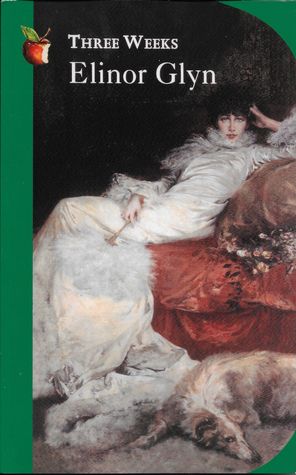
Review 1651: Three Weeks

I realized earlier this month that the deadline I set myself for finishing my Classics Club list is coming up this summer, with about a dozen books left. I’ve been reading lots of classic novels, just not necessarily the ones on my list. I have also read many of the ones on my list but just haven’t posted my reviews yet. So, I decided I was going to have to accelerate my schedule of reviewing and reading them in hopes of getting all my reviews posted on time. Here is one of them.

Elinor Glyn was a romance novelist at the turn of the 20th century whose works were considered scandalous at the time. Three Weeks is the story of a young English man who has an affair with an older Russian queen.

Naïve young Paul Verdayne fancies he is in love with the parson’s daughter, so his mother ships him off for a tour of the continent. He is young and sulky and hates Paris but, being a sportsman, enjoys Switzerland. While in Geneva, he becomes fascinated with a striking woman who is traveling only with her servants.

This mysterious woman, about ten years older than Paul, takes him in hand and begins opening his mind to art and ideas. Soon, they begin a torrid affair. But this affair must remain secret, because there is danger.

First, I found it difficult to buy that this sophisticated, cultured woman would fall madly in love with a gauche, uncultured young man whose only interest is his dog and horses and whose only attraction is his good looks.

Next, Glyn’s writing is florid and overwrought. It is often cloying and downright silly. The style resembles that of writers from the Romantic movement, which was well over by the time Glyn was writing. I have an idea that Glyn may be the type of writer Forster was mocking in A Room with a View.

Finally, the idea that Paul could become informed and educated just by spending three weeks with his mistress is ridiculous. The novel doesn’t say that he is interested in being more informed but that he comes back from his experience poised and culturally literate, enough so as to impress people with his elegance. Right.

In short, this is a really silly book.

Related Posts

Chéri

The Last of Chéri

Dolly: A Love Story

Classics Club Spin #26

It’s time for another Classics Club Spin. I have been trying to finish my list in time for my deadline, which is coming up at the end of June. I’m not going to make it, but I’ve been scheduling in books that I read months ago to try to get most of the books reviewed by then, and I have been reading like crazy to finish the others. With any luck, I’ll only be a month or so late. That means that my list for this spin is going to be repetitive.

To participate in the spin, you post a numbered list of 20 of the books from your Classics Club list (or in my case, however many books you have left over and over to make a list of 20). The Classics Club picks a number, and that determines the book you’ll read for the spin. So, here is my list! We are posting these lists by April 18th, and the deadline to read the chosen book is May 31.

  1. The Sea Hawk by Rafael Sabatini
  2. The Last of the Wine by Mary Renault
  3. The Viscount de Bragelonne by Alexandre Dumas
  4. The Brothers Karamazov by Fyodor Dostoevsky
  5. Evelina by Frances Burney
  6. The Duchess of Malfi by John Webster
  7. Titus Andronicus by William Shakespeare
  8. The Sea Hawk by Rafael Sabatini
  9. The Last of the Wine by Mary Renault
  10. The Viscount de Bragelonne by Alexandre Dumas
  11. The Brothers Karamazov by Fyodor Dostoevsky
  12. Evelina by Frances Burney
  13. The Duchess of Malfi by John Webster
  14. Titus Andronicus by William Shakespeare
  15. The Sea Hawk by Rafael Sabatini
  16. The Last of the Wine by Mary Renault
  17. The Viscount de Bragelonne by Alexandre Dumas
  18. The Brothers Karamazov by Fyodor Dostoevsky
  19. The Duchess of Malfi by John Webster
  20. Titus Andronicus by William Shakespeare

Review 1642: The Tenant of Wildfell Hall

Gilbert Markham is a young man running a family farm when a new, mysterious person moves into the neighborhood, taking up residence in an old, half-derelict house named Wildfell Hall. She is Mrs. Graham, a beautiful young widow with a five-year-old son, Arthur. She tends to be reclusive, which makes the neighborhood more interested in her. Finally, Gilbert goes with his sister to call and finds that Helen Graham is supporting herself working as an artist.

Gilbert falls in love with Helen, but she will not allow him to express any of his feelings. Then, he hears an ugly rumor about Helen and his friend Mr. Lawrence, Helen’s landlord. Helen has secrets, but they’re not the ones being repeated about her. She finally decides to confide in Gilbert by giving him her diary.

I hadn’t read this novel for many years, so I put it on my Classics Club list. I found the structure of the novel—epistological first because Gilbert is writing a very long letter to a friend, and then the diary—to be cumbersome. It seems as though a straightforward first-person narration would be less artificial for the first part, which must be the longest letter ever written. For the middle, diary portion, I understand why Brontë chose that method of telling her story, which makes up the bulk of the novel, but it seemed a little clumsy and too long.

Finally, there were times when I tired of the self-righteous Helen. It seemed to me that her attitude might have driven a better husband than the one she chose away from her. Of course, he is a scoundrel, so there was probably no attitude she could adopt that would reform him, which makes the ending kind of absurd. I don’t know how to explain it without spoilers, but I thought it might be a sop to the critics of Brontë’s time who would have thought Helen should not have deserted her husband. Either that or she is destined for sainthood.

I am probably being overcritical of this book, which would have been quite shocking for its time because of making a woman who has fled her home with her child its heroine. Although I’ve read a gothic novel or two with the same premise, I’m sure this one was more groundbreaking through the husband’s faults being those of cruelty and dissipation rather than, say, robbery and murder. Here, we see Brontë taking up a feminist viewpoint, and I guess I’m just saying that I found Helen a little too rigidly moral. She spends an awful lot of time being outraged. Jane Eyre is also moral, but somehow from her it doesn’t seem as irritating.

Related Posts

The Castle of Wolfenbach

Aurora Floyd

The Grey Woman

Review 1628: My Brilliant Career

My Brilliant Career is the very singular story of the life of an Australian teenage girl in the bush in 1901. It isn’t so much singular in its plot as in the personality of Sybilla, the main character.

Sybilla’s childhood was spent in comfort, as her father was a prosperous horse breeder. However, well before this novel starts, her father decided his talents were wasted, so he sold his property and began a career selling livestock. He was unsuccessful, and he drank heavily in entertaining prospective clients. When the novel opens, the family is struggling to run a dairy with their father drinking away the money he makes selling butter.

Sybilla at 15 is admittedly a difficult person. Her mother never gives her a kind word, and her mother and brother twit her about her lack of good looks. She angrily resents their life of endless labor for no good result. In fact, she is ambitious to become more but doesn’t know how to go about it. She is an unusual mixture of self-confidence and self-hatred and is angry and rebellious.

Sybilla’s mother becomes so angry with her that she arranges for her to go live with her grandmother farther into the bush. There, Sybilla blossoms under the kind treatment of her grandmother, her uncle, and her Aunt Helen. Her aunt helps her look more attractive, but she never gets over believing she is ugly. Romance even seems to be on the horizon.

I thought that the view this novel gives of Australian frontier life is really interesting, and I was particularly struck by the amount of traffic going by the grandmother’s house and the number of homeless, wandering men. However, I was unsatisfied with this novel, and to explain why, I have to include spoilers, so be warned.

A feminist interpretation of this novel might be that the heroine chooses to write a novel instead of getting married, but that would be ignoring Sybilla’s difficult personality. Continually, she seems to bite off her nose to spite her face, and in the case of marriage, really declines out of a sense of inferiority rather than anything else. She decides not to marry Harold and stays in a life she hates because she can’t believe he loves her and she thinks she is not good enough for him. I find that really frustrating. It’s not that I wanted a romantic ending so much as it bothered me how she never really sees herself or is able to get past being told how worthless she is by her mother.

I read this for my Classics Club list.

Related Posts

I Await the Devil’s Coming

My Mortal Enemy

The Vet’s Daughter

Review 1618: The Prince

I put The Prince on my Classics Club list mostly out of curiosity. Now that my curiosity has been satisfied, I can well understand some of the controversy surrounding it.

Machiavelli wrote the book for the newly arisen Medici family, and the last chapter is basically a plea for Lorenzo di Medici to rise up and conquer Italy. The Prince is a treatise on power: how to get it, how to keep it, what to do with it. It is utilitarian rather than moral. For example, it advises princes that they need not honor their promises once they are in a position of power if the promises are not in their best interests.

Although Cesare Borgia was considered ruthless and cruel even in his own time, Machiavelli several times holds him up as a model and clearly venerates him. But then, his ideas are not ours, for he tells a story of a principality being won. The principality needed good government, so the prince put in charge a man known for his ruthlessness and rapacity. Once the area was settled, the prince “wiped out” his lieutenant. Good work!

The book is regarded as a realistic analysis of the pursuit of power. This is why it is still widely studied. It is written in a straightforward style, assertion followed by example.

Related Posts

In the Name of the Family

Blood & Beauty

The Malice of Fortune

Review 1607: Classic Club Spin Result! Oroonoko

Oroonoko was the book I read for the most recent Classics Club Spin.

There are a few issues with Oroonoko, written in 1688, that might make it difficult for modern audiences. One is its acceptance of slavery (although the novel is viewed as an anti-slavery work), which in the 17th century was common. The other is its graphic violence, albeit off-stage, that has caused it to vary in popularity over time. (Apparently, even the publishers of the edition I read disagree about that, because the introduction says it was Behn’s most popular work, while the cover says it was not popular because of its violence.)

Oroonoko has been considered a novella rather than a biography, because there is no proof that such a man as Oroonoko existed. However, Behn writes the story in first person as herself, and she is known to have traveled to Suriname, where it is set, shortly before the country was ceded to the Dutch. So, you have to wonder.

Oroonoko is the prince of Coramantien, an area of present-day Ghana, the grandson of the king and a great warrior. He falls in love with a beautiful girl named Imoinda, and she becomes his betrothed. However, his grandfather sends her the veil, which means she is to join his harem, even though because of her betrothal that is a break in custom. Oroonoko must accept this or die, so he accepts it with the thought that the king cannot live long. However, the king regrets his actions and sees no way to recover the situation except if Imoinda was dead. He is unable to have her killed, though, so he sells her into slavery and tells Oroonoko she is dead.

Next, an English slave trader whom Oroonoko has sold slaves to invites him for a party. When he and his men have passed out from drink, the trader enslaves them and puts them on a ship for Suriname. It is when Oroonoko arrives there that he meets Behn and her traveling companions and they learn his tale and witness the rest of the action.

Oroonoko might be the first anti-slavery novel, although it is subtle about it, showing some of its abuses while not really commenting on the institution. Behn reveals the dastardly behavior of a series of Europeans, either slavers or owners, and contrasts it with the image she builds up of a handsome, brave, forthright black hero and his beautiful and virtuous lady. The novel was interesting, but I found what happened to Imoinda through Oroonoko’s hands distressing and the reflection of a type of thinking I did not find admirable—and the ending was just plain gruesome.

Related Posts

Merivel: A Man of His Time

Washington Black

Sugar Money

Review 1595: Mansfield Park

I was having difficulty reading another book, so I decided to take a break by rereading Mansfield Park, which is on my Classics Club list. In these days, Austen’s heroine, Fanny Price, is not admired, but she is a true and admirable product of her environment and circumstances.

At nine, Fanny is brought to live at Mansfield Park as an act of charity, for she is a poor relation. She is taught to be grateful for this charity and to have no expectations for herself. Sir Thomas Bertram is an upright, stern man whom she and her cousins fear. Lady Bertram is languid. Fanny’s Aunt Norris, who suggested they give her a home in the first place, actively dislikes her and favors her female cousins, particularly Maria.

Fanny is very shy and miserable at first, but the younger son of the house, Edmund, takes her under his wing, is her friend and educator.

As a young lady, Fanny is happy to be of service and not used to her needs or inclinations being attended to. Then two things happen at about the same time. Sir Thomas goes away on a lengthy business trip, and Mary and Henry Crawford arrive to stay with the Grants at the parsonage. Edmund, whom Fanny loves, is immediately attracted to Mary, but Fanny is dismayed by the sister and brother’s lack of principles. Maria Bertram is engaged by then to a rich but stupid young man, but Henry Crawford flirts with both Bertram sisters, playing one off the other. Mary’s behavior is more or less impeccable, but she expresses unprincipled ideas. Edmund seems blind to her faults.

Fanny is one of Austen’s more thoughtful heroines. Will she ever be appreciated for her qualities of affection, duty, and principle? Will Edmund marry Mary or recognize Fanny’s superior qualities? Well, we can all probably answer that, but the journey there is wonderful, as Austen’s novels tend to be.

Related Posts

Persuasion

The Making of a Marchioness

Murder at Mansfield Park