Review 2092: The Fair Jilt

I know that Aphra Behn wrote some bawdy comedies, and that’s what I was hoping The Fair Jilt would be. However, this prose work from 1688, which I read for my Classics Club list, is anything but funny.

Behn starts out with a long dissertation about foppishness, although it’s hard to say what that has to do with her story. She does not approve. Then she tells a story about a very beautiful woman named Miranda. She seems to like to pose her prose writing as if she is telling a true story with the names changed, as she did with Oroonoko.

Miranda starts out her career by flirting with all the men but never granting them favor. She lives in a sort of convent in Antwerp for women who have not made vows, but it seems to be full of her suitors. It is this kind of female aggression in her characters that has gotten Behn praise from feminists, but I’m not sure they understand her message. (Of course, she earns it for being a woman writer in the 17th century, as well as a spy.)

Miranda, who is as wealthy as she is beautiful, is living a gay and carefree life until she meets a beautiful young friar who is a prince with an unhappy past. She falls madly in love with him, but he is not interested. This fact enrages her and things go from bad to worse—for him.

Her continued career gets deeper into depravity after she marries handsome Prince Tarquin, even though he adores her. Her crimes include taking her husband’s ward’s fortune, lying, and incitement to murder.

So, you can imagine what a jolly tale this is. It even includes a man living after he is halfway decapitated. The biggest disappointment of this very unfunny work is that Miranda has a better fate than she deserves.

Related Posts

Oroonoko

The Duchess of Malfi

The Poison Bed

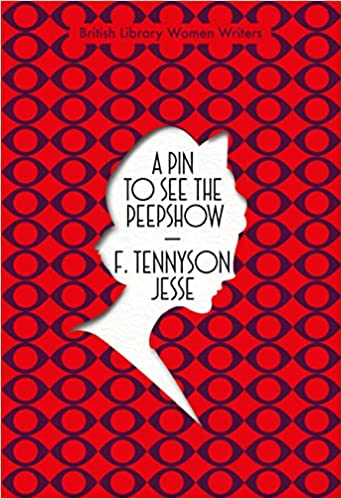
Review 2090: A Pin To See a Peepshow

A Pin to See a Peepshow is a fictionalized retelling of a famous British true crime. Jesse, who was a contributor to the Notable British Trials series, chose to make the life of her main character and the details of the crime slightly different from the actual events.

Julia Almond is an unusual girl who projects the assurance that her life is going to be different from that of the others around her. She has a sense of style and after finishing schooling, is able to find work at a small dressmakers.

Julia has lived mostly in a daze of romantic daydreams except for her work at the shop, where she thrives and is promoted. But she finds her real life boring and seems to care only for her dog, Bobbie. She is waiting for a great love.

What she gets is Mr. Starling, a friend of her father’s. During the First World War, her father dies. Her mother can’t afford the house even with Julia’s small salary, so her uncle, aunt, and cousin move in and begin to order things as they want. Julia’s bedroom, which has been her sanctuary, is invaded by her cousin Elsa. Julia is told that Bobbie can’t sleep in her room. She kicks up enough of a fuss to get that changed but finds Elsa trying to lure Bobbie away from her. When Julia finds living at home unbearable, she decides at twenty to marry Mr. Starling, whose wife has died and who looks a lot more handsome in his uniform. This, of course, does not work out well, but she gets along for years until she meets Leonard Carr, a sailor seven years younger, who begins pursing her.

Jesse’s message is that Julia would not have ended up as she does if she had not been lower class and financially insecure. Any poorer and she would have just left with her lover. Richer and divorce would have been commonplace, but to her it was a scandal. Further, although she was innocent of murder, she was convicted because of her adultery and the difference in age between her and her lover.

Jesse paints an open-eyed but sympathetic picture of Julia. Although I could have done without some of the sections at the end where others reflect on the execution, it is a powerful and affecting piece of writing.

Related Posts

Famous Trials

The Suspicions of Mr. Whicher

The Wicked Boy

Review 2088: Mrs. Tim Flies Home

I intended to read the Mrs. Tim books in order, but that hasn’t quite worked out, and I received this one just in time for Dean Street Press in December.

Hester Christie (Mrs. Tim) reluctantly leaves her husband in Kenya, where he is now posted, to form a household in England that her children can return to for the summer holidays. But en route she stops for two days in Rome. There she is unexpectedly met by family friend Tony Morley. Her couple days of sightseeing with him create a misunderstanding that travels all the way back to England to cause trouble for her through the person of Mrs. Alston, whom she met on the plane from Kenya to Rome.

Mrs. Tim has found a house in Old Quinings called the Small House. Although she loves the house, she finds she has a troublesome back neighbor and a landlady who isn’t to be trusted. She also meets some pleasant neighbors and helps out a young man in his romance with a nice young girl. She solves a mystery and finds out why some of the villagers are treating her oddly.

This book is another breezy entry in the Mrs. Tim series, written in the form of letters to her husband. It gets a little patronizing toward the ancient Romans (conveniently forgetting about the Inquisition), but they’re dead so they won’t mind. Otherwise, it’s an entertaining read.

I received this book from the publisher in exchange for a free and fair review.

Related Posts

Mrs. Tim of the Regiment

Mrs. Tim Gets a Job

The Two Mrs. Abbotts

Review 2084: Babbacombe’s

I asked Dean Street Press to rush me some books so that I could participate in Dean Street Press in December, and they have responded beautifully. Here’s a review of a book I received on Tuesday.

Beth Carson is a little disappointed after leaving school with high honors to take the job her father has arranged at Babbacombe’s, the large department store where he’s been employed for 30 years, instead of going to secretarial school. However, money has always been tight in the Carson household, and she is eager to help contribute.

Despite things being tight, the family is reluctant to take on a paying guest—George’s orphaned niece, Dulcie. But George feels guilty about neglecting her even though he didn’t like her father. When Beth goes to the railway station to collect her, she meets a nice young man after she is tripped up by his dog.

Dulcie turns out to be an unpleasant surprise for the family, but Beth finds herself enjoying her job in the dress department, even though it is at first exhausting. Then one day she is stuck in the elevator with the man from the railway station and finds out he is David Babbcombe, the boss’s son. When Beth learns he doesn’t work but collects an allowance from his father, she says she’d be ashamed to take money she didn’t earn.

Smarting from this, David, who threw away an opportunity at Babbacombe’s once already, goes to his father’s office and asks for a position. His delighted father starts him at the bottom this time instead of the top—in the meat department. He also has a secret from his father, he has submitted plans for a plane he designed to the government.

As David pursues Beth, her scruples interfere. Her father believes people should stay in their places, and she is sure Mr. Babbacombe wouldn’t approve of David dating one of his shop girls. Also not helping is Dulcie, who has decided she wants to marry David.

I’m having an inconsistent reaction to Scarlett’s work, probably because I don’t read too many straight romances. Although I liked another of her Cinderella stories, Clothes-Pegs, I often find the devices meant to keep the couple apart until the end are a little clumsy. In this case, Beth is almost stupidly obsessed by what their fathers will think, and Mr. Babbacombe’s confusion of the two girls doesn’t seem like him at all. Also, it seems to be a trope with Scarlett’s plots to involve a jealous, mischief-making other woman, which is a 50’s cliché. Still, this is pleasant light reading.

I received this book from the publishers in exchange for a free and fair review.

Related Posts

Clothes-Pegs

Summer Pudding

Begin Again

Review 2082: Mrs. Lorimer’s Quiet Summer

Liz of Adventures in Reading announced Dean Street Press in December long after I read this book, and the press is trying to get some new books to me in time, but since this one came up in my regular review schedule, I’ll take credit for it!

Because she has been trying to talk her husband Jack into buying it, Mrs. Lorimer is disappointed to learn that a nearby home, Harperslea, has been sold. Now that all their children except Guy are married, and some of them have children, their home, Woodside, is not big enough when they all come to visit, which they are doing this summer. With all the income from her writing, they can afford to move, but Jack refuses to consider it. So, her good friend Gray Douglas, also a writer, will help her out by putting some of the guests up.

Mrs. Lorimer, who tends to be a worrier, is also worried about her son Guy. He has been mentioning a girl quite often in his letters, but Mrs. Lorimer is worried that she won’t be good enough for Guy.

At any rate, when the family shows up, Phillie seems to be the one with the problem. She begins behaving temperamentally, being rude to her husband, dashing off to Harperslea because she’s seen Miss Smellie, one of the new occupants, playing tennis and she wants a game. Then bringing Miss Smellie home to dinner and just abandoning her to her mother and Guy.

Miss Smellie is young and not very prepossessing, and they find out she hates her name, which is Nesta Rowena. So, the family dubs her Rona.

These and other family concerns enliven this charming novel. The novel cover claims the book is autobiographical, and it certainly has some likable and entertaining characters. So far, I have very much enjoyed the novels I’ve read by Clavering.

Related Posts

Dear Hugo

Susan Settles Down

Touch Not the Nettle

Review 2074: #ThirkellBar! The Old Bank House

Although I keep hearing that Thirkell’s post-war Barsetshire novels are not considered her best, I am still enjoying them and look forward to seeing what happens to the characters. In particular, The Old Bank House brought me to tears over one event, although I won’t say what it was.

The novel begins with wealthy industrialist Sam Adams’ purchase of the Old Bank House, but it deals mostly with the Grantlys, a family referred to in the series (and, of course, a major family in Trollope’s Barsetshire series) but not before met. The Grantlys are Adams’ new neighbors at the rectory. The oldest son, Tom, has just come down from Oxford where he has been studying Greats but feeling out-of-place because his war years make him older than the others (although that must have been common, as it was here in the States). In any case, he has decided he wants to work on the land, but he doesn’t want to return to college, even agricultural college, to do so. (Ironically, in his chafing, Tom seems younger than he is, not older.) The youngest son, Henry, has applied for the army and goes down to the post office at least once a day to see if his orders have arrived.

The novel is more concerned with the daughter, Eleanor, who has taken Susan Belton’s job at the Red Cross library. She yearns to live in London and has attracted the attention of Colin Keith, now a successful barrister. However, on a visit to Pomfret Towers, she gets a romantic crush on tired Lord Pomfret.

After Tom Grantly applies at a few places, he is taken on by Lucy Marling as an ordinary laborer in the market garden she runs for Sam Adams, but Martin and Emmy Leslie are also evaluating his capabilities for Rushwater. Lucy Marling is making the garden a success and has seriously impressed Mr. Adams.

Again, I found this novel deeply touching at times. It also serves as a record for the difficult living conditions that still prevailed in England four years after the end of the war and for everyday life at that time. Unfortunately for me, I got this book mixed up with the next one and read enough of the succeeding one that I knew from the start how a few of the surprises would work out, but I still enjoyed this one. In fact, it’s one of my favorites.

Related Posts

Love Among the Ruins

Private Enterprise

Peace Breaks Out

Review 2064: Clothes-Pegs

After reading Susan Scarlett’s Summer Pudding, I wasn’t sure she was my jam. However, I was surprised by how much I enjoyed Clothes-Pegs, a Cinderella story.

Annabel Brown is an unassuming young woman whose only ambition is to do well at her job as a seamstress before marrying some young man whom she loves. She has no idea that she is beautiful.

Her employer, Tania Petoff, has noticed her, though. Tania runs an exclusive dress shop, designing and making her own creations in the shop. When one of her models quits without notice, she decides to give Annabel a try.

At first, Annabel feels totally out of place in her promotion. Of the three other models, Bernadette, Freda, and Elizabeth, only Bernadette is nice, and she helps Annabel out with suggestions.

When Annabel sees Octavia Glaye at a fitting, she thinks she’s the most beautiful woman she has ever seen. But Octavia is jealous of how much attention her friend, Lord David de Bett, pays to Annabel. Annabel soon notices David, though, and falls in love with him on sight. She doesn’t have any illusions of a future with him. She is content to love him.

For his part, David is struck by Annabel’s naturalness and innocence but thinks he’ll probably marry Octavia. Octavia is ready to try to make Annabel regret any attention David pays her.

The Cinderella story was fun, but I especially enjoyed the parts about Annabel’s engaging middleclass family. Annabel is a nice, occasionally foolish but usually practical heroine who only gets into situations because of her lack of experience and the venom of others.

I received this book from the publisher in exchange for a free and fair review.

Related Posts

Summer Pudding

Beneath the Visiting Moon

Touch Not the Nettle

Review 2063: Can You Forgive Her?

Can You Forgive Her? is the first of Trollope’s Palliser novels. Phineas Finn, which I read first, is the second. Palliser doesn’t actually appear in this novel until page 150, but then he plays an important role.

At issue in this novel are three romances, which explore the theme of who has the power in courtship and marriage. The most important is that of Alice Vavasor, and as I read her story, I couldn’t help reflecting how different it reads now. Alice is in love with and engaged to John Grey, but she feels that he is too perfect. Further, she is inclined to marry a man in politics while he prefers a retired life in the country.

As Trollope explains it, she overthinks her impending marriage. She goes on a trip to Switzerland with her cousin Kate Vavasor and Kate’s brother George. Years before, Alice was engaged to George but he somehow betrayed her and the engagement was broken off. But Kate is determined that Alice will marry George. George seems indifferent, but he frankly needs Alice’s money for a run for parliament. Slowly, though, readers learn that George is a scoundrel.

Another love triangle involves Alice’s cousin Lady Glencora. Lady Glencora is newly married to Plantagenet Palliser, the heir to the Duke of Omnium. Lady Glencora, a great heiress, is very young, and she was madly in love with Burgo Fitzgerald, a young wastrel. Her horrified relatives quickly pushed her into a marriage with Palliser, but he doesn’t have much in common with her and doesn’t know how to handle her. Lady Glencora befriends Alice and confides in her that Burgo wants her to run away with him. She is unhappy enough to be tempted.

The final love triangle is a comic one. Kate Vavasor’s Aunt Mrs. Greenow is a wealthy widow who has two suitors. Mr. Cheeseacre is a vulgar wealthy farmer who talks about his money all the time. The other is Captain Bellfield, who has some style and panache but probably isn’t a captain and has no money.

Modern audiences may have problems with some of the assumptions of this novel, but I always try to keep modern judgements out of my opinion of older novels. I found this novel interesting and especially got involved in Alice’s situation. She is so honest yet so misguided that it made her story intriguing. I was a little bored with the comic romance, although it dealt with some of the same issues as the other relationships.

Related Posts

Phineas Finn

Doctor Thorne

Barchester Towers

Review 2062: The Prisoner of Zenda

When I was making up my Classics Club list, I thought it might be fun to read The Prisoner of Zenda, a book I’ve heard of for years. I was surprised to find it was really good!

Rudolf Rassendyll is the younger brother of a British nobleman whose family has a tradition that an ancestress had an affair with a Ruritanian prince, bestowing on some of the family a pointed nose and red hair that Rudolph has himself. The family also stays away from Ruritania, but when Rudolf hears there is to be a coronation of the new king, he decides to attend.

Since Strelsau, the city where the coronation is to be held, is going to be crowded, he decides to stay in the village of Zenda and travel in for the ceremony. He lands in Zenda the day before and, while wandering in the woods, encounters the King, who looks exactly like him except for a beard. Amused, the King invites him to Zenda Castle, where he is staying as a guest of his brother, Duke Michael.

When the King drinks a bottle of wine gifted by Michael, his attendants can’t wake him. Duke Michael has drugged him so he’ll miss his coronation. The King’s attendants, Fritz and Sapt, talk Rudolf into impersonating the King just for the coronation. But things don’t go exactly as planned.

This adventure story is fast moving with interesting characters and lots of action. A fun read!

Related Posts

Kidnapped

The Sea-Hawk

The Queen of the Caribbean

Review 2055: #ThirkellBar! Love Among the Ruins

We meet many of the characters we’ve come to love in Love Among the Ruins, but principally the Marlings, the Beltons, the Deans, and the Leslies.

With a short stop-off to the Warings, where Mr. and Mrs. Waring have given over most of their mansion to their son-in-law, Philip Winter, for a boys’ school, the novel begins with the Leslie/Marling family, who are planning a birthday party for their beloved Lady Emily. Lady Emily tires easily and is sometimes confused, but still presents her overwhelming and charming personality. She is being capably cared for by her daughter, Agnes Graham, and Miss Merriman.

Lucy Marling has been manfully trying to keep her father’s estate running as neither of her brothers seem interested. They have no money, but she thinks if she can convince her father to sell some land, she can keep the rest going. But he is unwilling. Desperate to cultivate some wasteland, she looks to Mr. Adams for advice.

Oliver Marling is worried about Lucy, as she doesn’t seem to be marrying anyone and is depressed about her struggles with the estate. But Lucy is in love with Captain Freddie Belton and knows he doesn’t return her feelings. Oliver himself is spending a lot of time with Jessica Dean, the actress.

Jessica’s older sister Sue, a Red Cross librarian, has earned everyone’s respect with her quiet capability, and she has earned more than that from Freddie Belton. But a misunderstanding is keeping them apart. In the meantime, young Clarissa Graham is determined to land Freddie. And lest we forget Charles Belton, he has fallen, as do many younger men, for Agnes Graham.

This novel dwells a good deal on the difficult situation the British were in after the war, with limits on food, clothing, and gas, while apparently, I didn’t quite understand it, trying to prevent farmers from raising pigs. There are lots of snarky comments about the government, referred to as They, but I’m happy to say, far less snobbishness than in some of the previous novels. There is in some characters, though, an awareness of who is county and who is not, and it looks like the Deans may shortly be accepted as county.

The activities of this novel are centered around the fates of several characters, the Conservative Party Convention, and the Barsetshire Pig Show, so there’s a lot going on. I know Thirkell’s post-war novels were not considered her best, but I enjoyed this one about the same as the others, so so far, for me at least, they are not decreasing in enjoyment.

Related Posts

Private Enterprise

Peace Breaks Out

Miss Bunting