Charlotte Moley’s life has always been dominated by others—first by her mother, both before and after her marriage and widowhood, and lately by her grown daughter Alison. Her only periods of happiness were the summers she spent in Italy with Mrs. Gamalion and her friends, long ago before the war.
Now Mrs. Gamalion has left her a legacy—a run-down old house in the coastal town of Nything. It is full of souvenirs of the old lady’s life, and Charlotte decides to keep it and stay there, much to Alison’s disapproval. She also begins making friends, meeting Mrs. Bateman her first night on the esplanade.
Charlotte has old memories to deal with, both of her mother and her disappointment in love one Italian summer. It is Mrs. Gamalion’s gift that helps Charlotte let go of the past and make herself a new life.
I have read and enjoyed every Elizabeth Fair novel that Dean Street Press has reissued. This is another very pleasant light read in this imprint.
I received this book from the publisher in exchange for a free and fair review.
It’s hard for me to start this review without a swear word. A lot of discussion goes on in this novel about the nature of love and the difference between men and women, but to my mind, neither Maupassant nor his characters have a clue. But maybe that’s what I should expect from a man who died of syphilis at 43.
André Mariolle is a young, rich dilettante who is introduced into the salon of Madame de Burne, who is known for her flirtations that only go so far. Her salon is peopled with artists and musicians, and Mariolle is an outlier, but she embarks on a flirtation as she would with any new man in her circle. However, this time the two fall in love and begin an affaire.
Mariolle isn’t happy for long, though, because he wants her to be as madly in love with him as he is with her. We get lots of descriptions of heart rendings.
The Introduction to the novel includes a quote about it from Tolstoy: “In this last novel the author does not know who is to be loved and who is to be hated, nor does the reader know it, consequently he does not believe in the events described and is not interested in them.” Yes.
Private Enterprise is Thirkell’s first wholly post-war Barsetshire novel. It reflects the confusion and discomfort caused by government measures that make things seem more difficult even than during the war.
The novel begins with Noel and Lydia Merton. Noel is back at his law firm, and they are now parents of two small children. To them for part of the summer holidays comes Colin Keith, Lydia’s brother, whom we first met in Summer Half. It is immediately apparent that he has fallen in love, with Mrs. Arbuthnot, a young widow. He is trying to find a house for her and her sister-in-law, Miss Arbuthnot, near Barsetshire.
Colin makes a fool of himself over Mrs. Arbuthnot but manages to find the two women a house. They move in and are quickly welcomed into the community. Again, we meet or hear about quite a few of the characters from previous books, including Mrs. Brandon and Francis Brandon, her son. Mrs. Brandon has gotten older, but we remember how young men used to fall in love with her and Noel Merton enjoyed flirting with her. We’re told several times that Mrs. Arbuthnot resembles her.
Unfortunately, Colin is not the only person who makes a fool of himself over Mrs. Arbuthnot. In the meantime, Miss Arbuthnot, older and less expectant, has her own quiet romance.
I noticed Thirkell’s snobbishness more in this novel than the previous ones, maybe because the others were more fun. It is clear that things are changing for the entitled classes and they don’t like it. Still, this novel seems an accurate record of life for these families (and to some extent of those of the less privileged) in post-World War II England, and I am still enjoying hearing about my favorite characters.
A comment about my edition. In the series up to this book, I have been reading the Virago editions, but Virago chose not to issue the post-war books, so I will have to finish the series reading Moyer Bell editions. As always with Moyer Bell, I am spotting lots of typos that seem to result from machine-reading a word wrong and substituting one that doesn’t make sense. Those are trivial, though, compared to the odd selection of the cover design and pictures at the beginning of each chapter. They are all by John Everett Millais, a Pre-Raphaelite artist. I have nothing against the Pre-Raphaelites, but they were a Victorian movement, and Millais was dead by the beginning of the 20th century. The women depicted in his paintings are dressed completely wrong for post-World War II England, of course, which makes me wonder why these paintings were selected for this novel. It’s a very odd choice. Perhaps the editors thought the novel took place after the Boer War?
All during the war, Ruth, her husband, four friends, and the Adam children have been stuffed into an uncomfortable house in London, suffering privations of every sort. As early as 1941, they all began dreaming of taking a house in the country together, where they could have space, good food, and plenty of fresh air for the children. At the end of the war, Ruth finds an ad for a large house in Kent, 33 rooms. They go to see it and fall in love.
They figure that with their combined incomes, they can barely afford it. Ruth will do the housekeeping. The house comes with Howard, a handyman/gardener who has lived there most of his life and whose assistance proves invaluable.
Adam lets us know right away that this plan doesn’t work, but the descriptions of the beauties of the landscape and garden sometimes made me forget this. Written with a deadpan humor, the autobiographical novel tracks the ups and downs of this experience, through employment issues, attempts at agriculture, paying guests, house sharing. But as Adam repeatedly states, the house was built to be served, not to serve.
The story of the hapless occupants is funny and touching. I found it fascinating.
Although Peace Breaks Out begins by returning to Anne Fielding, now almost 19, who was Miss Bunting’s student in the last book, it spends a lot of time with the Leslie family, whom we have encountered in several of the books. Anne has just met Sylvia Halliday, a beautiful, golden girl a few years older, and shortly thereafter, both girls come to the attention of David Leslie.
At 37, David should have toned down his tricks, but he hasn’t, so Anne is smitten while the older Sylvia’s reaction is a bit harder to ascertain. Anne’s being smitten puts her friend Robin Dale in a funk, which is good because he was tending to take her for granted. And David seems to be almost seriously considering her as a wife.
For the first time, we get a true sense of how tired the British are with the living conditions of the war. This is expressed by being upset about the peace, which makes conditions even worse.
In this novel, readers meet or hear of almost all of the main characters from the previous novels. Rose Fairweather, in all her beautiful idiocy, reappears from America, and more importantly, Rose Bingham, a Leslie cousin who we saw a bit of on the occasion of the other Rose’s wedding, returns from the continent.
It’s really been useful for me to have begun reading these novels in order. I only wish I had started out making charts of characters’ relationships, what books they appeared in, and some notes about each one.
When I choose books for my Classics Club list, I try to pick some from very early times. This time I realized that although I knew of many of the stories of Achilles and Odysseus before reading The Iliad and The Odyssey, I knew nothing about that other great classic hero, Aeneus. So, I put The Aeneid on my list.
Regarding the translation, I had heard good things about the Fagles translations of several of these epics, and that was the one described on the library web page when I reserved the book. The translation I got, however, was by Sarah Ruden. Apparently, whoever picked this book off the shelves sees no difference (assuming they actually had the Fagles translation), which is odd for a librarian. I didn’t look into the reviews of this translator’s works, just read it, so I have no idea how that might have affected my enjoyment of the book. Suffice it to say that this version was easy to read and went relatively quickly.
Aeneus and his men are refugees from the fall of Troy who are looking for a place to settle. Prophecies have informed him that he will settle on the west coast of what is now Italy and found a great empire (Rome), but he is a long time getting there. Seven years is mentioned at one point.
In the beginning of the book, the Trojans’ ships are blown off course in a violent storm. Aeneus’s ship is separated from his father’s, but they all end up in Carthage. There Aeneus dabbles with Queen Dido and seriously considers staying, but a seer tells him to go to Italy, so he does, leaving some of his people behind. Poor Queen Dido stabs herself from sorrow. I don’t think he even bothers to say goodbye. What a guy!
I found the first half of the book fairly entertaining. There is a really creepy description of a visit to an oracle, maddened by her visions (and hydrogen sulfide gas, I presume), and not too much tedious listing. That changes with the departure for Italy, as Virgil names each man who comes along, including for some a brief history of their deeds. I envisioned Virgil making sure he has included the names of the ancestors of his potential patrons.
After that, as my husband and I say about ancient stories, “There’s a whole lot of smiting going on” as Aeneus and his men arrive in Italy and proceed to evict the inhabitants. And lots of it is gory. The gore didn’t bother me but the tedium of those described battles did.
Touch Not the Nettle is not necessarily a sequel to Molly Clavering’s Susan Settles Down, but it features the same locations and some of the same characters. The Armstrongs get a call from Jed’s cousin asking if her daughter, Amanda Carmichael, can come to stay. Amanda’s husband, Cocky, an explorer, has been lost in Brazil, and Amanda is being driven crazy by her selfish mother, who is demanding that she behave like a widow when they don’t know if he is dead. Although Amanda, rather brittle from her struggles in an unhappy marriage, doesn’t really want to go stay with strangers, she soon finds herself happy to be with Jed and Susan and loving the beauty of the borderlands of Southern Scotland.
Like Susan Settles Down, Touch Not the Nettle contains many descriptions of the lovely landscape and many of the same delightful or irritating characters. It is darker, however, and I’m not sure (spoilers!) how happy I am with the love interest for Amanda, Larry with the angry temperament and drinking problem. The couple’s problems are also too magically cleared up.
Perhaps this is a deeper novel than Susan Settles Down, but it is also more facile, and I didn’t like it quite as much.
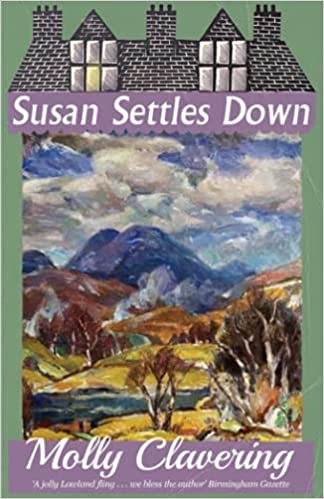
Susan Parsons has been leading a wandering life keeping house for her naval officer brother Oliver, but Oliver was badly injured in a fall months before and has left the Navy, still suffering a limp and not his old self. Then Oliver inherits a small estate in Southern Scotland. It’s not in good condition and the Parsons haven’t much money, but Oliver decides to make it their home.
While Susan struggles to get some help in the kitchen and repair the worst problems of the house, Oliver begins supervising the farm work and almost immediately meets Jed Armstrong, the farmer next door. Although they immediately become friends, Susan finds Jed rude and uncouth.
Soon, the two siblings become involved in village activities. Susan befriends Peggy Cunningham, the parson’s young daughter, who has been receiving unwelcome attentions from the organist. The Parsons become fast friends with the Cunninghams, and all try to avoid the Pringle sisters, three mischievous gossips.
This novel is a lovely tale of village life in pre-World War II rural Scotland, featuring two romances. The descriptions of the landscape are beautiful, the characters are attractive, and I enjoyed it very much. However, I continued to find problems with Furrowed Middlebrow blurbs. Twice now the main character’s name has been misspelled, and this time the blurb places the novel in the Highlands.
When I put Phineas Finn on my Classics Club list, I was just looking for a book by Trollope that I hadn’t read. I didn’t realize it was the second of the Palliser novels, so now I’m going to have to go back and read the first.
Against the advice of his father and his mentor, Mr. Low, Phineas Finn has been persuaded by friends to run for Parliament even though he has just recently finished his law studies. The difficulty is that he has no money and Parliamentary representatives aren’t paid, so his father, who is a country doctor, will have to continue to support him unless he can get a paid government position.
Nevertheless, he goes ahead and gets “elected” as member for an Irish pocket borough, where the lord who awards it has feuded with his son, the incumbent. So, Phineas begins his career.
One of his friends who has encouraged him in politics is Lady Laura Standish, a young woman who takes a great interest in politics. Although she had some fortune, she gave it away to her brother, Lord Chiltern, to pay off his debts in the hopes he can reconcile with his father, the Earl of Brentford. Both the Earl and Lady Laura are encouraging about Phineas’s career, and Phineas finds himself in love with Lady Laura. However, he has a rival, Mr. Kennedy, who is stiff and formal but very rich.
The novel details Phineas’s Parliamentary career as well as his friendships with several young ladies as he looks for a wife. It is thoughtful about the choices for women at this time and deals with the consequences when Lady Laura makes the wrong choice of husband. Another character, Laura’s best friend Violet Effingham, is wealthy in her own right and wants to remain single and run her own household but finds she is not allowed to. Finally, there is Marie Max Goesler, an intriguing character. She is a wealthy widow who is known for her select parties. She is an admitted social climber, but she takes a great interest in Phineas’s career.
Phineas himself is a likable fellow who sometimes seems a little suggestible but by and large works hard and leads an ethical life. I enjoyed this book very much. The only thing I found disappointing was that of the four women he considers marrying, he ends up with the least interesting and most insipid.
Miss Bunting is another re-read for me. I’ve looked over my original review, which seems fine, so use the link for the plot synopsis. One thing I notice is that because of reading the books in order and thereby getting to know the characters better, I found the ending of this novel more affecting than I did the first time.
So, here are my observations from this time through. First, I noticed the subtleties of the class distinctions. Although I mentioned in my first review that Thirkell’s usual upper-class characters are flustered at having the wealthy and vulgar Mr. Hill thrust his way in amongst them (and thrust he does, appearing several times uninvited), Jane Gresham is shocked when he implies that he considers himself better than his landlady Mrs. Merivale, who is educated and middle class and whose daughters have better marriage prospects than Heather Hill does. Of course, Heather’s ambitions are different than Mrs. Merivale’s. I myself was surprised to find the Middletons, who seemed fully accepted in Before Lunch, being considered socially inferior (mostly by Lady Fielding, who’s a real snob). Toward the end of the novel, Lady Fielding reflects that men like Mr. Hill have taken over, and there won’t be room for people like them. Lord Fielding reassures her, but she’s not far wrong.
This novel is sad in more ways than one, but particularly affecting is Jane’s situation, not knowing whether her husband is dead or alive. I won’t give the other reason away.







 What? Me Read?