Review 1584: Milly Darrell

When Mary Crofton attends a charmless school to learn to be a governess, she is befriended by an heiress, Milly Darrell. Milly is a beautiful and good-natured girl whose life becomes complicated when her widowed father remarries.

Augusta Darrell doesn’t like Milly, but the situation changes for the worse with the reappearance in the area of a neighbor, Angus Egerton. Before he returns, the girls hear the story of his falling out with his mother after he fell in love with a girl of low birth. When his mother prevented the marriage, he swore never to return while his mother was alive and was said to have lived dissolutely. His mother dead, he returns to try to repair his dilapidated estate.

It is easy to guess that Mrs. Darrell has something to do with this story but not so easy to see how that will affect the plot. This thickens when Milly and Angus fall in love with each other.

This novella is a typical sensation work of its time. It is short and fun to read. For some reason, though, the publisher has chosen to add an alternate ending which, while not materially different from the original, is a travesty of purple prose—an indication of a lack of discrimination on their part.

Related Posts

Aurora Floyd

The Mystery of Mrs. Blencarrow

Diana Tempest

Review 1581: Somewhere in England

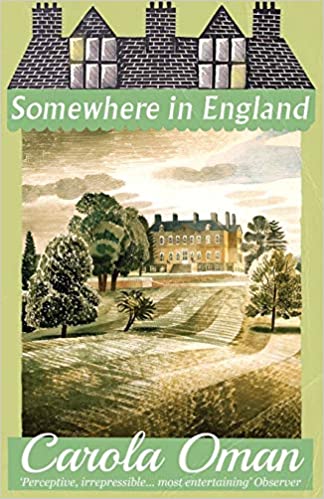
When I received a review copy of Somewhere in England from Furrowed Middlebrow, I realized that it was a sequel. So, I ordered the previous book, the delightful Nothing to Report, to read and review first.

To introduce the plot of Somewhere in England, I have to include a spoiler or two for the previous book. The novel begins with 18-year-old Pippa Johnson, who is about to take a position in a war hospital established in the family home of Mary Morrison, the main character of the previous book. In between novels, Mary Morrison married Kit Hungerford, who had purchased her family home. Now, Mary Hungerford is administering the hospital.

The first part of the novel has to do with Pippa meeting the hospital staff and villagers. It is more concerned with the social side of things than the war work as we meet familiar characters again. Elisabeth, who made her debut the summer of 1939 in the previous book, is a nurse whose fiancé has died, and she is rude to young Pippa. Lalage is friendly and will make a good nurse, but her sister Rosemary and mother Marcelle continue with their selfish ways. Most people, though, are occupied with some kind of war work.

The second part of the novel returns to the point of view of Mary, who is constantly dealing with difficult situations all the while worried for her husband overseas.

I enjoyed this novel, but it is hard to describe. It was fun to revisit the characters of Nothing to Report and see how they’re doing during the war. I think that as a sequel it stands well enough alone, but my enjoyment was enhanced by having read Nothing to Report first.

Related Posts

Nothing to Report

Northbridge Rectory

Atonement

Review 1580: Barometer Rising

I got interested in the 1917 Halifax Explosion through my friend Naomi of Consumed by Ink. She has a page of books she’s read about the event, from which I selected this novel, written in 1941.

Penny Wain believes that her fiancé, Neil Macrae, died in action in France. She is aware there is more to it than that, but no one will tell her what it is, even her father, Colonel Wain, who was Neil’s commanding officer. But then, her father hated Neil. Penny has been working as a ship designer and has just had a design accepted by the Admiralty.

Penny has an admirer, Angus Murray, a doctor who is home on leave because of an injury. Angus is a lot older than Penny and is considered washed up because of his drinking, but Penny sees more in him.

What Penny does not know is that Neil is in Halifax. He was due to be courtmartialed for disobeying orders when the shed he was in was hit by artillery. He awakened with amnesia, having been mistaken for another soldier. Now, he is searching for a man he hopes will prove him innocent of the original charges.

This novel begins a few days before the cataclysmic event and ends a few days after. The description of the event itself, which caused an earthquake, a tidal wave, and an enormous wind, is impressive. Although I personally think Penny chose the wrong guy, I found this novel very interesting and involving.

Related Posts

No More Parades

My Darling Detective

A Harp in Lowndes Square

Review 1575: Nothing to Report

Best of Ten!
The circumstances by which I came to read this novel were a bit different from usual. I received Somewhere in England by the same author as a review copy, but when I sat down to read it, I realized it was a sequel to Nothing to Report. So, I immediately sent off for this novel so that I could read them in order.

Mary Morrison, Button to her friends, is an unmarried middle-aged woman living in a village near London in 1939. She has been forced to sell the family home, which is now a school. From her cottage, she seems to be at the center of village life, often being called on for advice, running a woman’s society, and living a busy social life.

Her childhood friend, Catha, Lady Rollo, and her family have returned from years in India and want her to help them find a house. Catha’s youngest son, Tony, a surly university student and would-be revolutionary, is hanging around Mary Morrison’s house trying to avoid his family. Mary’s widowed sister-in-law, Marcelle, has just announced her plans to vacate London and move in with Mary, bringing her daughter Rosemary. Rosemary, in preparation for the move, has shipped her piano to Mary’s house. Mary herself has been trying to organize gas mask training. Finally, Catha’s daughter, Elizabeth, is preparing for her debut to society. In short, things are chaotic. Slowly, events work up to World War II, of course.

I was delighted to read this novel, which I found charming. It has some very funny scenes, such as Lady Rollo’s preparations for going to Ascot, and is at other times quite touching. I loved this book.

Related Posts

Northbridge Rectory

Bramton Wick

Mariana

Review 1567: Beneath the Visiting Moon

It is the summer of 1939. The Fontaynes are dreaming along in their stately but crumbling home, left without much money since the death of Mr. Fontayne, who had been a noted thinker and politician. Unusually for them, they attend a local dance, where 17-year-old Sarah meets and falls immediately in love with Sir Giles Merrick, a middle-aged diplomat. Sarah begins a series of attempts to develop more of a life for herself so that she can meet more people and perhaps see more of Sir Giles, her hazy mother Elisabeth seeing no attraction in anything but staying home.

The Fontaynes have been trying to sell their house. When they learn that an “artsy” family is leasing a house of no distinction, the children urge their mother to call on them in hopes the family will buy Fontayne. This meeting has unexpected consequences, for soon Elisabeth has agreed to marry Mr. Jones, an orchestra conductor on rest cure.

The Jones children, Peter and Bronwen, are more sophisticated than the Fontaynes and take delight in mocking things the Fontaynes like. The Fontaynes particularly find 13-year-old Bronwen, who has written a book that is being published and constantly quotes poetry, to be ghastly. Shortly after the marriage, Sarah decides it’s time to get a job.

I found this novel delightful and was disappointed to learn it was Cavan’s last, for she became a playwright later on, encouraged by Noel Coward. It’s a vivid picture of life in an eccentric household right before everything is about to change.

Full disclosure: I received a copy of this novel from the publisher in exchange for a free and fair review.

Related Posts

Not at Home

Guard Your Daughters

The Great Fortune

Review 1565: A Struggle for Fame

After reading The Uninhabited House, I looked for more books by Charlotte Riddell and came across the Recovered Voices series published by Tramp Press and this book, A Struggle for Fame. A Struggle for Fame is Riddell’s semi-autobiographical novel about the publishing industry.

Although Glen Westley is the main character in the novel, it follows the progress of two Irish young people who meet on the ship from Ireland and both end up in London’s literary milieu. Through poor investments, Glen’s father has lost the family home and all his money. She determines that they will travel to London so she can try to make a living as a writer.

On the ship, they meet Barney Kelly, a young chancer who is looking for a way to make money.

Glen works hard at good literary fiction and is repeatedly rebuffed by editors even while being told she has promise. Barney, on the other hand, falls into an opportunity to write articles for a journal. The novel makes clear that Glen has much more ability than Barney, but he is able to make a living at writing much earlier than Glen. It is clear from the beginning that the novel is about Glen’s rise and fall, but we are drawn in to see what happens.

A lot of characters are vividly drawn and quite Dickensian in their idiosyncrasies. It is fairly obvious that Riddell is depicting, sometimes satirically, publishers and authors she knew. Although written in 1883, the novel has observations about gender and ability that still apply today.

Related Posts

The Uninhabited House

The Blazing World

The Muse

Review 1564: Dangerous Ages

Thanks to Simon Thomas’s posts (Stuck in a Book) on the new British Library Women Writers series, I was able to request some review copies. I received Dangerous Ages, which, according to the novel, are all of them. This novel examines the lives of women in the early 1920’s.

Neville is 43, a woman who gave up her medical studies as a young woman to marry and raise a family. That job done, she finds herself feeling adrift, with no purpose, and views her mother, Mrs. Hilary, as an object lesson. She must find work and decides to return to studying medicine.

Mrs. Hilary is a silly woman who always pretends she has read important books and is knowledgeable on all subjects. At 63, she has nothing to do, because she defines herself as a wife and mother. Now she is a widow whose children are grown. She is jealous of anyone being intimate with Neville if her son Jim isn’t around and is jealous of Neville’s intimacy with Jim. She thinks psychoanalysis, which is being talked about, is horrid until she realizes it means someone will listen to her stories.

Nan, Neville’s younger sister, has been courted by Barry for ages. She finally decides she loves him, but instead of telling him so, she goes off to Cornwall to finish writing her latest book, never thinking that Barry might give up on her.

Gerda, Neville’s daughter, is ardently engaged in left-wing activities. The question is, when she falls in love with a man of a different background, whether she will compromise her principles, which reject all the values of her parents’ generation.

Macaulay’s novel is rooted in the early 1920’s, as characters examine hot topics of the time. I had to laugh at the scenes where Mrs. Hilary’s psychoanalysts inundate her with Freudian jargon that she has very little understanding of. That most of these women are frustrated in their aims should not be surprising, for this is a satirical look at the position of women in society. Only Neville’s sister Pamela, who refuses to be bothered, and Neville’s grandmother, who says she is past all that, seem happy.

Simon Thomas’s Afterword provides some insight into views of psychoanalysis in the early 1920’s, which is interesting.

I enjoyed this novel very much. It feels like light, lively reading while dealing with experiences that are universal, no matter the generation.

Related Posts

The Towers of Trebizond

Consequences

South Riding

Review 1563: #1956 Club! Palace Walk

I experienced quite a bit of culture shock reading Palace Walk, which made me realize that although I have read books set in Egypt about Egyptians, all but one were written by Western writers, and that one, Map of Love, was much more modern. Palace Walk is about Ahmad Abd al-Jawad and his family, and I believe it’s Mahfouz’s own family thinly disguised.

The novel is the first of three in Mahfouz’s Cairo Trilogy. It begins with al-Jawad’s wife, Amira, getting up at midnight to help her husband get ready for bed after his usual night of carousing and womanizing. Although her husband is a good friend and convivial participant in nightly drinking bouts, at home he is an angry tyrant to his wife and children. I found it interesting that although he has the reputation of a righteous and observant man, no one seems to think his drinking and womanizing make him a hypocrite.

Mahfouz was a writer in the Realism school and as such explores both the good and bad facets of his characters’ personalities (although it sometimes seems like Realists concentrate on the gritty). The novel develops slowly, introducing us to al-Jawad, Amina, and his five children—Yasin, a government clerk who immerses himself in sensuality like his father but with less control; Fahmy, a university student who is serious and ardent; Khadiya, the older, sharp-tongued daughter; Aisha, the younger, beautiful daughter; and Kamal, a schoolboy who may be Mahfouz’s alter ego.

Beginning in 1917 near the end of World War I, the novel at first focuses on purely family concerns such as Fahmy’s desire to be affianced to Maryam, the neighbor girl; Aisha’s receipt of an offer of marriage before Khadiya’s, when their father has decreed that the younger girl will not be married before the older; and Yasin’s mother getting married again, which Yasin thinks is obscene, since she has been married several times. In these domestic incidents, the family constantly faces their father’s anger and intransigence. Mahfouz frequently tells us of his good points although they are not often demonstrated. In fact, there is a lot of explanation going on about the thinking and characters of the family members, some of it quite repetitive.

As the novel develops, external events become more important, especially the Arab Revolution of 1919 against the protectorate of the British. This more outward view makes the second half of the novel move along more quickly.

Certainly, al-Jawad’s actions toward his wife and children are shocking, and Mahfouz makes clear that he is stricter than most others by the comments of al-Jawad’s friends. Yet, it is also clear that no one would interfere in his treatment of his family, since it is his right to behave as he wishes. As an example of some of the things he does, Amina, who has only left the house a few times in 23 years of marriage, takes the opportunity of her husband’s absence on a business trip to visit a nearby mosque. Because Kamal guides her out of her route so that he can visit a pastry shop, she becomes disoriented and faint and is hit by a car. After she recovers, her husband banishes her from the house for leaving it without asking him (and believe me, he would have said no).

His son Yasin, the leaf not falling far from the tree, thinks later in the book when his wife is not happy with his nights out that it is the husband’s right to do anything he wants and the wife’s to obey. Nice.

The trilogy is supposed to be about the effect the father’s tyranny has on his family. I read it for the 1956 Club, and I suppose I will go ahead and read the other two novels. It certainly provides an intimate look into family life and customs in early 20th century Egypt.

Related Posts

The Map of Love

Blood & Sand

Letters from Egypt

Review 1562: #1956 Club! The Fall

I’ve never read any Camus before, so I decided to read The Fall for the 1956 Club. This I can say: after reading The Kreutzer Sonata, The Prague Cemetery, The King Without a Kingdom, and The Fall, I’ve decided I hate novels that are monologues.

An unnamed person meets Clamence, an ex-Parisian lawyer, in an Amsterdam bar. Clamence begins his monologue explaining how his life changed. He began as a successful lawyer for the defense—handsome, genial, charitable, always doing good—and a womanizer. As he talks, we see that his charitable impulses are rooted in self-regard. His discourse becomes more and more cynical until . . . .

Well, I don’t know, because 50 pages before the end, I realized I was struggling to pay attention, and I stopped reading. His “witty” discourse may have been ground-breaking in 1956, but in 2020, it just seems banal.

Related Posts

The Kreutzer Sonata Variations

The Prague Cemetery

The King Without a Kingdom

Review 1560: #1956 Club! The Towers of Trebizond

Best of Ten!
The Towers of Trebizond, which I read for the 1956 Club, is said to be Rose Macaulay’s masterpiece. When I first began reading it, I was surprised at this, for it seemed to be a light comedy about eccentric people traveling in Turkey. To be sure, the narrator, Laurie, is erudite but relates the story in gushes of information, whimsy, and wit. But oh, when Laurie describes the wonders of past civilizations or her love of the rituals of the Anglican (high) church (I’m picking “her,” to discuss later), you see that there is more to this novel than humor.

Laurie and her Aunt Dot are on a trip to Turkey, accompanied by Father Chantry-Pigg. Laurie and Aunt Dot are writing a book about Turkey, Aunt Dot hopes to enlighten Moslem women by converting them to the Anglican church, and Father Chantry-Pigg, whose inappropriate last name becomes a running joke, wants converts. On the way, they pick up Aunt Dot’s friend Dr. Halide, who is also interesting in the liberation of women. Oh, and Aunt Dot brings her camel.

This may not sound funny, but all of the characters except Laurie are so obsessed with their hobby horses that the conversations are delightful. Later, we meet David, who has taken advantage of his ex-lover Charles’s death to steal the material Charles has written about Turkey and publish it under his own name—only Laurie has found Charles’s notebook in his old hotel room.

The central conflict for Laurie is that she is a believer in her church, but she has left it because of a long-lasting affair with Vere, a married man. Her heart yearns for the church, but she feels unable to break with Vere, whom she loves deeply.

This novel is beautifully written, witty, and finally bittersweet. I was unable to follow some of the detail about the church, and being American, I don’t have the classical background to understand all the references Laurie throws in about ancient civilizations. However, I greatly enjoyed this novel, which goes much deeper than it initially seems it will.

I wasn’t aware of this at first, but apparently there is an issue about Laurie’s sex—is she male or female? Perhaps this didn’t occur to me because my illustrated Folio Society edition makes the decision that she’s female. But what does occur to me is this: doesn’t the question imply sexism? That is, I can only imagine this question was raised because Laurie thinks nothing of, say, riding a camel across Syria by herself. But then, neither does Aunt Dot have any problem with walking across the Iron Curtain just to see what it’s like on the other side. I got no sense at all of a masculine personality in Laurie. Finally, Laurie’s bar to returning to the church is adultery, not adultery and homosexuality, and although Macaulay teases us for a while by not revealing Vere’s sex until the end, she finally does so. I think this whole sex issue is just caused by some people’s assumptions that a woman couldn’t be this adventurous in 1956.

Related Posts

A God in Every Stone

Guard Your Daughters

The Forty Days of Musa Dagh