Review 1459: The Charterhouse of Parma

I found a nice hardcopy edition of The Charterhouse of Parma a while back and finally decided to read it. I have to conclude that I am not a fan of Stendahl. I read The Red and the Black a few years ago and deeply disliked its hero, who is essentially a sociopath.

The Charterhouse of Parma is about the life of a young Italian nobleman, Fabrizio, the second son of the Marchese and Marchesa del Dongo. When Fabrizio is a boy, the region where he lives, near Lake Como, goes back and forth between occupation by the French and rule by Austria. Although Fabrizio’s father is a conservative devoted to the Austrian king, Fabrizio grows up with romantic stories about Napoleon’s exploits. When he is a young man, extremely naïve and stupid, he runs off to fight for Napoleon just in time for Waterloo. He doesn’t even know how to join the army so ends up being mistaken for a spy and having so many ridiculous exploits that I thought I was reading a comedy. I wasn’t. In any case, this adventure results in his being accused by his elder brother of being a spy for the French so that he can no longer reside in Austria, which includes portions of Italy.

Meanwhile, his beloved aunt, the Countess Pietranara, is widowed. She eventually meets Count Mosca, a powerful person in the government of Parma, who falls in love with her. He offers to quit his position and move to Milan to be her impoverished lover (he is married) or to have her marry Duke Sanseverina in name only so that she can respectably move to Parma and be at court—and also be his mistress. She chooses the latter plan.

After Fabrizio’s return from the front, Duchess Sanseverina and Count Mosca try to help Fabrizio gain some position worthy of his birth. They choose the church and advise him how to behave. But Fabrizio is struggling between his instincts and his conscience and consistently falls into one mishap after another.

When I tell you that Tolstoy modelled his description of Waterloo—the least interesting part of War and Peace, which I consistently skipped over—after Stendahl’s, and when I say further that Waterloo, to me, was one of the most interesting parts of this book, you will guess how much I enjoyed it. Actually, I should say the first half of the book, because I finally stopped reading. I did not find Fabrizio interesting and didn’t really care what happened to him.

Related Posts

Vanity Fair

Don Quijote

The Kreutzer Sonata Variations

Review 1429: The Old Man’s Birthday

I’ve only read two books by Richmal Crompton, but she seems to be interested in studying the individual members of large families. In The Old Man’s Birthday, she focuses this interest around Matthew Rowston’s 95th birthday.

Matthew has led an exciting and sometimes disreputable life, but he married an extremely conventional woman and now lives in a village stifled by class consciousness and respectability concerns. To this birthday party, he has insisted on inviting his grandson Stephen, who is living with a married woman and has been cast off by most of the rest of the family. Part of Matthew’s motivation is a perverse desire to shock these family members, but when he meets Stephen’s partner, Beatrice, he is also reminded of a girl he loved when he was young.

This novel is about how the introduction of a single person into a group can change dynamics that seem fairly set. You may feel that a multitude of difficult situations are resolved too easily, but still, this is an enjoyable and touching novel. I read it for Classics Club and was glad I did.

Related Posts

Family Roundabout

Greenbanks

The Priory

Review 1425: High Wages

Jane Carter is a young girl hoping to get a job in Tidsley so she can move out of her stepmother’s house. While her father was alive, she was educated and cherished, but since the age of 15, she’s only been tolerated in her home. In front of Chadwick’s shop, she sees a sign posted for a shop girl. This would be a good opportunity for her, because Chadwick’s is the best draper in Tidsley. And, as she is of genteel appearance, she is hired.

She is excited to get the job, although she slowly realizes its problems. The room above the shop where she must live is not very nice, but it seems fine to her, and her roommate, Maggie, is friendly. However, Mrs. Chadwick skimps on the girls’ food, and Mr. Chadwick sometimes cheats her out of her commission, taking it for himself. Worse, though, is his caution at change in the shop. Jane finds she is good at her job and has ideas that will make money, but Chadwick often won’t let her try them.

A difficulty she isn’t aware of, as Maggie and her young man, Wilfred, invite her out with them every Sunday, is that Wilfred is falling in love with her. She, herself, is attracted by a young man named Noel Yarde, but he is above her in class. Then, lives change as World War I begins.

This novel has an appealing heroine, naïve yet practical, and not to be beaten down. Its realistic portrait of the times, particularly as they change over a period of about eight years, is interesting. The flavor of the northern town, with its grimness and social barriers, is interesting, too. As usual with Whipple,, I enjoyed this novel very much.

Related Posts

They Were Sisters

Because of the Lockwoods

Greenbanks

Review 1423: Literary Wives! The Home-Maker

Today is another review for the Literary Wives blogging club, in which we discuss the depiction of wives in fiction. If you have read the book, please participate by leaving comments on any of our blogs. Be sure to read the reviews and comments of the other wives!

Eva of Paperback Princess
Lynn of Smoke and Mirrors
Naomi of Consumed By Ink

* * *

The Home-Maker is a reread for me, so let me just provide a link to my original review and then discuss our regular question.

What does this book say about wives or about the experience of being a wife?

Evangeline Knapp is a perfect example of a woman, like my mother, who was not suited to be a housewife, a kind of person not recognized in her time. Unlike my mother, who at home was the female equivalent of Lester Knapp at work, Evangeline compensates by becoming overzealous and overparticular in her housekeeping, making the immaculate home a miserable place for everyone, including herself.

In this ground-breaking work of 1924, the couple are forced to switch places, and Evangeline finds her place in life. At work in a department store, her efficiency and energy are appreciated, and because she enjoys the work, she loses her resentment. The Knapps change from a dysfunctional family to one that is much happier, because everyone is happy in his or her role. In  fact, to keep this happy solution in this chauvinist time, they have to come up with a rather shocking solution. The Knapps develop a true partnership in their marriage.

Literary Wives logoI like this novel because instead of depicting a family in stasis, it presents a problem that probably wasn’t much recognized in its time and shows how the family relationships improve as a result of its solution. The marriage evolves from a somewhat unhappy one to a happy one, and everyone is fulfilled. Lester understands Evangeline’s need for meaningful work, and he enjoys taking her position in the household, albeit not providing an immaculate household but a loving, slightly messy one. Evangeline’s sharp temper subsides.

In her way, Evangeline is a little more exaggerated version of Brenda in Happenstance, who began to have periods of anger before she took up quilting.

Related Posts

Happenstance

A Lady and Her Husband

The Awakening

Review 1412: Classics Club Spin Review! The Wise Virgins

The novel selected for me by the latest Classics Club Spin is The Wise Virgins by Leonard Woolf. This semi-autobiographical novel is partially about the courtship of Leonard and Virginia Woolf, in the characters of Harry Davis and Camilla Lawrence.

Harry and his family have just moved to the London suburb of Richstead and are shortly befriended by the Garland family, which has four unmarried daughters. Harry is disdainful of life in Richstead and of the fates of the spinster daughters, given up to good works or golf and tennis. The youngest daughter, Gwen, is naïve and gives undue weight to his discontented utterances. He amuses himself by giving her books and plays to read of Dostoevsky and Shaw.

In his art class, Harry is drawn to Camilla Lawrence, a cool beauty. When she invites him home, he finds it one of ideas and stimulating conversation. Camilla has suitors, but she is less interested in marriage than in a quest for self-fulfillment. She is repeatedly alleged to be passionless.

This novel was considered somewhat shocking in its time but was notable for examining the fates of conventional young women in Edwardian England. Harry is not a likable hero nor is Camilla very knowable. I personally did not like their glib and superior dismissal of whole classes of people. I always imagine the Bloomsbury circle snidely sniping at everyone else (and behind each other’s backs), and this novel didn’t make me rethink that idea.

This is probably taking the novel out of its time, but simply the continual reference to unmarried women by Harry as virgins irritated me to no end. He is so superior and supercilious. The introduction to the book says that “virgin” was synonymous with unmarried woman to Edwardians, but clearly for Harry there’s a sneer involved. One article I read calls Harry a truth-teller, but some of the things he says seem only designed to stir people up and make him seem more like eighteen than twenty-eight. Also uncomfortable for modern readers is the antisemitism that is accepted unquestioned by Harry and his family, who are Jewish.

Finally, there are lots of references to talking in this book, and for people who are looking for a purpose in life besides marriage and other predictable fates, they aren’t doing much actual acting. I think Woolf is pointing that out, though, by the chapter headings.

Related Posts

Mrs. Dalloway

To the Lighthouse

Flush: A Biography

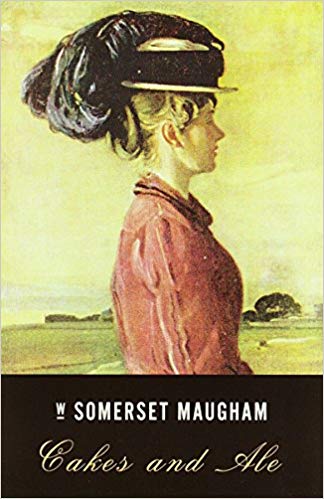
Review 1405: Cakes and Ale – #1930Club

I previously read only one book by Somerset Maugham, The Razor’s Edge. Frankly, I did not enjoy that book about two frightful people tormenting each other.

That was a long time ago, though. So, when I saw Cakes and Ale listed under books published in 1930, I thought, Why not give the guy and another chance and read it for the 1930 Club?

Another book I have already reviewed for 1930 is As I Lay Dying by William Faulkner.

* * *

William Ashenden, a moderately successful writer, unexpectedly hears from Roy Kear, another writer. Although Kear is a perfectly pleasant fellow, Ashenden knows he wouldn’t be hearing from him unless he wanted something. But Kear doesn’t come directly to the point.

Around the same time, Ashenden receives an invitation from Mrs. Driffield, the widow of Ted Driffield, widely considered Britain’s most important late Victorian novelist. He ignores this summons as he doesn’t know Mrs. Driffield. Finally, Kear admits he wants to pick Ashenden’s brain. He is writing an authorized biography of Driffield, and Ashenden knew Driffield and his first wife, Rosie, when Ashenden was a young man. Rosie was a beautiful, vibrant force of nature who was massively unfaithful to Driffield. The second Mrs. Driffield has dragged Ted into respectability and is concerned for his legacy. She wants Kear to leave Rosie out of the biography even though Driffield’s most important work was written during their marriage.

This novel about class snobbery is also a character study of an unusual woman. Because of Rosie’s promiscuity, the novel was highly controversial in its time. I wondered whether Ted Driffield was supposed to be Thomas Hardy and found out that others had supposed that at the time, although Maugham denied it. He did admit that Kear was modeled after Horace Walpole, however.

I enjoyed this novel and am willing to give Maugham another trial. The movie of The Painted Veil that came out a few years ago was beautiful, so I may try it next.

Related Posts

Tess of the D’Urbervilles

Consequences

Someone At a Distance

Review 1393: Friends and Heroes

Cover of Fortunes of WarAt the end of the previous book of Olivia Manning’s Balkan Trilogy, Harriet Pringle flew out of a besieged Bucharest without knowing whether Guy would be able to follow. She ends up in Athens, and the first person she meets is Prince Yakimov. Although he betrayed the Pringles to the Germans through his foolishness, Harriet is happy to see a friendly face.

Guy does arrive in Athens in the hope of getting a teaching job at the Academy. He finds Duderat and Toby Lush ensconced there as teachers. Although he employed them in Bucharest despite their lack of credentials, they do not repay his kindness with assistance. Instead, they lie to the director about him to prevent him getting a position. The director will not allow the Pringles to live at the Academy, so they find themselves with only a room to stay in and no money.

Even after they manage to establish themselves, Harriet feels alone. She understands that Guy considers her part of himself, but he therefore expends himself in work and helping others and hardly thinks of her. Out of loneliness, she finds herself attracted to a young soldier.

I didn’t like the turn the plot took with the soldier, whom I thought tiresome, but I have found this series more and more interesting. Although Friends and Heroes is the third book in the Balkan Trilogy, it ends with another evacuation and feels incomplete, so I feel compelled to read the second trilogy in the series Fortunes of War, the Levant Trilogy.

Related Posts

The Great Fortune

The Spoilt City

Munich

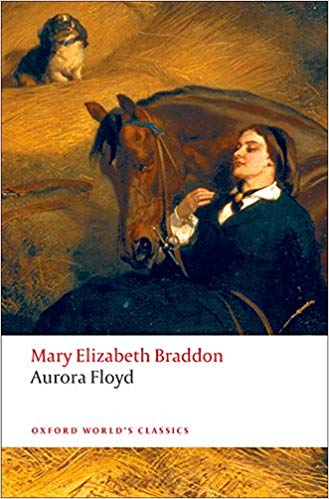
Review 1388: Aurora Floyd

The heiress Aurora Floyd is the apple of her elderly father’s eye. At 19, she is dark and high-spirited, with a flashing eye and an air of pride. She has just returned from finishing school in Paris when Captain Talbot Bulstrode notices her.

From a family that prides itself on its blemishless past, Bulstrode is looking for a pure and wholesome wife. He is disdainful of Aurora’s interest in horses and racing. Altogether, he feels he would like his wife to be more like her cousin, Lucy Floyd. Nevertheless, he can’t take his eyes off Aurora even though there seems to be a shadow over her.

Aurora has another admirer, John Mellish, a large, bluff Yorkshireman who worships her at first sight. In the beginning, Aurora pays little attention to either man. Then she seems to favor Captain Bulstrode.

Aurora has a secret, however, that will threaten her happy future. It is not a difficult secret for the reader to guess, but when a murder is committed, she finds that it must come out.

Mary Elizabeth Braddon was a writer of popular Victorian sensation novels, combining melodrama, intense emotion, and crime. Her best-known work is Lady Audley’s Secret, so if you are familiar with that, you know what to expect. The story evokes some true suspense, and the main characters are either likable or despicable, as intended. Occasionally, Braddon departs into little lectures, some of them loaded with literary allusions. They reminded me of some of Dickens’s writing, only I found them a little cumbersome and overbearing. Still, this novel is readable and generally moves forward at a good pace. I enjoyed it.

Related Posts

The Mystery of Mrs. Blencarrow

Diana Tempest

The Shuttle

Review 1384: The Spoilt City

Cover of Fortunes of WarThe Spoilt City is the second book of Olivia Manning’s Balkan Trilogy. I was confused about why this series had two series names until I read recently that this trilogy along with her Levant Trilogy are called The Fortunes of War.

The war, of course, is World War II. The Spoilt City begins during the summer of 1940 in Bucharest. When newly married Harriet Pringle arrived in the city less than a year before, it was opulent in its wealth, and Romania being agriculturally rich, loaded with good food. Although the country is neutral, it has been sending most of its food to Germany, and now it is becoming difficult to find anything good to eat.

King Carol has been trying to maneuver between threats from Germany and Russia. Romania has been an English ally, but when Russia is rumored to be ready to invade, Carol throws his lot in with the Germans. They immediately cede large portions of Transylvania to Hungary. The Iron Guard, an outlawed group of Fascists, reappear in the streets, and Germans begin arriving. People begin calling for Carol’s abdication. The English, who were formerly welcome, begin to feel threatened.

Harriet, who has married on three weeks’ acquaintance, is beginning to understand her husband, Guy. While he is popular with everyone and has an open, gregarious nature, he glosses over difficulties that she must tend to. He has offered the impoverished Prince Yakimov a place to stay while he acted in Guy’s play. When the play is over, Harriet doesn’t know how to get rid of him. Later, Yakimov repays this hospitality with a foolish betrayal.

The impending Drucker trial is all anyone talks about. Drucker, a wealthy Jew, is facing trumped-up charges after refusing to hand over his oil leases to the King’s mistress. Much of the family money is in the name of his son, Sasha, who has been forced into the army. Sasha, formerly Guy’s pupil, deserts and comes to Guy for help. Guy and Harriet hide him in a room on the roof, another danger to them.

Now that things have got going, I found this second book a lot more interesting than the first. I didn’t really like Harriet in the first book but found her much more likable in the second. With such a naïve and impractical husband, she is often faced with having to take care of unpleasantness. I am looking forward to the third novel and will probably also read the Levant Trilogy.

Related Posts

The Great Fortune

Midnight in Europe

Munich

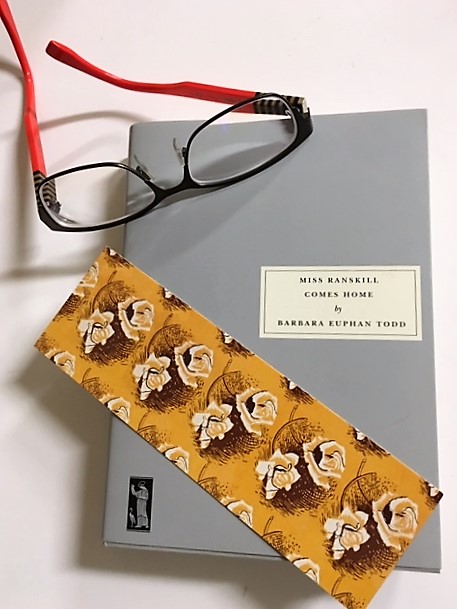
Review 1381: Miss Ranskill Comes Home

When I read that Miss Ranskill Comes Home is about a woman stranded on a desert island, I thought of some romantic comedies from the 50’s. But the novel is more serious than that. It’s about a woman struggling to find her place in a world completely changed.

The novel opens with Miss Ranskill burying the Carpenter, which is what she called the man who was her companion on the desert island where they both have been stranded since falling overboard. The Carpenter died, but he left her the boat he’d been building. When she casts off, hoping to encounter a ship, she occupies herself with the stories they used to tell each other about going home.

Miss Ranskill is picked up by a ship, but World War II has begun since she was lost. She doesn’t understand how the world works or have any papers. She gets off to a bad start after she arrives in England when she leaves her escort out of embarrassment. Even when she returns to her sister, she is made to feel like an encumbrance. Having lived literally stripped to the essentials, she doesn’t feel much sympathy for wartime bureaucracy or the pleasure some seem to take in their deprivations.

This novel is an unusual one. At times I didn’t buy what happened to Miss Ranskill after she returned home, particularly her reception. I also got irritated with her seeming determination to ignore the rules of wartime, even if some of them were silly. Still, this is a thoughtful examination of some of the attitudes of that time and ultimately a touching story.

Related Posts

Mariana

The Great Fortune

Robinson Crusoe