Review 1306: The Fortnight in September

Cover for The Fortnight in SeptemberIf you are a reader who needs a novel with a strong plot, The Fortnight in September is not for you. However, if you like to read about ordinary people doing ordinary things, then the novel will probably entertain you.

The Stevens family has vacationed in Bognor Regis every summer since Mr. and Mrs. Stevens’s honeymoon. It is time to go again. Although Mr. Stevens is conscious that this custom may be changing soon—his oldest children, Dick and Mary, are grown now and both working—he hopes that they will continue to vacation together a while longer. Everyone is excited as they sit down the night before to allocate last-minute tasks before they take the train the next morning.

This is a simple story about uncomplicated people doing what they have always done and enjoying it very much. There are hints that the future may not stay the same—for example, Mrs. Huggett’s Seaview House is getting worn and seedy and the Stevens find that she is losing customers. But that doesn’t matter much to them. They think others don’t understand the place.

Each member has his or her concern. Mr. Stevens is worried about some things at work. Dick is unsatisfied with his job at a stationers. Mary has made an attractive friend but feels guilty as the family always spends its time together. Mrs. Stephens doesn’t enjoy the sea very much, but she keeps that to herself, not wanting to mar the enjoyment of the others. Young Ernie is only concerned about bringing his toy yacht.

Sherriff manages to involve us in the thought and activities of these ordinary good people. I found this novel quite charming.

Related Posts

Greengates

Greenery Street

Seaview House

Review 1305: My Mortal Enemy

Cover for My Mortal EnemyWhen Nellie Birdseye is fifteen, she meets Myra Henshawe, who is a romantic legend in her small town of Parthia, Illinois. Twenty years ago or so, Myra deserted a life of privilege and wealth to run away with Oswald Henshawe, who her uncle had forbidden her to marry. True to his word, her wealthy uncle left his house and all his money to charity.

Nellie is entranced by the charismatic Myra. Following Myra’s visit to Nellie’s Aunt Lydia in Parthia, Nellie and her aunt return the favor with a trip to New York. There, Nellie admires the couple’s somewhat bohemian lifestyle and Myra’s capacity for friendship. Still, Nellie notices that Myra has ambitions for wealth and position that Oswald will never be able to provide, and she doesn’t always treat Oswald as kindly as she does others.

Ten years later, Nellie meets the couple under different circumstances.

Published in 1926, My Mortal Enemy is a character study rather than a story with a plot. It shows from a different angle the results of this love match that the youngsters in her home town thought was so romantic. My only caveat about it was that I didn’t really understand what about Myra made her so fascinating to Nellie. I think it would have been more effective if Cather had been able to make her readers feel this. I read this as part of my Classics Club list.

Related Posts

Fidelity

The Land of Green Ginger

The Home-Maker


Review 1304: Our Spoons Came from Woolworths

It’s typical of Barbara Comyns that she tells a horrifying story in a disarming, naive style. In Our Spoons Came from Woolworths, her theme is an ill-considered marriage.

Sophie marries Charles at 21 despite considerable opposition from his family. They make it plain that they don’t like her, think she isn’t good enough for Charles and that he shouldn’t marry before he can support a wife. They assume she has tricked Charles into marriage by getting pregnant when in reality she knows nothing whatever about sex. The fact that Charles says nothing in response to his family’s insults to his fianceé should have tipped Sophia off, but she’s not very good at picking up on things.

Charles is an artist, and apparently Sophia is meant to support him on her meager salary as a commercial artist. Although he occasionally picks up a contract, most of the time they are just getting by. Getting by, that is, until Sophia soon finds herself pregnant. Slowly, she learns that she has married a self-absorbed man who feels no responsibility toward her or their life.

This may sound like a depressing story, but there is something about its light, naive tone that lifts it up. Instead, it is a charming and funny story of depression-era poverty and a bohemian lifestyle.

Related Posts

Who Was Changed and Who Was Dead

The Vet’s Daughter

Sisters by a River

Day 1296: The Battle of Life

Cover to Dickens Christmas booksAs has been my tradition for several years, only missing the year I moved to Washington, I am reviewing one of Dickens’s Christmas books for the Christmas season. I only have one left, so I’ll have to think up a new tradition in a couple of years.

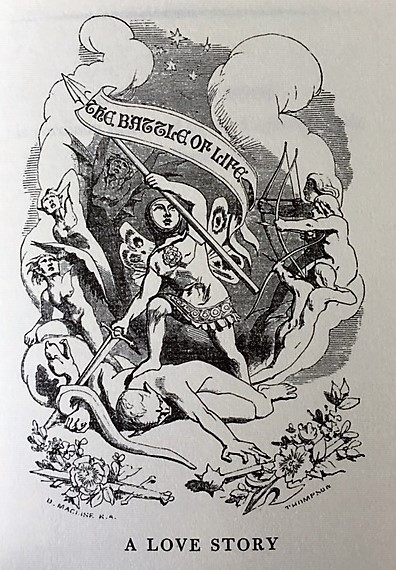
The Battle of Life begins with a section about a battle that was fought years before on the site of the main characters’ home. I thought that since Dickens’s Christmas books often involve ghosts, this battle might be the source of a ghost story, but no. Apparently, this section is just an extended and rather laborious metaphor.

In any case, we soon meet the Jeddlers, who are celebrating some important birthdays. It is the birthday of Marian, the younger and more beautiful Jeddler sister, who is provisionally engaged to Alfred Heathfield, Dr. Jeddler’s ward. It is also Alfred’s birthday. This day he will be released from his wardship and travel to the continent to study medicine. In three years, he will return and marry Marian, if they are both so inclined. There is something odd, however, in the way in which Marian bids farewell to her sweetheart, looking at her sister Grace all the while.

Illustration from The Battle of LifeIn the second part, the plot thickens. It is three years later. Alfred is due back, but another player has entered the scene. Michael Warden has ruined himself with his spendthrift ways and meets with his solicitors, Snitchey and Craggs, to discuss how he might save himself. Snitchey and Craggs have already appeared as Alfred and Dr. Jeddler’s solicitors and provide some of the typical Dickens comedy, along with their wives. During this meeting, Warden states his intention of eloping with Marian Jeddler. Could Marian be contemplating an elopement just when Alfred is due home?

This novella about two sisters each of whom is ready to sacrifice her own happiness for the other is a little predictable but makes a touching, if slightly sappy, story. As one of Dickens’s Christmas books, I would rate it below A Christmas Carol but above the others, especially The Chimes. I have one more to read, and next Christmas will show how well I liked it.

Related Posts

A Christmas Carol

The Chimes

The Cricket on the Hearth

Day 1285: Miss Buncle’s Book

Cover for Miss Buncle's BookMiss Buncle’s investments have not been providing her an income, so she realizes she must do something. She decides to write a book. She submits it to a publisher, Mr. Abbott, who can’t decide whether it is a sly satire or a story written by a rather simple person. Nevertheless, he likes it and decides to publish it. In particular, he is impressed by the lifelike characters.

Miss Buncle always says she has no imagination and has simply described the people she knows. When the book comes out, all of her neighbors begin to recognize themselves, and many of them are not pleased. But no one knows who the author, John Smith, is. Some of the less likable people in the village decide to find out. The topper is that Miss Buncle has imagined futures for some of her characters, and they start to behave as she predicted.

This is a delightful novel, a fun, light read. It’s the perfect thing to go with a cup of tea on a rainy afternoon. I can see why so many people have loved it. I read it for my Classics Club list.

Related Posts

Vittoria Cottage

The Baker’s Daughter

Sylvester, or the Wicked Uncle

Day 1278: The Forty Days of Musa Dagh

Cover for The Forty Days of Musa DaghBest Book of Five!
In 1915, the Ottoman Empire decided to make a scapegoat of its Armenian subjects. It declared all Armenians to be subversive and began “relocating” them to the deserts of Syria. Those who did not die on the way from starvation or mistreatment starved to death upon arrival. In this way, the Turks rid themselves of 1.5 million Armenians, a fact the Turkish government still denies.

In the shadow of the mountain named Musa Dagh, the inhabitants of seven villages decided not to go. After the villages received the news that they would soon be relocated, they sneaked supplies and livestock up into the mountain. Then, the day before the evacuation, they walked up onto Musa Dagh. There, for forty days, they managed to defeat the Turkish army’s attacks until they were rescued by the French navy. Although there were casualties, more than five thousand people were rescued.

The Forty Days of Musa Dagh is considered Franz Werfel’s masterpiece—his fictional account of the event. The main character is Gabriel Bagradian, a wealthy man raised in Europe who has recently returned to this family home after the death of his older brother. He is a reserve army officer, and when he reports to the regional capital to find out why he hasn’t been called up, he hears disquieting rumors.

Back home, he consults with village leaders until the arrival of Aram Tomasian, a Protestant pastor who was relocated with his family from another village. He and his family have been allowed to travel to his father’s village, the authorities thinking it will not affect his fate. But he is able to tell the villagers what is happening during the relocations.

Gabriel has been trying to save his French wife, Juliette, and his son, Stephan. But now he proposes that the villagers ascend Musa Dagh and defend themselves. Only the followers of one church decide to cooperate with the Turks.

At 800+ pages, this novel is very long, but completely absorbing. Werfel’s characters are not heroes but complex people. The novel is suspenseful because even though we know the result for the village as a whole, we don’t know what will happen to the individual characters. The villagers have deserters, loss of their livestock, a fire in their grainery, and other hazards to navigate. I don’t know any other way to explain it but to say this. This novel is fantastic. It is absolutely what I look for in a good novel, where I can immerse myself in another world for a short while.

P. S. If you are interested in reading more about the Armenian genocide, another touching novel is Birds Without Wings by Louis de Bernières.

Related Posts

The Bastard of Istanbul

In the Shadow of 10,000 Hills

A God in Every Stone

Day 1276: The Haunted Hotel

Cover for The Haunted HotelWilkie Collins’s The Haunted Hotel was the spooky book I read for the Classics Club Dare that will also do for the R.I.P. Challenge.

* * *

His family is shocked when Lord Montbarry jilts his gentle cousin, Agnes, and marries the infamous Countess Narona. Agnes herself cannot explain the behavior of the Countess when she meets her in London. The Countess seems horror struck by Agnes and says she will be her undoing.

Lord Montbarry and his new wife go off with her brother, Baron Rivar, to live in Venice. It is not long before the family hears, first, of the disappearance of Ferrari, Lord Montbarry’s courier and the husband of Agnes’s former ladies maid, and then of Lord Montbarry’s death from bronchitis. Lord Montbarry’s fortune is entailed, but he leaves a large life insurance award to his widow. Although the insurance company conducts an investigation into the death, they can find nothing wrong.

Lord Montbarry’s younger brother, Henry Westwick, has been trying to court Agnes, but she is still in love with her former fiancé. In the meantime, he occupies himself with investments, including in the hotel that used to be the villa where his brother died. After the hotel opens, one family member after another stays there, in room 14, all having bad experiences. What happened in that hotel?

Frankly, this short novel has neither the entertaining narratives of The Moonstone nor the intriguing plot of The Woman in White. It is a potboiler, not one of Collins’s best. The hero and heroine aren’t much more than cardboard figures. The only character of interest is Countess Narona herself. The plot is predictable, the novel not scary, and the truth, although creepy, is not told to maximize the effect. On the scary scale, it gets a low mark.

Related Posts

The Moonstone

Hide and Seek

Basil

Day 1273: The 1944 Club! They Were Sisters

Cover for They Were SistersBest Book of Five!
I was going to save my review of They Were Sisters for our February Literary Wives club, but I saw it was also published in 1944, so applied to the 1944 Club! So, for Literary Wives, I will just have to refer back to this review and then make my further comments about the depiction of wives in fiction.

I previously read another book published in 1944. Here is its link:

Friday’s Child by Georgette Heyer

* * *

Lucy’s sisters, Vera and Charlotte, are much younger than she, so much so that she was largely responsible for raising them when their mother died. Lucy never thought she would marry, but she is, happily, to William, who is a bit eccentric. She has misgivings, though, about her sisters’ choices of husbands, especially Charlotte’s.

Vera’s husband, Brian, is solid and devoted. Lucy likes him, but Vera, who is a stunning beauty, seems to be bored with him. She has a constant entourage of male followers and loves to entertain. They have two daughters, Meriel and Sarah. Meriel is close to her father and paternal grandmother, who hates Vera and is always trying to make trouble. Sarah is closer to her mother, but she is the volatile one, who has trouble making friends.

Charlotte married Geoffrey. As a young man, he was constantly pulling pranks, and Lucy couldn’t see what Charlotte saw in him. As a husband, he is hypercritical and verbally abusive, teaching his daughters, Margaret and Judith, to disrespect their mother.

1944 club logoThe three women have been apart for years when they get together at the beginning of the book. After that visit, Vera and Lucy vow to keep in better contact with Charlotte because they are worried about her. Only Lucy pursues this, however, and through her efforts falls completely for Judith as a child. Although Charlotte avoids Lucy as she loses herself to alcoholism, Judith becomes a regular visitor to Lucy and William’s home, where she sees a more normal home life than the one she has. She also makes unlikely friends with her cousin, Sarah.

This novel is an insightful study of the bonds of sisters, despite their differences. It is a lovely book, also about how the act of caring on Lucy’s part has ramifications beyond her own sisters’ lives. Again, Whipple gets better and better. I will be sad when I will have read all of her books.

More about this book in February for Literary Wives!

Related Posts

Because of the Lockwoods

Greenbanks

They Knew Mr. Knight


Day 1269: Greenery Street

Cover for Greenery StreetThe way I work my blog is that, as I finish a novel, I write up my notes in a book diary. Every five reviews, I pick out my next five books from those notes, and generally speaking, I run about six months behind what I have read.

Obviously, there’s room for error in this system, and I have made one with Greenery Street. I kept expecting my review to turn up, and finally, the other day, I looked the novel up on Goodreads to see when I finished reading it. More than a year ago! I looked back in my journals to see if I inadvertently skipped it, only to find that I apparently forgot to write it up. What a shame for this delightful novel!

Greenery Street is a story of ordinary life in a couple’s first home, written in 1925. It begins on a day in April when newly engaged Felicity Hamilton and Ian Foster wander into Greenery Street in search of a house and find a very small and pleasant one. Then it jumps back to cover their meeting and engagement.

The novel details the everyday life of this newly married couple. There is nothing particularly unusual about their lives (well, not for their time—not too many young wives spend their days shopping, socializing, and supervising the help anymore), but they are rendered in interesting detail and humor, small disagreements and the normal ups and downs of a new marriage. The end of the book is telegraphed from the beginning, when we’re told the house would be too small for three. However, the journey is delightful.

Related Posts

Greengates

Family Roundabout

Mrs. Dalloway

Day 1267: Alas, Poor Lady

Cover for Alas, Poor LadyBest of Five!
A Footman for the Peacock was a strange little book, so I didn’t quite know what to expect from the much longer Alas, Poor Lady. It turned out to be an astonishingly feminist novel for being published in 1937.

At the beginning of the novel, Miss Scrimgeour, an elderly woman, receives the charitable gift of a two-room flat and an annuity for life. One of the women involved in the charity realizes that Miss Scrimgeour is a gentlewoman, of the same class as herself, and that she previously had no income at all. She exclaims, “How did that happen?” This novel answers that question.

It begins in 1870, when Grace Scrimgeour is born into a wealthy family. She is the youngest of six sisters, born almost a generation behind her last sister, but she is not the youngest child. Two years later, the Scrimgeour’s only son is born.

All the girls are raised to become wives and mothers. At least the oldest girls are sent away to school, but after Charlie is born, Grace’s upbringing is neglected and she is left to be educated by a governess who is not very competent.

The two girls marry, but it becomes clear that Mary and Queenie will not. Mary attempts to be useful by offering to teach Grace and Charlie, but her attempts to find herself an occupation are rebuffed by her parents.

As biddable, affectionate Grace nears her debut, Captain Scrimgeour spends more and more of his money on Charlie, selling out of stable financial funds to do so. Grace’s unmarried sisters become a problem once she is “out,” because most hostesses don’t want to entertain six Scrimgeours, so they leave Grace off their invitation lists. Her parents are now too elderly to see she has proper opportunities to meet someone, and neither of her married sisters take her in hand.

The novel follows the downward trend of the family’s finances, especially after Mrs. Scrimgeour is left in charge, herself having never received any instruction about finances. Clearly, tough times are ahead for the three unmarried sisters.

This novel shows painfully the origins of the destitute lady spinster—how everything in her upbringing works against her ability to support herself. Painfully ironic for the reader, who can see where things are trending, is a scene in which the newly widowed Mrs. Scrimgeour, blithely pledging £500 for a bed in the hospital for children, money she cannot afford, ignores a plea to help indigent gentlewomen, thinking the women are shiftless.

This novel is touching and eye-opening. The two most sympathetic characters are Grace, even more so her valiant sister Mary. But there is also a delightful family Grace goes to work for later.

Although I found this novel sad, it was enthralling and affecting. I highly recommend it. Another great novel from Persephone Press.

Related Posts

A Footman for the Peacock

Dolly: A Love Story

Mrs. Palfrey at the Clairmont