Day 1166: The Mingham Air

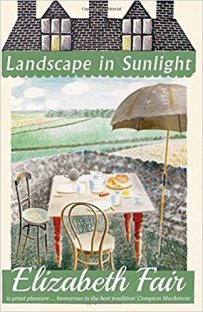
Cover for The Mingham AirA broken engagement followed by a bout of pneumonia brings Hester Clifford to Mingham and her godmother, Cecily Hutton, for recovery. She is inclined to think the Huttons need some organizing. Cecily is a woman of two moods, the creative and the motherly, of which the creative is the predominant. So, her household is poorly run. Her husband, Bennet, has been an invalid for so long that invalidism has become more of a habit than a necessity. Maggie works hard on a nearby farm, but Cecily is constantly scolding her for her dress and general messy appearance. Derek can’t decide what to do with his life, so keeps changing jobs.

The Huttons used to be friendly with Thomas Seamark, but since his wife’s death four years ago, he has become a bit of a recluse. Hester thinks it’s about time the friendship was renewed, and her efforts are successful. This renewed acquaintance leads Cecily to the conclusion that Hester would make a perfect wife for Thomas. She becomes so convinced of this that she doesn’t even notice she is putting obstacles in the way of his pursuit of her daughter, Maggie.

Like Fair’s other novels, The Mingham Air is full of colorful village characters, like Mrs. Hyde-Ridley who competes with her closest friend to entertain her while spending the least possible money, and Mrs. Merlin, the rector’s wife, who co-ops the parish féte for a display of country dancing. I enjoy these light novels, which contain just the slightest edge.

Related Posts

A Winter Away

Bramton Wick

Money to Burn

Day 1163: The Shuttle

Cover for The ShuttleAt first, I wasn’t sure I would like The Shuttle, despite my enjoyment of Frances Hodgson Burnett’s other novels. That is because it begins with an extended metaphor, rather cumbersome, about the shuttle of fate weaving together east and west. I wasn’t altogether sure which east and west she was talking about and had wild thoughts about China. But we weren’t leaving the Occident. By west she meant America, more precisely the United States. By east, England. But this introduction lasts only a couple of pages, and then we get into the action.

The novel begins with Rosalie Vanderpoel, the gentle, naive daughter of a New York millionaire. It is the early days of the migration of young, titled Englishmen to New York looking to marry money, and the relatively innocent New Yorkers don’t understand that most of these men are fortune hunters. Rosalie becomes engaged to Sir Nigel Anstruthers. Although Reuben Vanderpoel, Rosalie’s father, does not like Nigel, only nine-year-old Bettina sees him for the vicious bully that he is.

But Nigel hasn’t done his homework. He doesn’t realize that American girls don’t come with dowries nor that Rosalie won’t expect to hand her money over to her husband for handling, as an Englishwoman might. Once he realizes his mistake, he blames it on Rosalie.

Rosalie goes to live in dilapidated Stornham Court, where she is mistreated and bullied by her husband and his mother. Thinking that no man would take money from a woman, Rosalie doesn’t offer any, and it takes a while before she realizes that’s what he wants. But he doesn’t want money for the estate, just to support his vicious habits. He cuts her off from her family to make her miserable and keep control.

Rosalie isn’t the heroine of the novel, however. That honor belongs to Bettina, or Betty, who vows at the age of nine to go sometime and rescue Rosalie. And so she does, 15 years later.

This novel isn’t one of great surprises. When Betty finds Rosalie and her son alone and works to buck them up and get them ready to leave, the tension builds from the expectation of a showdown with Nigel. When Nigel finally arrives, he uses all his cleverness to foil Betty. We know who will win—we just don’t know how.

I don’t think Burnett’s adult novels were considered sensation fiction, but this one certainly deals with those kinds of topics and is very melodramatic. Still, it was a fun book to read. Betty is clever and determined. You know she will win at love and defeat Sir Nigel.

Related Posts

The Making of a Marchioness

That Lass o’Lowrie’s

Diana Tempest

Day 1156: Bramton Wick

Cover for Bramton WickI so enjoyed A Winter Away that I looked for more novels by Elizabeth Fair immediately. I found that they are being reprinted in a nice edition by Furrowed Middlebrow. Bramton Wick is Fair’s first novel, set in a village in post-World War II England. It is a gentle domestic novel with a bit of an edge.

Although the novel features several eccentric denizens of the village, it centers around Laura and Gillian Cole. Mrs. Cole and her family used to be the owners of Endbury, one of the large homes in the area, until Mr. Cole died and they had to sell. Mrs. Cole, although she dislikes the current owner of Endbury, Lady Masters, has begun to notice that Lady Masters’ son Toby has a liking for Laura.

Neighbors Miss Selbourne and her friend “Tiger” Garrett raise dogs in a cheerfully disordered household. Miss Selbourne has noticed, though, that whenever there is something unpleasant to be done, Tiger gets ill.

The neighborhood isn’t short of elderly women, for the Miss Cleeves are also nearby. The Miss Cleeves are penniless and dependent upon their landlord, Miles Corton, for help. Miss Cleeve is profoundly deaf, one sister is a religious fanatic, and the other sister sprinkles her malicious gossip with untruths.

Gillian, Mrs. Cole’s other daughter who is a war widow, has decided to take under her wing the wealthy new resident of the village. Mr. Greenley is from new money. He dresses like a parody of an English country gentleman and has not been welcomed to the village. Gillian thinks he just needs a little help fitting in.

This novel is gently comic, reminding me of Angela Thirkell without quite so much sharpness and snobbery. As Laura tries to figure out what she wants from life, we are greatly entertained by the antics of her neighbors.

Related Posts

A Winter Away

Wild Strawberries

Money to Burn

Day 1155: Literary Wives! A Lady and Her Husband

Cover for A Lady and Her HusbandToday is another review for the Literary Wives blogging club, in which we discuss the depiction of wives in fiction. If you have read the book, please participate by leaving comments on any of our blogs. Be sure to read the reviews and comments of the other wives!

Eva of Paperback Princess
Kate of Kate Rae Davis
Lynn of Smoke and Mirrors
Naomi of Consumed By Ink
TJ of My Book Strings

My Review

A few months ago for Literary Wives, we read The Awakening, one of the first feminist novels, written in 1899. A Lady and Her Husband was written 18 years later and shows great advances in feminist thought.

As I started the novel, I thought it was going to be about Rosemary Heyham, who is just about to be married, but instead it is about the awakening of her mother, Mary, a gentle, conventional soul who has been married to James for nearly 30 years. The action of the novel stems from Rosemary’s recognition that her mother is facing empty nest syndrome but also because she thinks her mother needs outside stimulation. She goes to her father with the idea that he give Mary a job.

James decides to put Mary to work looking into the welfare of his female employees, particularly the waitresses who work in his chain of tea shops. He believes he is a stellar employer and she won’t find anything to complain about, so in a way, this job is make work.

But Mary takes her job seriously. At first she finds nothing wrong, but she is shocked when she investigates the living conditions of the girls. (Of course, this dates the work, because these days the things she looks at and has control of would not be an employer’s business.) When she finally goes to James with some ideas, she is surprised to find him reacting angrily. What she asks for first are a room in each shop where the girls can eat their lunches, shoes that are more comfortable, and permission to do the washing up sitting down. What she gets are the shoes, but the girls will have to buy their own.

As Mary pursues her work, eventually asking for raises for the girls, she begins to see James in a less rosy light. It is difficult for me to guess how a contemporary audience would view their relationship, but for me, even when it is loving at the beginning, he patronizes her shamefully. All of this eventually leads to a crisis, when Mary is forced to evaluate even her own marriage.

While I wouldn’t say I loved this novel, I found it fascinating. A lot of it follows the evolution of Mary’s ideas from total acceptance of her situation in life to more of an awareness of her duty to herself and others. It also exposes James’s self-justifications. After I read Samantha Ellis’s introduction to the Persephone edition, which provides biographical information about Amber Reeves, I felt that if I ever had a hero, she would be it. As a young women, she had an affair with the much older H. G. Wells, whose ideas about free love didn’t include the woman being equally free, but she grew out of it. He never did, apparently, grow out of her, though, but kept rewriting her into novel after novel, where he depicted her changing from a vibrant, intelligent lover to a subservient wife. She never did, though.

What does this book say about wives or the experience of being a wife?

Mary has had a conventional marriage for her time. In the beginning of the novel, she sees that her role has to do with keeping house and caring for the children. She believes that only men are capable of understanding bigger issues. She loves her husband and takes care to present him with a placid home life.

However, largely because of his reaction to how she does the job he invented for her, she begins to re-evaluate her ideas about men and their relationship to women. She sees that men care more about things—their careers, their projects—more than they do about people. She begins to question her role in her marriage and in their business—in which she owns 50%—and to feel that she has a responsibility to make sure their employees aren’t treated badly.

She also begins to understand James’s self-justifications. As an example, when Mary, having seen how some of the waitresses live, points out that they are not receiving a living wage, both James and their son Trent remark that the girls just spend their money on ribbons. And she notices how James adroitly manages to blame a more serious marital problem on Mary herself.

Within the novel, Mary awakens from a woman who has been blinded by convention to a person who is more aware of the realities of life, who is able to think through her own difficulties and come to a solution.

Related Posts

The Awakening

Fidelity

Dept. of Speculation


Day 1153: Bleak House

Cover for Bleak HouseBest of Five!
I just love Bleak House. I hadn’t read it for years, so I was happy to pick it up as one of the last books on my first Classics Club list. Note: with this book, I have finally posted my last review for my first Classics Club list. I will soon have my second list posted at the link above.

At first, the novel appears to follow two distinct stories, that of the orphan Esther Summerson and that of the household of Lord and Lady Dedlock, but we find that these stories are entwined. Peopling the novel are countless other unforgettable characters.

Esther has had a sad childhood, but her life begins to improve when an unknown benefactor first takes her education in hand by sending her to school and then employs her to be the companion of Ada Clare. Ada, with her cousin Richard Carstone, is another orphan, and both are parties to the famous lawsuit of Jarndyce and Jarndyce. As they are wards of the court, a distant cousin, Mr. John Jarndyce, has agreed to be their guardian.

Dickens was famous as a social activist, and one of his targets here is the Courts of Chancery, where wills are proven. Jarndyce and Jarndyce is a famous case in Chancery that has been going on for years and has driven countless possible legatees to ruin. Mr. Jarndyce refuses to deal in this case and hopes to encourage Richard and Ada to leave it alone.

Esther makes a happy home for herself and Richard, Ada, and Mr. Jarndyce at Bleak House, Mr. Jarndyce’s home. But as Richard grows older, he fails to settle to a profession and devotes more and more time to the lawsuit. He is sucked in. And that is more a shame because Ada, whom Esther calls her darling, is in love with Richard.

At the Dedlock’s, a mystery begins that eventually takes up much of the novel. Lady Dedlock is beautiful and stately but deeply bored. However, one day when the Dedlock lawyer, Mr. Tulkinghorn, comes with papers to sign, Lady Dedlock glimpses some handwriting and promptly faints. Lady Dedlock has a secret, and Mr. Tulkinghorn is determined to find it out. Mr. Tulkinghorn is inexorable.

As with any Dickens novel, Bleak House is filled with entertaining characters. There is Mrs. Jellyby, who is so taken up by a charity for Africans that her children are neglected and her house is a disaster. Her unfortunate daughter, Caddy, covered in ink when we first meet her, becomes an important secondary character. One of Mr. Jarndyce’s friends is Harold Skimpole, who professes himself a mere child in worldly ways and proceeds to leech off his friends. There are many other notable characters, but one of the most interesting is the detective, Mr. Bucket. At first he seems rather sinister, but we soon change our minds about him.

Above all, there is Dickens’ style, which carries you along with the story. He makes you laugh, he makes you cry, and as always, he shows sympathy for the unfortunate, especially for children. It is easy to see from Bleak House, which many consider his masterpiece, why he was the most popular writer of his time.

Related Posts

David Copperfield

Great Expectations

Oliver Twist

Day 1144: The Victorian Chaise-Longue

Cover for The Victorian Chaise LongueThe Victorian Chaise-Longue is a short little tale of the macabre in honor of the season. Its plot is simple.

Wealthy Melanie Langdon is recovering from tuberculosis, complicated by recent child birth. When she is finally recovered enough, she is carried to lie on a Victorian chaise-longue that she bought in an antique store. There she falls asleep.

When Melanie awakens, she has returned to Victorian times and is locked in a Victorian body. When she is alarmed at her situation, she is thought to be hysterical.

logo for RIPI did not find the novel terrifying, but perhaps that is my own lack of imagination. I felt I needed to care for the character more before she was put in her dilemma. I understand from the introduction that Laski moved to a remote house to induce in herself a sense of fear, just to write this novel.

This is the final book I read for the R.I.P. challenge. Happy Halloween!

Related Posts

Sleep, Pale Sister

The Solitary House

The Sleep Room

Day 1141: The Moonstone

Cover for The MoonstoneBest Book of Five!
Although the first mystery stories are credited to Edgar Allen Poe, The Moonstone is widely regarded as the first ever mystery novel. It is not a murder mystery (although it includes a murder), but is instead about the mysterious disappearance of a valuable diamond.

Rachel Verinder inherits the moonstone from her uncle on her 19th birthday. Since the diamond was ruthlessly stolen by her uncle in India and is rumored to be cursed, this gift is meant maliciously, because Rachel’s mother wouldn’t have anything to do with him.

Rachel’s cousin Franklin Blake acts as courier of the diamond, and only his decision to travel early, we learn later, may have saved his life while the stone is in his possession. The Verinder’s house is visited twice by three mysterious Indians.

The night of Rachel’s birthday dinner, the moonstone disappears from a cabinet in her sitting room. Rachel’s subsequent behavior is inexplicable. She declines to be interviewed by investigators trying to find the diamond and is uncommonly offended by Franklin’s attempts to help solve the mystery.

A house maid named Rosanne seems to be involved in some way in the crime. But perhaps she is being unfairly judged, as she has a criminal past and is trying to reform.

The Woman in White is certainly Wilkie Collins’s most famous novel, but The Moonstone has always been my favorite. An epistomological novel, it is made vibrant by the distinctive and sometimes amusing voices of the various characters, who are requested to submit their testimonies of events. I especially enjoy the sections written by Gabriel Betteridge, the house steward with a fascination for Robinson Crusoe.

logo for RIPThis reread for my Classics Club list has not changed my opinion. The Moonstone has a complicated, but not absurdly so, plot and an exotic element. Although it occasionally contains comments, especially about women and Indians, that are no longer politically correct, they reflect the novel’s time and the attitudes of the narrators.

P. S., I am also reading this for the R.I.P. challenge.

Related Posts

Hide and Seek

Basil

Diana Tempest

Day 1139: Framley Parsonage

Cover for Framley ParsonageIn the fourth of the Barsetshire Chronicles, we meet some old friends and make some new ones. Of particular interest to Framley Parsonage are two occupants of the parsonage, Mark Robarts and his sister, Lucy.

Mark Robarts is a young clergyman who has been remarkably lucky and successful because of his friendship with Lord Lufton and his patronage by Lord Lufton’s mother, Lady Lufton. Instead of slaving away at a curacy like most clergymen of his age, he has the living at Framley, given to him by Lady Lufton, at a very good income. His lovely wife, Fanny, was chosen for him by Lady Lufton and makes him very happy.

Perhaps Mark has been too lucky, for he begins to think that his good fortune is due to his own efforts. He is a good man, but he is still only twenty-six. In any case, he ignores Lady Lufton’s prejudices against a set of people headed by Lord Omnium, her particular enemy, and accepts an invitation to Gatherum Hall. He believes he can better himself through acquaintance with the politicians he will meet there.

At this gathering, he is befriended by Mr. Sowerby, an insolvent member of parliament. Mr. Sowerby talks him into signing a bill for him for 500 pounds, promising repayment (reminding us of a similar subplot in Middlemarch). But Sowerby has no means by which to pay. Later, Sowerby talks Mark into compounding his error by signing another bill for £400. Mark is now in debt for his entire yearly salary.

Lucy Robarts, Mark’s sister, comes to live at Framley Parsonage after her father’s death. Lady Lufton has been trying to match her son with the beautiful Griselda Grantly, daughter of archdeacon Grantly, but Lord Lufton falls in love with Lucy. Lady Lufton is not at all in favor of the match.

Among these new acquaintances are old friends and acquaintances. The wealthy Miss Dunstable, whom Frank Gresham’s family wanted him to court in Doctor Thorne, is now being sought in matrimony by Mr. Sowerby. Doctor Thorne and his niece, Mary, also make an appearance. And the Grantly’s were, of course, prominent characters in the first two novels. We also see a lot more of Bishop and Mrs. Proudie than we have since The Warden.

I am really enjoying this series, and I like how Trollope ties in all of the characters so that some who are important to one book appear as minor characters in another. Trollope examines in this novel the standards of behavior expected of a gentleman, particularly a clergyman. Mark Robarts has broken with those standards, and as slight as his offence may seem, is forced to pay the consequences.

Related Posts

Doctor Thorne

Barchester Towers

The Warden

Day 1131: A Winter Away

Cover for A Winter AwayA review of A Winter Away tantalized me enough to make me order the book, a reprint from Furrowed Middlebrow. Much to my delight, the novel resembled, in different ways, those of two of my favorite authors for light, amusing reading.

Maud feels she has been too long at home, where she has always been regarded as delicate. Learning of an opportunity where she can live with Cousin Alice and her friend Miss Conway, thus satisfying her family’s demand about not moving to London, Maud has taken a job as a secretary to Marius Feniston of Glaine. Maud is at first terrified of making a mistake, for she knows her boss, called Old M. by Miss Conway, fired his last secretary. But she comes to like the old man and enjoy working in the crumbling but romantic mansion.

Marius Feniston is feuding with this nephew, Charles, who keeps a garden within Glaine’s grounds and operates greenhouses. At first, Maud is inclined to romanticize Charles and think that Oliver, Marius’s son, is demanding and boring. But sometimes Maud is prone to jump to conclusions.

A Winter Away is full of amusing situations and insights about people. Maud helps her neighbor Ensie in her romance with the curate. Miss Conway is jealous of Maud and tries to drive her away by sabotaging objects around the house, while Cousin Alice observes passively and Maud doesn’t even notice she’s doing it. Maud tries to discover the roots of the feud with Charles and prevent Oliver from arguing with his father every time he visits.

Fair’s observations about people are amusing and insightful, reminding me of Angela Thirkell but without its occasional class snobbery. Fair’s novels are a little more recent, and her situations and characters remind me of the best of Elizabeth Cadell. I enjoy both writers, so this novel was a pleasant discovery for me.

Related Posts

Northbridge Rectory

Wild Strawberries

Money to Burn

Day 1130: The Idiot

Cover for The IdiotI think I read The Idiot when I was about 13, and all I remembered of it was that at a tea party, someone stood on the table and shouted. That memory turned out to be false, but they might as well have, and I can’t imagine what my very young self must have made of this novel. My very old self is having trouble enough with it.

The thing about Dostoevesky—and I have read most of his novels, although none for a long time—is that his characters always behave as if they’re in a frenzy. The Idiot is no exception.

Prince Myshkin returns to Russia from years in Switzerland, where he was being treated for epilepsy, to inquire about a legacy he may receive. On the train he meets Rogozhin, who has just inherited a fortune and is on his way to pay court to Nastasya Filippovna Barashkova. Nastasya Filippovna was orphaned as a young girl then brought up by the lecherous merchant Totsky to be his concubine. Now Totsky wants to marry someone else, but Nastasya Filippovna has threatened terrible scenes if he does. Totsky is scheming to marry her off to Gavrila Ardalionovich Ivolgin for the sum of 75,000 rubles.

When the prince meets Nastasya Filippovna, he is so overcome with pity for her that he becomes irrevocably bound with her fate. Later, when he falls in love and wants to marry Aglaya Ivanovna Yepanchin, his entanglement with Nastasy Filippovna ruins him.

Prince Myshkin is completely naive, yet at the same time very perceptive. Dostoevsky wanted to portray in him a simply good man and show how this goodness is overcome by the cynicism and self-interest of society. At times, he is compared to Christ or to a knight.

Although Myshkin is a sympathetic character, he constantly has bad things done to him—is betrayed, libeled, slandered, and cheated—by the people he knows, many of whom are just plain annoying. There is Lebedev, for example, who constantly tells people how vile he is, then behaves badly. And Ippolit, a student dying of tuberculosis, who sneers at the prince, even while accepting his hospitality. Are people really like Dostoevsky’s characters? you may well ask. Of course, Myshkin forgives everyone.

Did I like this novel? I hardly know. I do know that it is one of the last books on my first Classics Club list.

Related Posts

The Kreutzer Sonata Variations

The Possessed: Adventures with Russian Books and the People Who Read Them

Death in Venice