Day 1144: The Victorian Chaise-Longue

Cover for The Victorian Chaise LongueThe Victorian Chaise-Longue is a short little tale of the macabre in honor of the season. Its plot is simple.

Wealthy Melanie Langdon is recovering from tuberculosis, complicated by recent child birth. When she is finally recovered enough, she is carried to lie on a Victorian chaise-longue that she bought in an antique store. There she falls asleep.

When Melanie awakens, she has returned to Victorian times and is locked in a Victorian body. When she is alarmed at her situation, she is thought to be hysterical.

logo for RIPI did not find the novel terrifying, but perhaps that is my own lack of imagination. I felt I needed to care for the character more before she was put in her dilemma. I understand from the introduction that Laski moved to a remote house to induce in herself a sense of fear, just to write this novel.

This is the final book I read for the R.I.P. challenge. Happy Halloween!

Related Posts

Sleep, Pale Sister

The Solitary House

The Sleep Room

Day 1141: The Moonstone

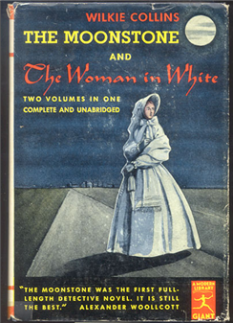
Cover for The MoonstoneBest Book of Five!
Although the first mystery stories are credited to Edgar Allen Poe, The Moonstone is widely regarded as the first ever mystery novel. It is not a murder mystery (although it includes a murder), but is instead about the mysterious disappearance of a valuable diamond.

Rachel Verinder inherits the moonstone from her uncle on her 19th birthday. Since the diamond was ruthlessly stolen by her uncle in India and is rumored to be cursed, this gift is meant maliciously, because Rachel’s mother wouldn’t have anything to do with him.

Rachel’s cousin Franklin Blake acts as courier of the diamond, and only his decision to travel early, we learn later, may have saved his life while the stone is in his possession. The Verinder’s house is visited twice by three mysterious Indians.

The night of Rachel’s birthday dinner, the moonstone disappears from a cabinet in her sitting room. Rachel’s subsequent behavior is inexplicable. She declines to be interviewed by investigators trying to find the diamond and is uncommonly offended by Franklin’s attempts to help solve the mystery.

A house maid named Rosanne seems to be involved in some way in the crime. But perhaps she is being unfairly judged, as she has a criminal past and is trying to reform.

The Woman in White is certainly Wilkie Collins’s most famous novel, but The Moonstone has always been my favorite. An epistomological novel, it is made vibrant by the distinctive and sometimes amusing voices of the various characters, who are requested to submit their testimonies of events. I especially enjoy the sections written by Gabriel Betteridge, the house steward with a fascination for Robinson Crusoe.

logo for RIPThis reread for my Classics Club list has not changed my opinion. The Moonstone has a complicated, but not absurdly so, plot and an exotic element. Although it occasionally contains comments, especially about women and Indians, that are no longer politically correct, they reflect the novel’s time and the attitudes of the narrators.

P. S., I am also reading this for the R.I.P. challenge.

Related Posts

Hide and Seek

Basil

Diana Tempest

Day 1139: Framley Parsonage

Cover for Framley ParsonageIn the fourth of the Barsetshire Chronicles, we meet some old friends and make some new ones. Of particular interest to Framley Parsonage are two occupants of the parsonage, Mark Robarts and his sister, Lucy.

Mark Robarts is a young clergyman who has been remarkably lucky and successful because of his friendship with Lord Lufton and his patronage by Lord Lufton’s mother, Lady Lufton. Instead of slaving away at a curacy like most clergymen of his age, he has the living at Framley, given to him by Lady Lufton, at a very good income. His lovely wife, Fanny, was chosen for him by Lady Lufton and makes him very happy.

Perhaps Mark has been too lucky, for he begins to think that his good fortune is due to his own efforts. He is a good man, but he is still only twenty-six. In any case, he ignores Lady Lufton’s prejudices against a set of people headed by Lord Omnium, her particular enemy, and accepts an invitation to Gatherum Hall. He believes he can better himself through acquaintance with the politicians he will meet there.

At this gathering, he is befriended by Mr. Sowerby, an insolvent member of parliament. Mr. Sowerby talks him into signing a bill for him for 500 pounds, promising repayment (reminding us of a similar subplot in Middlemarch). But Sowerby has no means by which to pay. Later, Sowerby talks Mark into compounding his error by signing another bill for £400. Mark is now in debt for his entire yearly salary.

Lucy Robarts, Mark’s sister, comes to live at Framley Parsonage after her father’s death. Lady Lufton has been trying to match her son with the beautiful Griselda Grantly, daughter of archdeacon Grantly, but Lord Lufton falls in love with Lucy. Lady Lufton is not at all in favor of the match.

Among these new acquaintances are old friends and acquaintances. The wealthy Miss Dunstable, whom Frank Gresham’s family wanted him to court in Doctor Thorne, is now being sought in matrimony by Mr. Sowerby. Doctor Thorne and his niece, Mary, also make an appearance. And the Grantly’s were, of course, prominent characters in the first two novels. We also see a lot more of Bishop and Mrs. Proudie than we have since The Warden.

I am really enjoying this series, and I like how Trollope ties in all of the characters so that some who are important to one book appear as minor characters in another. Trollope examines in this novel the standards of behavior expected of a gentleman, particularly a clergyman. Mark Robarts has broken with those standards, and as slight as his offence may seem, is forced to pay the consequences.

Related Posts

Doctor Thorne

Barchester Towers

The Warden

Day 1131: A Winter Away

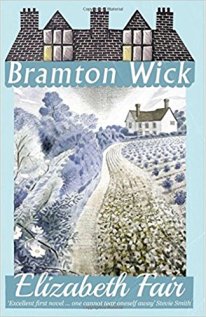
Cover for A Winter AwayA review of A Winter Away tantalized me enough to make me order the book, a reprint from Furrowed Middlebrow. Much to my delight, the novel resembled, in different ways, those of two of my favorite authors for light, amusing reading.

Maud feels she has been too long at home, where she has always been regarded as delicate. Learning of an opportunity where she can live with Cousin Alice and her friend Miss Conway, thus satisfying her family’s demand about not moving to London, Maud has taken a job as a secretary to Marius Feniston of Glaine. Maud is at first terrified of making a mistake, for she knows her boss, called Old M. by Miss Conway, fired his last secretary. But she comes to like the old man and enjoy working in the crumbling but romantic mansion.

Marius Feniston is feuding with this nephew, Charles, who keeps a garden within Glaine’s grounds and operates greenhouses. At first, Maud is inclined to romanticize Charles and think that Oliver, Marius’s son, is demanding and boring. But sometimes Maud is prone to jump to conclusions.

A Winter Away is full of amusing situations and insights about people. Maud helps her neighbor Ensie in her romance with the curate. Miss Conway is jealous of Maud and tries to drive her away by sabotaging objects around the house, while Cousin Alice observes passively and Maud doesn’t even notice she’s doing it. Maud tries to discover the roots of the feud with Charles and prevent Oliver from arguing with his father every time he visits.

Fair’s observations about people are amusing and insightful, reminding me of Angela Thirkell but without its occasional class snobbery. Fair’s novels are a little more recent, and her situations and characters remind me of the best of Elizabeth Cadell. I enjoy both writers, so this novel was a pleasant discovery for me.

Related Posts

Northbridge Rectory

Wild Strawberries

Money to Burn

Day 1130: The Idiot

Cover for The IdiotI think I read The Idiot when I was about 13, and all I remembered of it was that at a tea party, someone stood on the table and shouted. That memory turned out to be false, but they might as well have, and I can’t imagine what my very young self must have made of this novel. My very old self is having trouble enough with it.

The thing about Dostoevesky—and I have read most of his novels, although none for a long time—is that his characters always behave as if they’re in a frenzy. The Idiot is no exception.

Prince Myshkin returns to Russia from years in Switzerland, where he was being treated for epilepsy, to inquire about a legacy he may receive. On the train he meets Rogozhin, who has just inherited a fortune and is on his way to pay court to Nastasya Filippovna Barashkova. Nastasya Filippovna was orphaned as a young girl then brought up by the lecherous merchant Totsky to be his concubine. Now Totsky wants to marry someone else, but Nastasya Filippovna has threatened terrible scenes if he does. Totsky is scheming to marry her off to Gavrila Ardalionovich Ivolgin for the sum of 75,000 rubles.

When the prince meets Nastasya Filippovna, he is so overcome with pity for her that he becomes irrevocably bound with her fate. Later, when he falls in love and wants to marry Aglaya Ivanovna Yepanchin, his entanglement with Nastasy Filippovna ruins him.

Prince Myshkin is completely naive, yet at the same time very perceptive. Dostoevsky wanted to portray in him a simply good man and show how this goodness is overcome by the cynicism and self-interest of society. At times, he is compared to Christ or to a knight.

Although Myshkin is a sympathetic character, he constantly has bad things done to him—is betrayed, libeled, slandered, and cheated—by the people he knows, many of whom are just plain annoying. There is Lebedev, for example, who constantly tells people how vile he is, then behaves badly. And Ippolit, a student dying of tuberculosis, who sneers at the prince, even while accepting his hospitality. Are people really like Dostoevsky’s characters? you may well ask. Of course, Myshkin forgives everyone.

Did I like this novel? I hardly know. I do know that it is one of the last books on my first Classics Club list.

Related Posts

The Kreutzer Sonata Variations

The Possessed: Adventures with Russian Books and the People Who Read Them

Death in Venice


Day 1129: Consider the Lilies

Cover for Consider the LiliesWhile I was looking for a cover image for Money to Burn, I noticed that someone has been republishing Elizabeth Cadell’s novels (with horrible covers) and that there were several I’d never heard of. I went ahead and ordered three. This is the first one.

I have long read Cadell’s novels when I wanted something very light and funny. In general, they are mild romances with good dialogue, a touch of mystery, and a plethora of eccentric characters. Often they take place in a family setting.

A writer who produced more than 50 books from the 1940’s through the 1980’s, Cadell did not always produce work that was uniformly good. Unfortunately, Consider the Lilies, which she published as Harriet Ainsworth, is not one of her best. This novel is a murder mystery, which is unusual for Cadell.

Caroline is visiting her sister Kathryn and family for Easter when the vicar’s sister, Miss Burnley, asks Kathryn to do her a favor by asking Mrs. Lauder to donate some lilies for the Easter service. Mrs. Lauder has loads of lilies, but she has never been known to donate any or to give anything else, for that matter. Kathryn, however, is the only person from the village that Mrs. Lauder will receive, so Kathryn goes, taking Caroline with her. Mrs. Lauder, a wheelchair-bound invalid who is nasty to all, refuses.

Guy and Kathryn Heywood receive a surprising visit from Miss Parry, Mrs. Lauder’s companion. She asks Guy to read a letter that she believes threatens Mrs. Lauder and wants advice for what to do about it. Guy suggests she do nothing, since the letter was not addressed to her, but to Mrs. Lauder, and is ambiguous.

Later, Miss Parry reports that the letter was stolen from her purse, and not too long after that, Mrs. Lauder is found dead. Her wheelchair appears to have slipped off the veranda and she fell out of it. But Inspector Avery Freeland seems to think the death is suspicious.

This novel is not a murder mystery in the sense that we follow the investigation very closely. Rather, it is about how the murder affects the Heywoods, who live next door. They are on hand to witness a few strange incidents, and they are shocked to find that two people in their household may know something. The novel is also not a proper mystery, because there is no way anyone could guess the culprit, who appears so slightly in the novel as to be almost unnoticeable.

Further, Cadell’s trademark character development is lacking. We have very little sense of any of the characters, even the main ones. so, this book was a disappointment. This is the third book I read for the R.I.P. challenge.

Related Posts

Money to Burn

This Rough Magic

The Unforgotten

Day 1122: Lolly Willowes

Cover for Lolly WillowesThe two novels I’ve read by Sylvia Townsend Warner are as different as they can be. The True Heart is a historical novel about a woman who lives through great troubles to be with the man she loves. Lolly Willowes is a feminist novel about a spinster who tires of her life dedicated to her family.

The Willowes family doesn’t go in much for change. They have lived in the same house for years, and even after they move, they bring all their possessions, which are never moved from their set positions. Lolly Willowes grows up loving the countryside around her home, and she is so comfortable with her family that she never considers marriage. When her mother dies, she takes over running the house, and neither she nor her father want her to go.

But when her father dies, her wishes are not consulted. Her older brother Henry is more willing to have her in London than her younger brother at the family home. So, she moves to London to be of service to her family.

Twenty years later, she’s had enough. Without seeing it first, she decides to move to a rural village named Great Mop. Her family is very much against this plan, and it is only then that she finds out her brother has mishandled her money and there is very little left. She can’t have the house and donkey she planned on, but she plans to move, and move she will.

It is after Lolly moves that the novel takes a decidedly eccentric turn. Some readers will appreciate it more than others, and I’m not sure how much I do. I’m also not going to tell you what happens. But the message of the novel, though playfully told, is that women are not just adjuncts to their families, to have their lives plotted out for them just because they’re single. There were plenty of women in Lolly’s position in the 1920’s, when this novel was written, and that is probably the reason that the novel became an unexpected best seller in its time.

Related Posts

The True Heart

The Land of Green Ginger

The Daylight Gate


Day 1119: Northbridge Rectory

Cover for Northbridge RectoryEclipse day! We are not in the path of totality here,
but we are at about 97%. We thought about driving down into Oregon, but since the state is supposed to have more than a million extra people coming for the eclipse, we decided to stay home. I hope you have a nice view!

* * *

Northbridge Rectory is another of Angela Thirkell’s delightful Barsetshire books. I have been making no effort to read them in order, and this one is set during World War II.

The Villarses moved to Barsetshire only a year ago when Mr. Villars was appointed Rector. Mr. Villars formerly had a career as a headmaster of a boys’ school, and Mrs. Villars feels somewhat inadequate in her new role as rector’s wife.

The Villarses expected the rectory to receive its quota of refugees from London, but instead eight officers of the Barsetshire regiment have been quartered there. The Villarses particularly enjoy the company of Mr. Holden, who is managing some of his work as a publisher’s associate along with his military duties. Mr. Holden has become attached to Mrs. Villars and is constantly wearing her out by telling her she looks tired.

Although Northbridge Rectory is mostly from Mrs. Villars’s point of view, it also deals with two poverty-stricken scholars who share a house. Mr. Downing is a middle-aged man working on an abstruse book about medieval Provençal literature. His hostess, Miss Pemberton, is an older lady working on a monograph about the work of an Italian Renaissance artist. Miss Pemberton spends a lot of time keeping spinsters away from Mr. Downing. Mr. Downing, however, soon begins to feel very comfortable visiting the widowed Mrs. Turner and her bouncing teenage nieces.

Wartime brings everyone among unaccustomed people and activities, as when a watch from the church tower is proposed to look for parachutists. The Villarses spend an excruciating weekend entertaining an unexpected guest who will not stop talking, Mrs. Spender, the wife of Major Spender. Other entertaining characters include the couple of spinsters who so loved living in France that they throw mispronounced and misused French into every conversation.

Thirkell’s books are always funny, with a gentle humor that pokes fun without making anyone entirely unlikable. She has an unusual style of narration that breaks out to address readers directly, as if she is having a private conversation with us, usually just before a zinger.

Related Posts

Wild Strawberries

Pomfret Towers

Enter Sir Robert

Day 1116: Greengates

Cover for GreengatesBest Biweekly Book!
I knew that Greengates was about a retired couple, but I didn’t know it would strike home with me in several ways. Although it was written in the 1930’s, it has some universal themes.

Tom Baldwin has his last day at work, retiring from an insurance company where he has worked for 30 years. On his way home, he wonders what he will do with his time, but he decides he will have another career in history and work on his garden.

So, he arrives home full of plans, but within a few days, he realizes his plans were overly optimistic. He doesn’t have the background, even, to understand the history books he has, and his plans for the garden are thwarted because of poor soil and a lack of light.

Further, his wife, Edith, had not reckoned on the disruption to her life. He may be retired, but she still has to keep the house. He continually disrupts her routines. As he begins feeling more useless, he questions her comings and goings. For the first time, they begin to argue.

One day Edith remembers how they used to enjoy a walk to the country on autumn weekends. They would take the train out and then walk to the beautiful Welden Valley. She suggests to Tom that they go, and he reluctantly agrees. Little do they know that the walk will change the rest of their lives.

Although I have not so far experienced a loss of purpose since I retired, the activities I’ve been focusing on parallel those that finally give the Baldwins a renewed set of goals. So, that is what chimed with me.

But I think almost anyone could sympathize with the plight of this couple. Even though some of the details are dated, their problems still exist. Tom has spent most of his professional life involved in activities related to work, even to the company sports team. Now he has to find something else to occupy his time, and Edith has to find a way to cope with their altered life patterns.

This was another fine novel from Persephone Press. I really enjoyed it.

Related Posts

Greenbanks

One Fine Day

Major Pettigrew’s Last Stand

Day 1112: Brook Evans

Cover for Brook EvansSusan Glaspell’s novel Brook Evans shares some themes with her more famous Fidelity, but she makes an interesting inversion in the plot. Still, the ultimate message is the same as in her earlier novel.

Brook Evans’s story begins with that of her mother, Naomi Kellogg, in 1888. Naomi has been secretly seeing Joe Copeland since his mother objected to their keeping company. They plan to be married in the fall, after the harvest.

But Joe is killed in a farming accident. Seeing no alternative but disgrace, as she is pregnant, Naomi reluctantly marries her other suitor, Caleb Evans, and leaves her beloved Illinois home for Colorado.

Nineteen years later, Brook Evans wants to go to a dance with Tony Ross. Not only does her father, Caleb, not believe in dancing, being religiously strict, but Tony is a Catholic and part Native American. Naomi sees Brook’s relationship with Tony as an echo of hers with Joe, and she is determined not to sacrifice her daughter’s life to worries about what others may think. Unfortunately, the disagreement with Caleb brings out the truth of Brook’s parentage, with unforeseen results.

In Fidelity, the heroine’s decision to grasp life by running away with her married lover blights her life. In Brook Evans it is the instinct to conform with societal norms that is blighting. Still, the ultimate message of both books is to follow your heart. Although I wasn’t so fond of Brook’s ultimate choice (or the perceived alternative) I found this novel thoughtful and so touching that at times I was in tears. Glaspell’s characters show several sides throughout the novel, so that at times you change your mind about them. This novel is another thought-provoking read from Glaspell.

Related Posts

Fidelity

Greenbanks

Someone at a Distance