Day 1010: The Antiquary

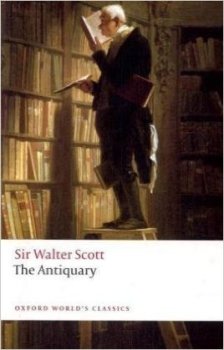
Cover for The AntiquaryThe Antiquary was considered Scott’s gothic novel, but I felt it was more a romance, in the old-fashioned sense of the word. The only gothic elements involve trickery and a ruined abbey. This novel was Scott’s favorite, as well. It is not mine, but it does have a good deal of humor.

The antiquary is Mr. Oldbuck, loquacious to a fault, a man who likes to lecture others on the history of every object that he sees and every subject in conversation. He befriends a young man he meets on a journey, Mr. Lovel, who arrives in the area on undisclosed business.

Mr. Oldbuck has a friend, Sir Arthur Wardour. Sir Arthur handles his money poorly and is in the thrall of a German conman, Herr Dousterswivel, who is trying to further deplete him. Mr. Lovel has formerly met Miss Wardour and proposed to her, but she has turned him down because of his lack of birth.

There are several plot lines in The Antiquary—the machinations of the German, the state of Mr. Lovel’s romance, and a terrible secret of the house of Glenallen that begins to emerge upon the death of the countess.

The dialogue for this novel is in Scottish dialect except for the well-born characters, and there is a good deal of humor around the characters of Mr. Oldbuck and of the rustics.  A beggar named Edie Ochiltree acts as a deux ex machina so often that I began to think the novel should have been called The Beggar. I enjoyed this novel, just not as much as I  have some others of Scott’s.

Related Posts

Guy Mannering

Waverly

The Castle of Wolfenbach

Day 1002: The Crowded Street

Cover for The Crowded StreetThe Crowded Street was Winifred Holtby’s second book, and like her others, one of its themes is a woman’s duty to herself and to a larger society than her local community. The novel’s main character is Muriel, who always tries to do what is right and good.

We first meet Muriel when she is nine and follow her for the next twenty years. In the first scenes of the novel, Muriel is excited to be attending a party. But her desire to enjoy the party by watching the others conflicts with the ideas of her mother, who thinks she should be dancing and socializing.

During the party, she dances with Godfrey Neale, who becomes important to her later in the novel. But in trying to escape her mother, Muriel falls into a situation where her behavior is misunderstood and the party is ruined for her.

Muriel begins a pattern of always trying to please her mother. Mrs. Hammond, though, has married beneath her and has spent her career social climbing to make up for it. Although Muriel would like to learn about astronomy and is interested in math, the only way she can please her mother is by marrying well. Unfortunately, she is shy and only moderately attractive. Still she decides fairly early on to devote herself to her mother.

Only one friend, Delia, urges her to do more. She tries to get Muriel to go to college, but Muriel is naive and for a long time believes what her mother tells her, which is that men do and women wait for them to act.

It took me a while to relate to Muriel, probably because she is so naive. But eventually I became engrossed in her story, as she learns to view her world and her mother with a more skeptical eye. Having grown up in the 50’s and 60’s, I remember my own mother coming out with some of the things implied or said in Holtby’s novel, only my own reaction was one of indignation. But that was 30 years after the setting of this novel.

I very much enjoyed this novel about Muriel and her slow turning toward a more feminist outlook.

Related Posts

The Land of Green Ginger

Anderby Wold

South Riding

Day 997: Doctor Thorne

Cover for Doctor ThorneBest Book of the Week!
In this third of Anthony Trollope’s Barsetshire Chronicles, the main character, Doctor Thorne, is presented with a dilemma. The outcome of the novel is fairly easy to predict, but the pleasure is in getting there.

Trollope begins the novel by explaining the situation of the Greshams of Greshambury, a proud but declining family. Squire Gresham has done his best to waste the family fortune, aided by his wife, Lady Arabella. When the novel begins, it is an acknowledged fact among Lady Arabella and her de Courcy relatives that young Frank Gresham, just of age, must marry money. Unfortunately for their plans, Frank has just declared himself to Mary Thorne, Doctor Thorne’s niece, who hasn’t a penny.

Mary has not encouraged Frank. In fact, she believes he is too young and injudicious to make such a decision. She refuses to listen to him, but she does begin to wonder about her own position, for she knows nothing about her own parentage. She has been brought up by Doctor Thorne to have a pride in breeding without understanding her own.

In truth, the story is not a good one. Her mother was the respectable sister of a stone mason until Doctor Thorne’s disreputable brother seduced her with promises of marriage. When Mary Scatcherd got an opportunity to marry and leave the country—only without her daughter—Doctor Thorne promised to raise the child as his own. This he has done without the knowledge of Roger Scatcherd, the child’s other uncle, who is now a wealthy member of parliament.

Doctor Thorne has continued to treat Roger Scatcherd, but he fears the man’s dedication to drink will soon put him in his grave. Since Scatcherd’s son Louis looks to follow in his footsteps, Doctor Thorne thinks that neither of them will live long. So, he is taken aback when Scatcherd confides that he will put his money in trust for Louis until he is 25, but if both of them die, he leaves his fortune to his sister Mary’s oldest child. Doctor Thorne urges Scatcherd to be more particular, because of course Mary’s oldest child is his own girl, Mary Thorne, whom Scatcherd thinks died as a child.

In any case, the Greshams find that Frank cannot be dissuaded from Mary Thorne. Although Mary has been raised with their daughter and is the best friend of Beatrice Gresham, Arabella banishes her from the house and eventually asks Beatrice not to see her. When Doctor Thorne, already sore because Mary is being punished for something she didn’t encourage, realizes that Mary actually does love Frank, he thinks it will all come right but is unable to tell anyone so because perhaps it will not.

Doctor Thorne is written in a different vein from the first two Barsetshire novels. For one, it is looking at a different strata of people. Some of the characters from the other novels are mentioned but do not appear. To be frank, I missed the delicacy of good old Mr. Harding. Dr. Thorne is rougher but no less principled, though. I did not enjoy as much the descriptions of Scatcherd’s doings, but after a while, I got to like Dr. Thorne and be interested in the outcome.

Related Posts

The Warden

Barchester Towers

The Rector and The Doctor’s Family

Day 994: The Lovers of Yvonne

Cover for Lovers of YvonneThe Sieur Gaston de Luynes is a soldier of fortune whose fortunes haven’t worked out so well at the beginning of The Lovers of Yvonne. Almost destitute, he was lucky enough to be hired by Cardinal Mazarin to teach his nephew Andrea de Mancini arms. But in the first chapter of the novel, the Cardinal fires Luynes after Andrea becomes drunk, blaming Luynes for his nephew’s behavior.

More dangerously, Andrea, who is a very young man, has been challenged to a duel. The Cardinal orders Luynes to make sure the duel doesn’t occur. The only way Luynes can see to honorably do that is to injure the other combatant, Eugène de Canaples, first. So, he duly insults Canaples and then handily beats him in a duel, making sure to wound him.

However, this fight attracts a mob, which chases Luynes with the object of hurting him. He is only able to escape by jumping into the carriage of a woman passing by. He falls madly in love with this woman, who unfortunately is Yvonne Canaples, the sister of his victim.

If this weren’t bad enough, the Cardinal informs him that he has arranged a marriage between Yvonne and Andrea. He tells him he will see him hanged if he finds him anywhere near Choisy, where the de Canaples live. But Luynes likes Andrea, so when invited to go along with him, he does. It’s a good thing, too, because several other suitors are on the way there, most notably the Marquis de St. Auban.

This novel is Sabatini’s first, and it is full of intrigue, sword fights, and kidnappings. Sabatini had only lived in England ten years before writing it, but the English is impeccable, his sixth language. Although Sabatini was himself disappointed in this novel, it is entertaining.

Related Posts

La Reine Margot

The Black Tulip

Merivel: A Man of His Time

Day 990: Cripps the Carrier

Cover for Cripps the CarrierAlthough Cripps the Carrier has behind it a serious adventure plot, it is mostly a comedy of rustic characters in a rural countryside around Oxford. One of these characters is Zachary Cripps, an honest, god-fearing carrier of goods, who acts as a deux ex machina.

But the novel begins with the disappearance of Grace, the beloved young daughter of Squire Oglander. No one even knows she is gone when Hetty Cripps, coming along by a deserted quarry with an evil reputation, sees some men burying a woman. It is a freezing night, and by the time the weather has let up enough to dig her up, the girl’s face has been smashed by the rocks. But the body that is buried has a mass of hair that appears to be Grace’s.

So, Grace is presumed dead, and her elderly father is stricken with grief. Only her suitor, Russel Overshot, won’t believe she is dead.

We soon learn that she is not dead. She is hidden away and believes she is following her father’s orders. Who is keeping Grace, though, and why?

There is a lot to enjoy in this novel—some rustic humor, some adventure, some danger, a dastardly villain, and some likable characters. Until recently, of R. D. Blackmore’s novels, I had only read Lorna Doone, but I enjoyed reading this, and I will continue to seek out more Blackmore.

Related Posts

Christowell, A Dartmoor Tale

Guy Mannering

La Reine Margot


Day 985: That Lass o’Lowrie’s

Cover for That Lass O'LowriesThat Lass o’Lowrie’s is Frances Hodgson Burnett’s first novel, written in the style of Realism. It is set in a Lancashire mining town and features a lot of Northern dialect.

The lass in question is Joan Lowrie, a miner’s daughter. She is a tall, strong, proud woman who has survived years of abuse at the hands of her father. At the beginning of the novel, she dresses partly in men’s clothing and works in the mine as a pit girl.

She attracts the attention of a young mining engineer, Derrick, and his friend Paul Grace, a curate. Later, Derrick finds her injured by her father and helps her, after which she promises to pay him back for his help. When Derrick has a dispute with Lowrie, who would like to revenge himself by ambushing Derrick, she follows Derrick home in the dark every night to protect him.

Grace himself is in love with the rector’s daughter, Anice. But Paul Grace is small and unprepossessing and doesn’t hold out much hope. He also has problems being accepted by the miners, who distrust clerics and think he is too small and refined to heed.

This novel deals with the difficulties of the miners’ lives and of their grievances against the owners. Although it sympathizes with them, it’s true that the only bad men in the novel are Lowrie and his buddies, as well as one son of an owner, who debauches a foolish girl that Joan befriends. It is in taking care of this girl’s child that Joan begins to want to learn more womanly ways and arts.

This novel provides some interest, but it is not one of Burnett’s best. The dialect can get old. Unlike the other books in dialect I’ve read recently, the dialect is not confined to minor characters, since Joan is from a poor background (although it’s easier to understand than Walter Scott’s Scottish dialect). The only relief we get from it is from the upper-class characters, Derrick, Grace, and Anice.

Related Posts

The Making of a Marchioness

The Secret Garden

The Perpetual Curate

Day 977: Far From the Madding Crowd

Cover for Far From the Madding CrowdBest Book of the Week!
I had to laugh at the blurb on my old 1960 paperback copy of Far From the Madding Crowd. It says, “She was a wanton who needed taming.” I think that says a lot more about 1960 than it does about Thomas Hardy’s novel.

Bathsheba Everdene is not a wanton, but she is a spirited, beautiful young woman. We first see her from the eyes of Gabriel Oak, a farmer and sheep breeder, as she moves house to live with her aunt. He observes that she is vain, but she takes his fancy. Soon, he proposes marriage.

Bathsheba is not interested. Still, Gabriel has fallen in love with her and stays in love. Soon, in a horrible mishap, Gabriel loses all his sheep and has to sell his farm for debts. His first thought is relief that she didn’t have to be brought low by his sudden poverty.

By this time, Bathsheba has left the area. When Gabriel is hired as a shepherd, he finds himself working for her, as she has inherited a substantial farm from her uncle. Soon, she has dismissed the thieving bailiff and put Gabriel in his place.

The bulk of the plot of this novel is about Bathsheba’s relationships with three different men—her growing friendship with Gabriel; the obsession Farmer Boldwood has for her, which is provoked by an act of mischief; and her own infatuation with Sergeant Troy, a liar and womanizer.

Far From the Madding Crowd is the first of Hardy’s Wessex novels, and it is much sunnier than any of the others. That is not to say it is light-hearted. It has many dark threads—Farmer Boldwood’s fetishist obsession, Gabriel’s ruin for a freakish reason, the fate of Fanny Robin, a supposed suicide, and a murder. Victorians would have categorized this novel as sensationalist.

With Tess of the D’Urbervilles, this is one of my favorite Hardy novels. I love its depictions of English rural life and customs of the times. I think Bathsheba is an interesting heroine and Gabriel a fine hero. I have been meaning to reread this novel since I saw the new movie last year (good, but not up to the Julie Christie classic), and I’m happy to have finally done it. Also, this is one of the few remaining books left on my current Classics Club list.

Related Posts

Tess of the D’Urbervilles

Rustication

The Land of Green Ginger

Day 971: Basil

Cover for BasilSuch a deal. Last spring I purchased the collected works of several writers from Delphi Classics in e-book form. I made my choices from authors whose works I thought may not all be available in hardcover, which I prefer. Wilkie Collins was one of them, although I already own copies of several of his novels.

I also decided to tackle these works in the order in which they appear in each collection, which is often in order of publication. That may not have been the best idea, because in some cases, although not all, it subjects me first to the novels that are, shall we say, less polished. In the case of Collins, I found his first novel, Antonina, unreadable. It is his only historical novel, set in Roman times, and it features turgid prose and overblown pseudo-archaic dialogue.

Basil is his second novel, and here he gets right into the sensationalist fiction for which he was known. The first thing I want to say about it is that usually I try not to judge an older book by modern standards, especially in regard to customs or mores. But I am going to have to address this subject a bit later on. First, I’ll tell you what the book is about.

Basil is the younger son of a very proud, wealthy upper-class man. Basil has always striven to please rather than to disappoint his father, unlike his older brother. But one day Basil decides on a whim to take an omnibus home. Such daring! On the bus, he sees a beautiful young woman and falls madly in love with her. To his dismay, he learns she is the daughter of a linen draper named Sherwin. Even though Basil knows his father will never approve, he enters into a secret marriage with Margaret. However, he agrees with her father’s demand that he live apart from her for a year, never to see her alone during that time.

Although any child could see through the cupidity behind this demand and understand that it was suspicious, Basil goes through with it. He marries Margaret when he has known her about a week and spoken to her only a handful of times.

Already, before the plot even thickened, I was close to putting the book down. I don’t like femme fatale plots, and it was clear this was going to be one. Collins does not even attempt to fool us that this is going to come out well, because Basil says at the beginning that he is writing the manuscript while living alone and in disgrace.

But here is where I might be judging the book based on modern ethos. What occurs between Margaret and Basil gives me the creeps. He follows her home from the bus and bribes her servant to tell him when she is going out. He ambushes her on her walk. Then after one conversation, he arranges the marriage with her father. If you’re thinking that marriages at that time were all arranged, it is clear by Mr. Sherwin’s reaction that this was a very unusual situation. That he leaps to take advantage only shows his greed. Basically, I had a hard time not thinking of Basil as a stalker, when I believe we’re supposed to be impressed by his virtue in offering marriage rather than something else. A stalker and an idiot.

Then Mr. Mannion returns and things get a little more interesting. Mr. Mannion is Mr. Sherwin’s confidential secretary, who has been doing business for him in France. Mr. Mannion is described as a handsome man with a wooden face. He seems to be a person originally from a higher class. It is clear to the reader that something is going on among Mannion, Margaret, and Mrs. Sherwin that Basil doesn’t notice.

The novel becomes darker and more complicated than I anticipated. Does this save it? Well, it kept me reading, but no, not really. Collins hasn’t yet figured out how to structure a narrative. He includes pages of fretting that are supposed to make us sympathize with Basil but instead are annoying. For example, after the main action ends in the wilds of Cornwall, he includes several letters. This technique allows him a bit of a cliffhanger (in more ways than one) while also leaving room to tie up loose ends. But the last three or four pages are almost entirely unnecessary, and they seem to go on and on.

My conclusion? Read some Wilkie Collins but not this one.

Related Posts

Sleep, Pale Sister

Christowell, a Dartmoor Tale

Passages in the Life of Mrs. Margaret Maitland, of Sunnyside

Day 966: Last Post

Cover for Last PostBest Book of the Week!
This last volume of Ford Madox Ford’s modernist work Parade’s End is unique in that its main character, Christopher Tietjens, barely appears, even though the book continues to be about him. It may be my imagination, but it seems as if he has been less of a presence with each book.

This volume is narrated from the point of view of four characters during a single day. Mark Tietjens, Christopher’s older brother, begins and ends it. Mark has been overcome by a stroke and is not speaking. He and his wife, Marie-Léonie, are living in a country cottage with Christopher and Valentine Wannop. They have built Mark a hut with no walls from which he watches and listens to the events of the countryside.

It is some time after the events of volume 3, but Mark remembers Armistice Day and the days following that brought them to the cottage. The peace of the cottage is about to be disturbed, though, because the vengeance of Christopher’s wife, Sylvia Tietjens, has provoked a number of people to descend upon it.

Sylvia has incited the eccentric tenant of Groby, the Tietjen’s ancestral home, to fell the great tree of Groby, and it has taken part of the house with it. Mrs. de Bray Pape has been egged on by Sylvia to belatedly ask permission from Mark. Accompanied by Christopher’s son, Mark, who keeps trying to draw her away, Mrs. de Bray Pape subjects the older Mark to an inaccurate lecture on history. Since Sylvia has hinted to everyone that Mark is ill from syphilis, they can’t understand why he won’t speak to them.

Subsequent sections of the volume are from the points of view of Marie-Léonie, Valentine, and Sylvia. As the cottage environment descends into chaos with the arrival of more visitors urged on by Sylvia, Sylvia makes a momentous decision.

Although I have not read much about Ford’s life, some of the notes in my annotated edition by Carcanet lead me to believe the novels are at least partially autobiographical, both in the portrayal of the war and in the personal relationships. I have really enjoyed this novel about a man who is completely misunderstood because his name has been blackened by his ex-wife and the wife of a woman whose husband owed him money. Some of the novel deals with the idiocy behind World War I, but it is mainly about the end of an era. Christopher thinks of himself as a man who belongs in the 18th century, and he is a symbol for the destruction of a way of life, with of a kind of outlook that others think must be dragged into modern times. I will be looking for more by Ford.

Related Posts

Some Do Not

No More Parades

A Man Could Stand Up

Day 959: The Perpetual Curate

Cover for The Perpetual CurateBest Book of the Week!
After the failure of Mr. Proctor in The Rector, the new rector, Mr. Morgan, has arrived to take charge of Carlingford Church. But he is almost immediately offended by the activities of the Perpetual Curate of St. Roque’s. Failing any leadership from the first two rectors but with their permission, the young Perpetual Curate has established a place of worship and a school in the poor area of what Mr. Morgan views as his own district. Now the curate refuses to give up these activities.

If you’ve read any of the earlier books in the Chronicles of Carlingford, you’ve had glimpses of the Perpetual Curate, Frank Wentworth, coming and going from the green door on Grange Lane, where the Wodehouses live. He and Miss Wodehouse have been working together on their charities, and he and Lucy Wodehouse are innocently in love. This love remains unspoken, for a Perpetual Curate cannot afford to marry.

The curate’s poor but apparently blissful and blameless life is first disturbed by the arrival of his aunts, just before Easter. His aunts have the gift of a living to bestow, which if given to Frank Wentworth would allow him to marry, and it will soon be available. But the commanding Miss Leonora Wentworth has religious views that are much more stern than Frank Wentworth’s, and he knows she will disapprove of the lilies on the altar and the surplice he wears in conducting his services. Frank’s adoring yet foolish (and irritating) Aunt Dora has supposed that Miss Leonora will be swayed in Frank’s favor if they attend his Easter service, but Frank knows it will not work that way, and it doesn’t.

Then Frank is suddenly besieged on all sides. Miss Wodehouse has asked him to secretly take in a lodger, a man who seems to be disreputable. Talk has just begun about this when Frank makes the mistake of escorting Rosa Elsworthy, the shopkeeper’s niece, down Grange Lane to her home one evening. Her foolish aunt and uncle make too much of this, even though he tells them sharply not to let her walk around alone at night. Then he is called home unexpectedly to try to talk his older brother Gerald out of resigning his post and turning to Rome.

This novel has some of the most endearing characters I have encountered so far in Oliphant’s work. Frank Wentworth at first believes naively that, having lived and worked blamelessly in Carlingford for years, people will understand his character, which is charitable and upright. But as circumstances build against him, even his friends have moments of doubt.

As a secondary plot, we occasionally visit Mrs. Morgan. She has waited ten years to marry Mr. Morgan and is disappointed to find him capable of pettiness and malice in regard to Frank Wentworth.

I just loved this novel. Mrs. Oliphant is able to create great suspense over a conjunction of trivial incidents that make Frank Wentworth look guilty of misbehavior. She introduces characters who are lovable, funny, and irritating, some all at the same time. This is another great novel from Mrs. Oliphant.

Related Posts

The Rector and The Doctor’s Family

Salem Chapel

Passages in the Life of Mrs. Margaret Maitland, of Sunnyside