Day 867: The Squire

Cover for The SquireI don’t think I paid attention to what The Squire was about when I picked it up. Instead, I homed in on the author’s name when selecting it from a list of Persephone books. I’m not sure whether I would have picked it out if I had noticed, since it is about childbearing and motherhood, something I have no experience with. Further, some of the attitudes expressed, particularly about the role of men, are very out of date, although well in tune with the novel’s time.

The squire, who is known only as that through the novel, is a woman past 40 who is due to give birth. With her husband away, she is trying to run her household in the last days of her pregnancy, and there are quite a few crises, particularly with the servants. The squire already has four children, the youngest about four, and she spends a lot of time observing them and thinking about their characters.

There are some things about this novel that I found very foreign. One is how much time the squire spends thinking about death. First, I thought this was because she was about to give birth, but later she considers the same trait in her daughter Lucy, who is only 11 or 12. The other was my surprise at the role of the midwife, who is there more for after the birth than the birth itself. She keeps the squire almost totally isolated and quiet, trying to get her milk to come in correctly. What a contrast to today, when women are practically booted out the door of the hospital. But also, there is a strong class aspect to this and to all the squire’s problems. A woman from another class would have to take care of all her children during this time, unless she was lucky enough to have a neighbor or family member to help, and her biggest concern wouldn’t be hiring a new cook or nursemaid.

I found some aspects of this book interesting, but I didn’t really relate to the main character. But then again, I also felt some distance from The Happy Foreigner, so maybe my problem is with Bagnold as a writer rather than the subject matter of this novel.

Related Posts

The Happy Foreigner

The Land of Green Ginger

Someone at a Distance

Day 859: They Knew Mr. Knight

Cover for They Knew Mr. KnightBest Book of the Week!
At the beginning of They Knew Mr. Knight, the Blakes are an ordinary, relatively happy middle-class family. Things are fairly tight for them financially, and their house is too small for the family. The two girls, Freda and Ruth, share a small room, and the boy Douglas lives up in the cold attic. Still, only two family members are discontented. Thomas Blake has always resented his feckless father having sold the family factory just as Thomas was old enough to work there and learn the business. He works there but only as an engineer, not as the owner. And his father left his mother and siblings penniless, so that Thomas and his wife Celia have had to support them ever since, his brother Edward being unable to hold down a job. The other discontented family member is Freda, the oldest girl, who dreams of leading a wealthy and fashionable life.

On the way to work one morning, Thomas saves Mr. Knight from falling on the stair to the train. Mr. Knight is a wealthy financier, and he immediately takes Thomas under his wing. He helps him buy back his family’s factory and gives him tips on investments. Soon, the family is doing enough better to move into a bigger house.

But Celia doesn’t like Mr. Knight or the effect he has on Thomas. She doesn’t like how Mr. Knight leaves Mrs. Knight alone all the time and flaunts his young mistress before her. She doesn’t like how Thomas has become a little self-important and doesn’t confide in her anymore or spend as much time with the family. She doesn’t like their new house and misses her old busy life.

As the Blakes’ fortunes improve, we get a growing sense that all will not be well for long. Celia finds herself in a big house with maids and nothing to do. Her new garden doesn’t inspire her, and the children are grown and going about their business. The two eldest have unhappy love affairs, both with charming but morally lax people they meet at Mr. Knight’s parties.

Through all this, Mr. Knight himself remains a shadowy figure, appearing seldom. He seems generous, but we already know he is restless and prone to losing interest in projects. We wonder what will happen when he loses interest in Thomas, who keeps trying to pay back the money he owes him, only to have Mr. Knight point him toward a new investment opportunity.

Celia is the main character in this novel, which manages to build up a fair amount of suspense over everyday concerns. Part of the novel touches on her spiritual needs, as she has sometimes felt she’s had a glimmer of the knowledge of God and wishes she could get closer to it.

I was completely gripped by this novel and its picture of the fleeting quality of happiness, the corroding effects of greed. Except for Mr. Knight, the main characters are mostly very human and likable. You want the Blakes to come through their acquaintance scatheless, but you know they will not. If it’s not telegraphing too much about the book to say so, this novel reminds me very much of The Way We Live Now by Anthony Trollope, only we are more attached to the characters.

Related Posts

Someone at a Distance

Greenbanks

A View of the Harbour

Day 844: Tess of the D’Urbervilles

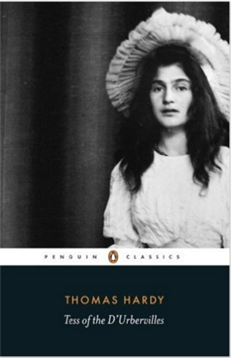
Cover for Tess of the D'UrbervillesBest Book of the Week!
I love Thomas Hardy’s rural novels set in southwest England, and one of the highlights of a trip to England years ago was visiting his cottage in Dorset. My favorite of his novels has long been Tess of the D’Urbervilles, which I recently reread. I don’t mind admitting that in this reread, I was picturing scenes from Roman Polanski’s wonderful movie Tess, which follows the novel carefully and envisions it beautifully.

There is no doubt about it, Tess is a real tear-jerker, so if you prefer novels with happy endings, this is not the one for you. Still, in its own way, the novel ends hopefully.

The novel spans about five or six years, and we meet Tess as a naive young country girl attending a club dance. There she first sees a young man who will be important to her, Angel Clare, but he does not dance with her.

Hardy can be quite the fatalist, though, and Tess’ fate is sealed already, when her father John Durbeyfield meets a clergyman who dabbles in genealogy. Parson Tringham ironically addresses him as “Sir John” and tells him his family is the remains of the once-powerful D’Urbervilles. Her father immediately sets off to celebrate.

Tess’ foolish and feckless parents learn there is a rich old lady by the name of D’Urberville some counties away, so when Tess is partially responsible for the death of her father’s horse (because her father was too drunk to take the bees to town), they push her to go visit the old lady and claim kinship with her in hope of financial benefit. There she meets the charming wastrel Alec D’Urberville, who knows perfectly well they are not related, his family having bought the name and titles.

Tess gets a job from Mrs. D’Urberville as a poultry keeper, but Alec is always pursing her with his attentions. Tess finds these attentions unpleasant, but she is too naive to know what they mean or what she might fear.

Tess returns home with a past that is obvious to everyone and heartache ahead of her. Eventually, she gets another chance, as a dairymaid. There she meets Angel Clare, a gentleman studying to be a farmer, and finally falls deeply in love. But Angel is an idealist who has fantasized her into the embodiment of a pure child of nature. So, he is the last person to forgive her past.

Tess of the D’Urbervilles was a controversial book when it was published in 1891, because Hardy subtitled it “A Pure Woman.” This subtitle caused an uproar with the Victorians. Hardy’s message is strongly against the societal and religious laws that would condemn Tess.

Another aspect of the novel that I found more interesting this time through is that it depicts a rural way of life that is long gone. Although many of Hardy’s novels are rurally based, this one has more about the customs, work, and lifestyle as we follow Tess from one workplace to another than any of his novels except Far from the Madding Crowd. Tess’ father is a freeholder, a step up from a migrant farm worker, one whose family has leased the same land for generations. But when John Durbeyfield dies, the lease is up, and his widow and family are abruptly evicted so that the landlord can make room for someone who works for him. Such activities, Hardy makes clear, are the root cause of people migrating from the country to towns and cities, not that they were unsatisfied with country life.

Years after reading this novel last, I still became thoroughly engrossed in the story. It is a powerful one, poetically written, with gorgeous descriptions of the countryside and vivid imagery. I just love this novel.

Related Posts

The Land of Green Ginger

Independent People

The Warmth of Other Suns: The Epic Story of America’s Great Migration

Day 831: Fresh from the Country

Cover for Fresh from the CountryOne of the pleasures I have not had for years is to read a novel by Miss Read, who wrote quite a few books over the course of 50 years, beginning in the 1950’s. Many of these novels are gentle stories about village life, but Fresh from the Country is about living in town.

Anna Lacey is a country girl who has recently finished training as a teacher and has taken a position as a primary school teacher in a new suburb of London. The school and the town are suffering the results of the post-war baby boom. Shoddy houses are going up quickly, and lodging is scarce. In the first scene of the novel, Anna inspects the grim quarters that will be her new home and is clearly cheated in her rent by her miserly landlady, who also underfeeds her throughout the novel.

The school, too, is crowded, as 48 children are crammed into her class in space meant for 20. The numbers in her class are a constant worry as she learns how to control the children, work in limited space, and keep the class productive. She also has to cope with the peculiarities of the various inspectors, since as a new teacher she is on probation.

Anna flees joyfully home on the weekends and holidays, to the large old farmhouse, her cheerful parents, and the beauties of the countryside. She finds the ugly scenery and the noise of the suburb hard to take.

Although Anna is a nice person, she at first tends to look askance at some of the foibles of her coworkers. It is her friendship with another teacher, Joan Berry, that teaches her not to be so hard on people who haven’t had the advantages of loving parents and a stable upbringing.

This is a gentle novel about the difficulties of being away from home for the first time, about learning new skills and learning to understand others, about the problems of the teaching profession. It has a tinge of light romance as well. It is mildly humorous, especially in the details of Anna’s life as a teacher.

Related Posts

South Riding

Miss Bunting

A God in Ruins

Day 825: The Cricket on the Hearth

Cover for The Cricket on the HearthA year ago I reviewed two of Charles Dickens’ Christmas stories at Christmas time, and since I have a book containing all of them, I thought I’d continue the tradition.

We first meet the Peerybingles in their home, made cheerful by a bustling wife and a cricket on the hearth. John Peerybingle is an honest carter, quite a few years older than his wife. They have a baby and a clumsy maid named Miss Slowboy.

The plot is simple. It is the eve of the marriage of Mr. Tackleton to a much younger bride, May. He comes to invite the Peerybingles to the wedding as an example of a happy May-December union. But the wedding is set for the couple’s anniversary, and they have plans to spend it alone. Still, they include May in a visit to the house of their friend Caleb Plummer and his blind daughter Bertha. An unexpected visitor is with them—a deaf old man who accepted a ride in John’s cart but seems to have nowhere to go.

Mr. Tackleton is not a nice man. He’s been a grasping employer and landlord to Caleb, and it is clear that May is reluctant to marry him. At a point in the evening, Mr. Tackleton takes John aside and shows him something that makes him think his wife has deceived him.

This story is not one of Dickens’ best. Its pleasures are in its scenes of idealized domestic happiness in the Peerybingle home. But since we can’t reconcile our first glimpses of the Peerybingles with any such betrayal as alleged, we’re not in much doubt that everything will turn out to be a misunderstanding. Most of the characters are mere sketches, the only ones even slightly developed are the Peerybingles and Caleb and Bertha Plummer.

Since I recently read Dickens’ biography, though, I was interested in his little fantasy about marriage, particularly it being between two people so disparate in age, years before his affair with Nelly Ternan but only a few years after his wife’s younger sister, Georgina, moved in to live with them.

Related Posts

Two Christmas Novels by Dickens

Oliver Twist

Mr. Timothy

Day 824: The Optimist’s Daughter

Cover for The Optimist's DaughterLaurel McKelva Hand, a widow from Mississippi who now designs fabrics in Chicago, is called to New Orleans, where her elderly father is undergoing an eye operation. Laurel is anxious. Her experiences with the health issues of her mother were not good; there is a sense that something about her mother’s final illness wasn’t handled well.

Judge McKelva’s new wife, Fay, younger than Laurel, is vulgar, frivolous, and stupid. She objects to the procedure. But the judge has a cataract in his other eye, and without the operation at this time, he would end up blind. Dr. Courland thinks the operation will save the judge’s sight, so it is performed.

While the judge struggles to recover, Fay complains about missing Mardi Gras and goes shopping. Unfortunately, as they say, the operation is successful but the patient dies. Although the judge is ordered not to move, his wife shakes him, later saying she was trying to “shake him into life.”

Back home for the funeral in the small town of Mount Salus, Mississippi, Laurel is greeted by old friends who are preparing for the funeral. Fay arrives later and is obviously upset at what she views as an intrusion. It soon appears that Becky, Judge McKelva’s first wife, is the elephant in the room, along with the genteel friends’ incomprehension of what led the judge to marry Fay.

Since Fay has told everyone she has no family, they are surprised when the Chisoms arrive from Texas for the funeral. They are obliviously and cheerfully vulgar, and they add a good deal of macabre humor to the funeral. Fay is so determined that the judge will not be buried next to Becky that she buries him in the unpleasant newer part of the cemetery, right next to the new interstate.

When Fay leaves briefly for a visit with her family, she makes it clear that she expects Laurel to be out of her house when she returns a few days later. Laurel must reconcile herself to the loss of all her parents’ belongings and her childhood home as well as residual pain about both her parents’ and her husband’s death.

This very short novel, written in 1972, is considered Welty’s best, although I confess to a preference for the more lovable The Ponder Heart. The Optimist’s Daughter compresses a lot in just a few pages. At times, the Southern darkness almost reminds me of the grotesque humor of Flannery O’Connor, who is a bit too much for me, but Welty is kinder to her characters.

Related Posts

Wise Blood

The Mansion

The Collected Stories of Carson McCullers

Day 822: Miss Pettigrew Lives for a Day

Cover for Miss PettigrewBest book of the week!
This novel is a confection. It is absolutely delightful.

Miss Pettigrew is a poor, middle-aged governess with no family who has been haunting an employment agency hoping for a job. This morning she is in luck. The agency has two openings, one for a maid and one for a nursery maid. The agency sends her off to interview with Miss La Fosse (by mistake).

Miss Pettigrew is received by a beautiful young woman in a negligee. She is clearly entertaining a young man. Miss Pettigrew has been brought up to be a proper lady, but instead of being shocked, she is entranced by this glimpse of an exotic lifestyle.

Without even inquiring who Miss Pettigrew is, Miss La Fosse asks her to find a way of getting her friend Phil to leave before her other friend Nick arrives. Miss Pettigrew is successful in doing this and begins to discover in herself an untapped capacity for organization. Soon, she is responding to Miss La Fosse’s pleas to stay with her during Nick’s visit. Miss Pettigrew sees that Nick is an attractive but dangerous man.

Over the period of a day, Miss La Fosse and her friends involve Miss Pettigrew deeper in their affairs. She is fascinated by this view into a more Bohemian existence, even though her mother would have considered her new friends vulgar. Attracted by their affectionate natures and their colorful lives, she decides that for one day she will enjoy herself and worry about the future tomorrow.

I thoroughly enjoyed this lovely novel about a timid spinster who learns to unfurl her petals. It is a Cinderella story with a 1930’s edge.

Related Posts

The Making of a Marchioness

Nightingale Wood

Love in a Cold Climate

Day 820: Enter Sir Robert

Cover of Enter Sir RobertLady Graham and her youngest daughter Edith are the main characters of Enter Sir Robert, set in post-World War II Barsetshire. Thirkell relates her novels as if she’s personally telling you a story, and although all the novels are set in Barsetshire, this one seems a little more rural than the others I’ve read recently. People are always running off to look at the pigs.

Lady Graham is a charming woman whom everyone loves, although she is a little scatter-brained. With most of her children married and her husband, Sir Robert, almost always away on some vital service to the nation, she has only Edith, who is 18, left at home.

Mrs. Halliday has an invitation for Edith. Her daughter Sylvia, who is expecting, is coming for a visit. Mrs. Halliday would like Edith to stay for a while to be company for Sylvia. Mrs. Halliday is taken up with Mr. Halliday, who is not well, and her son George has been working the farm as best he can alone. Meanwhile, Lady Graham is preparing a small memorial service for the anniversary of her own mother’s death.

Edith enjoys herself very much at the Halliday’s, visiting with Sylvia, entertaining Mr. Halliday, and viewing the farm with George, who seems to like her company. When the Hallidays all go to view the Old Manor House, which they have been leasing to a bank, they meet Mr. Cross, son of Lord Cross and also a delightful young man.

Like Thirkell’s other novels, Enter Sir Robert depicts the everyday life of the people of a certain social station with wit and humor. Her characters are mostly nice people, with only a few barbs directed at the bishop. The countryside is lovingly described, and there is always a little light romance. They are a pleasure to read. Oh, and if you care to read this one, you’ll find that the title is Thirkell’s little joke.

Related Posts

Happy Returns

Miss Bunting

Barchester Towers

Day 818: The Making of a Marchioness

Cover for The Making of a MarchionessBest book of the week!
Although The Secret Garden was one of my favorite childhood books, I had no idea that Frances Hodgson Burnett also wrote novels for adults until I read a review of The Making of a Marchioness. The Preface points out that Polly references it in Love in a Cold Climate, but there Burnett’s name isn’t mentioned. In any case, I’m happy to report that it is a delightful novel.

The Making of a Marchioness combines a Cinderella story with a realistic description of an evolving marriage. It has been called “a romance between two unromantic people.” It also has a bit of peril mixed in.

Emily Fox-Seton is a woman in her 30’s of good birth but very poor. When her parents died, her more fortunate relatives made it clear they couldn’t be bothered with her. So, she has created a business of doing small tasks and running errands for her wealthy clients. She has the happy characteristic, though, of being a positive person who perceives kindness everywhere.

Lady Maria Bayne enjoys both Emily’s company and her utility, so she invites her to Mallowe for a house party in August, thinking Emily can help with the arrangements for her annual féte. Emily is delighted to leave the city in summer and soon becomes interested in the competition among three guests to snare Lord Walderhurst, a 50-year-old widower who is also a marquis. She finds herself rooting for Lady Agatha, a beautiful girl from a poor family that has several daughters to marry off.

Lord Walderhurst, though, likes the open expression in Emily’s eyes and her happy, busy ways. To Emily’s astonishment, he proposes, and she gladly accepts.

But that is only the beginning of the novel, about how gratitude and love can provoke love in its turn. Some piquancy is added by a plot development that puts Emily in danger from her husband’s heir, who has always considered Walderhurst’s vast estates as almost his.

This is a lovely novel that brought tears to my eyes. Its characters are prosaic but nice (except the heir). Even selfish Lady Maria is quite lovable. The writing is beautiful, and Emily’s story is touching.

By the way, a recent television adaptation of this novel, titled The Making of a Lady, follows the plot with some changes, but it wildly miscasts the two main characters, making them both younger and more attractive than they’re supposed to be in the novel. Still, I marginally enjoyed it.

Related Posts

Persuasion

Love in a Cold Climate

Major Pettigrew’s Last Stand

Day 792: Cheerful Weather for the Wedding

Cover for Cheerful WeatherBest Book of the Week!
The house is in chaos on this morning of the wedding of Mrs. Thatcham’s daughter Dolly. Her two sons are arguing about the socks Robert has on and Kitty, the younger daughter, is screaming at the top of her lungs for her maid to find her brooch.

Breakfast has not been served after Mrs. Thatcham’s contradictory commands, and Mrs. Thatcham has just come in from a bitterly cold gale. Still, she thinks the weather is cheerful, as we find that her only criterion for cheerful weather is visibility.

Upstairs, Dolly is putting on her bridal garb with a bottle of rum in her hand. Downstairs, one of the guests, Joseph, has been asking if he can see the bride before the wedding.

At a little more than 100 pages, this novel by Julia Strachey (Lytton Strachey’s niece) is astonishingly rich. Upon its publication in 1932, it was regarded as nearly perfect. And so I find it.

Related Posts

Greenbanks

Someone at a Distance

Mrs. Dalloway