Day 713: Salem Chapel

Cover for Salem ChapelBest Book of the Week!
Because of the order the books were listed in on Wikipedia, I thought that Salem Chapel was the first of Margaret Oliphant’s Chronicles of Carlingford. However, the introduction to the book says it is the second. When I started to read it, I thought it was going to be, like Miss Marjoribanks, a light satire on society, only a different level of society. But it is much more dramatic than that.

Arthur Vincent proudly takes up his first clergy position as the Dissenting vicar of Salem Chapel at Carlingford. He is an educated gentleman of some ability, and he is certain he will soon be an accepted member of the best Carlingford society. But he receives a shock when he meets his congregation of buttermen, poulterers, and greengrocers and their wives. He soon finds, too, that he is expected to bend to their wishes, as they pay his salary.

Arthur is a proud young man of good family, and this doesn’t sit well with him. Still, he makes an impression with his first sermon and dutifully goes about his business until he is struck by the sight of the beautiful, young Dowager Lady Western. Although a mutual acquaintance tries to warn him not to make anything of her warm manner to him, as she is like that with everyone, he doesn’t pay attention. Soon, he is informed that his parishioners are displeased. He has been seen paying a call in Grange Lane, the home of the upper-class residents of Carlingford (and setting of Miss Marjoribanks), who all attend St. Roque’s.

Arthur has also made the acquaintance of a less prosperous woman, Mrs. Hilyard, an impoverished gentlewoman who takes in sewing. Mrs. Hilyard is an odd and unfortunate woman, and it is a favor she asks of Arthur and his family that drives the larger actions of the plot.

Up until the major events are set in motion, I found the book amusing, as when Arthur, moonstruck by the sight of Lady Western, spends an entire week daydreaming about her. His congregation interprets this lack of activity as a scholarly application to his sermon and is impressed.

This novel contains wonderful characters who can be a bit Dickensian, like the well-meaning butterman Deacon Tozer or the disturbing Mrs. Hilyard, who reminds me a bit of Rose Dartle in David Copperfield. From humor, the novel soon takes a more serious turn.

The introduction to this novel says that once Mrs. Oliphant was one of the most well-regarded of the Victorian novelists, but she is now nearly forgotten. I have found the two of her novels I’ve read to be very entertaining. I think she reminds me, with a delicate touch, more of Jane Austen than any other writer I’ve encountered, and some of the events of Salem Chapel are remindful of Pride and Prejudice. I can only hope that more people will decide to read the works of Margaret Oliphant.

Related Posts

Miss Marjoribanks

Persuasion

David Copperfield

Day 707: Don Quijote

Cover for Don QuijoteI know. This is not the spelling of “Quixote” most people are accustomed to seeing, but it is the one used in my Norton Critical Edition, translated by Burton Raffel. And a sprightly translation it is.

Don Quijote is the story of an old man who has studied the popular chivalric romances so much that they have addled his brain. He declares himself a knight errant and takes to the road seeking adventure. Accompanying him is a neighboring farmer, Sancho Panza, who he has convinced to come with him as his squire in exchange for a share in certain rewards. In particular, Sancho has his heart set on the governorship of an island.

Don Quijote doesn’t just look for adventure. In the first book, he hurls himself at every passer by, convincing himself that windmills are giants, a barber is a knight, an inn is a castle. Above all else, he worships his lady, the beautiful Dulcinea, whom he has never met but whom Sancho remembers as a muscular peasant girl.

Don Quijote is both a parody of the chivalric romances and a satire against the Spanish conquistadores. Its most important distinction is that it is considered the first modern novel. I found volume one to be amusing in a sort of slapstick style, as Don Quijote’s adventures always go wrong and end up with him and Sancho Panza being beaten up.

Volume two was a little too much of the same, though. In a bit of metafiction, Cervantes lists some of the things readers criticized from the first volume and then attempts to avoid them. So, for example, the two adventurers are not beaten up as often. However, both volumes contain long disquisitions on such topics as marriage, poetry, chivalry that don’t all translate well into modern times.

Finally, after Don Quijote had himself lowered into Montesino’s Cave to see its wonders and then fell asleep and dreamt a bunch of nonsense and never even saw the cave, I had to stop. Quijote was in the midst of recounting his ridiculous dream, which he took for reality, and it seemed to go on and on. I leafed ahead, looking for the end of it, never found the end, and finally lost patience. I fully believe, since apparently someone else published a book about our hero after the first volume came out, that Cervantes only brought Quijote back out on the road so that he could kill him off at the end.

Related Posts

People of the Book

The Black Tulip

Othello

Day 688: The Age of Innocence

Cover for The Age of InnocenceI have certainly read The Age of Innocence before, but it was not until this rereading that I gained a full appreciation for its subtlety and complexity. I may have read it years ago, but I became really interested in it after an interview with Martin Scorsese about his movie adaptation (my favorite film ever) where he commented on “the brutality under the manners” of the upper class New Yorkers in the novel, set in the 1870’s, and likened them to gangsters.

This novel is about the tension between individual desires and the expectations of a rigid society. However, it is also about the two main characters trying to do the right thing in the face of yearning and passion.

Newland Archer is an intellectually inclined young man interested in art and travel who thinks he understands but sometimes is a little impatient of the rigid and insular customs of his time and social class. He has just become engaged to May Welland during a difficult time for the Welland family. May’s cousin, the Countess Ellen Olenska, has returned to New York to her family, having left her husband, and society is shocked to see them bringing her to parties and the theatre. Archer decides to show solidarity with the Wellands and soon finds himself drawn into the Countess’ affairs in his professional capacity as a lawyer. Countess Olenska wants to divorce her husband, and the family is horrified, asking Newland to convince her not to.

Newland succeeds, but he soon realizes that he is in love with Ellen Olenska himself. Ellen is determined not to betray her cousin.  When she admits she loves Newland, she comments that by getting her to drop her divorce, he has assured that they can never be together. A disappointed Newland marries May.

Within a short time, Newland regrets his marriage and foresees a gray existence of doing the same things with the same people year after year. The innocence and purity he saw in May is actually an incuriosity and inability to grow or change. Although Newland doesn’t see Ellen, who has moved to Washington, he has begun to think of her as the only real corner of his life. All these feelings are brought to a climax when the Countess returns to New York and her family decides she should reunite with her husband.

This novel is vivid with carefully observed descriptions. Underlying it all is an understated yet savage critique of petty and provincial New York society of the time. Almost every sentence is double-edged, such as when Wharton describes a soprano’s solo in the first chapter:

She sang, of course “M’ama!” not “he loves me,” since an unalterable and unquestioned law of the musical world required that the German text of French operas sung by Swedish artists should be translated into Italian for the clearer understanding of English-speaking audiences.

Nice! I understand that when this book was published, nearly 50 years after its setting, members of New York society were still able to match most of the characters in the novel with their real counterparts.

Related Posts

The Master

Persuasion

Miss Marjoribanks


Day 687: Someone At a Distance

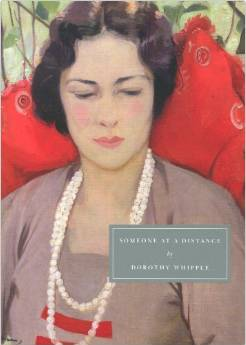
Cover for Someone at a DistanceBest Book of the Week!
I would normally not give away something important that happens well into a novel, but the book blurb openly presents it as the novel’s central conflict. The Norths are an affectionate and happy family with little to discontent them in post-World War I England. Avery enjoys his work as a partner in a publishing firm and is a loving husband and father. He dotes on his daughter Anne especially. Ellen loves her family and her garden. Although she perhaps does too much for her family, she enjoys it. Hugh is serving his term in the army but can’t wait to get out and work at his father’s firm. Fifteen-year-old Anne loves her family and especially her horse.

The only small annoyance in the family’s life is Avery’s mother, who is critical and discontented, wanting more attention than the busy family can provide. But she soon solves her own problem by hiring a companion, a French girl named Louise Lanier.

Louise is a selfish and discontented young woman who is fleeing the end of an affair in which she was felt to be socially inferior to her lover and unworthy of marrying him. Eventually, she sets her sights on Avery, heedless of any destruction she may wreak with her harmful intentions and toxic personality.

I spent the first half of this novel entranced by this perceptive and layered novel and the last third in tears. The characters are wonderfully realized. Perhaps Louise’s character lacks a little nuance, but we have all met people who are able to justify their own bad behavior to themselves. This is a great book that should have had more attention since it was written in the 1930’s.

Related Posts

The Watch Tower

A View of the Harbour

The Travelling Hornplayer

Classics Spin #9!

Cover for The MoonstoneI always enjoy the Classics Club spin, where the club invites members to post a list of 20 book from their Classics Club lists, draws a number, and then you promise to read the book corresponding to that number by the deadline. Unfortunately, the date for posting that list always seems to fall on the same day as Literary Wives club, so I’m posting it a little early. Here is my list, and I will read the book chosen by May 15.

  1. The Vicar of Wakefield by Oliver Goldsmith
  2. Henry VI Pt I by William Shakespeare (chosen by the spin)
  3. The Idiot by Fyodor Dostoevsky
  4. The Call of the Wild by Jack London
  5. Night by Elie Wiesel
  6. The Moonstone by Wilkie Collins
  7. Vanity Fair by William Makepeace Thackeray
  8. Troy Chimneys by Margaret Kennedy
  9. Far from the Madding Crowd by Thomas Hardy
  10. Rebecca by Daphne du Maurier
  11. The Remains of the Day by Kazuo Ishiguro
  12. The Beggar Maid by Alice Munro
  13. Ada by Vladimir Nabokov
  14. Red Pottage by Mary Cholmondeley
  15. A Wreath of Roses by Elizabeth Taylor
  16. Bleak House by Charles Dickens
  17. Middlemarch by George Eliot
  18. O Pioneers! by Willa Cather
  19. The True Heart by Sylvia Townsend Warner
  20. Beloved by Toni Morrison

Day 664: Miss Marjoribanks

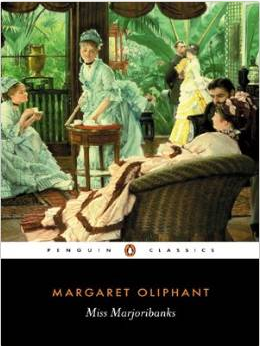
Cover for Miss MarjoribanksBest Book of the Week!
It’s not often that I discover a delightful novel by a classic author whose works I am unfamiliar with. But that’s the case with Miss Marjoribanks. It is a wonderfully ironic comic novel about middle class mores with an exasperating and ultimately lovable heroine.

We first meet Lucilla Marjoribanks at the age of 15. Her long-ailing mother has died, and Lucilla rushes home vowing to be a comfort to her father. Dr. Marjoribanks, who has been looking forward to a comfortable bachelor existence, wastes no time in sending her back to school.

Four years pass, and Miss Marjoribanks returns from her tour on the continent determined to devote herself to her father for the next ten years, suggesting that by then she may have “gone off” a little and will start looking for a husband. Lucilla is a young woman of energy and complete self-confidence who is determined to be a force in Carlingford society. But first she must deal with a proposal from her cousin, Tom Marjoribanks. She loses no time in dispatching him to India.

Dr. Marjoribanks watches in amusement as Lucilla calmly removes the reins of his household from his redoubtable cook Nancy and begins to take control of Carlingford society. Her first project is to begin a series of “evenings” every Thursday.

As Lucilla deftly and with dauntless good humor manages the affairs of her friends, somehow none of a series of eligible men ever come up to scratch with a marriage proposal when her friends expect them to. But Lucilla insists she will dedicate herself to her father’s happiness at least until she is 29.

Although Lucilla, with her managing ways, could easily be a figure of satire, I grew to admire her and like her friends and neighbors, who are fully realized even though  this book is the fifth in a series and I have not read the others. We even feel sympathy for Barbara Lake, the contralto whose voice goes so well with Lucilla’s that Lucilla invites her to her evenings. Barbara, from a lower strata of society, sees Lucilla’s actions as condescension and rewards Lucilla’s impulse with spite.

I was hugely entertained by Lucilla’s career and have already started looking for more books by Oliphant. Margaret Oliphant, I find, was once one of the most popular authors of the mid-19th century, and she deserves to be remembered.

Related Posts

Anderby Wold

Good Behaviour

Mrs. Dalloway


Day 638: The Singing Sands

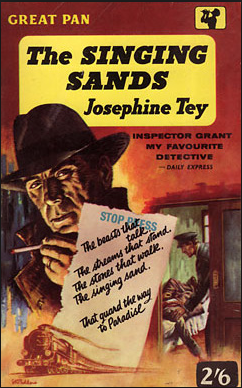
Cover for The Singing SandsEvery once in awhile, I like to read a classic mystery, and I have only read a few by Josephine Tey. Tey’s novels acted as a bridge between the Golden Age of mysteries and the modern mystery, when the genre moved toward more realism.

The overworked Inspector Grant is on his way to a holiday in Scotland and is concerned because he has developed a debilitating claustrophobia. Upon leaving the train at Euston station, he comes across a porter trying to rouse an apparently inebriated passenger. Grant sees right away that the man is dead. When he examines the body, he drops some of his own papers, and while picking them up, accidentally removes the dead man’s newspaper.

Relaxing at his cousin’s house in the Highlands and preparing to go fishing, Grant checks the paper the next day to see what it says about the dead man. His face has stuck in Grant’s mind. He finds that the man has been identified as a Frenchman named Charles Martin. He has already discovered the man’s newspaper, with some verse scratched on it referring to animals that talk, streams that stand, stones that walk, and singing sand. He recognizes the man’s handwriting as the unformed style learned by British schoolboys, and he can’t imagine that the dead man was French. So, he decides to look into the death a bit more.

Except for The Daughter of Time, Tey’s most well-known book, I have only read a couple of Tey’s one-off novels, not her Inspector Grant mysteries. After reading this one, I think I’ll look for more. Inspector Grant is interesting and likable, as are the relatives he visits. The mystery is involving without being so overcomplicated as to be unlikely, as Golden Age mysteries often are. When Grant travels to the island of Claddagh (referred to as Cladda in the novel) in search of the singing sands, we also get to explore a new landscape.

Day 636: Their Eyes Were Watching God

their-eyes-were-watching-godTheir Eyes Were Watching God was my selection for Classics Spin #8 for the Classics Club! Here is my review.

I had a complex reaction to this novel. On the one hand, I liked its protagonist, Janie Crawford, and was interested in her struggle to define her own identity. On the other hand, I didn’t much like any other characters in the novel. On the one hand, Janie’s struggles to define herself make the novel a landmark feminist book; on the other hand, Janie defines herself through her choice of husbands and her relationships to them. On the one hand, I don’t usually like tales in the vernacular; on the other hand, both the educated omniscient narrator and Janie’s vernacular third/first-person narration have moments of entrancing imagery. And speaking of that imagery, for a book written in 1937, the novel is occasionally startling in its sexuality.

A woman in her 40’s, Janie has recently returned home without Tea Cake, the man she left with. Having departed in some scandal, a well-off widow with a much younger, penniless man, she is figuring in a lot of talk. So, when her friend Pheoby comes to see her, Janie decides to tell her the story of her life.

Janie was raised by her grandmother in West Florida after her mother had her as a result of rape and then disappeared. Janie is a light-skinned black woman with long beautiful hair, and her appearance features in much of her story. When she is still an extremely innocent 16-year-old, her grandmother marries her off to a much older man, trying to give her stability. Janie thinks that marrying will make them love each other, but she is soon disillusioned and finds he is inclined to treat her like a work horse.

Then she meets Joe Stark, a flashy well-dressed man who seems to be going somewhere, and is. She leaves with him and they settle in an all-black town in “the new part of Florida,” where Joe soon becomes the mayor and store owner. But he defines his marriage by what he gives her and expects her to maintain a certain decorum as his wife, not allowing her to participate in many of the small town amusements. Also, he treats her with disrespect, publicly ridiculing her.

After Joe dies, under circumstances that have already started talk, Janie meets Tea Cake and eventually leaves with him to work in the Everglades. Although Tea Cake is in some ways an improvement over her other two husbands, there are some events that disturbed me. First, he steals her $200 and comes back with $12, but she is only upset when she thinks he has left her. Next, he earns it back but makes her put it in the bank and promise to live off what he can provide, a classic play for dominance that ignores the fact that she soon has to go to work next to him, manually in the fields. Finally, he beats her up once, not because of anything she does but because he wants to show everyone that she belongs to him.

Hurston was a trained ethnographer, and her fiction details a way of life in small-town Florida of her time. I found many of the details interesting. A fascination with skin color and Caucasian features is one theme that comes up several times. In fact, when Tea Cake beats Janie, instead of provoking a discussion of the fairness of the beating, the people are more fascinated by Janie’s skin being fair enough that they can see the bruises, which makes the other men envious.

Janie is often viewed harshly and unfairly by others. But it is part of her growing self-awareness that she doesn’t care. Although to me she sometimes seems too passive in her relationship to men—her gentle response to Tea Cake’s beating is seen as a good thing—she is otherwise a strong and resourceful heroine.

Day 633: Kim

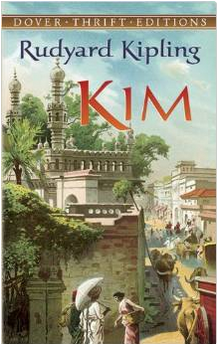
Cover for KimBest Book of the Week!
Up until now, the only book I read by Rudyard Kipling was Puck of Pook’s Hill, which is definitely a children’s book. I always assumed that Kim was a children’s book, too, or at most a boy’s adventure story, but I don’t think I would describe it that way.

Kim is the son of an Irish soldier in India, but both of his parents died impoverished when he was young. He has been brought up by a Eurasian woman who leaves him to himself most of the time, only insisting that he wear European clothing. But he keeps some native clothing hidden away, and when he is wearing it, he cannot be discerned from any other street urchin. He knows everyone in Lahore, and they call him Friend of All the World.

One day he is playing outside the Lahore museum when a holy old lama comes to look at the wonders inside. Kim sees that he is a truly guileless man with no one to help him in a foreign country. The lama explains that he is searching for a holy river that will wash clean all his sins. Kim decides that he will go with the lama as his chela, his disciple who begs for him and takes care of him. Before leaving Lahore, though, Kim goes to see Mahbub Ali, an Afghani horse dealer for whom he has run some errands. Mahbub gives him a dispatch to take to a British Colonel Creighton.

The description of the journey of Kim and the lama is very colorful and interesting, reflecting Kim’s joy in the bustle of the road and a love of the country on the part of the author. But Kim’s father told him long ago that he would be saved by a red bull on a green field, so when he sees a regimental flag flying the device, he goes nearer to look and is suspected of being a thief.

He has always carried his papers in an amulet, and when he is captured, his identity as Kimball O’Hara is established. The priests in the regiment, of which Kim’s father was a member, plan to send him away to a Masonic orphanage. Kept a watch on and forbidden to see his lama, Kim writes to Mahbub for help. Mahbub makes sure that Colonel Creighton understands how valuable a boy like Kim would be as part of the Great Game, of spies and explorers in the far regions of the area.

So, Kim’s fate is taken out of his own hands and he is sent to school to learn to take his part in the Raj. But the lama pays for his schooling and makes sure he goes to a better school than originally intended.

This is really a great novel. I came to it prepared for perhaps some outmoded racism or hints of British superiority but found a novel that reflects a deep love of India and of all its peoples. Of course, there is an implicit assumption that the Raj is a good thing, but the British characters in the novel are as varied as any, and there are comments about mismanagement and misplaced airs of superiority on the part of the British. Kim is rich in colors and smells, in the flavors of language and the stories of the orient, and in this complex tale of a boy with loyalties both to the soldiers who raised him and to his beloved lama.


Day 631: Two Christmas Novels by Dickens

Cover for A Christmas CarolIn the spirit of the season, I thought I’d take a look at a collection I have of Charles Dickens Christmas books. As you may know, Dickens wrote a short Christmas book every year for years. A Christmas Carol was the first one, and it did much to revive Dickens’ career, which was flagging after Martin Chuzzlewit. My book contains the Christmas stories in order, and this Christmas I have read the first two.

Dickens is closely associated with Christmas. He didn’t invent our current traditions, but through his glimpses of how happy families celebrated it, some traditions were probably set and promulgated.

The introduction to this collection admits that A Christmas Carol is the best of the Christmas books, which is probably why it is most well known and adapted. Still, it has been a long time since I read it, and I found it interesting to compare it with the screen renditions, with which I am more familiar. (In my opinion, the best one because of its atmosphere is the 1951 version with Alistair Sim—but only in black and white, mind.) What stood out the most is that in one of the movies, Scrooge actually fires Bob Cratchit, a cruel joke even if only momentary, but he does not in the book. The movies also seem to put more or less of Scrooge’s nephew Fred in them, depending.

Of course, A Christmas Carol is the story of the miserly Ebenezer Scrooge, who has grown so obsessed with the accumulation of wealth that he has given up all pleasure and human companionship, and even worse, from Dickens’ point of view, all charity. Through the intercession of his dead partner Jacob Marley and the visits of three ghosts, he gets a second chance to be a better person.

chimesI haven’t read any of the others before, but I found The Chimes to be a similar story. Trotty Veck is a poor porter. He lives nearby a church that has a set of bells considered to be haunted. But Trotty likes the bells and in his simple way is always praising them.

One day an overbearing alderman makes some comments to Richard, who is the fiancé of Trotty’s beloved daughter Margaret, about how foolish he is as a young man to be getting married. Richard and Margaret are to be married New Years’ Day, and when Trotty sees Margaret in tears later, he thinks the alderman’s comments have caused Richard to break it off. This and other encounters cause Trotty to have doubts about the goodness of humankind. Later, the bells lure Trotty up to the bell tower and teach him a lesson.

The lesson of this story is much more garbled than that of A Christmas Carol. Since Trotty’s thinking processes are a bit murky at times, I wasn’t even sure exactly how Trotty supposedly transgressed the bells. Still, Dickens always manages to bring a tear to your eyes when he tries.