Day 618: Giants in the Earth

Cover for Giants in the EarthI don’t usually read introductions until after I read a book, but I began to read the one for Giants in the Earth because I was curious about the book’s origins. I had always assumed it was an American book because it is about settlers in the Dakota territory. But in fact it was originally written in Norwegian and published in Norway in 1925 and 1926 and then translated to English in 1927, for Rölvaag came to the States in 1896 as a young man of 20.

The reason I mention the introduction by Lincoln Colcord, who translated the book with Rölvaag, is that it gives away a key plot point of the novel in the second paragraph. I couldn’t believe this, as it certainly affected how I read the novel, and it is especially egregious in that the event referred to does not happen until the very end of the book. If part of your enjoyment of a novel comes from not knowing what to expect, as mine does, do not read the introduction.

Per Hansa and his family have lost their way crossing the featureless prairies at the start of the novel. They had been travelling out with a group of Norwegians and Norwegian-Americans, but Per Hansa had difficulties with his wagon and the others went on ahead, even his best friend Hans Olsa. Then Per Hansa’s little group got lost in the fog for awhile, and now Per Hansa is afraid he might have missed the others and gone past them.

Per Hansa is an ebullient, sociable, hard-working man, and when he and his family finally arrive at the group of homesteads by Spring Creek, he is delighted with the land Hans Olsa has already marked out for him. He finds the prairie beautiful and is confident that he is going to make a wonderful life there for his family.

His wife Beret feels otherwise, and it is around her reaction that much of the novel centers. She is appalled by the prairie, this vast expanse that has not a single tree to hide behind. She soon begins to view the land as if it is some sort of godless and primitive monster, while Per Hansa sees only that it is rich and fertile.

The novel is set in the 1870’s and early 80’s and details the hardships of life so far away from any amenities. The men have to travel days for firewood in one direction and for supplies in another. Still, more immigrants keep arriving until there is a little settlement by the creek.

This is a fascinating novel about the Norwegian contribution to the settlement of the country. It is a realistic novel, not romanticized, with no big feats of heroism or villainy, just details of the life these people have chosen and its effects on them.

Day 614: The Bridge of San Luis Rey

Cover for The Bridge of San Luis ReyThe Bridge of San Luis Rey is a moral fable that explores whether there is a purpose in life beyond that of a person’s own will. This theme is not one that interests me, nor do I usually enjoy fables, but I did enjoy Wilder’s rich characterizations in this short novel.

The novel begins in 1714 in Peru, when the bridge of San Luis Rey collapses, killing five people. A monk, Brother Juniper, believes that this event may be his opportunity for scientific proof of the will of God. So, for six years he collects information about the lives of each victim.

What follows is a chapter about each of the lives of the victims, in all their humanness and contradictions. The Marquesa de Montemayor is an ugly, rich old woman who is despised by many for her eccentricity. She obsessively loves her daughter, who has moved to Spain to get away from her, and she writes her rambling but marvelous letters that only her son-in-law reads. With her dies her young maid Pepita.

Esteban is a twin whose brother Manuel recently died. Esteban and Manuel were inseparable until Manuel fell in love with the actress Perichole, who used him to write her love letters. Ever since Manuel’s death, Esteban has been inconsolable.

Uncle Pio was a wanderer who eventually settled down to mentor Perichole, whom he raised from a young barroom singer to become a great actress. But Perichole begins to have ambitions beyond the theatre and eventually throws off Uncle Pio. Uncle Pio has devoted himself only to her, though, and promises to educate her son Jaime.

This novel is beautifully written and touching in its acceptance of the foibles of humanity.


Day 613: Brave New World

Cover for Brave New WorldIt has been many years since I first read Brave New World, and I didn’t remember very much at all of this acid dystopian novel. It takes a bitter, satiric look into the future from 1931, and like the best of futuristic novels, is somewhat prophetic.

Bernard Marx is an unusual misfit in a society structured around the contentment of its people, or contentment as is rigidly defined there. Family units no longer exist. Society is strictly tiered. Everyone is artificially born, and the lower castes are cloned in multiples. Each caste is conditioned chemically and psychologically from before birth to be content with its lot, the mental and physical abilities of the lower castes chemically limited.

Everything is designed around productivity and consumption. People spend their leisure hours in pursuit of pleasure and get their daily dose of the drug soma. The arts are obsolete, supplanted by a very limited science.

At first it seems as though the discontented Bernard will be the hero of this novel, but there actually is none. He likes Lenina Crowne but is afraid to approach her for fear of being rejected. Lenina is a bit attracted to Bernard and is getting flak from her friends for being too exclusive of late, for there is no concept of faithfulness in this society: “everyone belongs to everyone.” So, she agrees to go with Bernard on a trip to New Mexico to view the savages—remnants of society, apparently American natives, who have not been civilized and live within a barbed wire reservation.

Lenina is too conventional a girl to enjoy this trip, horrified by the dirt and squalor of life that is not antiseptic. But Bernard, who has heard his boss’s story of a lost girlfriend in New Mexico years ago, is intrigued to find this woman, Linda, and her son John, actually born of his parent. John is an outcast of his culture, because he is the son of a woman considered a whore for behavior her own culture believes is normal. He has educated himself from Shakespeare’s complete works. Bernard gets permission to bring Linda and John back to London, setting in train unforeseen consequences.

Huxley apparently firmly believed that future societies would be controlled by drugs and psychological conditioning. It is his interest in cloning and the power of propaganda that strikes more modern readers. I’m willing to bet he paid attention to the then-current theories of eugenics that were particularly popular in England and Germany. His choice of Henry Ford as a godlike image for that society is telling not only for Ford’s invention of the assembly lines, clearly a model for Huxley’s vision of the Central London Hatchery and Conditioning Centre, but also for Ford’s own interest in eugenics.

I couldn’t help comparing Huxley’s vision of sexual freedom with that of Heinlein in Stranger in a Strange Land, a book I really hated. There are other similarities too, John the Savage almost standing in for Heinlein’s alien-born Messiah, only finally shunning what he views as an immoral society rather than trying to start a religion. I think Huxley’s ideas are much more insightful, though.

That being said, I enjoyed this re-read only moderately. I appreciate Huxley’s deadpan humor, but a late section of the book, where Mustafa Mond explains his choices in life, is a bit too much like a sort of reverse didacticism, by which I mean that Huxley is not trying to make us agree with him, but trying to show us what is wrong with Mond’s ideas (or maybe I’m wrong—I believe Huxley thought that such controls over society were inevitable). In any case, any kind of didacticism in a novel is a good thing to avoid. Still, reading this novel after such a long time was an interesting experience.

Day 605: The Watch Tower

Cover for The Watch TowerBest Book of the Week!
The Watch Tower opens when Laura and Clare Vaizey are abruptly pulled out of school after their father dies. They move with their mother Stella to an apartment in the Sydney suburbs. While Stella lounges around in bed, she has the girls do all the housework. Laura, who thought she might become a doctor or an opera singer, is made to leave school and take a secretarial course. Later, to keep Clare in a decent school, Laura has to turn over all her earnings from a secretarial job in a factory, for her mother would as soon see Clare in the local high school, which only teaches girls home economics.

When World War II breaks out, Stella decides to return to England, leaving her girls to fend for themselves. By then, Laura is in her early 20’s and Clare in high school. When Laura wonders what she can do to keep Clare in high school, her mother suggests she get her a job in the factory.

Laura confides her problems to her boss, Felix Shaw, whom she thinks of as a good man. Felix has an idea that will keep Clare out of the factory. Laura should marry him, and he will support both girls. Stella refuses to give her advice, but she obviously prefers any solution that will be less trouble for herself. Seeing Felix’s offer as a sort of business deal, Laura accepts.

Laura and Clare do not know it, but they have put themselves into the hands of an emotionally and sometimes physically abusive man. The resulting story is one of great psychological depth. While Laura becomes a woman who will do anything to keep peace in the house, Clare finds herself attempting to stay in some way true to herself.

The novel is an absorbing account of the need of one person for escape from an abusive and emotionally stifling situation while another attempts to close every avenue of escape. Felix is continually involved in shady business deals with proteges who disappear as soon as they’ve managed to cheat him. Felix then takes everything out on his wife, showing her contempt so that others treat her contemptuously, too. Laura will do anything to appease him, including preventing her sister from attempting to leave.

This story is a dark and compelling one.

Day 598: Mrs. Palfrey at the Claremont

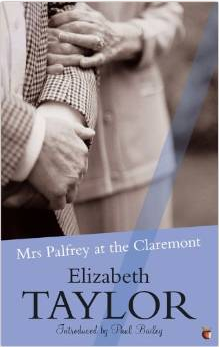
Cover for Mrs. PalfreyI’ve read two books by Elizabeth Taylor, who is beginning to be appreciated as a novelist years after she authored the books. Both the novels are melancholy, about sad people in realistic situations.

Mrs. Palfrey is an old lady who takes a permanent room at the Claremont, a hotel that has seen better days. Staying at the Claremont are several other older people who are all living on limited means.

One reason Mrs. Palfrey chose the Claremont instead of a seaside resort her daughter recommended is because her grandson Desmond lives in London and works at the British Museum. Mrs. Palfrey regrets having mentioned him to the other guests, though, as day after day passes and no one comes to visit.

The life of all the permanent residents of the Claremont is similar to hers, as they sit waiting for something to happen. Mrs. Post knits while Mr. Osborne writes letters to various newspapers hoping to see them in print. Any incident, no matter how trivial, constitutes a break in the monotony.

One day while out walking, Mrs. Palfrey falls. A young man runs out from a nearby building and helps her. He is Ludo Myers, an impoverished would-be novelist. After this encounter, the two become friends of a sort. Mrs. Palfrey doesn’t know that Ludo has decided to write about old people and is using her as a model. Still, they both behave kindly to one another, he even pretending to be her grandson so she can save some face with the other hotel residents.

Underlying the lives of all the old people are sadness and boredom, but Ludo also feels lonely. His mother goes from one affair to another and doesn’t seem to care if he comes to visit. He eventually takes up with Rosie, a young woman who also doesn’t care for him much.

This novel is observant enough of people’s behavior that it is sometimes funny, but mostly it sensitively explores the solitude that is in all of us. I saw the movie a few weeks after I read the book and was interested, but not surprised, to see how the movie was just enough more heartfelt and touching to make it avoid the central message and atmosphere of the book. I liked the movie, but it missed the point.

Day 569: The Castle of Wolfenbach

Cover for The Castle of WolfenbachThe Castle of Wolfenbach is one of several “horrid” novels referred to in Jane Austen’s Northanger Abbey. All of these novels, as I reported awhile back, are packaged together in a book for Kindle, so I thought I’d try them out.

This novel begins in the wilds of Switzerland on a stormy night when a mysterious young lady asks for shelter for herself and her servant at a small cottage. The inhabitants of the cottage take the fugitives to the nearby Castle of Wolfenbach for more comfortable accommodations. This castle is not being occupied by its owner but is maintained by two servants, and the castle’s upper floors are reputed to be haunted.

The young lady, Matilda Weimar, is not afraid of ghosts, however. She sleeps upstairs, and although she hears noises and sees lights across from her bedroom window, she goes the next day to explore that part of the castle. There she finds in residence an older lady and her female servant. The castle servant Joseph knows they are there, but his talkative wife does not.

Matilda explains why she is a fugitive. She has never known her parents, but was raised by her uncle. Lately, her uncle has begun showing her attentions that make her uncomfortable. What made her flee was that she overheard the housekeeper advising him to sneak into Matilda’s bedroom at night and claim her for his own.

The older lady, the Countess of Wolfenbach, offers to tell part of her story to Matilda, but Matilda asks her to wait until the next day. However, that night there is a disturbance, and Matilda visits the “haunted” area of the castle the next day to find the countess’s attendant murdered and the countess gone. When Matilda was leaving the countess the day before, however, the countess offered to send a letter to her sister in Paris asking for refuge for Matilda. Soon Matilda is on her way to the Marchioness of Melfort in Paris.

Matilda and her friends have many more adventures, in which Matilda unfailingly demonstrates her purity and honor. The evil Herr Weimar chases after her and tries to remove her from her friends, telling her that he is not actually her uncle but found her by the roadside. A young count falls in love with her, but her scruples about her unknown lineage do not permit her to accept his proposal of marriage. Temporarily, she retires to a convent.

The plot of the novel is quite convoluted and involves several kidnappings, pirates, murders, deathbed confessions, scandalous rumors, defamation of character, and other food for melodrama. Characters are mostly either good or evil, although all the evil people repent. Dialogue is elaborate and ceremonial.

This novel is not terribly scary to modern sensibilities, nor does Parsons do a very good job of creating suspense. But The Castle of Wolfenbach, which was written in 1793, is an early effort in what is essentially a genre of potboilers. Although Matilda is so good and does a lot of fainting, she at least shows some occasional evidence of spunk. Even as scary as its contemporary audiences found it, there is little doubt of a happy ending.

WolfenbachI was disappointed not to find a spooky cover available for this novel, although the one for the collection I am reading isn’t bad, so I attach a picture of this scary castle. It came up on a search for the cover, but I actually have no idea at all where it came from.


Day 552: Dracula

Cover for DraculaHaving experienced other gothic classics of the 18th and 19th century, I was delighted to find Dracula unexpectedly readable. I was also surprised to find how little it resembles its many theatrical and movie productions, even those that attempt to stay closer to the original work.

All versions begin the same, however, with poor Jonathan Harker sent out by his office to Transylvania to complete a property deal with his client, Count Dracula. While staying at Dracula’s castle, he begins to suspect something is badly amiss and eventually fears for his life.

Back in England, his fiancée Mina Murray corresponds with and later stays with her good friend Lucy Westerna at a seaside town. In one day, Lucy has received proposals from three different young men, who all feature strongly in the novel. Dr. Jack Seward is in charge of a local insane asylum. Quincy Morris is a manly, amiable Texan, whom I feared all along was designed for a ghastly death. Lucy’s chosen is Arthur Holmwood, another manly young man who is soon promoted to a lordship by the convenient death of a benefactor. (I don’t think these things work this way, since Arthur is not his benefactor’s relative, but never mind.)

After a freakish storm, a Russian ship arrives unmanned at the port where Mina and Lucy are staying with Mrs. Westerna, who is gravely ill. As it arrives, a large dog jumps off it and runs ashore. Aboard is not a single live human. We horror aficianados know that Dracula has arrived.

While Mina waits for news of Jonathan, Lucy begins sleepwalking and behaving oddly. Dr. Seward makes notes about a patient who eats bugs and babbles about his master. Soon Van Helsing will be needed.

Unlike in most of the spin-offs, except for Jonathan Harker’s experiences at the beginning, Dracula is mostly an unseen menace for much of the novel. I’m guessing that the original readers did not necessarily realize the identity of that bat fluttering outside Lucy’s window.

In any case, the novel covers a lot more ground than does the standard remake. It is epistolary, written entirely as letters and journal entries. It is well written and moves along nicely except for the occasionally long-winded expulsion of pseudo-scientific mumbo-jumbo by Van Helsing or Seward. In the true gothic fashion, it is a classic battle of good versus evil, with the prize the soul of our heroine Mina.

Modern readers may be bothered by the depiction of the two women. Lucy is supposed to be a modern woman—who else would have three suitors at a time? She is both innocent and pure in herself and quite the seductive vamp when under the spell of Count Dracula. The men do a lot of harm to both her and Mina by trying to protect the “little women” from knowledge of what is going on. Again, try to judge the novel’s attitudes by the standards of its own time, when it was simply considered a whomping good tale.

Day 551: Mrs. Dalloway

Cover for Mrs. DallowayMrs. Dalloway is preparing for a party at her home. She goes out herself in the morning to pick up the flowers.

Clarissa Dalloway enjoys her walk. She loves the air, the invigorating city of London, the people. As she walks, she thinks about events from her past, particularly a summer when she was being courted by Peter Walsh at her home of Bourton.

On her walk, Mrs. Dalloway briefly encounters an old friend and we follow him and his thoughts for awhile. So through the day, the novel moves from the consciousness of one character to another, culminating in Mrs. Dalloway’s party. Thoughts and memories are triggered by random images, as Woolf tries to replicate human consciousness.

Woolf’s express purpose in writing this novel was to depict one day in a woman’s life. She also does a turn on the marriage plot—for we see thirty-some years later how that plot worked out.

Mrs. Dalloway harks back to her youth, when it seemed possible she would marry Peter. They argued a lot, though, and it seemed to her that he criticized her. We learn from Peter’s memories that he suddenly had the flash of a thought that she would marry Richard Dalloway. Convinced of this, he left for India. Now, he has returned to tell her he is in love again—with a much younger married woman who has children and is not of his class. Still, by the end of the novel it is as if he has forgotten his new love.

Clarissa married comfort and stability in Richard Dalloway. Instead of a challenging and more bohemian existence with Peter, she has a very structured life. But she is recovering from illness and sleeps in a narrow, prim bed in the attic. It is unclear whether she is happy, except in the delight of living she feels by her nature.

Septimus and Rezia Smith are a couple unknown to Clarissa who are also important to the novel. Septimus is suffering from a delayed shell shock and hallucinations from his experiences in World War I. Rezia, the wife he brought back from Italy, is taking him to see Sir William Bradshaw. Bradshaw is a Harley Street specialist who appears later at Mrs. Dalloway’s party.

As with other modernist novels, I sometimes felt I was missing something. At other times, though, I felt that my reaction was supposed to be something like “This is what life is.”

Having recently read The Hours (wrong way around, I know), Michael Cunningham’s tribute to the novel, I was fascinated by how, with slight adjustments of character and by breaking the novel into three time periods, he invokes even stronger feelings and gives us a fresh look at the material.

Day 549: Classics Club Spin #6! Herland

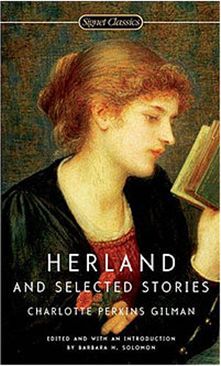
Cover for HerlandHerland is the novel chosen for me from my Classics List by the Classics Club Spin #6!

******

I guess most of my reaction to Herland is based on a dislike of utopian fiction, which seems to be more than ordinarily didactic. I like the occasional dystopian novel, but in my experience the dystopian writers are a bit more subtle about their lessons. Or in the case of Margaret Atwood’s Maddaddam trilogy, if not subtler, funnier. I chose this novel for my list just because I thought I had never read it and I was trying to make sure I selected quite a few notable works by women.

Vandyck Jennings, Jeff Margrave, and Terry Nicholson are traveling when they hear of a land of only women and female children. They hear that men are not welcomed, so of course, they decide to go there. The land is isolated at the top of an unclimbable mountain, but the three fly up in Terry’s plane. There they are taken prisoner by the women, who educate them in their customs before allowing them to mix freely with the inhabitants. It is this education and subsequent discussions that make up the bulk of the novel.

These women have been isolated for thousands of years and began to reproduce asexually through parthenogenesis. Their world is a garden, perfectly peaceful, with no disease or strife. Although two of the men are sympathetic characters (the third is a first-class chauvinist), the implicit message is somewhat misandrist—that women can get along perfectly well, better really, without men.

The book is funny at times, as these bewildered males take in the lessons of Herland. The funniest scene is after the men marry, and Van is trying to get his wife Ellador to understand the pleasures of having sex more often than when she’s scheduled to reproduce. But most of the charm the novel has is overridden for me by its didacticism, even while I believe Gilman brings up some important issues.

Development of character is not something Gilman is very interested in for this novel. The men all have distinct but pretty much one-dimensional personalities, and the women are virtually indistinguishable except for older versus younger. Science and psychology must have been hot topics at the time (1912), because terms from both are thrown around quite a bit. Unfortunately, there is also an implicit advocacy for some of the theories of eugenics.

What I was most interested in was what happened to Ellador after she and Van escort the exiled Terry out of the country. But Gilman doesn’t say.

In Gilman’s time, many of the ideas that don’t seem so revolutionary now—like the need of all people to have a sense of purpose and the idea that subordination results in stunted humans—were probably revelatory and maybe even shocking. Some of them still are. Gilman certainly deserves to be read, but I prefer some of her other works, notably The Yellow Wallpaper.

Day 544: Death in Venice

Cover for Death in VeniceGustave Aschenbach is a renowned author who has devoted his life to intellectual pursuits and his art. He leads an orderly life, conscientiously applying himself to his work.

One day when he is feeling over-taxed, he goes out for a walk and spots a red-haired man dressed as a traveler. Although the man appears to view him with disdain, at the sight of him Aschenbach is suddenly possessed with the desire to travel.

After stopping a few days on an island in the Adriatic, he decides to go to Venice. The city is gray and unwelcoming. The air is miasmic, and he wonders if he should have come. Then at the hotel he sees a beautiful boy. At first he simply enjoys looking at him, but eventually he becomes erotically fixated.

In writing this novella, Mann wanted to examine the relationship between art and the mind, a life of the senses and a life of intellect. At first, Aschenbach tries to rationalize his obsession by philosophizing about it. Mann makes many allusions to Greek mythology and calls the boy’s beauty godlike. But Aschenbach is lead inexorably into mental degradation. On the boat to Venice he was repelled by an older man, hair dyed and face rouged, who was traveling with a bunch of students. By the end of the novella, he has become that man.

While respecting the merits of the novella, I found Aschenbach’s obsessions and rationalizations repulsive, but I believe that is what Mann intended. In many ways, the story has similarities to Nabokov’s Lolita. However, while Nabokov’s language was beautiful enough to make me somehow grasp what Humbert Humbert felt, Mann’s was written with a different intent, I think.