Day 538: Treasure Island

Cover for Treasure IslandIf I had to guess which of Robert Louis Stevenson’s books is the most popular, I’d pick Treasure Island. My own favorite is Kidnapped, though, and I probably wouldn’t have reread Treasure Island except that it came free with a reading app for my iPad. Still, it’s a pretty good adventure story.

The plot is familiar to everyone. Jim Hawkins and his parents run the Admiral Benbow Inn in an isolated location near the English seashore. A shifty old sailor comes to stay. He seems to be on the watch for someone, and asks Jim to alert him to strangers. Soon more shifty sailors arrive looking for him. The Hawkins’ guest is drinking himself to death, though, and he dies soon after Jim’s father does. In his sea chest is a treasure map.

Jim has gone for help to the Squire Trelawny and Dr. Livesey. Soon they prepare a ship to go collect the treasure, taking Jim with them. A crucial misstep occurs when the Squire hires the crew without waiting for the captain (something that seemed not only improper but stupid to me). He hires as the cook a one-legged man named Long John Silver. Silver and a good part of the crew turn out to be pirates who know about the map and want the treasure.

I was struck by a few cases when the protagonists behave nonsensically, the biggest being abandoning the ship when they find out a mutiny is afoot. Almost all the sailors are ashore at that point. It seemed like they should just sail away to another part of the island.

Still, the novel is written really well, and Stevenson is good at building suspense. I’m sure that successive generations of young people are thrilled to discover this adventure story.

Day 528: A Tale of Two Cities

Cover for A Tale of Two CitiesIt has been a long time since I read A Tale of Two Cities, and I did not remember anything except its broadest outlines. The novel is unusual for Dickens in two respects. It is his only historical novel, and it is probably the grimmest. Although he handles some weighty subjects in other novels—the poor laws, the civil justice system, mistreatment of children, abusive schools—this novel about the French revolution shows little of his celebrated sense of humor.

The novel centers around a much smaller cast of characters than usual for Dickens. It begins with Dr. Alexandre Manette, long a resident in a French prison for reasons we do not learn until the end of the novel. When the book begins, he is free but severely disturbed from trauma. His daughter Lucie travels with his banker Jarvis Lorry from England to bring him back to London.

Five years later, he is living contentedly with his daughter in England. Their friend French émigré Charles Darnay is tried for treason on bogus charges, but he is released when his defense proves that the principal witness cannot tell him apart from Sidney Carton, a barrister. These characters will soon become well acquainted.

When the novel returns to France, it shows us the extreme poverty of the poor as well as grim depictions of their mistreatment by aristocrats. Darnay returns to France to meet his uncle, the Marquis St. Evrémonde, and renounce his inheritance. St. Evrémonde’s careless slaughter of a young child when he runs over him in his carriage and his disdainful treatment of his nephew are all we see of him before his murder.

Secretly, a revolutionary society is growing and taking note of atrocities such as those committed by Evrémonde. Wine shop owners Monsieur and Madame Defarge are involved, and at first we have sympathy with their cause.

Charles Darnay marries Lucie Manette in London, but Sidney Carton has fallen in love with her as well. Although he considers himself unworthy of her, he pledges to do anything he can for her or for anyone she loves.

Meanwhile, France falls into revolution and brutal chaos. It becomes a place where revenge is more important than justice.

The fates of the main characters reach a climax when Charles returns to Paris to help an old retainer and is denounced by the revolution. Although he has committed no crime, his relationship to St. Evrémonde puts him in peril. Dr. Manette’s sanity is also threatened when he, Lucie, and Jarvis Lorry travel to Paris to try to help Charles.

The novel is a little more melodramatic than I prefer, unleavened as it is by Dickens’ usual antics. Only a couple of major characters provide momentary relief, and Madame Defarge is like a heavy dark cloud hovering over everything. The novel is also a bit disjointed through moving back and forth between the two cities. Still, Dickens always manages to bring tears to my eyes.

Day 524: Things Fall Apart

Cover for Things Fall ApartThis book is another one for my Classics Club list. It is the late 19th century, and at the beginning of Things Fall Apart the Nigerian villagers have only heard of white men. They lead their agrarian life, counting wealth in yams and cowrie shells, and occasionally go to war.

The main character of the novel is Okonkwo. He is a proud man, once a great wrestler, who is intent on accumulating wealth and honor. His father preferred playing his flute to cultivating yams. Okonkwo did not respect him and has a secret fear of ending like him. To compensate, he is occasionally brutal and rigidly observant of the village customs, especially the “macho” ones.

After a woman from their village is murdered while visiting another village, the elders go to negotiate a settlement. They return with a hostage, a boy named Ikemefuna. He is handed over to Okonkwo and becomes part of his household. Okonkwo grows to care for him like a son and thinks Ikemefuna is a good role model for his own son Nwoye, in whom he fears weakness. After three years, though, the elders decide to kill Ikemefuna. An old man advises Okonkwo not to take part, but he does not want to look weak.

After Ikemefuna’s death, things begin to go wrong for Okonkwo. First, he is banished from his village for seven years for accidentally killing a man. Although he fares well in his mother’s village, he just wants to return home. While he is gone, though, missionaries arrive in his home village and a colonial government is set up. Nwoye and others convert to Christianity. Tragic cultural misunderstandings ensue between the Europeans and the villagers.

I was sympathetic to Okonkwo at times, but I did not like him. He is not fleshed out as a character, because he is more of a symbol for his culture. His tragedy stands in for the clash of cultures between the whites and the villagers. Certainly, the colonial government is arrogant and more interested in enforcing European concepts of law and morality than in trying to understand the local customs.

Things Fall Apart is a sparely written novel that is one of the most widely studied in African literature. Although I recognize its merits, I sometimes had difficulty staying with it.

Day 515: Robinson Crusoe

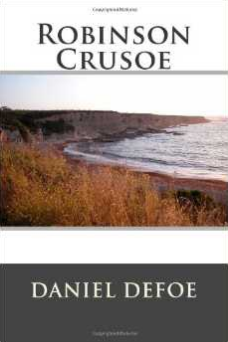
Cover for Robinson Crusoe Here I am with my third review for the Classics Club. Robinson Crusoe is a difficult novel for the modern reader. It is one of the earliest novels and as such lacks some of the characteristics we associate with the form. It has no chapters—just a few breaks here and there—little dialogue, minimal characterization, and a primitive plot structure. If you think of the novel as a children’s story, you are wrong (although when I was looking for a cover for this article, I saw that it is marketed as such).

In fact, the story that has made several exciting movies is related in a mundane manner with little notion of building suspense and would probably bore most kids silly. Instead, Crusoe’s novel is an expression of the importance of self-reliance and an assertion of Defoe’s religious faith.

The story is familiar, although I was surprised by just how much happens before the famous shipwreck and after the rescue. As a young man, Robinson Crusoe is in a position where he could live a good life at home. His father urges him to be content, but he determines to be a sailor. He makes several voyages, ending in Brazil, where he accumulates property and an estate. But he is not satisfied to stay at home. He takes on an errand from neighbors to travel back to Europe for business, and that is when he is shipwrecked.

The rest of the novel is about his efforts to survive and make himself a home, his religious musings, and (after years of being alone) his encounters with other people. As I mentioned before, none of the characters are fully realized. In fact, aside from Crusoe, only Friday even has a name. Everyone else is just called by his station. (I say “his,” because there are no female characters.)

Modern readers may also have problems with such issues as racism or sexism in the novel (sexism only in the sense that Defoe ignores women—he mentions a few, but they are clearly unimportant). I don’t think that works should be judged outside the standards of their time, though. By the standards of his own time, Crusoe probably treats Friday pretty well.

The only other novel I have read by Defoe is Moll Flanders, which has the advantage of being bawdy. I think the way to approach this novel is not as an adventure story but as an example of an early novel and as a story about self-reliance.

Day 512: Troubles

Cover for TroublesBest Book of the Week!
It is the summer of 1919. Major Brendan Archer has just left the hospital after his experiences in the trenches of France. When on leave in 1916, he met Angela Spencer. Although he has no recollection of having asked her to marry him, she has ever since then written him exhaustive letters signed “Your loving fiancée.” Determined to find out if he is engaged, the Major travels to the Majestic, Angela’s family hotel in County Wicklow, Ireland.

Troubles is about the decline of the once powerful Anglo-Irish aristocracy. Nothing symbolizes this decline quite as effectively as the state of the Majestic. Once a grand resort hotel, the Majestic is now the crumbling permanent home for a handful of old ladies who knew it from their heyday.

The Palm Court is so overgrown that it gets more and more difficult to find the chairs. No staff is visible when Archer checks in, and he is finally vaguely shown around by Ripon, Angela’s brother, who urges him to pick a room. When Archer retires, he finds his bed has no sheets, and his investigation of a sickly smell leads to the discovery of a sheep’s head in a pot in his room. Most frustrating, though, is that he can find no opportunity to speak to Angela, who shortly after his arrival shuts herself up in her room.

Major Archer soon finds himself drawn into the activities and personalities of the household. Angela’s father Edward seems unconcerned about the increasing decrepitude of the house. He occupies himself with projects such as raising piglets in the squash court or conducting bizarre experiments in “biological research.” He is most concerned with preventing Ripon from marrying the daughter of a merchant, whom Ripon has made pregnant. Edward’s objection? She is Catholic.

It is the time leading up to the partition of Ireland, with events that 40 years later will result in The Troubles. To Edward’s way of thinking, along with most of his class, those who want independence from Britain are nothing but hooligans. He refuses to recognize that his impoverished and desperate tenants have legitimate grievances.

The growing sense of dissolution both in Ireland and—periodically interjected by newspaper articles—in other parts of the British Empire keeps the novel from being simply a comedy such as Cold Comfort Farm. That, and Farrell’s writing style of cool and precise satire. As poor Major Archer bumbles in a well-meaning way through the political briars and Edward becomes more detached from reality, the Majestic slides perceptibly into ruin.

This is another book from my Classics Club list.

Day 488: As I Lay Dying

as-i-lay-dyingAs I Lay Dying is the first Faulkner novel set in the fictional Yoknapatawpha County, about the death of Addie Bundren and the efforts of her family to cart her body to Jefferson, Mississippi, for burial. As an early Faulkner work, it is one of the first in his experiments with stream of consciousness and is unusual in that its plot is conveyed solely through the thoughts of its many narrators.

At the beginning of the novel, Addie Bundren is dying. Her son Cash is building her coffin right outside her window while she watches. Her husband Anse and sons Darl and Jewell are discussing whether Darl and Jewell should go off to work a job that will earn $3 so close to the time of her death.

The plot is fairly simple—they go, she dies before they get back, there is a big storm that washes out the bridge, and the whole family takes her with great difficulty to Jefferson, trying to find a way to get across the river. The accomplishment of the novel is in revealing the complex relationships among the family members from the sometimes incoherent thoughts of themselves and some of the people they encounter on their journey.

This is a dark and pessimistic novel. Although its characters are uneducated, rough, and bluntly spoken, some of them, particularly Darl, have unexpected sophisticated and even poetic thoughts. On the other hand, there is Anse, shiftless and selfish, but stubborn as the dickens when he makes up his mind to do something.

Although Addie made Anse promise to bury her in Jefferson almost as punishment for the life she hated, it is not clear whether his new teeth or his promise is the reason for the trip. On the road, there are several occasions where his determination not to be “beholden” puts his family to major inconvenience or even danger, yet on another occasion he is outraged that his neighbor refuses the use of his mules for an attempt to cross the river that results in the death of Anse’s own  mules.

We don’t hear much directly from Addie. As Cash builds the coffin she is a staring presence who doesn’t utter a sound. She has only one chapter to herself, in which she reveals her true disdain for her husband and children except for her son Jewell, the fruit of an illicit affair. Why she married Anse in the first place is not entirely clear, except that she hated her life as a schoolteacher.

The trials that the family must face to get to Jefferson are almost epic, but for what? Addie makes clear that her wish was malicious. Anse has ulterior motives. Yet Jewell is driven to Herculean efforts and loses the only thing he loves, Anse’s stubbornness nearly makes Cash lose his leg, and Darl ends up perpetrating an infamous act and being committed. The young boy Vardaman is traumatized on several occasions, and in town the only daughter, Dewey Dell, is cruelly duped.

Some of the themes of this novel are those of selfhood and existence, the contrast between spoken words and thoughts, the treatment of different social classes, and the irony of extraordinary but pointless acts. The ending makes the pointlessness clear by its almost comic mundanity.

Although this novel has echoes of characters who will appear in later novels—mentions of Snopes, Quick, the Tulls, and other characters—it has none of the bleak humor of the Snopes trilogy. It is widely regarded, though, as one of Faulkner’s most powerful novels and as a vivid example of the then new stylistic techniques of Modernism.

My Classics List

I am following my friend Cecilia’s lead and participating in the Classics Spin. It sounds like fun. It isn’t clear to me if you have to be a member of the Classics Club or not, but anyway, here goes. I have to make my own list of 20 classics, and then each month the club will arbitrarily pick a number, and I have to read and review that book that month. Sounds like fun! Most of these are books I haven’t read, although there are a few I want to reread in the near future. Here is my list, in no particular order.

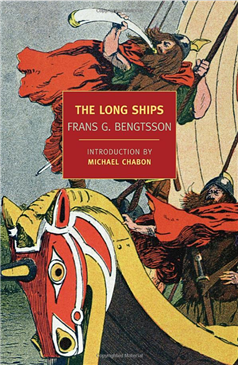
  1. Cover for The Long ShipsThe Remains of the Day by Kazuo Ishiguro
  2. Summer by Edith Wharton
  3. The Call of the Wild by Jack London
  4. Stoner by John Williams
  5. Middlemarch by George Eliot
  6. The Known World by Edward P. Jones
  7. O Pioneers! by Willa Cather
  8. Bleak House by Charles Dickens
  9. Things Fall Apart by Chinua Achebe
  10. Greenbanks by Dorothy Whipple
  11. Brave New World by Aldous Huxley
  12. The Scottish Chiefs by Jane Porter
  13. Robinson Crusoe by Daniel Defoe
  14. Beloved by Toni Morrison
  15. Light in August by William Faulkner
  16. Snow Country by Yasunari Kawabata
  17. The Idiot by Fyodor Dostoevsky
  18. The Beggar Maid by Alice Munro
  19. Their Eyes Were Watching God by Zora Neale Hurston
  20. The Long Ships by Frans G. Bengtsson

Day 434: Coriolanus

Cover for CoriolanusCoriolanus is one Shakespeare tragedy with which I was previously unfamiliar, and it is a powerful one. More than any other Shakespeare play I’ve read, it is about politics, class dissension, and the fickleness of popularity. It is also about excessive pride.

The play has references to events of the time it was written, for it begins with a riot over corn, the like of which had taken place in Warwickshire the year the play was written. Its war between the Romans and the Volscians is also a reference to the war the English and Spanish had been carrying on intermittently.

Caius Marcius is a warrior who has spent most of his life as a soldier and has no social graces. He is proud and arrogant and disdains the common man. After he soundly beats the Volscians in battle, particularly his bitter enemy Aufidius, and conquers their city of Corioles, the Roman generals rename him Coriolanus and the senate wants to award him a consulship. This office as ruler of Rome is the one that all great men aspire to. Unfortunately, to have the office, Coriolanus must beg the honor from the public and show them his wounds gained in defending the state.

He is reluctant to do so, knowing that he is unable and unwilling to ask for what he thinks he deserves, but his austere mother Volumnia and his supporters talk him into it. Two jealous tribunes, who are representatives of the people, are afraid that Coriolanus will strip them of their offices. So, the two, Brutus and Sicinius, work to enrage the people after they have already sworn to support Coriolanus.

The result is another riot, and instead of receiving the high honor, Coriolanus is declared a traitor. The tribunes even try to have him executed, but he is banished.

The seeds of Coriolanus’ downfall are sown both by the treachery of his rivals and by his own hubris. Things go downhill from there.

It is interesting that in the class divide, Shakespeare’s sympathies seem to align with the men of power even while he deplores Coriolanus’ flaws. There are several speeches about the public not being able to make a decision, about their fickleness, and so on, and the actions of the public seem to bear these ideas out. You can image what Shakespeare would think about a democracy or about our current political situation.

Day 430: The Mansion

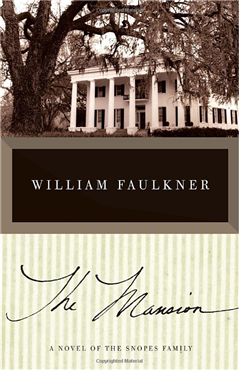
Cover for The MansionBest Book of the Week!

The Mansion is the compelling final novel in Faulkner’s Snopes Trilogy, a series remarkable for the way Faulkner is able to focus the activity on a character, Flem Snopes, who is less and less present in each novel. Told again by multiple narrators, each unreliable in his own way (they are all male), the story’s truth is one we don’t begin to really understand until the final omniscient chapters.

This last novel concludes the events of the previous two and in many ways reinterprets them. It begins with Mink Snopes, serving 20 years for a murder he committed in The Hamlet. This event, not so important in the first book except for demonstrating the sheer cussedness of the Snopes clan, becomes the focus of the third book. The Town related how Mink paid no attention to his own murder trial, simply waiting for his powerful cousin Flem to arrive and get him out of his mess. But Flem never arrived, respectability having bitten him by then, and Mink went to jail vowing to kill Flem when he got out.

The beginning of The Mansion returns us back a few years in the events covered by The Town to when Mink is two years from freedom, having rigorously followed the advice he was given when he went in, to do everything he is told to do and not try to escape. Mink has been concentrating all this time on one thing, getting out and having his revenge.

As he is also a Snopes, Flem knows this, so he frames another cousin, Montgomery Ward Snopes, for an offense that is worse than the one Montgomery actually committed, to get him in to the penitentiary. Then Flem pays Montgomery to convince Mink that Flem is helping him escape, further humiliating Mink by getting him to make the attempt in a dress, and then turning him in during the attempt. Mink earns himself twenty more years in the pen–or Flem earns it for him.

The middle portion of the novel focuses on Linda Snopes, Eula’s daughter, who thinks Flem is her father, and her relationship with the upright Gavin Stevens. Stevens helped her escape Jefferson in The Town, and the largest portion of The Mansion covers her life before and after her return to Jefferson from a more exotic life in New York City. Despite her willingness, Stevens refuses to marry her because of the 20 years difference in their ages. She embarks on an apparently naïve and bumbling career of good works.

Finally, the novel comes back to Mink, as he unexpectedly learns he may be eligible for parole two years early, if only he can find a relative to sign for him. His wife died years ago, his children are long dispersed, but a relative does sign for him, Linda Snopes. The novel builds to a climax after his release, following Mink as he tries to get his final revenge against Linda’s father Flem and Gavin Stevens tries to prevent it.

I think the achievement this trilogy represents is astounding, written as if it were gossip told around an old country store (and later in Gavin Stevens’ law office), centering on one man but leaving that man an enigma, almost a ghost in his own life. Events are told and retold, interpreted and reinterpreted, and so this “oral” history of Faulkner’s fictional county in Mississippi is created.

Day 415: Antony and Cleopatra

Antony and CleopatraOf the Shakespeare tragedies I have been reading, I think I have the least sympathy for the characters in Antony and Cleopatra (except perhaps for Othello–I have no sympathy at all for him). One of the problems is in, of course, how their relationship has historically been portrayed–with Cleopatra as a manipulative slut instead of a sovereign trying desperately to save her kingdom from being swallowed up by the Roman Empire. But the victors always get their way in portraying the conquered.

Antony and Cleopatra is, of course, the play about the last years of the relationship between Marc Antony and Cleopatra of Egypt, their political maneuverings with Rome and particularly with Octavius Caesar, and their deaths.

I believe the traditional way of looking at this play is of the great man brought down by his fascination with a rapacious woman. However, pay attention to the difference between how the characters talk about the nobility of the Romans and how the Romans actually act. I think something more subtle is going on here. I don’t see much evidence of a great man in this play. I see a soldier who pretends to be a noble Roman and is not. I see a female ruler who is more of an enigma, who controls her own shifting image, like a chimera.

image of The Death of Cleopatra by Reginald ArthurNot having the strongest grounding in classical literature, it is not always clear to me what is going on during the political maneuverings and battles, and which characters are on whose side. Of course, it is a historical fact that Cleopatra fled the battle of Actium with her ships at a strategic point, causing the battle to be lost. Why she did so is still a mystery.

For a different view of Cleopatra, although maybe a closer view than Schiff thinks, see Stacy Schiff’s excellent biography.